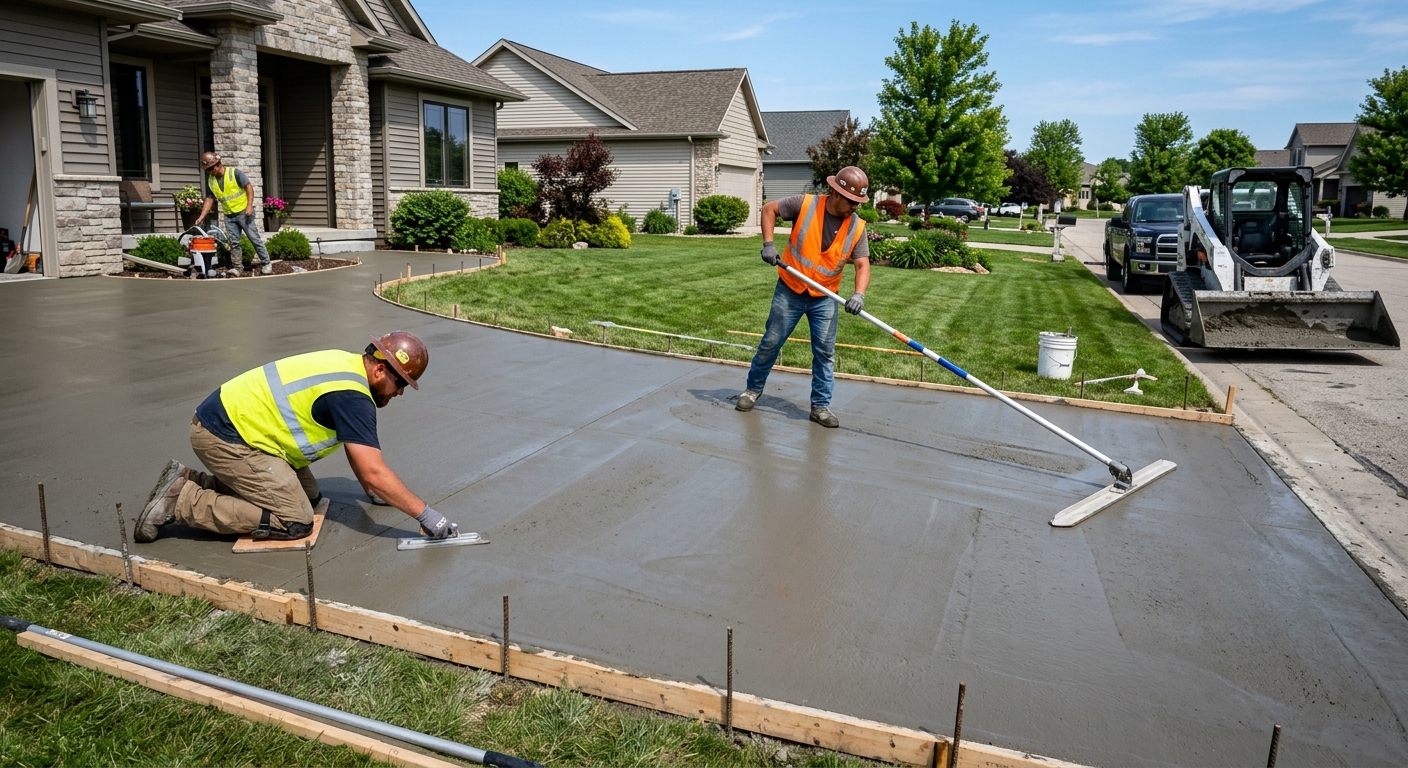
Concrete work options and costs in Camlachie
Camlachie is a smaller Ontario community where many homes are still built close to the ground, so concrete flatwork like driveways, patios and walkways tends to be one of the first “outside” upgrades homeowners notice. In a 2021 Census snapshot, Camlachie has a population of 7,506 (Statistics Canada, 2021 Census), and the housing pattern is dominated by single-detached homes, which is the primary market for exterior concrete pours that handle everyday parking, winter foot traffic and garden drainage. That matters because your concrete is exposed to Ontario’s freeze–thaw cycles year after year.
In the Toronto economic region, costs are strongly shaped by frost depth and how long we can pour and finish in the season. Local specs typically push exterior footings below design frost depth (commonly at least 1.2 m in Ontario) and require air-entrained mixes for durability. Contractors also plan curing and surface protection around cooler stretches—when temperatures dip toward about 10 °C or below, concrete needs extra care to reach proper strength and reduce surface scaling.
In Camlachie, demand is especially high around the more established residential streets near local services where driveways and front steps get replaced more often after wet spring seasons. If your soil holds water or your eaves shed onto the slab, the prep and drainage scope grows, and so does the final price.
Below is a practical comparison of common options, with realistic price bands for Camlachie-style projects, before you dial in site conditions and finish level.
| Application |
Typical Size |
Key Spec |
Finish Option |
Price Range |
| Concrete driveway (standard broom finish) |
400–600 sq. ft. |
Air-entrained mix, 4 in. slab, control joints |
Broom finish, sealer recommended |
$7,200–$13,000 |
| Exposed aggregate driveway |
400–600 sq. ft. |
Air-entrained mix, 4 in. slab, proper base |
Exposed aggregate with sealer |
$9,000–$16,000 |
| Stamped concrete driveway or patio |
300–500 sq. ft. |
Air-entrained mix, thicker section in wear areas |
Stamp pattern + release + integral colour options |
$10,000–$18,500 |
| Plain concrete patio or walkway |
200–400 sq. ft. |
Air-entrained mix, 4 in. (patio) or 4 in. walkway base |
Broom finish or lightly textured |
$3,200–$9,800 |
| Garage floor (interior slab) |
300–600 sq. ft. |
Interior mix, vapour barrier where needed, joints |
Broom finish or hard trowel (with plan) |
$5,400–$15,000 |
| Foundation footings (structural, below frost) |
Per linear foot |
Engineered depth below frost, reinforcement as required |
Structural concrete only (no decorative finish) |
$180–$300 |
Prices are estimates only and vary by project scope, site access and material selection.
What affects the price of concrete work in Camlachie
If you get two quotes for what looks like the same job in Camlachie, it’s not unusual to see differences that land around 30–50% across the wider Toronto area and Ontario. The gap usually comes down to how each contractor sizes the excavation, base build-up and reinforcement to your soil and drainage, and how they address frost and freeze–thaw exposure.
In Ontario, frost depth and freeze–thaw cycles dictate nearly every spec in the Toronto region: footings must extend below the design frost depth (often at least 1.2 m), and exterior flatwork needs air-entrained concrete so water freeze/expansion doesn’t pop the surface. When contractors price winter risk, they include cold-weather curing precautions—like insulating blankets or temporary heating—because colder pours require more protection and stricter curing control. De-icing salts also accelerate spalling on poorly sealed or non-air-entrained concrete, so sealing and surface protection are often part of the durability plan.
In Camlachie specifically, a few local conditions commonly raise costs. First, if your driveway ties into older hardscape (walks/steps) and the excavation is tight, the formwork and concrete placement time increases. Second, saturated clay or low spots can mean a thicker, more carefully compacted granular base and improved drainage—often pushing a “plain” patio from the $16–$26 per sq. ft. range toward the upper end. Third, if you want decorative finishes like stamped concrete (typically $24–$40 per sq. ft.), labour steps—colour, stamping, timing, and curing protection—add up fast. Conversely, if your soil is already stable and drainage is good, a standard broom-finish driveway may stay closer to the lower end of the Toronto-area driveway band.
| Price Factor |
Why It Matters |
Cost Impact |
| Frost line depth — determines footing depth and form height |
Deeper footings reduce frost heave and differential movement |
Can add significant labour and excavation—often one of the biggest drivers for foundations |
| Site preparation — excavation, grading, compacted granular base |
Proper base prevents pumping, settlement and early cracking |
Unstable soils can increase granular material and compaction time |
| Reinforcement — rebar or wire mesh requirement |
Controls cracking and improves load capacity |
Steel and labour add cost; under-specifying can lead to premature failures |
| Mix design — air-entrainment and compressive strength spec |
Air-entrainment improves freeze–thaw durability |
Premium mixes cost more but reduce spalling and scaling risks |
| Finish type — broom vs. stamped vs. exposed aggregate |
Decorative systems require extra steps and careful timing |
Stamped/exposed typically adds labour and materials versus broom-finish |
| Pour size and concrete truck access to site |
Access affects pump vs. wheelbarrow time and placement efficiency |
Tight access can increase labour and equipment charges |
| Cold-weather curing precautions — heating and blankets |
Protects concrete until it reaches strength gain |
Blankets/heaters and longer protection window add to the total |
| Control joint pattern and sealing cost |
Joints manage cracking; sealing improves salt and moisture resistance |
Proper jointing and sealing are often small costs compared with repairs |
Permits & regulations in Ontario
In Ontario, structural concrete work generally requires a building permit and—depending on the scope—engineered drawings reviewed by the municipality. That includes work like footings and foundation walls, grade beams and any structural support elements. For example, if you’re doing foundation underpinning, adding a basement, or replacing structural foundation components, expect permitting and engineering involvement before concrete is poured.
Concrete flatwork (driveways, patios, walkways) usually does not require a permit by itself. However, it can trigger a permitting conversation if it affects lot grading, increases impervious surface coverage beyond municipal limits, alters drainage patterns, or changes work near the municipal right-of-way (especially where there are curb/sidewalk relationships). Always confirm with the local authority before breaking ground—this is where “cheap” quotes can go sideways if assumptions are wrong.
For contractor verification in Camlachie, take these steps:
- Request their certificate of liability insurance and confirm it covers your property and the contract scope.
- Ask for proof of WSIB/WCB coverage (or exemption documentation where applicable).
- Request references from similar-scale local jobs (driveways, patios, and any structural work if they claim experience).
- Use the contractor’s name/business details to check online registrations/licensing where available in Ontario, and ensure the documents match the legal business name on the quote.
- Get everything in writing: permit responsibility, schedule, exclusions, and warranty terms.
That documentation process protects you during placement, curing and any subsequent inspections, which is especially important in Ontario’s freeze–thaw conditions where failures can show up within a few seasons.
Getting concrete right in Camlachie's freeze-thaw climate
Concrete failures in Camlachie most often come down to one thing: water gets in, freezes, and the surface can’t tolerate the stress. In a freeze–thaw environment, inadequate air-entrainment is a common root cause of spalling and scaling, especially on driveways and steps where de-icing salts are used. The fix isn’t “different magic concrete”—it’s correct specs and execution: base prep, the right air-entrained mix, joint planning, proper curing and sealing.
Start with base preparation. Exterior slabs and driveways should be built on well-compacted granular sub-base to the right depth for local soil and frost protection. Next, mix design: for exterior flatwork, aim for air-entrainment around 5–7% and minimum compressive strength of at least 32 MPa, with consistent batching. Third, control joints: they should be placed to limit random cracking, with a pattern that matches slab dimensions and traffic areas. Fourth, curing: plan for at least 7 days under protective conditions. In cooler stretches, protecting the pour with insulation blankets or temporary heat (as needed) helps the surface reach strength without damage. Finally, sealing: apply a penetrating sealer after the slab cures (commonly at about 28 days) to repel moisture and reduce salt attack.
As a practical cost example, homeowners sometimes compare a plain broom-finish patio versus a stamped option. Stamped concrete often runs about $24–$40 per sq. ft., while plain concrete walkways/patios are commonly in the $16–$26 per sq. ft. range. If you keep both options on the same compacted base, use air-entrained concrete and add a proper sealer, the “extra” stamped cost is mainly for appearance—not for durability. The biggest durability wins come from the spec details that prevent spalling, not just the finish.
| Spec |
Why It Matters in Camlachie |
What to Ask For |
Impact if Skipped |
| Compacted granular base (depth?) |
Prevents settlement and reduces water movement into the slab |
Granular base type and target compacted thickness based on soil and site drainage |
Early cracking, rocking slabs, and accelerated freeze–thaw damage |
| Air-entrained concrete mix (target air %?) |
Improves freeze–thaw durability and helps resist spalling |
Confirm air entrainment target around 5–7% for exterior flatwork |
Surface scaling/spalling in winters, especially after salt exposure |
| Compressive strength (MPa rating) |
Strength gain supports load capacity and reduces surface failure |
Minimum 32 MPa (or higher if specified for the use case) |
Weaker surface, rutting and faster degradation |
| Control joints (spacing per ACI guidelines) |
Controls where cracking occurs under thermal movement |
Joint layout plan and planned sealing of joints where appropriate |
Random cracking and water ingress along uncontrolled cracks |
| Minimum 7-day curing period |
Ensures strength development and surface durability in Ontario weather |
How they protect the pour when temps drop toward 10 °C or below |
Surface weakness, scaling and reduced long-term performance |
| Penetrating sealer (when applied after cure) |
Repels moisture and reduces salt-related attack |
Sealer type and timing (commonly around 28 days after pour) |
Higher risk of spalling and staining within a few winters |
How to choose a concrete work contractor in Camlachie
Choosing the right contractor in Camlachie is mostly about verification and clarity. First, confirm Ontario coverage details. Ask for their certificate of liability insurance and ensure the coverage is active for the project period. Next, request proof of WSIB/WCB coverage (or an exemption letter where applicable) so you’re not left responsible for worker-related incidents. Then, check whether the contractor’s business name and contact details match the legal entity on your quote and insurance certificate—this matters when claims or warranty issues arise.
Second, don’t accept one “lump sum” estimate without a breakdown. Get 2–3 itemised written quotes showing labour and materials separately, and make sure they include base prep, excavation, granular supply, reinforcement, concrete supply, finishing, and sealing/curing protection if listed. Concrete bids can look close on paper until you compare inclusions like disposal, permit handling (if required for structural work), and concrete truck access charges.
Third, read the warranty section closely. You want a workmanship warranty length stated clearly, plus what’s covered for the product/manufacturer side. Ask if warranties are transferable if you sell the home.
Finally, agree on payment milestones. A practical rule of thumb is never paying more than about 10–15% upfront; hold back a portion until the job is complete and cleaned up. Get a start date and a completion estimate in writing, and confirm what happens if weather slows curing or requires additional protection.
- Ask whether they spec air-entrained concrete for exterior work in Ontario conditions.
- Request their proposed concrete thickness and base build-up details.
- Confirm reinforcement requirements (rebar vs. mesh) for your slab type.
- Ensure control joint layout is included, not left as “to be determined.”
- Check if curing protection (blankets/heating) is included for cold snaps.
- Verify sealing is included or clearly excluded, including timing (often after ~28 days).
- Confirm disposal of excess soil and old concrete is part of the scope.
- Ask how they handle grading and drainage around the slab/edges.
- Require a timeline that includes curing protection time—not just pour day.
- Confirm who pulls any required permits for structural work.
- Review warranty terms in writing: what fails, who fixes it, and the timeframe.
- Make sure they state concrete truck access method (pump/wheelbarrow) and costs.
Concrete red flags I see around Camlachie include contractors who won’t discuss frost-depth and air-entrainment specs, quotes that skip reinforcement without explaining why, no clear joint plan, no written curing/sealing schedule, and payment terms that ask for most of the money before forms are even set.
Frequently asked questions — concrete work in Camlachie
How do I seal concrete to protect it in Camlachie?
In Camlachie and across Ontario, sealing is about repelling water and limiting how de-icing salts attack the surface. For most driveways and patios, we typically recommend a penetrating sealer applied after the concrete cures—commonly around 28 days—once the surface is dry and ready to accept treatment. Before sealing, the concrete should be cleaned and any curing compounds must be fully removed if they were used. In freeze–thaw weather, sealing helps slow moisture movement that can lead to spalling, but it doesn’t replace good base preparation or proper air-entrainment in the mix. If you’re comparing options, a standard broom-finish driveway may be in the $18–$28 per sq. ft. band; the durability benefit of sealing often comes at a modest added cost compared with repairs.
What is the difference between concrete and cement?
Concrete is the final building material you pour—cement plus aggregates (sand and gravel), water, and often additives like air-entrainment. Cement is one ingredient inside the concrete mix. Put simply: cement is the binder that helps hold everything together; concrete is the full mixture that becomes the slab or driveway when it cures. This distinction matters when you’re reading specs or asking questions—what you want isn’t just “cement quality,” but the overall concrete design for Ontario’s freeze–thaw cycles. For exterior flatwork in Camlachie, reputable contractors will specify air-entrained concrete and compressive strength (commonly minimum 32 MPa) rather than focusing only on the cement brand. A good quote will explain that mix design, thickness, base build-up, and curing steps—not just a per-square-foot number.
How much does concrete work cost in Camlachie?
Concrete pricing in Camlachie generally tracks the Ontario/Toronto region bands, but your site conditions can move the number up or down. For a driveway or slab, typical concrete driveway work is often estimated at about $18–$28 per sq. ft., and patios/walkways commonly land around $16–$26 per sq. ft. If you choose stamped concrete for appearance, that’s usually higher—often about $24–$40 per sq. ft.—because of extra labour for colour and stamping. Foundation footings are priced differently (commonly per linear foot) and are often estimated around $180–$300 depending on depth, reinforcement and access. Expect cost changes for excavation and base prep if your soil holds water, and for curing protection if a cold snap hits the pour schedule. The safest approach is to compare itemised quotes that include base, reinforcement, disposal and sealing (if recommended).
How deep must footings be for Camlachie's frost line?
In Ontario, structural footings must extend below the design frost depth to help prevent frost heave and differential movement. In the Toronto region, a common requirement is at least about 1.2 m below grade for many structural applications, though exact design depth can vary based on building type and engineering assumptions. The key point for homeowners is that you shouldn’t guess—your permit set, engineered drawings (where applicable), or local requirements will drive the depth and reinforcement details. If someone quotes structural work without discussing frost-depth expectations, that’s a concern. Also remember that freeze–thaw isn’t just about depth—it’s about how the base and drainage are handled around the foundation after construction. In Camlachie winters, proper placement depth paired with robust mix specs and site grading is what protects the foundation performance over time.
Why does concrete crack in Camlachie and how is it prevented?
Concrete cracks in Camlachie primarily because concrete shrinks as it cures and then expands/contracts with temperature and moisture swings during freeze–thaw cycles. On exterior slabs, water movement and salt exposure can widen existing micro-cracks and accelerate spalling if the mix and construction details are wrong. The most common preventions are: using air-entrained concrete for freeze–thaw durability, placing the slab on a properly compacted granular base to reduce settlement, and installing control joints so cracking happens where it’s planned rather than randomly. Joint spacing depends on slab dimensions and design guidelines, but the contractor should provide a layout plan in advance. Curing also matters—skipping proper protection in cooler weather can increase surface cracking. Finally, sealing (often after ~28 days) helps limit moisture intrusion, which slows crack progression over subsequent winters.
Stamped vs broom-finish concrete — cost difference?
Stamped and broom-finish concrete differ mostly in labour and finish system complexity, not in the fundamental durability specs—both should be built with air-entrained concrete and proper base prep to withstand Ontario’s freeze–thaw cycle. Broom-finish concrete is the simpler, traditional look and usually fits the driveway/slab band around $18–$28 per sq. ft. Stamped concrete is typically higher, often around $24–$40 per sq. ft., because it includes extra steps such as colour application, stamping/mould work, and careful timing to ensure consistent texture and curing protection. Whether stamped is “worth it” depends on your priorities: if you’re paying for appearance and curb appeal, stamped often delivers that value. If your main concern is preventing winter damage, both options become durable when the contractor nails the same technical foundations—base, air content, joints and curing.