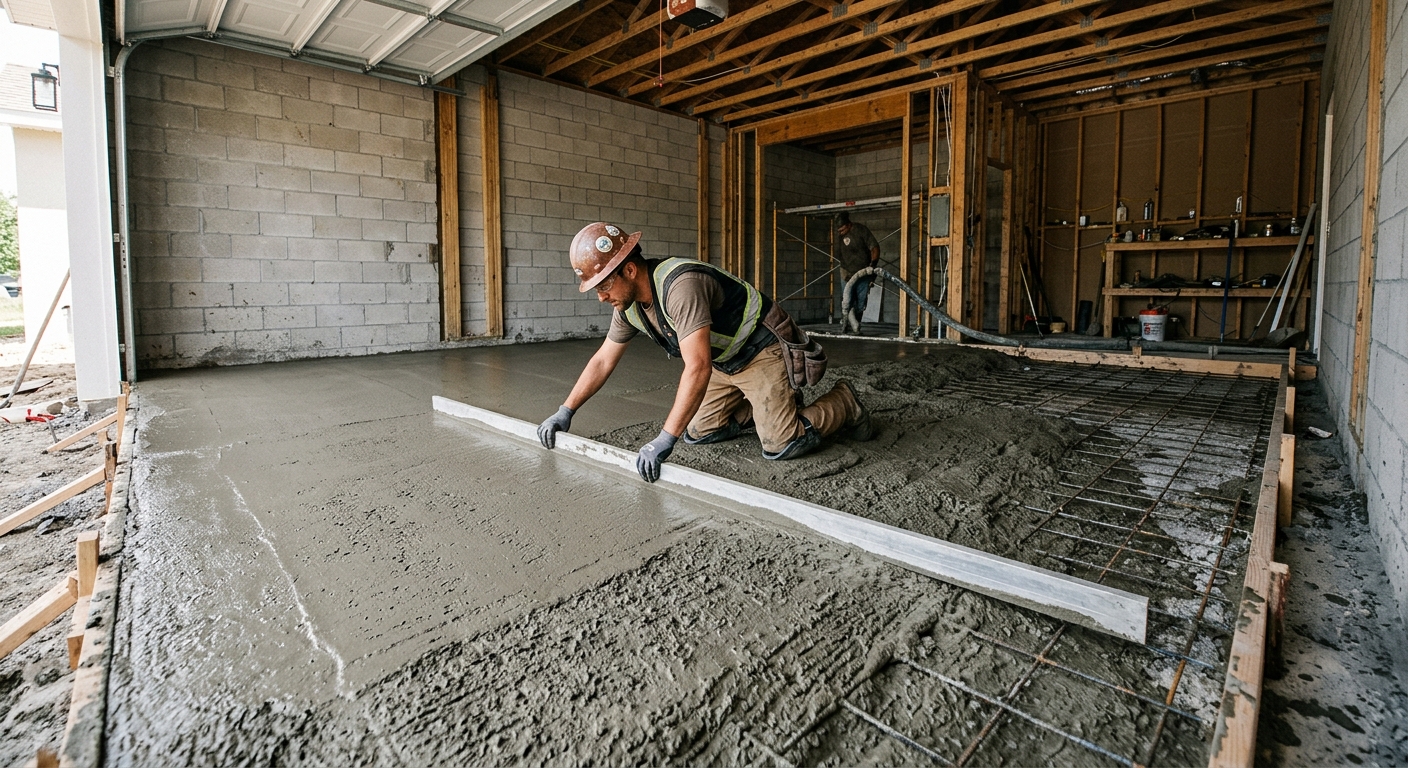
Concrete work options and costs in Pioneer Park
Pioneer Park, Ontario has a steady run of homeowners upgrading driveways, patios and walkways—especially as properties near schools and busy streets get more vehicle traffic. With a population of 9,108 (Statistics Canada, 2021 Census), demand is consistent, but availability can tighten during the GTA’s short reliable pour window. You’ll also see plenty of single-detached homes in the area market, which is the primary driver of exterior concrete flatwork projects like new driveways and backyard patios. (Statistics Canada, 2021 Census)
Concrete pricing here is strongly shaped by Toronto-region frost depth and freeze–thaw cycles. For structural work, footings are typically designed to extend at least 1.2 m below grade to reduce frost heave and differential movement, which raises excavation and forming costs. For exterior slabs, contractors commonly use air-entrained mixes and specify proper base drainage so saturated subgrade doesn’t expand and contract against the concrete every winter. In practice, that means crews prioritize well-compacted granular base, control joints, and curing protection when temperatures drop toward 10 °C or below.
In Pioneer Park, concrete demand is especially high around established residential pockets such as the Kirkfield Lane and surrounding residential streets where driveways and garden walkways are common renovation targets. If you’re comparing options, use the ranges below as a realistic starting point—then match the finish, thickness, and access conditions to your site.
| Application |
Typical Size |
Key Spec |
Finish Option |
Price Range |
| Concrete driveway (standard broom finish) |
400 sq. ft. (approx. 20 ft x 20 ft) |
Air-entrained mix, compacted granular base, control joints |
Broom finish, light edging |
$8,000–$11,200 |
| Exposed aggregate driveway |
400 sq. ft. (approx. 20 ft x 20 ft) |
Air-entrained mix, proper curing window, sealed surface recommended |
Exposed aggregate with surface retarder |
$10,000–$14,000 |
| Stamped concrete driveway or patio |
300 sq. ft. (approx. 15 ft x 20 ft) |
Air-entrained mix, rebar where needed, control joints |
Stamped patterns + integral/spot colour |
$10,000–$16,500 |
| Plain concrete patio or walkway |
200 sq. ft. (approx. 10 ft x 20 ft) |
Drainage base, air-entrained mix, saw cuts |
Float + broom edge |
$3,200–$5,200 |
| Garage floor (interior slab) |
400 sq. ft. (approx. 20 ft x 20 ft) |
Vapour barrier (if required), reinforcement as specified, proper curing |
Steel trowel or broom-finish |
$7,200–$12,000 |
| Foundation footings (structural, below frost) |
Varies by foundation layout |
Excavation + formwork, concrete designed for structural loads, below frost depth |
Typical structural concrete (not decorative) |
$180–$300 |
Prices are estimates only and vary by project scope, site access and material selection.
What affects the price of concrete work in Pioneer Park
In the Toronto economic region, it’s common to see quotes for the “same” concrete job swing by about 30–50% once you compare specs, site conditions and finishing complexity. Two contractors can both price a driveway, yet one includes a deeper, well-compacted granular base with drainage and air-entrained concrete—and the other uses a thinner section or cuts corners on curing protection. In Pioneer Park, those differences matter because freeze–thaw cycles punish weak base prep and low-air mixes.
Every structural footing is governed by frost depth and required embedment to control frost heave. In Ontario, that typically means footings extend at least 1.2 m below grade (and often designed around the site’s frost considerations), which drives form height, excavation time and disposal. Exterior slabs also require air-entrained concrete mixes to manage repeated freeze–thaw impacts and reduce spalling. GTA crews often concentrate pours in warmer months to support curing; when temperatures trend down toward 10 °C or below, cold-weather precautions (insulating blankets, heaters, longer protection) can add real labour and materials costs.
De-icing salts are another local cost driver. Salts accelerate surface deterioration if the concrete isn’t properly sealed, so sealing is often recommended—especially for driveways and garage walkways where cars track salt onto the slab.
Concrete examples in Pioneer Park that commonly move the needle: (1) poor drainage or saturated subgrade can force a thicker granular build-up and more granular hauling before any concrete is placed; (2) tight access near side yards can increase equipment time; (3) going from a plain patio to stamped concrete usually shifts you into the higher price band of roughly $24–$40 per square foot due to stamp mats, additional labour and finishing time.
| Price Factor |
Why It Matters |
Cost Impact |
| Frost line depth |
Determines footing depth and form height |
Higher excavation + more concrete; typically increases structural pricing |
| Site preparation |
Excavation, grading, compacted granular base |
Can add truckloads and labour if soft spots or drainage issues are found |
| Reinforcement |
Rebar or wire mesh requirement |
Cost rises with reinforcement placement, supports/chairs, and labour time |
| Mix design |
Air-entrainment and compressive strength spec |
Air-entrained exterior mixes and stronger specs cost more but reduce failure risk |
| Finish type |
Broom vs. stamped vs. exposed aggregate |
Stamped and exposed finishes add labour and materials (forms/retarders/sealers) |
| Pour size and concrete truck access to site |
Placement speed and distance from truck to form |
Poor access can increase pump/telehandler time and labour |
| Cold-weather curing precautions |
Heating and blankets |
Additional protection supplies and time can be required near the shoulder season |
| Control joint pattern and sealing cost |
Jointing limits random cracking; sealing protects from de-icing salts |
Sealing is an extra line item but often prevents surface spalling and scaling |
Permits & regulations in Ontario
In Ontario, structural concrete work generally requires permits because it affects the building’s load-bearing system. That means projects such as foundation footings, foundation walls, grade beams, and other structural elements typically require a building permit, and municipalities often expect engineered drawings or stamped calculations for the structural portion. Concrete flatwork—driveways, patios, walkways—usually does not require a permit by itself unless it changes lot grading, increases impervious surface beyond municipal limits, impacts required drainage, or interferes with municipal right-of-way/sidewalk areas. Even then, requirements can vary by site.
For Pioneer Park homeowners, the best approach is to verify both the scope and the impact. Before breaking ground, confirm: (1) whether your work is within the structural envelope (permits more likely), or (2) whether it affects drainage, swales, or approvals tied to stormwater management (permits more likely than people expect).
Step-by-step, here’s how to verify a contractor in Ontario: First, check the contractor’s licensing status through the appropriate Ontario online registry tools (and confirm the legal business name matches the quote). Second, request an up-to-date certificate of insurance (liability) showing they can cover property damage and injuries. Third, ask for proof of WSIB/WCB coverage—then verify the clearance letter/certificate is active for the project period. Finally, ask for references on similar foundation or exterior flatwork jobs in Ontario so you can compare how they handle frost-related specs and base drainage.
Getting concrete right in Pioneer Park's freeze-thaw climate
Concrete commonly fails in Pioneer Park during freeze–thaw cycles when water gets into the slab and freezes, expanding against weak paste or a poorly prepared base. The fix isn’t one “magic ingredient”—it’s the full assembly: a properly compacted granular base, the right air-entrained mix, deliberate control joints, proper curing, and sealing. In the Toronto market, contractors also plan pours around curing conditions; if you pour late in the season and don’t protect the concrete, you’ll often see surface deterioration earlier and more random cracking.
To spec correctly, start with base prep: compacted granular sub-base to the designed thickness for local soil conditions and frost considerations. Next, mix design: exterior flatwork should be air-entrained, targeting about 5–7% air content, and contractors should meet minimum 32 MPa compressive strength for typical residential exterior work. Third, control joints: saw cuts or formed joints should be placed to limit random cracking, with spacing planned for the slab size and orientation. Fourth, curing: plan on at least 7 days of curing under suitable conditions; in cold snaps, additional insulation/heating can be necessary. Fifth, sealing: apply a penetrating sealer after the slab has cured—commonly around 28 days post-pour—so de-icing salts don’t drive freeze–thaw damage at the surface.
As a practical example, if stamped concrete is priced toward the higher band of about $24–$40 per square foot, the premium can be justified when the contractor also includes robust base prep and correct air-entrainment. Skipping those basics is the fastest way to pay again—because the stamp may look good, but spalling and patchwork won’t.
| Spec |
Why It Matters in Pioneer Park |
What to Ask For |
Impact if Skipped |
| Compacted granular base (depth?) |
Limits water pumping and heave during freeze–thaw |
Base thickness and compaction test/standard; drainage plan |
Settlement, rocking, and accelerated cracking/spalling |
| Air-entrained concrete mix (target air %?) |
Protects paste against freeze damage and scaling |
Target air content (about 5–7% for exterior flatwork) on the ticket/spec |
Higher risk of spalling and surface flaking in winter |
| Compressive strength (MPa rating) |
Ensures durability and structural adequacy |
Minimum 32 MPa (or project-specific structural spec) |
Premature wear, cracking, and reduced lifespan |
| Control joints (spacing per ACI guidelines) |
Controls where cracks form during seasonal movement |
Planned joint spacing and saw-cut timing |
Random cracking that can open and let in water |
| Minimum 7-day curing period |
Builds strength before winter exposure |
Curing duration and cold-weather protection plan |
Lower surface durability and higher scaling risk |
| Penetrating sealer (when applied after cure) |
Repels salt water and reduces freeze–thaw damage at the surface |
Confirm product type and application timing (commonly after cure, around 28 days) |
Faster salt-related deterioration and spalling |
How to choose a concrete work contractor in Pioneer Park
Choosing the right concrete contractor in Pioneer Park is mostly about verification and detail. Start with Ontario licensing: confirm the business name on the quote matches the registered name, and ensure they’re properly authorized for the type of work being proposed. Next, request proof of liability insurance and WSIB/WCB coverage. In practice, you should receive a current certificate of insurance and an active clearance letter or coverage document for the relevant trade period—don’t accept “we’re covered” without paperwork.
Then get 2–3 itemised written quotes that separate labour and materials. You want line items for excavation/site work, granular base, reinforcement (if needed), formwork, concrete supply, finishing, curing protection, and sealing (for exterior). A good quote also states what’s excluded—like rock removal, disposal fees, snow/ice removal before pour, temporary fencing, and whether permits (when required) are included. If the contractor can’t explain joint layout, base thickness, or curing approach, treat that as a warning.
Warranty matters too. Ask for the workmanship warranty length and what it covers (hairline cracks, spalling, settlement issues, etc.). Also ask whether the manufacturer warranty on materials is included and if it’s transferable to you.
On payment, avoid large upfront payments: a common safe range is 10–15% deposit, with the balance tied to milestones. Hold back retainage until the job is complete and cleaned up. Finally, demand a written start date and completion estimate—Toronto-region scheduling can shift when weather threatens curing conditions.
- Check Ontario registration details match the quote and contract
- Verify liability insurance certificate is current and project-appropriate
- Confirm WSIB/WCB clearance/coverage is active
- Ask whether air-entrainment is specified for exterior flatwork
- Require base prep details: excavation depth, granular thickness, compaction
- Get reinforcement notes: rebar vs. wire mesh and where it’s placed
- Review control joint plan (spacing and saw-cut timing)
- Ask how they’ll protect curing if temperatures drop during the first week
- Confirm sealing scope: penetrating sealer and timing after cure
- Demand itemised labour/material pricing—not a vague lump sum
- Clarify exclusions: disposal, rock, regrading, sidewalk/approach impacts
- Set a payment schedule with holdback until completion and walkthrough
Concrete contractor red flags in Pioneer Park include: (1) quotes that don’t mention air-entrainment for exterior slabs, (2) refusing to provide proof of WSIB/WCB or insurance, (3) vague answers about base thickness and drainage, (4) no mention of control joints (or joint plans that don’t match slab size), and (5) asking for most payment up front without a milestone schedule.
Frequently asked questions — concrete work in Pioneer Park
How do I maintain concrete in Pioneer Park's freeze-thaw climate?
In Pioneer Park and across Ontario, maintenance is mainly about keeping water and salts from stressing the surface. Sweep debris regularly so fine grit doesn’t hold moisture against the slab. Use de-icing products carefully: if you must salt, avoid over-salting and switch to brine or sand where practical to reduce chemical exposure. For exterior driveways and walkways, a penetrating sealer applied after proper cure (often around 28 days) helps repel salt and water from freezing and expanding in the pores. Inspect seasonally for early signs of spalling, scaling, or joint separation; small repairs are cheaper before freeze-thaw forces widen the damage. If you’re budgeting, remember that a sealed plain patio in the $16–$26 per square foot range is typically far less than paying for replacement after repeated winter scaling.
What causes concrete to spall in Pioneer Park winters?
Spalling usually happens when freeze–thaw cycles push water into the concrete and then expand it as temperatures drop, breaking the surface paste. In the GTA region, the most common causes are inadequate air-entrainment, poor finishing/cure, and saturated base or drainage problems that allow water to reach the slab. If joints are missing or poorly spaced, random cracking can open pathways for water. Also, de-icing salts accelerate the deterioration of the surface when moisture is present repeatedly. That’s why reputable contractors specify air-entrained concrete for exterior flatwork and plan control joints. If you had a low-end patio price that seemed too good—closer to the bottom of the $16–$26 band—ask whether the quote included air content, curing protection and sealing, not just the concrete pour.
What is rebar and when is it required in Ontario?
Rebar (reinforcing steel) is used to help concrete resist tensile forces and reduce cracking in certain slabs and structural members. In Ontario, whether rebar is required depends on the engineered design and the type of concrete work. Structural elements like foundation footings and grade beams typically require reinforcement designed for load conditions and the foundation layout. For exterior slabs like driveways and garage floors, rebar or mesh may be recommended based on thickness, sub-base support, and expected vehicle loads. For flatwork, the “when” is project-specific: a thicker slab on well-compacted base can perform differently than a thinner slab on marginal soil. The best approach in Pioneer Park is to ask your contractor to state the reinforcement type and placement in the quote (and whether it’s in the engineer’s scope, if applicable), so you can compare quotes fairly.
How long does a concrete project take in Pioneer Park?
Timing in Pioneer Park depends on pour size, access, and—most importantly—weather for curing. A typical residential exterior flatwork job can look fast on pour day, but the total timeline includes layout, excavation, forming, base prep, inspections (if required), the pour, finishing, and curing protection. For many patios and walkways, you might see completion for the main work in about 3–7 days including curing protection and finishing stages, though full strength development continues after that. Driveways and larger slabs may take a week to more, especially if reinforcement, saw-cut scheduling, sealing timing, or complex access applies. In the Toronto area, crews often schedule exterior pours in warmer months to avoid cold-weather curing costs and risk; if temperatures fall near the end of the first week, extra heating/blankets can extend the practical timeline.
What is a concrete overlay and is it suited to Pioneer Park?
A concrete overlay is an additional concrete layer placed over an existing slab—used to restore appearance and levelness without full demolition. In Pioneer Park, overlays can be suitable when the original slab is generally sound (limited settlement, no major structural failure, and proper bonding conditions). However, overlays aren’t a cure-all: if the old slab has widespread spalling, deep cracking, or drainage issues that let water migrate, the problem can reappear under the new surface. Overlays also require careful surface preparation and bond management—scarifying, cleaning, and often a bonding agent—plus correct joint thinking so freeze–thaw movement doesn’t shear the new layer. If your current driveway has only minor surface wear, an overlay might be cost-effective compared to replacement in the $18–$28 per square foot concrete band. If structural issues exist, full replacement may be the more durable choice.
How do I seal concrete to protect it in Pioneer Park?
Sealing helps protect exterior concrete from salt and water intrusion—big in Pioneer Park winters where freeze–thaw cycles turn moisture into repeated surface stress. Use a penetrating sealer (not just a glossy film) for best salt resistance. The key is timing: seal after the concrete has cured sufficiently—commonly around 28 days after the pour for exterior flatwork—so you don’t trap excess moisture under the sealer. Before sealing, the slab should be clean and dry; power washing with the right approach can help, but allow full drying time before application. Apply as specified by the manufacturer (often two passes or one heavier application depending on product). If you’re comparing prices, sealing is usually a small add-on compared with the cost of redoing a driveway; it’s often part of the more complete exterior packages that sit toward the mid-to-upper end of local bands like the $18–$28 driveway range.