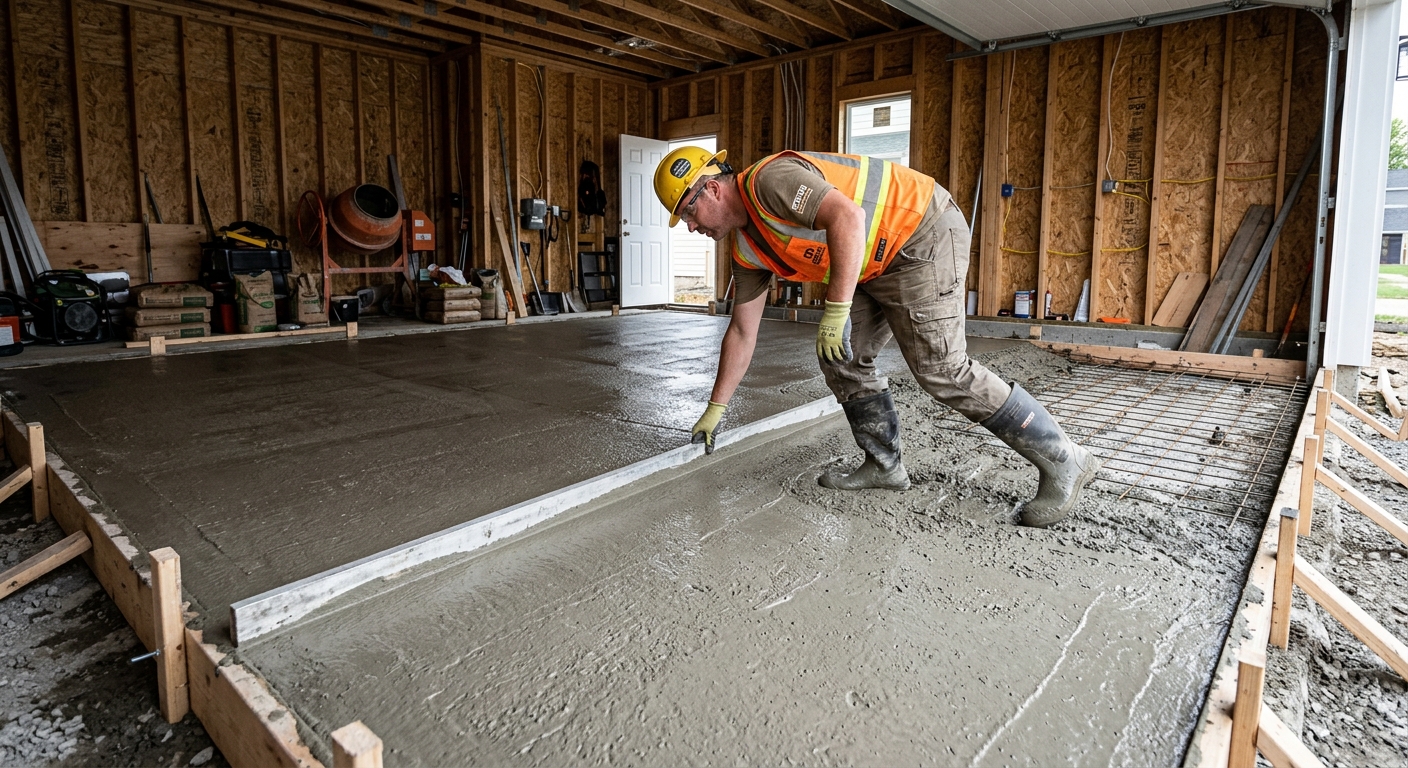
Concrete work options and costs in Ridgetown
Ridgetown is a small Ontario community where concrete flatwork still gets frequent upgrades—especially in older neighbourhoods close to downtown and along the main approach roads. With a population of 3,002 (Statistics Canada, 2021 Census), you’ll often see driveways and patios renewed as homes change hands, additions go on, or drainage issues show up. While the town’s overall pace is smaller than the GTA, the Toronto construction climate still drives the way contractors design for frost movement and freeze–thaw cycles.
In practice, most concrete work in Ridgetown is for single-family residences and rural-edge lots where exterior slabs do a lot of work—parking, walking access, and seasonal drainage. Toronto’s freeze–thaw pattern is one reason Ontario contractors commonly price concrete with deeper preparation and more durable exterior mixes than homeowners expect. For example, structural footings typically must extend at least 1.2 m below grade in much of Ontario to reduce frost heave risk, and exterior slabs should use air-entrained concrete to survive repeated winter temperature swings. The region’s labour availability and scheduling also matter: contractors often concentrate exterior pours into the warmer months so curing isn’t compromised when temperatures trend toward 10 °C or below.
In Ridgetown, areas like the older residential blocks near the downtown core tend to be in demand for driveway replacements and walkway repairs because access is tight and many lots have mature trees, which can restrict equipment placement. That’s also where good drainage and base prep are most critical. Below is a practical comparison of common options so you can match budget to the finish you want.
| Application |
Typical Size |
Key Spec |
Finish Option |
Price Range |
| Concrete driveway (standard broom finish) |
400 sq. ft. |
Air-entrained mix; compacted granular base; control joints |
Broomed |
$7,200–$11,200 |
| Exposed aggregate driveway |
400 sq. ft. |
Air-entrained mix; proper curing; stone exposure method |
Exposed aggregate |
$9,200–$14,800 |
| Stamped concrete driveway or patio |
250 sq. ft. |
Air-entrained mix; colour hardener; seal coat |
Stamped pattern |
$6,000–$10,000 |
| Plain concrete patio or walkway |
200 sq. ft. |
Compacted base; air-entrainment; edges formed |
Broom finish (light) |
$3,200–$5,200 |
| Garage floor (interior slab) |
400 sq. ft. |
Interior mix; vapour considerations; control joints |
Smooth trowel or broom |
$7,200–$12,000 |
| Foundation footings (structural, below frost) |
Varies (per linear ft.) |
Structural concrete; depth below design frost; engineered rebar |
Formed, structural |
$180–$300 |
Prices are estimates only and vary by project scope, site access and material selection.
What affects the price of concrete work in Ridgetown
In Ridgetown, you can see the same “driveway replacement” quote swing by 30–50% across Ontario because concrete pricing is really a bundle of decisions: excavation depth, base build-up, reinforcement, mix design, finishing labour, and how well the crew can manage curing. Even when the slab size is identical, two contractors may be building very different systems under the concrete to handle freeze–thaw and moisture movement. The Toronto economic region drives many of these specs—local departments and Ontario Building Code expectations for frost protection influence footing depth, and the freeze–thaw cycle influences exterior durability details.
Here’s the core: frost line depth and freeze–thaw cycles dictate every spec in Ontario. Footings must extend below the design frost depth to prevent frost heave and differential movement. Exterior flatwork should also be air-entrained to survive repeated freeze–thaw, and colder conditions shorten the reliable pour season. When temperatures drop toward 10 °C or below, crews often add cold-weather curing precautions (insulating blankets, temporary heat, longer cure protection), and that labour and equipment shows up in your total. De-icing salt also accelerates spalling on underbuilt surfaces, so sealing and surface protection become part of long-term cost control.
Two quick examples that commonly move price in Ridgetown: (1) If your driveway sits on poorly drained clay or old fill, the contractor may need thicker compacted granular base and better sub-drainage—budget closer to the higher end of the concrete driveway range (roughly $18–$28 per sq. ft.). (2) If you want stamped work, the additional labour and materials usually justify the premium compared with a plain patio or walkway (often $16–$26 per sq. ft.), but only if the base and joints are built correctly—otherwise the finish won’t last.
| Price Factor |
Why It Matters |
Cost Impact |
| Frost line depth — determines footing depth and form height |
Deeper excavation and more forming reduce frost-related movement |
Can materially raise foundation/footing costs (often priced per linear ft.) |
| Site preparation — excavation, grading, compacted granular base |
Proper base prevents pumping, settling, and edge failure |
Often one of the biggest drivers when soil conditions are variable |
| Reinforcement — rebar or wire mesh requirement |
Improves crack control and load capacity |
Adds material and labour; required for many structural applications |
| Mix design — air-entrainment and compressive strength spec |
Helps resist freeze–thaw damage and surface deterioration |
Higher-spec mixes can add cost but reduce early spalling risk |
| Finish type — broom vs. stamped vs. exposed aggregate |
Finishes require different labour intensity and curing/seal approach |
Stamped/exposed usually cost more than broom-finished concrete |
| Pour size and concrete truck access to site |
Access constraints can require smaller loads or additional labour |
Delays and extra handling increase total price |
| Cold-weather curing precautions — heating and blankets |
Protects strength gain and surface durability when cool evenings hit |
Can add a noticeable premium in shoulder seasons |
| Control joint pattern and sealing cost |
Limits random cracking; sealer helps repel de-icing salt |
Small line items, but they prevent costly premature repairs |
Permits & regulations in Ontario
In Ontario, structural concrete work almost always needs a building permit. If you’re doing new or modified footings, foundation walls, grade beams, or any structural element supporting the house, expect a permit and, in many cases, engineered drawings reviewed by the municipality. Concrete flatwork—patios, walkways and typical residential driveways—often does not require a permit by default, but it can if it affects lot grading, drainage, or impervious surface coverage limits, or if work touches municipal right-of-way areas. Before any demo or excavation, confirm what applies to your address and scope with the local authority.
For your concrete contractor in Ridgetown, require proof first: (1) liability insurance certificate, (2) WSIB coverage (or the applicable coverage/clearance documentation), and (3) the Ontario business licensing/registration needed to operate in the market. Step-by-step, you can verify by requesting the contractor’s certificate of insurance and confirming the policy is current and covers the described job. Next, ask for their WSIB/WCB clearance letter or proof of account status, then match the work location to your project. Finally, check their Ontario business details through the appropriate online registry resources and confirm the listed name matches the invoice and contracts you’ll sign.
Also ask for references on similar-scale projects—especially exterior flatwork built for freeze–thaw durability. That’s the difference between “it looks good” and “it holds up through Ontario winters.”
Getting concrete right in Ridgetown's freeze-thaw climate
Ridgetown winters can be hard on concrete because water in the base and slab expands as it freezes, then contracts during thaws. Over repeated freeze–thaw cycles, weak or saturated sub-base can cause settlement and cracking; the slab surface can also degrade if the mix isn’t properly air-entrained. The most common failure I see on exterior work is spalling—flaking or scaling—often traced to inadequate air-entrainment, poor curing, or skipping sealing where de-icing salt is used.
To spec the job correctly in Ontario’s Toronto-shaped climate, focus on five areas. First, base preparation: build a well-compacted compacted granular sub-base to the right depth for your soil and frost protection needs, with grading to drain away from the house. Second, mix design: require air-entrainment (typically about 5–7% air content for exterior flatwork) and a minimum 32 MPa compressive strength target. Third, control joints: plan them so cracking happens where you can manage it—spacing matters more than people think. Fourth, curing: protect the pour for at least 7 days under proper conditions; if you’re close to cold weather, curing protection becomes a real cost item, but it prevents early damage. Fifth, sealing: apply a penetrating sealer after the concrete has cured—commonly around 28 days post-pour—so de-icing salts have less direct impact on the surface.
As a practical dollar example: upgrading from a plain broom-finished patio to a stamped finish might look like the extra cost on paper (stamped work commonly lands higher than plain work in the $24–$40 per sq. ft. band), but I only call it “worth it” when the contractor also locks in base prep, joints, and the right exterior mix. If those fundamentals are skipped, you’ll pay twice—first for decorative work, then again for patching and rework.
| Spec |
Why It Matters in Ridgetown |
What to Ask For |
Impact if Skipped |
| Compacted granular base (depth?) |
Controls settlement and limits water movement under the slab during freeze–thaw |
Granular base depth and compaction method based on your soil and frost considerations |
Cracking, heaving, and edge failure |
| Air-entrained concrete mix (target air %?) |
Improves freeze–thaw durability so the surface resists spalling in Ontario winters |
5–7% air content for exterior flatwork (documented mix design) |
Spalling/scaling, especially where salt is used |
| Compressive strength (MPa rating) |
Strength gain affects long-term performance under vehicle and foot traffic |
Minimum 32 MPa compressive strength target (confirm pour design) |
Weak slab, increased cracking and surface wear |
| Control joints (spacing per ACI guidelines) |
Ensures cracking occurs in planned locations instead of random patterns |
Joint layout and spacing plan tied to slab dimensions |
Random cracks and difficult-to-repair damage |
| Minimum 7-day curing period |
Curing quality affects strength development through early freeze/thaw transitions |
Protection plan and curing time confirmation, especially if cool nights occur |
Early weakness, cracking, and durability loss |
| Penetrating sealer (when applied after cure) |
Helps repel de-icing salts and reduces moisture ingress |
Penetrating sealer applied around 28 days post-pour (or per product spec) |
Faster surface deterioration and higher spalling risk |
How to choose a concrete work contractor in Ridgetown
Choosing the right concrete contractor in Ridgetown is mostly about verifying the basics and making sure the quote reflects the technical specs you need for freeze–thaw durability. First, confirm Ontario licensing/registration where applicable, then get proof of liability insurance and WSIB/WCB coverage. To check insurance, ask for a current certificate of insurance showing the contractor’s legal name and coverage for the work being performed. For WSIB/WCB, request a clearance letter or proof of account status—then ensure the document is valid at the time of the job and that it aligns with the work location.
Next, insist on 2–3 itemised written quotes rather than a single lump sum. You want a breakdown that includes labour and materials, plus line items for excavation/removal, granular base, reinforcement (if required), concrete supply and finishing, curing protection (if needed), and disposal. Carefully review exclusions: Ask whether permit pulling (if required), dump fees, surface restoration, and any adjustments to drainage are included. A clear scope prevents “surprise extras” after demo.
On warranty, ask for (1) workmanship warranty length and what it covers, (2) product/manufacturer warranty for sealers or special materials, and (3) whether the warranty is transferable if you sell the property. For payment, never pay more than 10–15% upfront; hold a reasonable portion back until the job is complete and the finish quality is accepted. Finally, get a written start date and completion estimate, since exterior concrete in Ontario often depends on getting the pour and curing window right.
- Request proof of liability insurance and confirm it covers the Ridgetown worksite.
- Obtain current WSIB/WCB clearance or account proof before work begins.
- Get a detailed, itemised quote (labour + materials), not just one total price.
- Confirm base depth, compaction method, and drainage direction away from the house.
- Ask for the air-entrainment and minimum strength spec for exterior pours.
- Confirm whether rebar/wire mesh is included where structurally required.
- Review control joint placement and sealing plan for exterior flatwork.
- Ask how they protect curing in cool weather (blankets/heating if needed).
- Check that disposal/dump fees and site restoration are included.
- Get a written timeline with start and substantial completion dates.
- Verify warranty terms for workmanship and any sealer/product warranties.
- Ensure the contract matches the quote scope and drawings/specs (if any).
Concrete contractor red flags I watch for in Ridgetown: (1) vague quotes that don’t state base prep, mix type, or curing protection; (2) skipping air-entrainment for exterior work; (3) no plan for control joints or sealing; (4) asking for large upfront payments beyond 10–15%; and (5) refusing to show insurance/WSIB documentation or giving inconsistent business details on paperwork.
Frequently asked questions — concrete work in Ridgetown
What causes concrete to spall in Ridgetown winters?
Spalling in Ridgetown (and across Ontario) is usually driven by freeze–thaw damage plus salt exposure. When water gets into the concrete or along a weak base, it freezes and expands, creating internal stress. If the mix isn’t air-entrained to handle that expansion, the surface is more likely to scale or flake off—especially where de-icing salt is applied and people drive or plow frequently. Other contributors are poor curing early on and insufficient sealing once the concrete is mature. If your driveway or walkway is failing, ask your contractor whether the original pour used the right exterior mix, included proper base prep, and whether a penetrating sealer was applied about 28 days after placement. For a typical plain patio or walkway, homeowners often budget roughly $16–$26 per sq. ft., but durability depends on specs—not just the price tag.
What is rebar and when is it required in Ontario?
Rebar is steel reinforcement embedded in concrete to improve tensile strength and crack control. In Ontario, whether you need rebar depends on the structural design and the scope: foundation footings, grade beams, and other structural members commonly require engineered reinforcement details. For exterior flatwork like typical patios or walkways, reinforcement may be included depending on soil support, thickness, and loading (especially for driveways). The key is that “required” is driven by the engineered or design requirements for the specific project, not by a one-size rule. If you’re building new foundation work, expect engineered drawings and inspection requirements, with rebar placement guided by those documents. For homeowners planning flatwork, ask whether reinforcement is necessary for your thickness and base condition. A contractor quoting structural footings should also align with the below-frost depth expectations that protect against frost movement.
How long does a concrete project take in Ridgetown?
Timeline depends on scope and weather, but a typical exterior flatwork project is often measured in days of activity plus curing time for strength development. For example, a driveway or patio pour is usually a one-day placement (weather permitting), but prep and forming can take additional days—especially if there’s removal, hauling, or drainage adjustments. In Ridgetown, freeze–thaw and cool shoulder-season nights affect curing protection, so contractors may schedule around the warmer part of the season and add blankets or other measures when temperatures drop toward 10 °C or below. Even after the concrete is poured, it usually needs at least 7 days to cure adequately for many next steps, and full performance is longer. If you’re budgeting, plan for curing-related protection costs as part of the quote, not as a “later surprise.”
What is a concrete overlay and is it suited to Ridgetown?
A concrete overlay is a new concrete layer placed over an existing slab—often to restore appearance or add surface thickness without full demolition. It can be suited in Ridgetown when the existing concrete is still structurally sound, the surface can be properly prepared (cleaned, profiled, and bonded), and drainage issues are corrected. However, overlay isn’t a cure-all if the old slab is already heaving, settling, or failing due to freeze–thaw movement from a weak base—adding concrete on top can hide the problem temporarily but not fix the root cause. For projects where the existing slab is cracking broadly or lifting at joints, full removal is usually the safer long-term approach. If you’re comparing options, remember that decorative work like stamped concrete typically costs more per sq. ft. than plain concrete, while the right repair approach depends on why the original slab failed—often tied to base prep and moisture management.
How do I seal concrete to protect it in Ridgetown?
In Ontario winters, sealing helps reduce moisture and salt penetration, which can slow spalling and scaling. For most exterior slabs, you should apply a penetrating sealer after the concrete has fully cured—commonly around 28 days after the pour—so you don’t trap excess moisture in the slab. Surface prep matters: the concrete must be clean and dry, and crack repairs (if needed) should be completed before sealing. Ask your contractor what sealer system they use and how it’s applied, including coverage rate and whether it’s designed for salt exposure. If you’re sealing a driveway or walkway that sees de-icing, sealing is especially relevant. A common budget range for plain patios and walkways is about $16–$26 per sq. ft., but the long-term value comes from sealing the right product at the right time—not rushing the process.
What is the difference between concrete and cement?
Concrete is the final building material you place on site, made from cement plus water, aggregates (like sand and stone), and often admixtures (such as air-entrainment for exterior durability). Cement is one ingredient inside concrete—typically Portland cement—that reacts with water to create strength. Homeowners usually purchase “concrete” by mix design and performance specifications (like minimum compressive strength and air content for freeze–thaw exposure). That’s why your contractor’s concrete quote should reference the exterior mix requirements, curing approach, and reinforcement details where applicable, rather than just stating “cement” is included. In Ridgetown, the practical takeaway is this: for exterior slabs and driveways, the mix must be air-entrained and properly cured to handle Ontario’s freeze–thaw cycles. That technical choice affects longevity even when decorative options or basic broom finishes change the appearance and price.