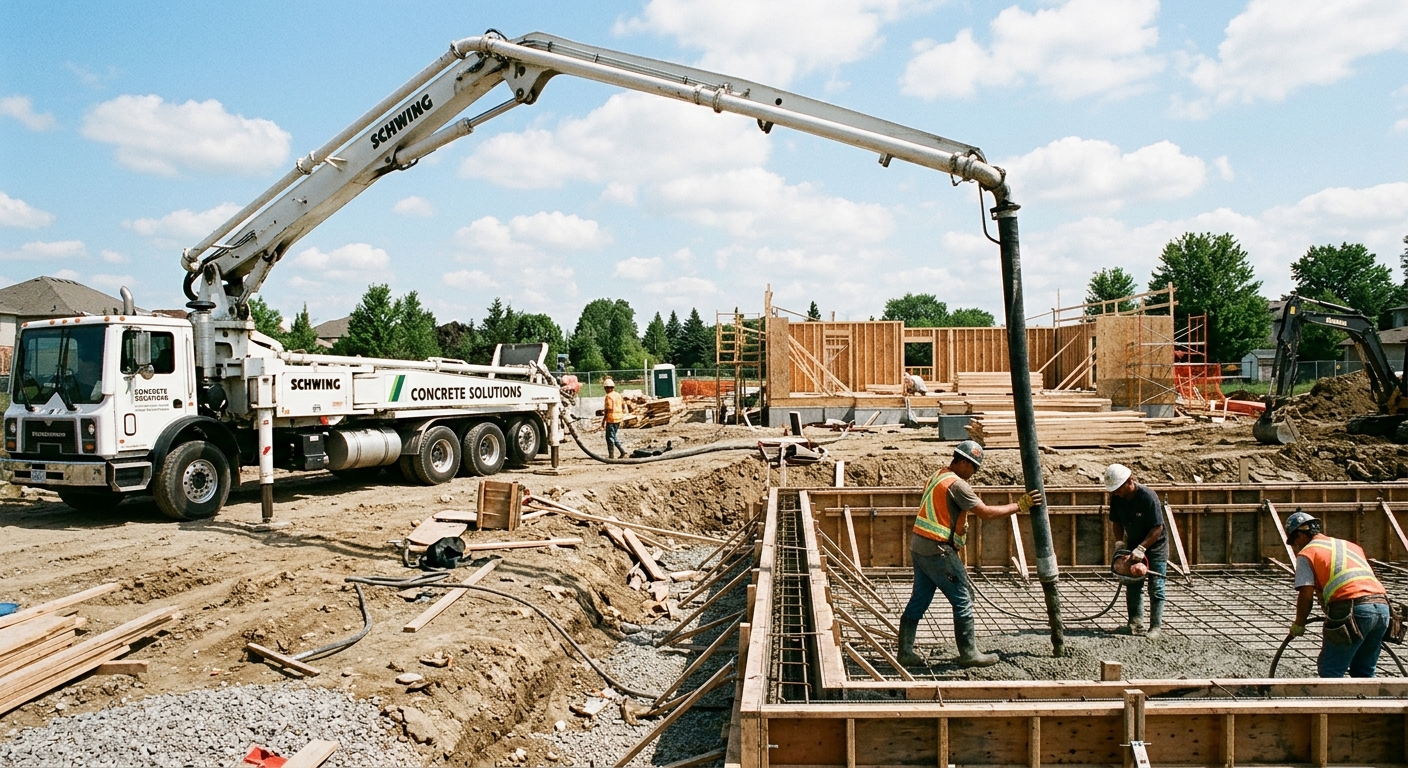
Concrete work options and costs in Waterford
Concrete work in Waterford, Ontario is all about getting the right spec for the long Toronto-area winters, not just pouring a smooth surface. With a population of 3,132 (Statistics Canada, 2021 Census), Waterford is a smaller community, so reputable crews often prioritize nearby GTA jobs when schedules open up. For most homeowners, the main concrete needs—driveways, patios, walkways, and garage slabs—typically serve single-family properties, where curb appeal and year-round durability matter. The Toronto economic region’s freeze–thaw cycles strongly influence both material choice and installation steps, which is why bids can shift even when the visible square footage looks the same.
In practice, local pricing is driven by frost protection, base preparation, and curing management. Ontario Building Code requirements generally push exterior structural footings to extend to at least about 1.2 m below grade to reduce frost heave and differential movement. Exterior flatwork also needs air-entrained concrete and a thickness that holds up to repeated moisture and freezing. When fall temperatures drop toward 10 °C or below, contractors either schedule earlier in the season or add cold-weather precautions to protect curing, which adds labour, blankets, or temporary heat. On top of that, de-icing salt can accelerate surface damage if the mix and sealing plan aren’t done right.
If you’re near the core of Waterford (especially around the downtown area where access is tighter), expect more time for traffic control, careful forming, and sometimes more site prep—factors that increase labour and equipment costs. Below is a straightforward comparison of common options to help you align your budget before you book site visits.
| Application |
Typical Size |
Key Spec |
Finish Option |
Price Range |
| Concrete driveway (standard broom finish) |
400 sq. ft. (approx. 20' x 20') |
Air-entrained mix; reinforced as needed; compacted granular base |
Broom finish + control joints |
$18,000 – $28,000 |
| Exposed aggregate driveway |
400 sq. ft. (approx. 20' x 20') |
Air-entrained mix; proper curing and aggregate exposure |
Exposed aggregate (light to medium stone) |
$22,000 – $34,000 |
| Stamped concrete driveway or patio |
300 sq. ft. (approx. 15' x 20') |
Air-entrained mix; reinforced; colour hardener where specified |
Stamped pattern + sealer |
$24,000 – $40,000 |
| Plain concrete patio or walkway |
200 sq. ft. (approx. 10' x 20') |
Air-entrained mix; well-compacted base; drainage away from house |
Broom finish |
$16,000 – $26,000 |
| Garage floor (interior slab) |
520 sq. ft. (approx. 20' x 26') |
Vapour barrier where needed; reinforcement as specified |
Steel-trowel finish or broom finish (as specified) |
$18,500 – $30,000 |
| Foundation footings (structural, below frost) |
Assume typical footing package for a small foundation |
Excavation; rebar; formwork; below-frost depth |
Structural concrete only |
$180,000 – $300,000 |
Prices are estimates only and vary by project scope, site access and material selection.
What affects the price of concrete work in Waterford
In the Toronto region, it’s common to see the “same” concrete job priced 30–50% apart—mainly because the quote isn’t only about concrete; it’s about what’s under and beside it. Two contractors can both show a driveway on paper, but one may include the right granular base, frost-protected excavation allowances, reinforcement, and proper drainage, while another might assume average soil and limited prep. Labour rates also differ based on crew size and how often contractors can schedule pours during the warmer window.
Frost depth and freeze–thaw cycles dictate the build-up everywhere in the region. Structural footings must extend below design frost depth (Ontario commonly about 1.5–2.4 m, depending on location and conditions) to prevent frost heave and differential movement. Exterior flatwork also requires air-entrained concrete so the mix can survive repeated expansion and contraction through the season. Colder weather shortens the reliable pour and curing period, so contractors may need cold-weather curing precautions—insulating blankets or temporary heating—to protect concrete while it gains strength. Finally, repeated traffic and de-icing salt can accelerate surface spalling; that’s why sealing (applied after proper cure) is frequently included for patios and driveways.
In Waterford, a few real-world conditions commonly move prices. If your site has soft, saturated soil after spring melt, excavation and granular replacement can increase costs. If access is limited near the downtown area or along narrower lanes, time spent on concrete placement and forming can run higher. Conversely, a straightforward, well-draining lot with clear truck access can keep your driveway closer to the $18–$28 band, while decorative upgrades like stamped concrete often track the $24–$40 band because of added labour, tools, and sealing.
| Price Factor |
Why It Matters |
Cost Impact |
| Frost line depth |
Determines footing depth and form height |
Deeper excavation and formwork can add significant labour and equipment time; structural work can swing by tens of thousands on foundation jobs. |
| Site preparation |
Excavation, grading, compacted granular base |
Wet or poor soil often requires granular replacement and more compaction lifts; this is a common cause of 30% price differences. |
| Reinforcement |
Rebar or wire mesh requirement |
Steel increases material cost and placement labour, but it reduces cracking risk and deflection. |
| Mix design |
Air-entrainment and compressive strength spec |
Air-entrained mixes cost a bit more, and higher strength specs can require longer protection during curing. |
| Finish type |
Broom vs. stamped vs. exposed aggregate |
Stamps and aggregate exposure add labour and consumables; decorative work typically sits higher within local bands. |
| Pour size and concrete truck access to site |
Placement speed and equipment limits |
Poor access can force smaller pours, more handling, and additional labour for placement and cleanup. |
| Cold-weather curing precautions |
Heating and blankets |
When temperatures drop near or below 10 °C, protection increases material and labour requirements. |
| Control joint pattern and sealing cost |
Manages cracking and limits salt-driven surface damage |
Proper jointing is often included; sealing adds a discrete line item but can extend service life. |
Permits & regulations in Ontario
In Ontario, most structural concrete work—especially anything tied to a foundation system—requires a building permit. That means tasks like footings, foundation walls, grade beams, and other structural elements typically need permits and often engineered drawings reviewed by the municipality. For concrete flatwork such as driveways, patios, and walkways, permits are usually not required by default; however, you may need approval if your project changes lot grading, affects impervious surface coverage limits, or touches municipal right-of-way conditions (for example, drainage and how runoff is managed). Always confirm with the local authority before breaking ground.
For contractor compliance, treat “licensed and insured” as non-negotiable. Start by asking whether the contractor carries general liability coverage and proof of WSIB/WCB (or equivalent coverage). Next, verify the contractor’s Ontario licence/registration where applicable (many concrete trades are connected to broader contracting categories) and request a clearance letter where the contractor uses a sub-trade network. Finally, review references on similar foundation or exterior flatwork projects—especially in freeze–thaw conditions like Waterford.
Step-by-step, a homeowner can verify safety and compliance: (1) check the contractor’s registry information online for active status, (2) request a current certificate of insurance showing liability limits and expiry dates, (3) obtain WSIB/WCB clearance confirmation, and (4) confirm the permit responsibility is clear for structural scopes. If a contractor can’t provide paperwork promptly, that’s usually a sign to pause and ask questions.
Getting concrete right in Waterford's freeze-thaw climate
Concrete failures in Waterford are rarely about “bad luck.” The most common problems in freeze–thaw conditions are spalling (surface flaking), random cracking, and scaling—usually traced back to base prep, mix design, and curing/protection choices. When moisture gets into small surface pores and the temperature cycles from above to below freezing, the concrete’s internal pressures rise. If the mix isn’t air-entrained or the curing and sealing plan is off, the surface can break down faster under traffic and de-icing salt.
To spec the job correctly, you want a build-up that’s designed for Ontario conditions: (1) base preparation with a compacted granular sub-base to the right depth for your soil and intended slab thickness, with grading that keeps water draining away from the house; (2) a mix design with air-entrainment—typically 5–7% air content for exterior flatwork—and a minimum compressive strength commonly around 32 MPa for durable performance; (3) control joints placed to manage shrinkage cracking rather than letting random cracks form; (4) curing that protects the concrete for at least 7 days under suitable conditions, with extra measures if temperatures are cool; and (5) penetrating sealer applied after full cure—often around 28 days post-pour—to help repel de-icing salt and reduce surface damage.
Use these as technical questions when you compare quotes. For example, if two contractors both offer a driveway in the $18–$28 band, but one includes air-entrainment, thicker slab build-up, and proper joint spacing, that extra work can be worth it—because it targets spalling and scaling risk. By contrast, paying for stamped concrete in the $24–$40 band only makes sense if the contractor also plans for correct base prep and sealing; otherwise the decorative surface may deteriorate sooner than you expect.
| Spec |
Why It Matters in Waterford |
What to Ask For |
Impact if Skipped |
| Compacted granular base (depth?) |
Controls frost-related movement and water storage |
Confirm granular base depth and compaction method for your soil and slab thickness |
High water retention and voids can lead to settlement, cracking, and premature failure |
| Air-entrained concrete mix (target air %?) |
Improves freeze–thaw durability for exterior slabs |
Ask for air content target (typically 5–7% for exterior flatwork) and mix design sheet |
Inadequate air leads to spalling/scaling under winter cycling |
| Compressive strength (MPa rating) |
Strength gain affects durability and load performance |
Minimum 32 MPa specification and verification of curing conditions |
Lower strength can increase cracking and surface abrasion from traffic |
| Control joints (spacing per ACI guidelines) |
Limits random cracking and maintains surface integrity |
Confirm joint spacing, saw-cut timing, and layout around forms and penetrations |
Uncontrolled cracking can allow water ingress and freeze damage |
| Minimum 7-day curing period |
Ensures proper strength development before exposure |
Ask how curing will be protected if temperatures drop during/after the pour |
Premature exposure increases scaling, cracking, and reduced durability |
| Penetrating sealer (when applied after cure) |
Repels salt and reduces freeze-driven surface deterioration |
Confirm sealer type and timing—often about 28 days post-pour |
Higher risk of surface spalling and faster wear in winter conditions |
How to choose a concrete work contractor in Waterford
Choosing a concrete contractor in Waterford starts with verifying Ontario compliance and practical experience in freeze–thaw jobs. First, ask for proof of liability insurance (with limits appropriate to your scope) and confirm coverage for workplace injuries through WSIB/WCB (or the contractor’s clearance documentation). To verify, check the contractor’s Ontario registration/licence status online where available, and request current certificate of insurance documents before work begins. A reputable contractor will provide these quickly and will not pressure you to sign before paperwork is reviewed.
Next, get 2–3 itemised written quotes. You want a breakdown that separates labour, excavation/site prep, granular base, reinforcement, concrete supply, finishing (broom/stamped/exposed), and sealing where included. Avoid vague “lump sum” quotes that don’t explain what’s in or out. Clarify permit pulls for structural work, disposal and haul-away for excavated material, and whether truck access constraints are included in the price. Also confirm how the contractor schedules cold-weather protections—blankets/heating—if the pour window shifts.
Warranty matters: ask for the workmanship warranty length, how manufacturer warranties apply to sealers or decorative materials, and whether any warranty is transferable if you sell your home. For payment, keep it safe: never pay more than 10–15% upfront; hold back the remainder until the job is complete and walk-through items are addressed. Finally, require a written start date and completion estimate.
- Ask for WSIB/WCB clearance proof and confirm coverage dates.
- Request certificate of insurance and verify liability limits.
- Get at least 2–3 itemised quotes (labour + materials + base prep).
- Confirm excavation scope, granular replacement, and compaction method.
- Ask whether the mix is air-entrained for exterior slabs.
- Confirm reinforcement details (rebar size/grid or mesh) where required.
- Ask for control joint layout and planned saw-cut timing.
- Verify curing plan (especially if temps drop toward 10 °C or below).
- Clarify sealing: product type and timing (often after full cure).
- Check what’s excluded: permit fees, disposal, site protection, landscaping restoration.
- Require a detailed schedule: start date and finish date in writing.
- Confirm workmanship and product warranty terms in plain language.
Red flags to watch for in Waterford: vague specs like “standard mix” with no air-entrainment mention, skipping proof of insurance/WSIB/WCB, promising decorative finishes without discussing sealing or curing protection, using no plan for drainage away from the foundation, and demanding large upfront payments (beyond 10–15%) without a clear schedule or scope document.
Frequently asked questions — concrete work in Waterford
Can concrete be poured in cold weather in Waterford?
Yes, concrete can be poured in Ontario in cold weather, but it needs a protection plan. In the Waterford/Toronto area, the concern isn’t just the air temperature—it’s how long concrete stays near freezing during placement and early curing. When temperatures drop toward 10 °C or below, many contractors add measures like insulating blankets, windbreaks, and sometimes temporary heat so the slab can gain strength properly. Your quote should spell out the cold-weather curing approach and the curing timeframe, not just the pour day. For structural work (footings/foundation elements), permitting and engineered details also affect the schedule. If the contractor can’t explain how they’ll protect the pour, that’s a sign to delay or choose another crew.
How do I maintain concrete in Waterford's freeze-thaw climate?
Maintenance in Waterford is mostly about limiting water and salt exposure so freeze–thaw can’t chew up the surface. Start with drainage: keep runoff moving away from the house and avoid letting downspouts dump onto the slab. For exterior flatwork, use a penetrating sealer applied after the concrete has fully cured (often around 28 days post-pour). In winter, de-icing is fine, but avoid over-salting—excess chloride can increase spalling risk if the mix and sealing plan weren’t done correctly. For driveways and patios, clean off sand and grit to reduce abrasion. If you see small cracks, don’t ignore them; sealing joints helps prevent water ingress, which can freeze and expand behind the surface.
What causes concrete to spall in Waterford winters?
Spalling in Waterford usually comes from freeze–thaw damage combined with moisture and de-icing salt. The biggest technical driver is often inadequate air-entrainment—if the mix doesn’t include enough properly distributed air voids, the water inside can expand during freezing and break off the surface. Other contributors include insufficient base prep (so water sits under or against the slab), poor curing (concrete not reaching strength before exposure), and joints that weren’t cut and sealed in a controlled way. On top of that, if the slab surface isn’t sealed after cure, salt can accelerate scaling. That’s why it’s smart to compare quotes that mention air-entrained mix specs and include sealing—decorative options like stamped concrete in the local $24–$40 band should always come with a durability plan, not just a pattern.
What is rebar and when is it required in Ontario?
Rebar is steel reinforcement placed inside concrete to help control cracking and improve load capacity. In Ontario, whether rebar is required depends on the structure’s design and the risk factors for the specific slab or foundation detail—soil conditions, slab thickness, and loads (like vehicle traffic on a driveway). For many foundation systems and structural elements (footings and foundation walls), reinforcement is typical because it’s part of the structural design reviewed for permitting. For exterior flatwork, some jobs need reinforcement and others don’t; it’s driven by engineering guidance, slab thickness, and the intended use. Don’t rely on “everyone does mesh” as a rule—ask your contractor to explain how their reinforcement plan matches the thickness and expected loads. A good quote will specify reinforcement details, not just “reinforced concrete.”
How long does a concrete project take in Waterford?
Timelines depend on scope, access, and curing/season conditions. A typical exterior flatwork job—like a plain patio or walkway—often runs a few days from site prep through finishing, but curing and weather protection influence when you can use the surface. Most crews still treat curing as essential even if the surface looks ready the next day. Driveway projects commonly take longer due to excavation, grading, base compaction, forming edges, and managing control joints. If temperatures are cool, contractors may add time for insulation/blankets and for the concrete to reach safe strength before removal of forms. Structural work (like footings below frost) can take longer because excavation, inspections, and engineered steps may affect the schedule. For budgeting, think in days for pour + finishing, plus additional days for curing; don’t plan to rush the job based only on the calendar.
What is a concrete overlay and is it suited to Waterford?
A concrete overlay is an additional concrete layer poured on top of an existing slab, usually after surface prep and repairs. It can be a cost-effective way to refresh appearance and improve usability when the original slab is still structurally sound, but overlays are not ideal if the base has significant settlement, deep cracking, or recurring moisture issues. In Waterford’s freeze–thaw climate, the key question is why the existing slab is deteriorating. If spalling or cracking came from moisture infiltration and salt exposure, you’ll want to correct drainage and address joint performance before overlaying. Maintenance planning matters too—sealed surfaces and properly managed joints help. Overlay pricing varies widely; for homeowners who need a full replacement, local driveway bands often land around $18,000–$28,000 for standard work, so you should compare overlay quotes against replacement scope to ensure you’re not paying near-replacement pricing without solving the underlying issue.