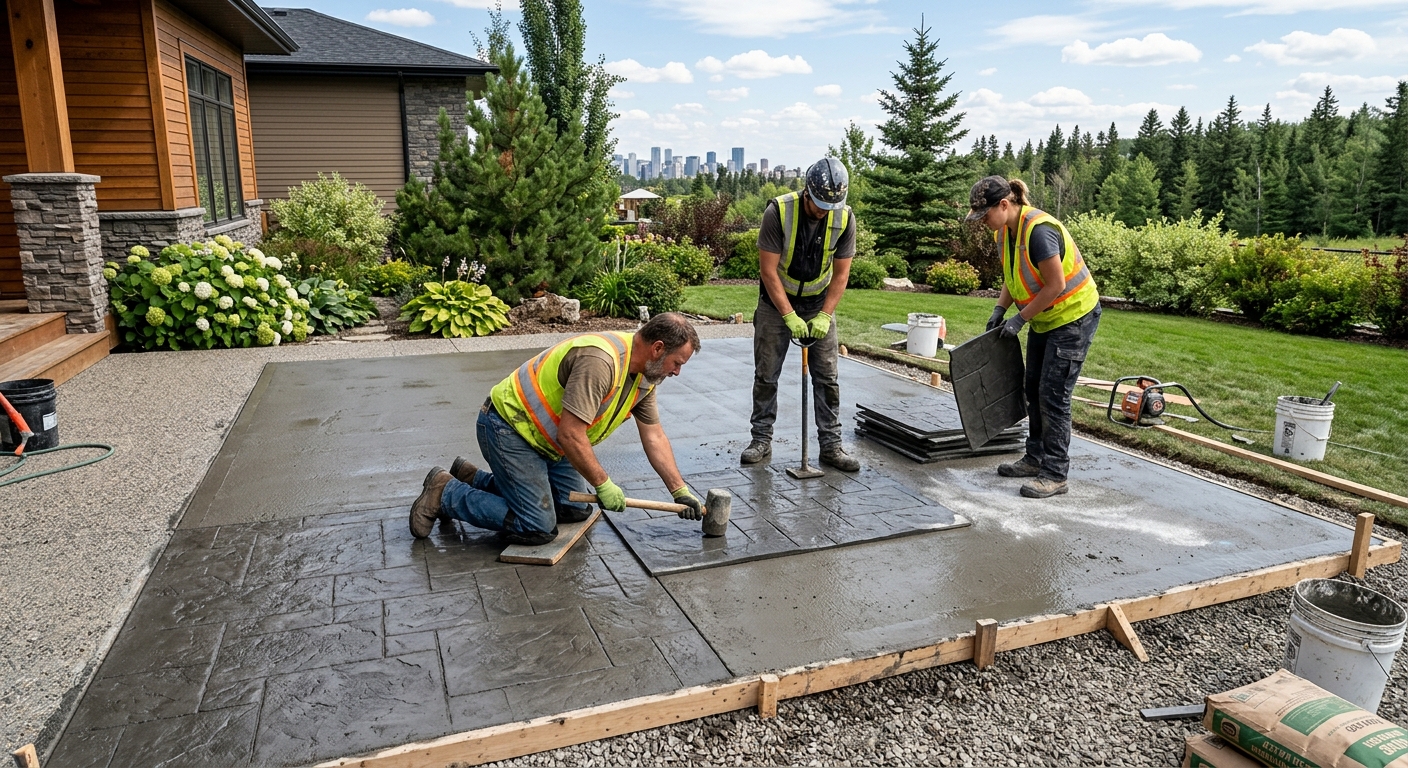
Concrete work options and costs in Forest Hills
Concrete work in Forest Hills, Ontario, is a year-round topic, but the price and the results you get depend heavily on frost depth, freeze–thaw cycles, and how well the sub-base is prepared. With a population of 6,238 (Statistics Canada, 2021 Census), Forest Hills is a smaller community within the wider Toronto economic region, so the most in-demand contractors often focus on exterior work—especially driveways, patios, and walkways. In this area, many homeowners are working on established residential properties where upgrading flatwork is one of the highest-ROI improvements.
In the GTA, local concrete specifications are shaped by municipal expectations and the Ontario Building Code approach to frost protection for structural elements. For example, structural footings typically need to extend at least 1.2 m (about 4 ft) below grade to reduce frost heave and differential movement. Exterior slabs also need air-entrained concrete and careful drainage so saturated soils don’t expand and contract every winter.
Contractor availability can affect pricing too. Pour schedules tend to concentrate in the warmer months because curing slows as temperatures approach 10 °C or below. Wet springs and cooler fall conditions mean more protection on-site (blankets, covers, and longer cure management), which adds labour and supervision. On top of that, de-icing salt use can accelerate surface spalling if the mix and sealing plan aren’t right.
Demand is especially steady around Centennial Park area and nearby residential pockets where driveways are frequently resurfaced or expanded. Below is a practical comparison of common options you’ll see in Forest Hills, along with realistic cost bands to help you budget before you request quotes.
| Application |
Typical Size |
Key Spec |
Finish Option |
Price Range |
| Concrete driveway (standard broom finish) |
400 sq ft (about 20 ft x 20 ft) |
4 in slab on compacted granular base; air-entrained |
Broom finish + control joints |
$7,200 – $11,200 |
| Exposed aggregate driveway |
400 sq ft (about 20 ft x 20 ft) |
Air-entrained mix; proper retarder timing; durable base |
Exposed aggregate finish |
$9,500 – $14,800 |
| Stamped concrete driveway or patio |
300 sq ft (about 15 ft x 20 ft) |
Air-entrained mix; reinforcement where required |
Stamped pattern + sealer |
$10,800 – $16,200 |
| Plain concrete patio or walkway |
200 sq ft (about 10 ft x 20 ft) |
4 in slab; drainage slope; air-entrained exterior mix |
Light broom + control joints |
$3,200 – $5,200 |
| Garage floor (interior slab) |
480 sq ft (about 20 ft x 24 ft) |
6 in slab where needed; vapour barrier if required |
Standard smooth-trowel (light float) + joints |
$9,000 – $14,800 |
| Foundation footings (structural, below frost) |
Varies (example: 50 linear ft) |
Concrete footings below frost depth; engineered rebar |
Structural concrete only |
$9,000 – $15,000 |
Prices are estimates only and vary by project scope, site access and material selection.
What affects the price of concrete work in Forest Hills
In the Toronto economic region, it’s common to see quotes for the “same” concrete job vary by 30–50%. The reason isn’t just the concrete—it’s the foundation of the quote: excavation, base preparation, reinforcement detailing, mix design, curing protection, and how long the contractor expects the site to take. When one proposal includes proper granular base, air-entrainment, and a sensible control joint plan—and another only assumes “standard thickness”—you can easily get a large swing in labour and materials.
Frost line depth and freeze–thaw cycles dictate the specs. For Ontario, structural footings must extend below the design frost depth (often at least 1.2 m) to prevent frost heave and differential movement. Exterior flatwork also needs air-entrained concrete mixes to survive repeated freeze–thaw, and that adds cost versus basic non-air mixes. When temperatures drop toward 10 °C or below, contractors must protect curing—using insulating blankets or temporary heating in some cases—so the concrete gains strength properly. Finally, GTA winters are hard on surfaces: de-icing salt can accelerate surface deterioration, so sealing is often recommended for driveways, patios, and walkways.
In Forest Hills, a few local realities commonly push prices up or down. If your driveway is on soft fill or the soil is saturated after spring rain, the granular base may need to be deeper and better compacted—adding cost. If you have easy truck access and a straightforward demo, you may land near the lower end of the $18–$28 driveway band. If you choose stamped concrete (often in the $24–$40 decorative band), the added labour for formwork, stamping mats, and finishing typically justifies the increase, especially where drainage grading is already being corrected.
| Price Factor |
Why It Matters |
Cost Impact |
| Frost line depth — determines footing depth and form height |
Footings must be placed below design frost depth to prevent heaving and movement |
Higher excavation + more concrete; typically increases foundation costs substantially |
| Site preparation — excavation, grading, compacted granular base |
Concrete performs based on the base; saturated or poorly compacted soils fail sooner |
Can swing job cost significantly, especially on regrade or soft-soil sites |
| Reinforcement — rebar or wire mesh requirement |
Reinforcement controls cracking and improves load performance |
Extra material and labour; omission often leads to early cracking |
| Mix design — air-entrainment and compressive strength spec |
Air-entrainment improves freeze–thaw durability; strength spec supports service life |
Up-front mix cost; typically smaller savings if cut corners are avoided |
| Finish type — broom vs. stamped vs. exposed aggregate |
Finish method drives labour time, tools, and curing/sealer workflow |
Decorative finishes generally cost more (time + materials) |
| Pour size and concrete truck access to site |
Long carries or difficult access increase labour and can change pour planning |
Access issues add labour, sometimes affecting the schedule and crew size |
| Cold-weather curing precautions — heating and blankets |
Ensures adequate strength gain when temperatures drop |
Adds equipment and crew time; cost rises as weather window shrinks |
| Control joint pattern and sealing cost |
Joints manage shrinkage cracking; sealing helps repel salt and moisture |
Small material cost but meaningful labour and product application |
Permits & regulations in Ontario
In Ontario, the rule of thumb is: structural concrete usually needs a permit, while plain flatwork often doesn’t—but it depends on grade, drainage, and how the work affects your property and adjacent areas. In Forest Hills, concrete work that typically DO require a building permit includes structural elements such as foundation walls, grade beams, footings, and other supporting concrete. These projects often require engineered drawings reviewed by the municipality to confirm rebar sizing, placement, and foundation design.
Concrete flatwork—like driveways, patios, walkways, and garage slabs—generally does not require a permit unless it changes lot grading, impacts municipal drainage requirements, or involves work within a right-of-way that triggers additional approvals. Even when a permit isn’t required, your contractor should still plan drainage so water doesn’t get pushed toward the house or neighbour’s property.
Step-by-step verification you can do before signing in Ontario:
- Ask for the contractor’s liability insurance certificate (COI) showing jobsite coverage.
- Confirm WSIB clearance (or equivalent coverage status where applicable) and request documentation.
- Check for a valid contractor licensing/registration where required, and confirm the legal business name matches the contract and COI.
- Request references for similar scope (exterior flatwork in cold climates is a different skill set than interior slabs).
- Get everything in writing: scope, rebar/mix specs, disposal, and whether protection/curing measures are included.
Getting concrete right in Forest Hills's freeze-thaw climate
Concrete failures in Forest Hills are usually predictable: water gets in, freezes, and expands behind a weak base or within a surface that isn’t protected. In a freeze–thaw environment, the most common problems are cracking from shrinkage and movement, and spalling (surface scaling) when the concrete lacks enough air-entrainment or when curing was rushed. The fix is not guesswork—it’s specifying the right base preparation, mix design, control joints, curing, and sealing for Toronto-area winters.
Start with base prep: use a compacted granular sub-base sized to suit local soil and frost conditions, then ensure the slab is built with proper slope and drainage. Next, specify an air-entrained mix with a target of 5–7% air for exterior flatwork and a minimum 32 MPa compressive strength. Then manage shrinkage with a control joint plan—spacing that matches the slab geometry—so cracks are directed where you expect them. Finally, curing should last at least 7 days under proper conditions; if you pour when nights cool quickly, insulation blankets or heaters may be warranted so the concrete develops strength. After cure, apply a penetrating sealer around 28 days post-pour to repel de-icing salts and reduce moisture ingress.
Here’s a practical dollar example: a typical plain broom-finished patio or walkway may land in the $16–$26 per square foot range, while stamped concrete often moves into the $24–$40 band due to finishing labour and extra materials. That price difference is worth it when your contractor is already doing the “boring” durability items correctly—air-entrainment, base depth, joint layout, and curing protection—because decorative looks don’t matter if the slab spalls.
| Spec |
Why It Matters in Forest Hills |
What to Ask For |
Impact if Skipped |
| Compacted granular base (depth?) |
Prevents pumping, supports load, and reduces freeze–thaw movement |
“What base depth and gradation are you compacting to (and how will you verify compaction)?” |
Early settlement, cracking, and uneven slab movement |
| Air-entrained concrete mix (target air %?) |
Improves freeze–thaw durability and reduces spalling risk |
“Confirm air content target (5–7%) for exterior flatwork, and show the mix ticket spec.” |
Surface scaling/spalling and faster deterioration after winter |
| Compressive strength (MPa rating) |
Ensures proper strength gain for service life in cold seasons |
“What is the minimum MPa rating (at specified curing time) for this pour?” |
Weaker concrete, increased cracking and surface damage |
| Control joints (spacing per ACI guidelines) |
Directs shrinkage cracking so it doesn’t become random structural cracking |
“What joint spacing and pattern will you use for my dimensions, and how deep?” |
Uncontrolled cracking and higher repair likelihood |
| Minimum 7-day curing period |
Builds strength and helps reduce early cracking |
“How will you protect the slab for at least 7 days in cool or wet weather?” |
Inadequate strength, weaker surface, and more premature failures |
| Penetrating sealer (when applied after cure) |
Helps repel moisture and de-icing salt intrusion |
“Will you apply a penetrating sealer after full cure (around 28 days) and in what weather conditions?” |
Faster salt-related surface damage and reduced long-term durability |
How to choose a concrete work contractor in Forest Hills
Choosing a concrete contractor in Forest Hills comes down to verifying credentials, confirming technical details, and making sure the quote matches how concrete actually fails in our climate. In Ontario, you should verify (1) Ontario business legitimacy/registration where applicable, (2) liability insurance for jobsite risk, and (3) WSIB coverage (request a clearance/status document). Don’t accept “we’re insured” as a statement—ask for the certificate of insurance and ensure the legal name matches the contract.
Then, request 2–3 itemised written quotes. You want a breakdown that separates excavation/base prep labour, concrete supply/mix, reinforcement, forms, finishing, sealing, and disposal. A lump sum can hide major omissions—like whether the contractor is actually pricing air-entrainment, proper joint cutting, or cold-weather protection.
Read the scope carefully: what’s excluded (tree root removal, hauling, rock excavation, foundation drain tie-ins), is a permit included where required, and is demolition/disposal part of the price? For warranty, confirm workmanship coverage length, whether product/manufacturer warranty applies, and whether it transfers to future owners. Ask about payment scheduling: never pay more than 10–15% upfront. Hold back a portion until the work is complete, joints are finished, cleanup is done, and sealing/curing steps are satisfied. Finally, insist on a written timeline with start date and estimated completion.
- Confirm they can show mix details (air-entrainment and strength spec) and provide mix ticket info on request.
- Ask who does base preparation and how they verify compaction.
- Confirm reinforcement plan (rebar/wire mesh where required) and bar sizes.
- Verify whether they include control joints and the exact joint spacing.
- Check if sealing is included and when it will be applied (timed to cure).
- Ask about cold-weather precautions if nights cool toward 10 °C or below.
- Ensure demolition and disposal are clearly stated (include weight limits if dumpster is used).
- Confirm truck access plan and whether sawcutting/clean edges are included.
- Ask for references on similar exterior work in Ontario winters.
- Confirm liability insurance and WSIB status with documents before work starts.
- Require an itemised quote rather than only a single line “concrete supply and install.”
- Get the warranty in writing, including what it covers and for how long.
Concrete red flags in Forest Hills include: quotes that omit air-entrainment language, promises to “pour and you’ll be fine” without discussing curing protection, no mention of base depth/compaction, no control joint plan (or joints “later” without a schedule), and cancellation of sealing/curing steps to save money after the slab is already in place.
Frequently asked questions — concrete work in Forest Hills
What is the difference between concrete and cement?
In Ontario, people often use “cement” and “concrete” interchangeably, but they aren’t the same. Cement is the binding ingredient (the powder) that reacts with water. Concrete is the full engineered material: cement plus water, sand, gravel/stone (the aggregates), and—when needed—additives like air-entrainment for freeze–thaw durability. For Forest Hills exterior flatwork (driveways, patios, walkways), contractors typically specify an air-entrained mix because Toronto-area winters can be tough on surfaces exposed to de-icing salt.
When you’re comparing quotes, ask what mix design is being used and whether it’s explicitly air-entrained and rated for the exterior application. That’s often more important than brand names, because the performance comes from the mix proportions and finishing/curing practices.
How much does concrete work cost in Forest Hills?
Concrete pricing in Forest Hills generally follows the broader Toronto-region bands, adjusted for base conditions, access, and finish choice. For driveways, many homeowners budget around $18–$28 per square foot for standard concrete, while patios and walkways typically fall around $16–$26 per square foot. Decorative options can run higher: stamped & decorative concrete commonly sits in the $24–$40 range depending on labour intensity and finishing.
Your final total can also jump if excavation needs extra work (rock, saturated sub-base) or if the contractor includes cold-weather curing protection when nights are cool. A small difference in included items—like proper granular base depth and sealing—can be the difference between a slab that performs for years versus one that starts scaling or cracking sooner.
How deep must footings be for Forest Hills's frost line?
For Forest Hills (Ontario), structural footings are typically required to be placed below the design frost depth to prevent frost heave. In the Toronto area, local building practice and code expectations commonly target at least 1.2 m (about 4 ft) below grade for most footing designs. Exact depth can vary based on engineered requirements and soil conditions, so you should treat depth as an engineered spec, not a “one-size-fits-all” number.
If you’re planning foundation work (footings, foundation walls, grade beams), it’s usually permit-and-engineering territory. That means the contractor should provide the engineered drawings and rebar placement details, not just a casual assurance. Ask how they confirm frost depth and how they protect excavation from water accumulation before the pour.
Why does concrete crack in Forest Hills and how is it prevented?
Cracking in Forest Hills is usually a combination of shrinkage, temperature change, and movement caused by moisture and freeze–thaw cycles. Even high-quality exterior slabs shrink as they cure and can crack if joints aren’t planned. In Ontario winters, saturated base material can also contribute to movement—so a weak base or poor drainage can turn small cracks into bigger problems.
Prevention is about specifications: use proper base preparation and compaction, specify an air-entrained mix for freeze–thaw durability, and include a control joint pattern designed for your slab dimensions. Many contractors also use sealers and adequate curing time. If you want durable results, ask whether the quote includes control joints (spacing and cutting depth) and whether sealing is planned after full cure.
Stamped vs broom-finish concrete — cost difference?
Stamped and broom-finish concrete differ mostly in labour and finishing complexity. A broom-finish driveway or patio is comparatively straightforward: the surface gets finished and grooved with a controlled joint layout. Stamped concrete includes extra steps—forms or moulds, colouring and texture finishing, and often a different curing/sealer workflow—so it typically costs more.
In Forest Hills, homeowners commonly see standard concrete within the $18–$28 driveway band, while stamped & decorative concrete often falls in the $24–$40 range. That higher cost can be justified when the contractor is also doing the durability basics: air-entrainment, proper thickness, correct base compaction, and proper curing protection for Ontario temperature swings. If those items are cut to “buy the stamp,” the appearance won’t save the slab from spalling and premature wear.
When is the best time to pour concrete in Forest Hills?
The best time to pour concrete in Forest Hills is typically during the warmer part of the season when air temperatures stay in a workable range and concrete can cure reliably. In the GTA, many exterior pours are scheduled for spring through early fall so that curing proceeds at a steady rate. As temperatures trend toward 10 °C or below, contractors often need added protection—insulating blankets, covering, or heating—so the concrete reaches strength without freezing or curing too slowly.
Wet weather can also be an issue, especially if your site becomes saturated before excavation and base prep are complete. For best results, ask your contractor for their planned curing protection approach for night temperatures, and make sure the job includes weather-dependent steps rather than assuming an “average day” will work.