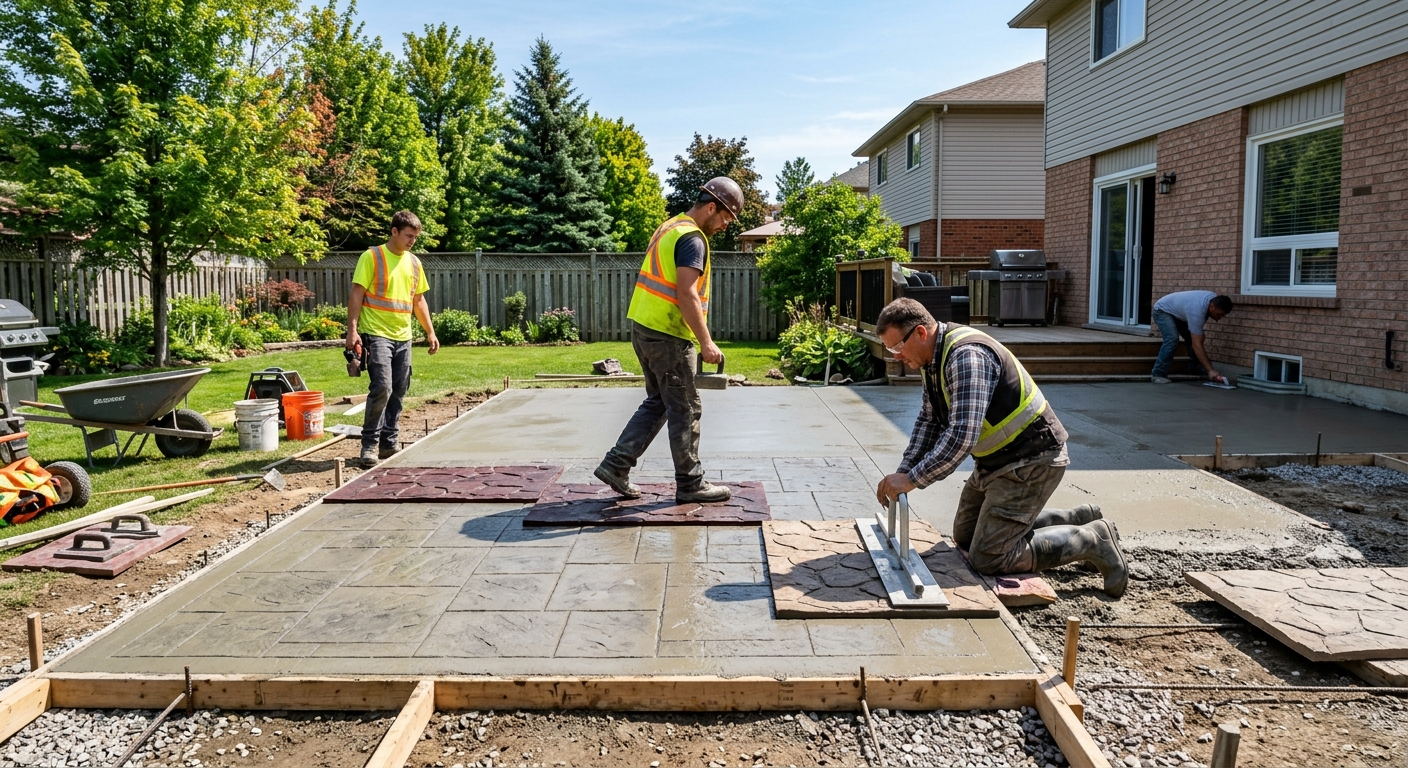
Concrete work options and costs in Bayview Village
Bayview Village, Ontario is a mature, family-focused community where driveways, patios and walkways take a beating from Toronto-area freeze–thaw cycles. With a population of 21,396 (Statistics Canada, 2021 Census) and a strong share of single-detached housing that typically includes longer driveways and more exterior flatwork, homeowners often price concrete as part of renovations and curb appeal upgrades. In the GTA, contractors see the most demand around established streets and service areas close to the Bayview Village Shopping Centre corridor, where accessibility and consistent turnaround matter.
Concrete pricing in the Toronto economic region is shaped by frost depth requirements, the need for air-entrained mixes, and how well the base is prepared and drained. Exterior slabs are usually spec’d with proper granular sub-base, controlled cracking via joints, and careful curing—especially when temperatures fall toward 10 °C or below. When crews have to slow down for curing protection (insulating blankets, minimal retempering risk, and sometimes temporary heating), costs move upward. Availability can also tighten during warmer months because pour seasons are shorter than in milder regions.
Below is a practical comparison of common options you’ll see in Bayview Village, including typical sizes and what to ask for so you can compare quotes on equal footing.
| Application |
Typical Size |
Key Spec |
Finish Option |
Price Range |
| Concrete driveway (standard broom finish) |
400–600 sq. ft. |
Air-entrained exterior mix, reinforced slab, granular base + drainage |
Broom finish with saw-cut control joints |
$18,000–$28,000 |
| Exposed aggregate driveway |
400–600 sq. ft. |
Air-entrained exterior mix, proper curing to achieve clean exposure |
Exposed aggregate with sealer |
$22,000–$34,000 |
| Stamped concrete driveway or patio |
300–600 sq. ft. |
Air-entrained mix, reinforcement + integral colour, release powder technique |
Stamp pattern + integral colour |
$24,000–$40,000 |
| Plain concrete patio or walkway |
150–350 sq. ft. |
Air-entrained exterior mix, compacted granular base |
Broom or light trowel finish |
$16,000–$26,000 |
| Garage floor (interior slab) |
400–550 sq. ft. |
Vapour barrier, reinforcement, smooth finish for use and cleaning |
Steel trowel finish |
$18,000–$28,000 |
| Foundation footings (structural, below frost) |
Typical footing package |
Excavation, forms, rebar cages, concrete below required frost depth |
Structural concrete (engineered) |
$180,000–$300,000 |
Prices are estimates only and vary by project scope, site access and material selection.
What affects the price of concrete work in Bayview Village
In Bayview Village and across the Toronto region, the same “simple” concrete job can land 30–50% apart once contractors price in frost protection, base prep, reinforcement, and how they manage curing. That’s because Toronto-area concrete work isn’t just about pouring concrete—it’s about building a system that survives freeze–thaw cycles, moisture movement, and drainage issues. Ontario’s requirement for many structural footings to extend at least about 1.2 m (roughly 4 ft) below grade (to reduce frost heave and differential settlement) is a direct cost driver: deeper excavation, more forms, and more material are unavoidable.
Exterior slabs and flatwork also need air-entrained concrete mixes to tolerate repeated freezing and thawing, and crews often focus exterior pours in warmer months for proper curing. When you pour when temperatures drop toward 10 °C or lower, curing protection can add labour and materials (blankets, coverings, and careful scheduling) rather than letting the slab “just cure.” De-icing salts in winter further increase the risk of surface deterioration—so sealing is a frequent recommendation.
In Bayview Village, two practical examples explain why costs rise. First, if your driveway requires additional excavation to reach firm native soil and then replace with well-compacted granular base, labour increases quickly and strongly. Second, if you’re on a tighter lot where a truck can’t park close to the formwork, pump/placement and labour time increase. On the other hand, a small patio with easy truck access and a straightforward base profile can stay closer to the lower end of common flatwork pricing such as $16–$26 per sq. ft. for plain work, whereas stamped work at about $24–$40 per sq. ft. is justified when colour, stamp labour, and finish detailing are included rather than treated as an afterthought.
| Price Factor |
Why It Matters |
Cost Impact |
| Frost line depth — determines footing depth and form height |
Deeper footings require more excavation, rebar, and concrete volume to resist frost heave |
High; often the biggest swing item on foundation work |
| Site preparation — excavation, grading, compacted granular base |
Proper base prevents settlement and reduces water pathways that feed freeze–thaw damage |
Medium to high; can add substantial labour days |
| Reinforcement — rebar or wire mesh requirement |
Reinforcement helps control cracking and improves performance under loading and shrinkage |
Medium; depends on slab thickness and design |
| Mix design — air-entrainment and compressive strength spec |
Air entrainment (for exterior) is essential for freeze–thaw durability; strength affects mix and batching |
Medium; protects long-term durability, not just appearance |
| Finish type — broom vs. stamped vs. exposed aggregate |
Stamped and exposed aggregates require additional labour, materials, and timing control |
High; finish complexity is a direct cost multiplier |
| Pour size and concrete truck access to site |
Small pours may need extra mobilization; limited access can require pumps or additional handling |
Medium; affects labour time and equipment |
| Cold-weather curing precautions — heating and blankets |
Ensures concrete reaches adequate strength before exposure; reduces risk of surface scaling |
Low to high depending on season and schedule |
| Control joint pattern and sealing cost |
Good jointing limits random cracking; sealing helps resist chloride intrusion from de-icing salts |
Low to medium; small line item with big durability payoff |
Permits & regulations in Ontario
In Ontario, structural concrete work typically requires a building permit. That includes footings, foundation walls, grade beams, and any other structural elements where concrete supports the building. In many Bayview Village projects, engineered drawings are also reviewed by the municipality before construction can start. For concrete flatwork—like patios, walkways, and most driveway slabs—permits are often not required, unless the work impacts lot grading, changes drainage patterns, or triggers municipal requirements tied to impervious surface coverage or right-of-way considerations. Before breaking ground, confirm with the local authority to ensure you’re covered.
For contractor readiness, verify three things: liability insurance, WSIB coverage (or WCB equivalent coverage where applicable), and proper documentation of the scope being proposed. Step-by-step, a Bayview Village homeowner can:
- Check the contractor’s Ontario business/labour authorization details via the appropriate online registry and any trade licensing information they provide.
- Request a valid Certificate of Insurance (liability). Confirm the named insured and policy dates, and ask whether concrete removal/hauling is included.
- Ask for proof of WSIB/WCB clearance or account coverage number; request a clearance letter (or equivalent proof) for the timeframe of the work.
- Review references for similar-scale concrete jobs (same size, same finish category, and similar site access).
- Confirm who pulls permits when required and whether permit fees are included or itemized separately.
This is especially important in older neighbourhoods and when foundation modifications are involved, because structural concrete decisions can’t be “value engineered” without changing how the system performs.
Getting concrete right in Bayview Village's freeze-thaw climate
Concrete failure in Bayview Village is usually a durability problem, not a strength problem. Freeze–thaw cycles combined with moisture and de-icing salts can cause surface scaling and spalling when the mix doesn’t have enough air-entrainment, when water can reach the slab base, or when joints and curing were handled poorly. To spec correctly for the Toronto market, think in five layers: base, mix, reinforcement, joints, and curing/sealing.
1) Base preparation: ensure a compacted granular sub-base at the right depth for your soil and frost conditions, with grading that drains away from the house. If base prep is rushed, the slab can settle and crack—then water finds its way in.
2) Mix design: for exterior flatwork, target air-entrainment around 5–7% air and specify minimum 32 MPa compressive strength. That air is what gives the concrete microscopic space to expand during freezing, reducing spalling risk.
3) Control joints: use a joint pattern and spacing that limits random cracking. Joints must be cut/specified at the right timing to be effective.
4) Curing: plan for a minimum 7-day curing period under proper conditions; cold weather needs extra protection.
5) Sealing: apply a penetrating sealer after cure (commonly after about 28 days) to repel meltwater and chloride exposure.
When comparing options, it’s normal to pay more for stamped or exposed aggregate because labour and materials are higher. For example, if a plain patio is near the low band (around $16–$26 per sq. ft.), choosing stamped at the higher band (about $24–$40 per sq. ft.) can be justified when you’re also getting thicker reinforcement/spec’d air-entrainment, correct joint layout, and a sealer plan—not just a decorative surface.
If you only ask about the stamp pattern and not the air content, you can “buy” a cheaper-looking slab that fails sooner in Bayview Village winters.
| Spec |
Why It Matters in Bayview Village |
What to Ask For |
Impact if Skipped |
| Compacted granular base (depth?) |
Prevents settlement and limits water availability that feeds freeze–thaw damage |
State required base thickness by site condition and confirm compaction testing/procedure |
Cracks, uneven settling, and faster deterioration |
| Air-entrained concrete mix (target air %?) |
Reduces spalling risk during repeated freezing/thawing |
Target 5–7% air for exterior flatwork and confirm mix is air-entrained |
Surface scaling and spalling in winter seasons |
| Compressive strength (MPa rating) |
Strength affects durability and how the slab performs under load and weathering |
Minimum 32 MPa specified on the pour ticket/scope |
Reduced performance and increased cracking risk |
| Control joints (spacing per ACI guidelines) |
Controls where cracks form so they’re predictable and less damaging |
Confirm joint spacing and the saw-cut or formed timing plan |
Random cracking that lets water penetrate |
| Minimum 7-day curing period |
Helps concrete gain early strength before exposure to winter conditions |
Specify curing method and protection if temps drop |
Weaker surface and higher risk of scaling/spalling |
| Penetrating sealer (when applied after cure) |
Repels meltwater and chloride exposure from de-icing salts |
Penetrating sealer applied after cure (commonly around 28 days) |
Faster staining, surface wear, and reduced lifespan |
How to choose a concrete work contractor in Bayview Village
Choosing the right concrete contractor in Bayview Village comes down to verification, clarity, and realistic scheduling around the pour season. First, confirm Ontario readiness: ask whether they carry liability insurance and WSIB/WCB coverage, then check for proof. For licensing, you can verify the business details through Ontario’s online sources and request their documentation for the specific scope (concrete placement, excavation, and any sub-trades). Next, request a Certificate of Insurance showing current dates and coverage limits appropriate for your project.
For WSIB/WCB, ask for a clearance letter (or equivalent proof of coverage) dated for the work period. This matters because even a driveway or patio project often involves excavation, hauling, and liability exposure. If anything is unclear, ask again before signing.
Then, get 2–3 itemised written quotes—not just lump sums. A good quote breaks down labour and materials (concrete volume, base material, reinforcement, forming, finishing, saw cutting, sealing, and disposal). Read the scope carefully: what’s excluded (demo, curb removal, regrading, waterproofing tie-ins), is the permit pull included if required, and is spoil disposal included? Finally, ask about warranty: workmanship coverage length, whether it’s prorated, whether product warranties apply separately, and whether you can transfer coverage if you sell your home.
For payment, avoid large deposits—generally no more than 10–15% upfront. Use a holdback until the job is complete and deficiencies are addressed. Ask for a written start date and completion estimate; schedule certainty is a big issue in the Toronto freeze–thaw window.
- They can show prior Bayview Village–area concrete projects with photos and dates.
- They specify the mix is air-entrained for exterior work (and provide the air/strength requirements).
- They list base thickness, compaction approach, and drainage/grading plan.
- They include reinforcement details (mesh/rebar type and placement) where needed.
- They confirm joint spacing and saw-cut/formed timing to control cracking.
- They include curing method and cold-weather protection if temperatures drop.
- They state whether sealing is included and when it’s applied after cure.
- They itemize disposal and concrete waste handling.
- They note equipment access requirements (truck/pump/spot placement distances).
- They provide clear cleanup and final grading restoration.
- They include permit responsibilities (especially for structural concrete).
- They provide insurance and WSIB/WCB proof before mobilizing.
Concrete red flags to watch for in Bayview Village: vague specs (no mix, no air-entrainment, no strength); quotes that don’t mention base depth/compaction; “we’ll pour anyway” language when temps drop without curing protection; no discussion of joints and sealing; and payment terms that demand large upfront deposits or avoid a holdback.
Frequently asked questions — concrete work in Bayview Village
What is air-entrained concrete and why does it matter here?
Air-entrained concrete is mixed with tiny microscopic air bubbles designed to tolerate freezing and thawing. In Bayview Village and the broader Toronto area, winter freeze–thaw cycles plus moisture and de-icing salts are the main reasons exterior slabs can scale or spall. Without the right air content, water that gets into the concrete expands as it freezes, damaging the surface. That’s why GTA contractors typically specify air-entrainment and adequate thickness for driveways, patios and walkways. It also ties directly to long-term value: a decorative stamped or exposed aggregate finish costs more (often aligning with the $24–$40 range), and you don’t want durability to be the compromise. When you ask for the mix spec, insist the concrete is air-entrained and meet a suitable strength rating for exterior exposure.
How do I prepare the base for a concrete slab?
Proper base prep is the difference between a slab that lasts and one that cracks early. For Bayview Village projects, contractors should excavate to the required depth, remove soft or unsuitable material, and install a compacted granular sub-base designed for your site’s soil and drainage conditions. The granular layer must be graded so water sheds away from the house rather than pooling against the slab edges. Crews should then compact in lifts and maintain the profile tolerances needed for thickness and slope. Many early failures start with “good enough” base work, especially where saturated soils expand and contract each winter. If you’re comparing quotes, require the contractor to state base depth, granular material type, and reinforcement placement, and confirm they’ve planned drainage and edging details.
How do I compare concrete quotes?
To compare quotes fairly in Ontario, make sure they describe the same scope and specs. Start with the finishing type and size, but then verify the hidden items that drive durability: air-entrainment, minimum compressive strength, reinforcement (mesh vs. rebar and placement), base thickness and compaction approach, and the control joint plan. Next, check what’s included for access and protection—truck placement distance, pumping needs, curing blankets or heating if temperatures are cool, and whether sealing is included after cure. If one contractor prices around the plain flatwork band (for example $16–$26) while another lands higher, it may be due to a real spec difference—like higher reinforcement or a proper curing/protection plan—not just marketing. Ask for itemized labour/materials and confirm disposal and cleanup are included.
Can concrete be poured in cold weather in Bayview Village?
Yes, concrete can be poured in cold weather in Bayview Village, but it requires the right precautions. When temperatures trend toward about 10 °C or lower, curing slows and early-age strength gain changes. Ontario contractors typically manage this by scheduling pours strategically, using curing protection (insulating blankets and coverings), and sometimes temporary heating to keep the slab in a workable temperature range until it reaches safe strength. The key is that the contractor must plan curing, not just place concrete. If you’re quoted for a winter pour, ask what protection they’ll use, how long it will remain on, and whether they’ll monitor temperature during curing. If the proposal doesn’t address cold-weather curing explicitly, that’s a risk factor for surface scaling and cracking.
How do I maintain concrete in Bayview Village's freeze-thaw climate?
Maintenance in Bayview Village is about limiting water and salt exposure. Start with the basics: keep surface water draining away from the slab, and address minor issues early—small cracks can become pathways for moisture. For exterior flatwork, sealing after cure (often around 28 days) is a practical step because it helps repel meltwater and chloride attack from de-icing salts. In freeze–thaw seasons, avoid aggressive chipping on the surface and use de-icers that are less corrosive where possible. If you have a sealed driveway or patio, re-seal according to the product’s lifespan recommendation and the condition of the surface. Also watch for joint failure: if joints were sealed at the time of construction (where specified) and they’re opening up, it can be time to repair so water doesn’t migrate beneath the slab.
What causes concrete to spall in Bayview Village winters?
Spalling is usually caused by a combination of moisture intrusion, freeze–thaw expansion, and salt exposure—most commonly when air-entrainment and surface durability aren’t adequate. In Bayview Village winters, water gets into microcracks and pores; when temperatures drop, freezing creates internal pressure that breaks down the surface layer. If the concrete mix doesn’t have the correct air content or if the base/subgrade holds water against the slab, spalling risk rises. De-icing salts accelerate deterioration by increasing chemical exposure at the surface. Poor curing can also contribute by leaving the surface more vulnerable during early age. When comparing contractor proposals, insist on the mix being air-entrained and ask about sealing after cure. It’s especially important for exterior work that you’re paying for in the $16–$26 or $24–$40 per sq. ft. bands—because appearance doesn’t prevent spalling on its own.