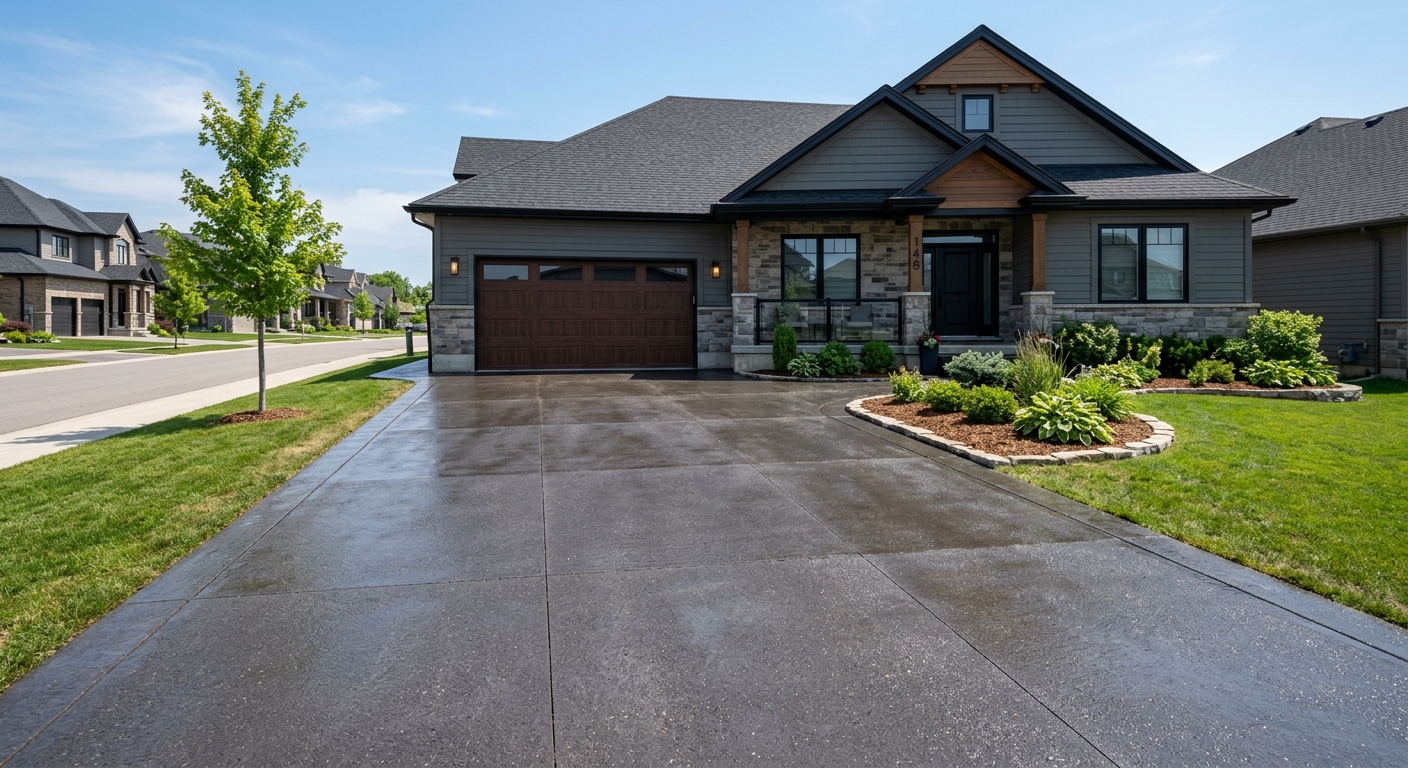
Concrete work options and costs in Westvale
Concrete work in Westvale is usually driven by the realities of Ontario freeze–thaw—especially how quickly winter wetness and spring melt can saturate soil under exterior slabs. With Westvale’s population of 6,730 (Statistics Canada, 2021 Census), the local market is relatively compact, so trades tend to be busier around the prime pour window. In this part of the Greater Toronto area, most concrete flatwork is installed for single-detached homes and typical suburban lots, where driveways, patios and walkways get heavy seasonal use.
Toronto-region concrete costs are shaped by frost depth and differential movement. Exterior pours must be built on well-compacted granular base and properly drained so saturated soil doesn’t expand and contract against the slab every winter. For structural work, footings are typically taken below the design frost depth—often at least 1.2 m below grade in Ontario—to reduce frost heave risk. That depth requirement directly affects excavation, formwork, and rebar tying, which is why foundation/footing pricing sits apart from flatwork.
Labour availability also matters: many exterior contractors concentrate work in warmer months to maintain proper curing. When temperatures drop toward 10 °C or below, more protection (insulating blankets, curing methods) may be needed, and that can push timelines and add cost. In Westvale, concrete work is especially in demand in neighbourhoods like Westvale Village, where homeowners commonly renovate driveways and add patio extensions for backyards and side entries.
Below are common options and realistic cost bands for Westvale. Use them to compare quotes before you request line-by-line pricing.
| Application |
Typical Size |
Key Spec |
Finish Option |
Price Range |
| Concrete driveway (standard broom finish) |
16 ft x 18 ft (288 sq ft) |
Air-entrained mix, proper base drainage |
Broom finish with control joints |
$18,000–$25,000 |
| Exposed aggregate driveway |
16 ft x 18 ft (288 sq ft) |
Air-entrained mix; correct curing for wash/retard |
Exposed aggregate with sealed finish |
$24,000–$32,500 |
| Stamped concrete driveway or patio |
10 ft x 20 ft (200 sq ft) |
Air-entrained mix; integral colour |
Stamped pattern + release agent + sealer |
$13,500–$20,000 |
| Plain concrete patio or walkway |
10 ft x 12 ft (120 sq ft) |
Air-entrained mix; compacted granular base |
Float + broom or light trowel finish |
$2,500–$4,000 |
| Garage floor (interior slab) |
20 ft x 22 ft (440 sq ft) |
Vapour barrier (if required), proper thickness |
Steel trowel finish or broom (depending on use) |
$7,000–$12,000 |
| Foundation footings (structural, below frost) |
Varies by home footprint |
Excavation below frost, rebar cage, formwork |
Typical concrete walls/footings (not decorative) |
$180,000–$300,000 |
Prices are estimates only and vary by project scope, site access and material selection.
What affects the price of concrete work in Westvale
In Westvale, homeowners often see quote differences of 30–50% for what sounds like the “same” concrete job because the hidden variables change the real workload: excavation quantity, base prep depth, reinforcement, mix design, and how the contractor manages curing in Ontario’s cold snaps. Even within the Toronto economic region, subsurface conditions and access constraints can swing costs quickly. Add decorative options—like stamped or exposed aggregate—and you introduce labour time, materials, and finishing complexity that’s not reflected in simple “per square foot” comparisons.
Most pricing hinges on frost depth and freeze–thaw cycles. Structural footings generally need to extend below the design frost depth (commonly at least 1.2 m in Ontario) to reduce frost heave and differential movement. For exterior slabs—driveways, patios and walkways—contractors typically specify air-entrained concrete mixes to help survive repeated freezing and thawing. When conditions drop toward 10 °C or below, proper curing becomes harder: cold-weather precautions (blankets, heated enclosures in some cases) and longer protection windows can raise labour costs. Finally, GTA winters and de-icing salt can accelerate surface spalling if the mix and sealing approach aren’t right, so many contractors factor in sealing as part of long-term durability.
Two practical Westvale examples: (1) If your driveway ties into an older lowered curb or has poor drainage, base regrading and sub-drain work can add several thousand dollars, even when the concrete size is unchanged. (2) If you’re comparing a plain patio in the $16–$26 band to a stamped option in the $24–$40 band, the difference is usually not just the stamping—it's the integral colour, additional steps, and more careful finishing to control surface texture and cracking.
Also, newer homes built on engineered fill may require less rework, while older lots with clay-like subgrade can need deeper granular replacement and more time to compact. Those depth and prep differences are where the dollars show up.
| Price Factor |
Why It Matters |
Cost Impact |
| Frost line depth |
Footings must sit below design frost to prevent heave and settlement. |
Higher excavation/form height increases labour and materials. |
| Site preparation |
Grading and compacted granular base control drainage and slab movement. |
More trucking and compaction time can add significant cost. |
| Reinforcement |
Rebar or mesh reduces cracking and controls slab movement. |
Extra steel, chairs, and labour for placement raise the total. |
| Mix design |
Air-entrainment and strength specs support freeze–thaw durability. |
Better mix requirements can increase material price and inspection time. |
| Finish type |
Broom is simpler; stamped/exposed aggregate add steps and curing discipline. |
Decorative work usually costs more per square foot (and takes longer). |
| Pour size and concrete truck access to site |
Access affects how fast the pour can be placed and levelled. |
Long carry distances or tight access may require additional crews/gear. |
| Cold-weather curing precautions |
Heating/blankets protect early-age concrete from damage and strength loss. |
Added coverings, monitoring, and time can increase the budget. |
| Control joint pattern and sealing cost |
Joints manage shrinkage cracking; sealing helps resist salt and water intrusion. |
Proper joint layout and sealer materials add line items, but reduce failures. |
Permits & regulations in Ontario
In Ontario, the rule of thumb is that structural concrete work needs municipal review, while standard flatwork often does not. Specifically, structural concrete—including footings, foundation walls, grade beams, and other foundation-related elements—requires a building permit, and engineered drawings are commonly reviewed by the municipality before construction. For concrete flatwork such as driveways, patios, walkways, and steps, a permit is usually not required unless the work affects lot grading, triggers impervious surface constraints, or impacts any municipal right-of-way or drainage approvals.
Before breaking ground in Westvale, verify your contractor covers the administrative and safety basics. Step-by-step, homeowners should: (1) confirm the company is licensed/authorized for their scope (and request their licence details if applicable), (2) ask for a current certificate of insurance showing liability coverage matching your project size, and (3) verify WSIB/WCB coverage (clearance letter or account confirmation, depending on the contractor’s situation). Don’t rely on verbal assurances—request documents in writing and keep copies for your records.
Also ask for references on similar-scale Ontario projects and ensure the contract states who obtains any required permits (if any) and who is responsible for inspections. This protects you when municipal requirements apply and prevents delays once forms and inspections are scheduled.
Getting concrete right in Westvale's freeze-thaw climate
Concrete failures in Westvale are usually traced back to one of five issues: poor base preparation, an inadequate mix (especially air-entrainment), missing or incorrectly spaced control joints, insufficient curing, or skipping sealing when de-icing salt is present. Ontario’s freeze–thaw cycles push moisture into concrete and the pores around it; if the concrete can’t tolerate that expansion and contraction, you’ll see surface scaling/spalling, random cracking, and premature deterioration.
To spec the job correctly, start with the base: excavate to the right depth for your local soil and frost considerations, then build a compacted granular sub-base with proper grading and drainage. Next, specify the mix: for exterior flatwork, air-entrainment is commonly targeted in the 5–7% range, and you’ll want a minimum 32 MPa compressive strength expectation from the supplier (with air and slump targets documented). Control joints should be planned from day one—spacing determines where cracks are allowed to occur rather than letting them wander. Curing is equally critical: plan for at least 7 days under suitable protection conditions, and protect against early-age damage if temperatures fall. Lastly, use a penetrating sealer applied after full cure—often 28 days post-pour for exterior work—so the surface resists salt and water intrusion.
When choosing options, the price premium should match the performance goal. For example, if a stamped driveway brings you from the standard broom band to the stamped band, you’re paying for integral colour, added finishing steps, and typically extra sealing discipline. That’s justified when you want appearance without sacrificing durability. However, if your base and drainage are weak, paying for stamping won’t stop freeze–thaw damage.
| Spec |
Why It Matters in Westvale |
What to Ask For |
Impact if Skipped |
| Compacted granular base (depth?) |
Proper base and drainage limit water saturation and slab movement during freeze–thaw. |
Ask for base thickness and compaction method (and whether subgrade soils are stabilized/replaced). |
More heaving, settlement cracks, and premature surface failure. |
| Air-entrained concrete mix (target air %?) |
Air bubbles provide space for ice expansion in freezing conditions. |
Request the supplier’s target air content (commonly 5–7% for exterior). |
Higher risk of spalling/scaling in Ontario winters. |
| Compressive strength (MPa rating) |
Strength supports long-term durability and resistance to wear. |
Confirm minimum 32 MPa and test/documentation expectations. |
Weaker concrete surface and faster deterioration under traffic and de-icing. |
| Control joints (spacing per ACI guidelines) |
Joints manage shrinkage cracking and freeze–thaw movement. |
Ask the contractor to lay out joint spacing and show the plan on site. |
Random cracking that can lift edges and trap water. |
| Minimum 7-day curing period |
Early-age curing affects strength gain and freeze resistance. |
Ask what curing method/protection will be used and how cold weather is handled. |
Reduced strength and increased cracking risk. |
| Penetrating sealer (when applied after cure) |
Sealer reduces water and salt penetration that drives spalling. |
Ask for sealer type and timing—commonly after 28 days cure for exterior. |
Higher chance of scaling and salt-related surface breakdown. |
How to choose a concrete work contractor in Westvale
Choosing the right concrete contractor in Westvale means verifying documentation, then verifying the scope. First, confirm Ontario licensing/authorization for the work being done (ask the contractor directly for their proof of qualification for the stated trade scope), then request a certificate of insurance showing liability coverage appropriate for your project. For employee coverage, ask for current WSIB/WCB clearance (or equivalent proof) before the first pour. If they won’t provide certificates or claim “we’re covered,” that’s a red flag.
Next, get 2–3 itemised written quotes instead of one lump-sum number. You want labour and materials separated: excavation, formwork, base/granular supply, rebar/wire mesh, concrete supply (including air-entrainment), finishing, joints, and sealing. Confirm what’s excluded: removal/disposal of old concrete, weekend work, permit handling (if required), and any regrading/drainage corrections. A reputable contractor will clearly note exclusions so you can compare quotes fairly.
Warranty matters in concrete because seasonal problems can show up later. Ask for the workmanship warranty length and whether any product/manufacturer warranty is included for the concrete mix and sealer. Also clarify if warranty coverage is transferable if you sell the home.
For payment, avoid paying big deposits. A common safe approach is no more than 10–15% upfront, then progress payments tied to milestones (base complete, steel placed, pour completed). Holdback until the job is fully finished and sealed (when included). Finally, get a start date and completion estimate in writing so you’re not stuck waiting during the short GTA pour season.
- Confirm licence/authorization for the exact scope (flatwork vs structural).
- Verify liability insurance with an active certificate.
- Provide WSIB/WCB clearance or documentation before work begins.
- Ask for 2–3 itemised quotes (labour + materials line items).
- Check scope inclusions: base thickness, compaction, and drainage provisions.
- Confirm concrete spec: air-entrained mix and minimum strength expectations.
- Require a joint layout plan (spacing and where joints will be installed).
- Ask how they protect curing in cool weather (blankets/heating if needed).
- Clarify finish specs: broom vs stamped vs exposed aggregate, and whether sealer is included.
- State disposal/removal of old concrete and site clean-up in writing.
- Confirm permit responsibility if anything affects grading or impervious limits.
- Use milestone-based payment; keep a holdback until final cure/cleanup/sealing.
In Westvale, 4–5 concrete contractor red flags to watch for: no written joint plan, vague mix wording (“standard concrete” without air/strength targets), skipping base compaction details, refusing to discuss curing methods for cold nights, and asking for large upfront payments without a clear milestone schedule.
Frequently asked questions — concrete work in Westvale
How long does concrete take to cure?
Concrete curing depends on temperature, wind, and whether cold-weather protection is used—very relevant in Westvale’s freeze–thaw season. In typical Ontario conditions, contractors plan for at least 7 days of curing before normal light use, but full strength gain continues beyond that. For exterior durability, most reputable crews protect the surface during early age curing to prevent surface damage and cracking. If temperatures fall toward 10 °C or below, expect added protection (insulating blankets/heating strategies) and a slower schedule so the concrete reaches the required strength before exposure cycles begin. For sealing, many contractors target an exterior sealer after full cure—commonly 28 days post-pour—because sealing too early can trap moisture and reduce performance.
Do I need a permit for concrete work in Ontario?
In Ontario, structural concrete work usually requires a permit. That means footings, foundation walls, and grade beams typically fall under municipal building-permit requirements, often with engineered drawings reviewed by the municipality. For concrete flatwork—driveways, patios, and walkways—a permit is often not required, but you must confirm if the work affects lot grading, impervious surface coverage limits, or the municipal right-of-way/drainage approvals. In Westvale, it’s worth checking before you break ground, especially if you’re lowering a driveway, changing drainage patterns, or connecting to existing foundation/yard drains. Always verify the contractor clarifies permit responsibility in the contract so delays don’t land on your shoulders.
Concrete vs pavers for a patio in Westvale?
Both can work well, but concrete is often the more cost-stable choice when you want a smooth, uniform surface and you’re budgeting within the typical patio band of $16–$26 per square foot (depending on finish and site complexity). Pavers can look great and are easier to replace individual stones, but they often require more detailed base construction and careful edging/drainage design to prevent shifting during Ontario’s freeze–thaw cycles. Concrete patios also benefit from predictable joint patterns and air-entrained mixes when they’re built correctly. If you expect heavy de-icing use, concrete with proper sealing after full cure tends to hold up well. If you want maximum flexibility in future repairs and you’re already planning a more involved base/edge system, pavers can be competitive—just compare fully itemised quotes, not just per-unit pricing.
How long does a concrete driveway last?
A well-built concrete driveway in Ontario often lasts 20–30 years or more, but that lifespan depends heavily on base prep, air-entrainment, proper joints, curing discipline, and sealing. In Westvale’s climate, the driveway is exposed to repeated freeze–thaw and winter salt, so durability is not just about thickness—it’s about moisture control beneath the slab and a mix designed to handle freezing. If the contractor uses a standard broom-finish driveway within the typical driveway band of $18–$28, the real question in your quote is whether the base is properly compacted and drained and whether control joints are planned (not improvised). When those elements are done right, you can minimize spalling, scaling, and random cracking.
What is air-entrained concrete and why does it matter here?
Air-entrained concrete includes tiny, evenly distributed air bubbles that give freezing water room to expand without breaking apart the paste. In Westvale and across the Toronto area, freeze–thaw cycles and seasonal saturation make this essential for exterior slabs like driveways, walkways, and patios. If the mix isn’t air-entrained (or if air content is outside the target range), you’re more likely to see spalling and scaling—especially when de-icing salts are used on the surface. That’s why strong quotes specify an air-entrained mix rather than leaving it to “standard concrete.” For homeowners, you can ask the supplier or contractor to confirm the target air content (commonly 5–7% for exterior flatwork) and the minimum compressive strength expectation.
How do I prepare the base for a concrete slab?
Base preparation is the foundation of a durable slab, and it’s where Westvale projects commonly succeed or fail. A correct base process starts with excavation to the required depth, removal of soft/unstable soils, and grading to direct water away. Then the contractor places a compacted granular sub-base in lifts, using the right compaction equipment so the material can handle Ontario winter expansion and contraction. The goal is to prevent saturated soils from pumping under the slab and to reduce settlement. The contractor should also discuss drainage and whether additional base replacement is required based on your soil. For quotes, ask for the granular base thickness and compaction method—not just the concrete price—because base work can be the largest contributor to differences between budgets.