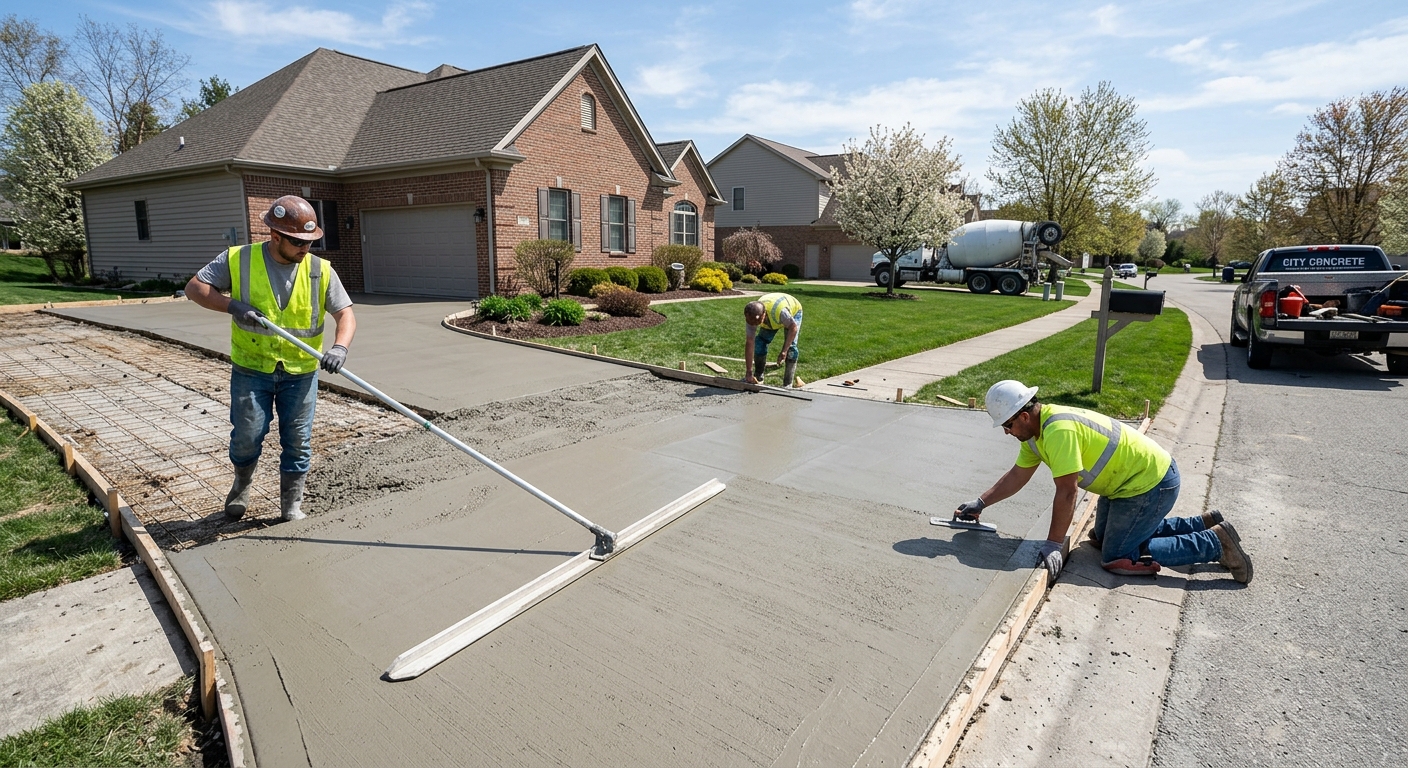
Concrete work options and costs in Orillia
Orillia is a busy lake-and-lifestyle town in Simcoe County, and concrete flatwork is one of the most common home improvements you’ll see—from driveways to patios in older neighbourhoods. With 55.7% of local dwellings being single-detached homes (Statistics Canada, 2021 Census), the demand for driveways, walkways and backyard patios is steady year-round. The housing base is also established: 58.0% of homes were built before 1981 (Statistics Canada, 2021 Census), which often means lots with mature grading, older sub-bases, and more tie-in work around existing sidewalks, steps, and garage approaches.
In the Kitchener–Waterloo–Barrie market, costs are shaped by a cold, high freeze-thaw climate. Frost depth commonly reaches about 1.0–1.2 m (3–4 ft), so structural concrete specs need footings set below frost to reduce heave and long-term cracking. That same freeze-thaw pattern also stresses exterior slabs, so driveways and patios typically use air-entrained concrete and proper drainage, plus a smart control joint layout. Labour and equipment costs can run higher because excavation takes longer and the effective pour season can be shorter in cold snaps—contractors often plan for curing blankets, membrane curing, and protection from early de-icing salt.
You’ll notice this trade is especially active around East Orillia and near areas with lots of older grading and frequent driveway replacements. If you’re comparing options, the quickest way to sanity-check quotes is to look at typical sizes and the key finish/spec differences in the table below.
| Application |
Typical Size |
Key Spec |
Finish Option |
Price Range |
| Concrete driveway (standard broom finish) |
400–600 sq. ft. |
Air-entrained mix, compacted granular base |
Broom finish + control joints |
$6,000–$12,000 |
| Exposed aggregate driveway |
400–600 sq. ft. |
Air-entrained mix + proper wash timing |
Exposed stone aggregate + sealer |
$9,000–$16,000 |
| Stamped concrete driveway or patio |
300–500 sq. ft. |
Air-entrained mix, color hardener |
Stamped patterns (field size dependent) |
$7,500–$18,000 |
| Plain concrete patio or walkway |
180–350 sq. ft. |
Air-entrained mix + drainage grade |
Float/screed + light broom |
$2,500–$6,500 |
| Garage floor (interior slab) |
300–600 sq. ft. |
Vapour barrier (as required), air mix as specified |
Power trowel or broom finish |
$4,500–$12,000 |
| Foundation footings (structural, below frost) |
Per linear foot concept |
Designed by engineer; below frost depth |
Structural concrete + forms |
$120–$220 |
Prices are estimates only and vary by project scope, site access and material selection.
What affects the price of concrete work in Orillia
In Orillia and across the wider Kitchener–Waterloo–Barrie region, it’s common to see quotes for the “same” concrete job swing by 30–50%. The difference usually isn’t the concrete alone—it’s excavation depth, base build-up, reinforcement decisions, curing protection, and how much detail the contractor includes for drainage and crack control. Ontario projects also tend to carry more documentation and oversight when structural work is involved, and that labour time shows up in the final number.
Start with frost and freeze-thaw. Frost depth commonly reaches around 1.0–1.2 m (3–4 ft) in the cold, high freeze-thaw climate, so exterior structural concrete specs require footings set below the design frost depth to limit frost heave and cracking. Exterior slabs also typically need air-entrained concrete to survive repeated freezing and thawing. Then there’s the shorter effective pour season: cold weather curing precautions (heating, insulating blankets, and longer protection windows) can add cost—especially for driveways and patios that must meet strength before heavy traffic. De-icing salt can accelerate surface spalling, so sealing timing and product selection matter to long-term performance.
In practical Orillia terms, costs rise when your lot has mature trees, poor access, or older fill that needs removal and re-compaction. Foundation work can also climb quickly if trenching needs shoring, or if water needs pumping. On the other hand, simple re-pours or straight runs with easy truck access can stay closer to the lower end of typical bands—plain patios and walkways often land nearer $14–$22 per sq. ft., while decorative options like stamped concrete commonly move toward the higher end when rebar, extra labour, and colour materials are bundled together. For older homes (58.0% built before 1981), expect more grading tie-in and demolition/haul-away work to bring everything back to grade and drainage.
| Price Factor |
Why It Matters |
Cost Impact |
| Frost line depth — determines footing depth and form height |
Deeper footings increase excavation, forms, and concrete volume |
Higher material and labour time; can move structural scopes significantly |
| Site preparation — excavation, grading, compacted granular base |
Proper sub-base thickness and compaction prevent settlement and random cracking |
Often a top driver; poor soil can add haul-away and re-fill |
| Reinforcement — rebar or wire mesh requirement |
Reinforcement helps control cracking and supports loads |
Costs rise with steel tonnage and tying/layout labour |
| Mix design — air-entrainment and compressive strength spec |
Air-entrainment improves freeze-thaw durability; strength spec affects mix/cost |
Exterior durability upgrades increase material cost but reduce failures |
| Finish type — broom vs. stamped vs. exposed aggregate |
Decorative finishes require extra steps, timing, and finishing labour |
Stamped/exposed typically cost more than plain broom |
| Pour size and concrete truck access to site |
Smaller pours or restricted access increase staging time and labour |
Can add crew hours and reduce scheduling efficiency |
| Cold-weather curing precautions — heating and blankets |
Protection supports strength gain before winter stresses the slab |
More labour/equipment days in late fall and early spring |
| Control joint pattern and sealing cost |
Joints manage movement; sealing helps repel salt/surface moisture |
Proper jointing and sealing are a “small step” with major payback |
Permits & regulations in Ontario
In Ontario, most structural concrete work requires a building permit and often engineered drawings reviewed by the municipality. That means anything tied to the stability of the home, such as footings, foundation walls, and grade beams typically falls under the permitting umbrella. If your project affects load paths, foundation elevations, or the structural system, you should assume a permit is required until the contractor confirms otherwise.
Concrete flatwork—like driveways, patios, and walkways—usually does not require a permit by default. However, permits can become necessary if the work changes grading, alters stormwater drainage, increases impervious surface past local limitations, or affects municipal right-of-way areas (for example, work near a curb/sidewalk interface). Always confirm with the City of Orillia or the local permitting office before excavation begins.
Homeowners should also verify the contractor is properly insured and compliant. Step-by-step: (1) request their certificate of insurance naming you as the certificate holder where applicable, (2) confirm WSIB/WCB coverage for their workers, and (3) verify licensing/registration where applicable for the trade activities. In practice, you’ll often find insurance details directly on their COI, and WSIB/clearance can be checked through the official Ontario worker protection clearance process. Ask for references on similar-scale Orillia projects so you know they’ve handled local excavation, drainage, and freeze-thaw curing expectations.
Getting concrete right in Orillia's freeze-thaw climate
Concrete failure in Orillia winters typically comes down to one thing: water + freeze-thaw finding a weak link. In a cold, high freeze-thaw environment where frost depth can reach roughly 1.0–1.2 m (3–4 ft), your job must be designed to keep water away from the slab and to control movement so cracking doesn’t become a pathway for moisture. The key specs start with base preparation: install a compacted granular sub-base at the right depth for your soil and frost conditions, with proper drainage grade. If the base is underbuilt or poorly compacted, you can get settlement and random cracking even with good finishing.
Next is mix design. For exterior flatwork, use air-entrained concrete (often targeting about 5–7% air content) and a minimum of 32 MPa compressive strength unless your engineer specifies otherwise. Air entrainment is what helps reduce spalling by giving microscopic space for freezing water to expand. Then use control joints at an appropriate spacing to limit random cracking—joints are planned weak points.
Curing is the schedule-critical step. Aim for minimum 7 days of proper curing conditions, and in colder periods, protection may be needed (insulating blankets and careful temperature management) so the slab can reach adequate strength before winter stress. Finally, apply a penetrating sealer after the concrete has cured (commonly after 28 days) to help repel de-icing salts and surface moisture.
To see where costs are justified: a plain broom-finished patio might price lower (often in the $14–$22 per sq. ft. band), but spending on correct base depth, proper air-entrainment, and joint layout is what protects it through Orillia’s winters. Skipping these steps can lead to early surface scaling and repairs that cost more over time.
| Spec |
Why It Matters in Orillia |
What to Ask For |
Impact if Skipped |
| Compacted granular base (depth?) |
Prevents settlement and keeps water from migrating into the slab |
Granular sub-base thickness and compaction method based on site/soil |
Uneven settling, cracking, and shortened service life |
| Air-entrained concrete mix (target air %?) |
Improves freeze-thaw durability in Orillia’s winter cycles |
Confirm air-entrainment targeting about 5–7% for exterior flatwork |
Higher risk of spalling (surface pop-outs and scaling) |
| Compressive strength (MPa rating) |
Strength gain supports load performance and reduces surface damage |
Minimum 32 MPa stated in the mix requirements |
Greater wear, scaling, and early failure under traffic/salt |
| Control joints (spacing per ACI guidelines) |
Controls where cracks happen during drying and temperature change |
Planned joint layout and approximate spacing consistent with industry guidance |
Random cracking and moisture intrusion into cracks |
| Minimum 7-day curing period |
Allows proper strength development before freeze-thaw stress |
Curing plan (membrane/blankets) and timeline for temperature protection |
Lower strength and higher chance of surface defects |
| Penetrating sealer (when applied after cure) |
Reduces salt/water penetration that drives spalling |
Sealer applied after adequate cure (often 28 days post-pour) |
Faster deterioration in winter maintenance cycles |
How to choose a concrete work contractor in Orillia
Choosing the right contractor in Orillia comes down to verifying the boring stuff—then making sure their scope matches your climate reality. First, confirm Ontario compliance and coverage: request their certificate of insurance (liability) so you know you’re protected if there’s property damage, and verify their WSIB/WCB coverage for worker protection. Next, ask for references from similar jobs—driveways, patios, and basement/footing work—especially projects in areas with older housing stock and more challenging drainage tie-ins.
Then, insist on 2–3 itemised written quotes. A good quote breaks down labour and materials, not just a lump sum, and it clearly lists removals/demolition, excavation depth, base compaction, reinforcement (if included), mix spec (including air-entrainment for exterior work), finish method, curing protection, and sealing. Watch the exclusions: is disposal/haul-away included, is permit work included if required, and what happens if unanticipated poor soil is found?
Review warranty terms: you want a workmanship warranty length and clarity on manufacturer/product warranties (and whether they’re transferable if you sell). Payment should be controlled—never pay more than about 10–15% upfront; hold back the remainder until the job is complete and cleaned up. Finally, ask for a start date and a completion estimate in writing—winter scheduling and curing protection are critical here, and a contractor should plan for temperature and protection rather than “hope for the best.”
- Ask for a written scope that includes excavation depth, base thickness, and compaction requirements.
- Confirm the concrete mix is air-entrained for exterior slabs in Orillia’s freeze-thaw climate.
- Get the reinforcement plan in writing (mesh vs. rebar, tied/capped, spacing).
- Request the control joint layout and timing (saw-cut or formed, with a planned pattern).
- Verify curing protection details for any late fall/early spring pours.
- Ask if penetrating sealer is included and when it’s applied after curing.
- Confirm disposal/haul-away is included for demo and excavated material.
- Check whether truck access, staging, and sidewalk/landscaping protection are included.
- Ensure permit pull responsibilities are clear (who applies, who pays, who coordinates inspections).
- Request warranty duration and what defects are covered (cracking, scaling, spalling).
- Confirm product/manufacturer warranty terms and whether they transfer to a new owner.
- Use milestone-based payments: small deposit, holdback until final acceptance.
Concrete contractor red flags in Orillia: they won’t specify air-entrained mix requirements; they dismiss freeze-thaw curing protection when pours occur near cold weather; they provide only a lump-sum quote with no breakdown for base prep and joints; they ask for most of the money upfront; or they can’t show proof of liability coverage and WSIB/WCB clearance.
Frequently asked questions — concrete work in Orillia
How do I compare concrete quotes?
In Orillia, you’ll get the fairest comparison by lining up scope details, not just total price. Ask each contractor to itemise labour and materials for removal/demolition, excavation depth, granular base compaction, reinforcement (mesh/rebar), air-entrained mix for exterior work, finishing method (broom vs stamped/exposed), curing protection, control joint layout, and whether penetrating sealer is included. If you’re looking at a driveway, compare against realistic per-area allowances: standard broom-finished driveway work often reflects the lower range in the regional market (commonly around the $15–$25 per sq. ft. band), while stamped upgrades can move higher because of colour hardener, formwork for borders, and finishing labour. Also verify whether disposal/haul-away and truck access logistics are included—those can easily swing pricing.
Can concrete be poured in cold weather in Orillia?
Yes, concrete can often be poured in cold weather in Ontario when contractors use cold-weather procedures—but it must be done correctly for strength gain. In Orillia’s freeze-thaw climate, the risk isn’t just “cold concrete,” it’s curing conditions that prevent the mix from reaching adequate strength before winter stress. A competent contractor should use temperature monitoring, insulated curing blankets or membranes, and (when appropriate) controlled heating to maintain curing conditions. They should also specify protection time and avoid early de-icing salt or heavy loads until strength requirements are met. If someone tells you they can pour “any day, any time” with no protection plan, that’s a warning sign—especially for exterior slabs that must endure repeated freezing cycles.
How do I maintain concrete in Orillia's freeze-thaw climate?
Maintenance is mostly about controlling water and minimizing salt exposure. Start with drainage: keep downspouts directed away from the slab edges and avoid letting soil or mulch contact the concrete surface. For winter, use de-icing products carefully—salt can accelerate spalling if the concrete surface isn’t adequately protected. That’s why many homeowners in Orillia opt for a penetrating sealer applied after proper curing (often after about 28 days). Reseal schedules vary by exposure, but if your driveway sees frequent winter maintenance, reapplication earlier than “every five years” can be worthwhile. Also inspect seasonally for small cracks: address sealant in control joints early so water doesn’t migrate beneath the surface and undermine the slab over time.
What causes concrete to spall in Orillia winters?
Spalling is commonly caused by water getting into the concrete and then freezing and expanding at the surface. In Orillia’s cold freeze-thaw cycles, this is especially likely when exterior concrete isn’t air-entrained to the proper spec. Without adequate air-void structure, freezing pressure builds up and the surface breaks down into pop-outs or scaling. Another contributor is insufficient curing or poor finishing that traps weak surface paste. De-icing salts can intensify the damage by increasing moisture movement near the surface during winter. The best prevention is a properly air-entrained exterior mix, correct base drainage, control joints to manage cracking, and penetrating sealing after cure—together, these break the water/freezing cycle that drives spalling.
What is rebar and when is it required in Ontario?
Rebar (reinforcing steel) is used to add tensile capacity and control cracking by holding the slab together under movement and loading. In Ontario, whether rebar is required depends on the design loads and the scope: engineered structural elements like certain foundation components typically involve reinforcement per drawings/specs. For exterior flatwork, some projects use wire mesh or rebar depending on thickness, sub-base quality, and whether the slab carries vehicular loads. In Orillia, because freeze-thaw can worsen movement and cracking, properly designed reinforcement (or appropriately specified alternatives like mesh) is often part of driveway and garage slab specs, especially where the base is challenging or thickness is reduced. Ask your contractor to state what reinforcement will be installed, how it will be supported (chairs/spacers), and whether it matches the intended load and local soil conditions.
How long does a concrete project take in Orillia?
Timelines depend on removal, weather, and curing requirements. For a typical exterior flatwork job, the “placement day” is often only one or two days, but the overall timeline includes excavation, base prep, forming, reinforcement installation, finishing, and curing protection. Curing time matters: you should expect at least a 7-day period before normal heavy use, and sealing is often scheduled after full cure (commonly around 28 days) so the sealer can bond correctly and repel moisture/salt. If you’re comparing driveway options in Orillia, standard broom-finished work may move faster than stamped concrete because stamped jobs require extra steps and timing, and the total schedule may extend to accommodate finishing complexity and cure/protection windows. If pours are near cold weather, allow extra days for blankets/heating and strength verification.