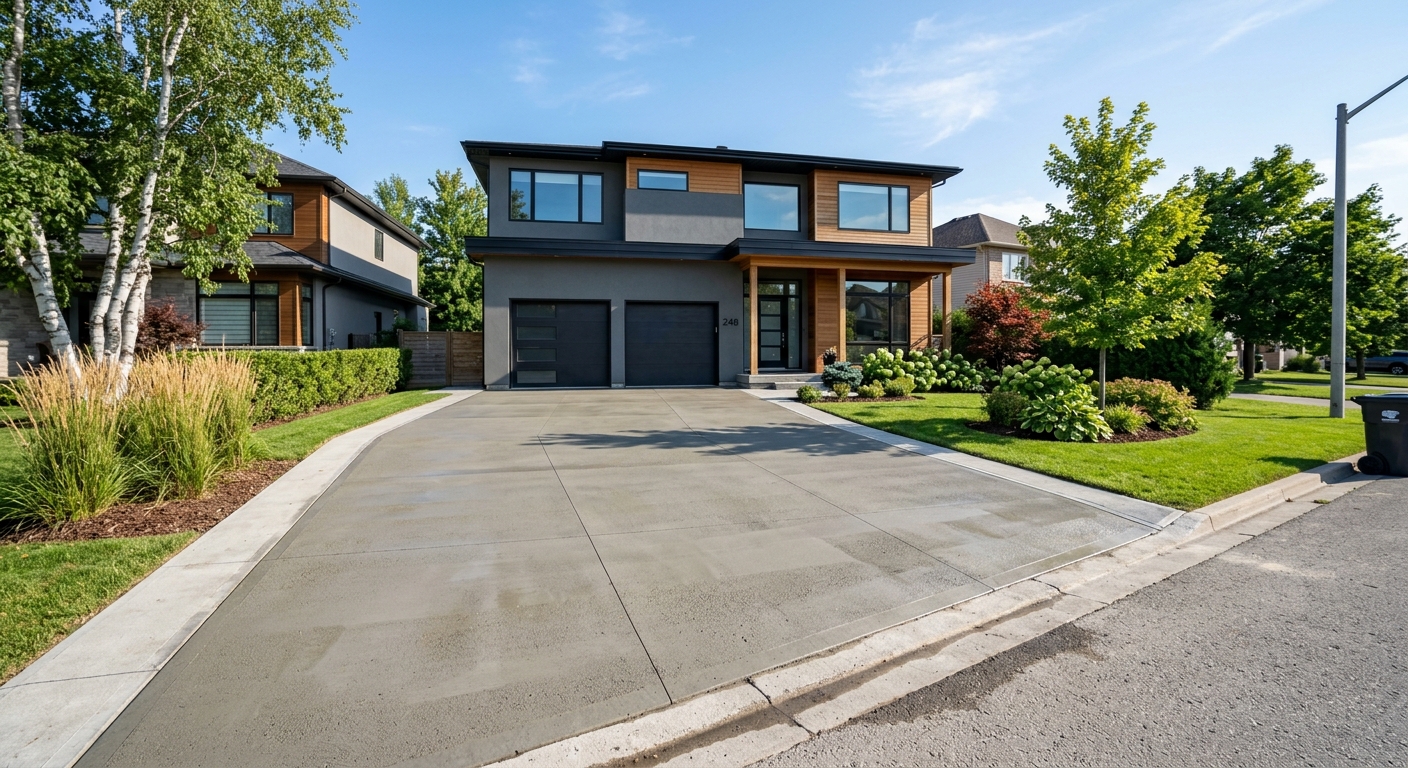
Concrete work options and costs in Virgil
In Virgil, concrete work is a year-round conversation, but the best results depend on when you pour and how the crew manages Toronto-area freeze–thaw. Virgil has a small, stable population (2,937 residents per the Statistics Canada, 2021 Census), yet the housing market around the GTA still drives steady demand for practical exterior surfaces. Most driveways, walkways, and patios are tied to long-term homes that need durable exterior flatwork—especially in areas where families update front approaches or backyards to match an active lifestyle. In communities such as the Virgil/Thorold corridor, contractors are especially busy with driveway replacements and patio upgrades because access off major roads can be straightforward while excavation and drainage still need careful planning.
Pricing in the Toronto economic region tends to run higher than many rural areas because concrete specs have to fight frost depth, saturation, and winter salt exposure. Local crews commonly design exterior slabs with air-entrained mixes, adequate thickness, and control joints to limit random cracking through repeated freeze–thaw cycles. They also schedule pours in warmer months to keep curing consistent; once temperatures slide toward 10 °C or below, protective measures like insulating blankets and slower turnaround can add labour and material costs. For homeowners comparing bids, the differences usually come from site prep, reinforcement decisions, and finish selection—not just the number of cubic metres poured.
Use the table below to compare typical options you’ll see in Virgil, then align the scope and specs so apples-to-apples quotes actually match.
| Application |
Typical Size |
Key Spec |
Finish Option |
Price Range |
| Concrete driveway (standard broom finish) |
300 sq. ft. |
Air-entrained exterior mix, compacted granular base |
Broom finish |
$18,000–$28,000 |
| Exposed aggregate driveway |
300 sq. ft. |
Air-entrained mix, proper curing before washing |
Exposed aggregate (washed) |
$22,000–$34,000 |
| Stamped concrete driveway or patio |
300 sq. ft. (drive/patio) |
Air-entrained mix, thicker slab for durability |
Stamp + colour hardener |
$24,000–$40,000 |
| Plain concrete patio or walkway |
200 sq. ft. |
Air-entrained mix, drainage and edge detailing |
Smooth or broom |
$3,200–$5,200 |
| Garage floor (interior slab) |
400 sq. ft. |
4 in. typical thickness, fibre or mesh as required |
Broom finish (common) |
$7,000–$12,000 |
| Foundation footings (structural, below frost) |
Per linear foot equivalent |
Engineered footing depth below frost, rebar and forms |
Structural concrete (no decorative finish) |
$180–$300 |
Prices are estimates only and vary by project scope, site access and material selection.
What affects the price of concrete work in Virgil
In the Toronto economic region, you can see the same general “driveway replacement” scope priced 30–50% differently between bidders, even when the final concrete volume looks similar. The biggest drivers are the specs that protect the slab during harsh winters: footing and formwork height (set by frost depth), base preparation quality, reinforcement choices, and the mix design. On top of that, labour availability in the GTA is tighter during the short reliable pour season, and crews often add cold-weather protections when temperatures drop toward 10 °C.
Frost depth and freeze–thaw cycles dictate nearly every exterior spec. Structural footings generally need to extend at least 1.2 m (about 4 ft) below grade in Ontario to reduce frost heave and differential movement. Exterior slabs are typically built with air-entrained concrete to survive repeated freeze–thaw, and they require well-compacted granular base plus drainage so saturated soils can’t expand and contract against the concrete every winter. When crews can’t rely on warm-day curing, costs rise for insulating blankets, heating, and longer scheduling. De-icing salts also accelerate surface wear and spalling, which is why sealing and good curing matter—especially on driveways and steps where salt use is frequent.
In Virgil, cost can move up or down based on the site. For example, a driveway with poor drainage or soft subgrade often needs deeper excavation and more granular base (raising the job), while a simple, level access route with firm soil can keep costs closer to the lower band of $18–$28 per sq. ft.-type driveway pricing. A stamped option can be worth the premium—often aligned with $24–$40 decorative concrete pricing—when you’re also improving thickness, joints, and edges for long-term performance, rather than just “adding pattern.”
| Price Factor |
Why It Matters |
Cost Impact |
| Frost line depth |
Determines footing depth and form height |
Higher footing depth increases excavation, rebar and forms |
| Site preparation |
Excavation, grading, compacted granular base |
Soft subgrade and drainage work add labour and material |
| Reinforcement |
Rebar or wire mesh requirement |
Correct reinforcement can prevent early cracking (cost up, failure risk down) |
| Mix design |
Air-entrainment and compressive strength spec |
Air content and higher specs can cost more but improve freeze–thaw durability |
| Finish type |
Broom vs. stamped vs. exposed aggregate |
Decorative finishes add materials and labour steps (form-release, stamps, wash) |
| Pour size and concrete truck access to site |
Limits pour method and equipment needs |
Long carries, access constraints, or multiple pours raise labour |
| Cold-weather curing precautions |
Heating and blankets |
Protective measures and scheduling can add significant cost in late-season pours |
| Control joint pattern and sealing cost |
Manages cracking and reduces salt damage |
Better jointing and sealing add line items but extend service life |
Permits & regulations in Ontario
In Ontario, structural concrete work generally needs a building permit, particularly when it affects the structural system. That typically includes footings, foundation walls, and grade beams, and it’s often supported by engineered drawings that the municipality reviews as part of the permitting process. For concrete flatwork—patios, walkways, and driveways—a permit is usually not required as long as the work doesn’t materially change lot grading, drainage patterns, or increase impermeable surface coverage beyond municipal expectations. It still needs to be coordinated: if you’re changing the driveway profile, altering slopes toward drainage inlets, or affecting right-of-way edges, the local authority may require approvals.
To confirm before you break ground in Virgil, use a simple checklist. First, ask the contractor to provide proof of liability insurance and WSIB/WCB coverage. Next, verify the contractor’s licensing information through the appropriate Ontario registry channel (your contractor’s documentation should reference the correct registration type). Then, request a clearance letter or equivalent proof of good standing, if applicable. If the scope includes any foundation work, also ask whether they are pulling the permit themselves and whether engineering drawings are included. Finally, check references: insist on past jobs with similar footing depth, reinforcement detailing, and exterior conditions so you can see how they handle freeze–thaw performance.
Getting concrete right in Virgil's freeze-thaw climate
In Virgil and the broader Toronto area, concrete most commonly fails due to water movement, freeze–thaw expansion, and salt exposure—not because the mix “didn’t set.” The slab must be built like a system. Start with base preparation: a properly excavated and compacted granular sub-base set to the right depth for local soil and frost protection reduces settlement and prevents saturated soils from pressing against the concrete. Next, lock in the mix design: for exterior flatwork, crews typically specify air-entrained concrete with an air content around 5–7% and a minimum 32 MPa compressive strength target so the paste survives repeated freezing. Then plan control joints with spacing that limits random cracking paths through the winter cycle. Curing matters too—plan for at least 7 days curing under proper conditions, and in cooler weather, protective measures are often needed to keep strength development on track. Finally, use a penetrating sealer applied around 28 days post-pour to help repel de-icing salts and reduce surface deterioration.
If you’re comparing options, the price difference is justified when the lower quote cuts corners on base depth, air content, or joint/sealer planning. For instance, a decorative stamped driveway may land in the $24–$40 range, but it’s only “worth it” when it also includes the correct air-entrained mix, slab thickness, and a proper joint layout—otherwise you’re paying more for a finish that can still spall early. Ask your contractor the questions below and insist the spec matches the climate reality.
| Spec |
Why It Matters in Virgil |
What to Ask For |
Impact if Skipped |
| Compacted granular base (depth?) |
Prevents saturation and limits movement during freeze–thaw |
Exact base depth and compaction method |
Settlement and early cracking |
| Air-entrained concrete mix (target air %?) |
Improves freeze–thaw durability for exterior exposure |
Air content target (typically 5–7%) on the ticket |
Spalling risk increases significantly |
| Compressive strength (MPa rating) |
Ensures adequate strength gain for exterior service |
Minimum 32 MPa (or higher as specified) |
Surface wear and premature failure |
| Control joints (spacing per ACI guidelines) |
Controls where cracks occur during seasonal movement |
Planned joint layout and sawcut timing |
Random cracking across visible areas |
| Minimum 7-day curing period |
Strength development stabilizes the slab before winter stresses |
Curing plan, protection in cooler conditions |
Weaker concrete and higher freeze–thaw damage |
| Penetrating sealer (when applied after cure) |
Repels salt water and slows surface deterioration |
Sealer type and application timing (around 28 days) |
Faster spalling and staining from de-icers |
How to choose a concrete work contractor in Virgil
Choosing the right contractor in Virgil is about verifying coverage, matching specs, and keeping your payment schedule controlled. Start with proof of Ontario licensing/registration where applicable to the scope, then ask for a certificate of liability insurance naming you as the client (or showing adequate coverage). Confirm WSIB/WCB clearance so you’re not exposed if a worker is injured on your property. A reputable crew won’t hesitate to share these documents before you sign—especially for exterior work that involves excavation and truck traffic.
Next, get 2–3 itemised written quotes that break out labour and materials. You’re looking for details like excavation depth, granular base depth, reinforcement type, air-entrainment confirmation, control joint layout, curing method, and whether sealing is included (and when). Avoid “lump sum only” estimates that don’t say what’s excluded: disposal of old concrete, dust control, sawcutting, forms, edge restraints, and permit pulling (if needed). For warranty, ask about both workmanship warranty length and any product/manufacturer warranty tied to sealer or concrete admixtures. Clarify whether the warranty is transferable to future owners.
Finally, protect your cash flow. Don’t pay more than 10–15% upfront. Use a holdback until completion and final cleanup. Get a written start date window and completion estimate so you can plan around the Toronto-season curing reality.
- Request proof of liability insurance before measurements are finalized.
- Confirm WSIB/WCB clearance (ask for a current confirmation letter).
- Match quotes line-by-line: base depth, reinforcement, and mix specs—not just total price.
- Ask whether the contractor confirms air-entrainment on the concrete delivery ticket.
- Verify control joint spacing and who performs sawcut timing.
- Confirm disposal included for old concrete and topsoil stockpiling/cleanup.
- Ask if sealing is included and whether it’s applied after cure (around 28 days).
- Ensure cold-weather protection is described if pours happen late-season.
- Review their payment schedule—limit upfront and require holdback.
- Get start date and pour/completion timeline in writing.
- Ask for photos/references of similar Virgil-area exterior projects.
- Confirm warranty terms are written and not “verbal only.”
Concrete red flags in Virgil include contractors who: (1) won’t show WSIB/WCB clearance or insurance paperwork, (2) quote a decorative job without explaining joint layout and sealing timing, (3) discuss freeze–thaw but can’t state their air-entrainment target or curing plan, (4) use a “cheap mix” discussion instead of delivering spec on the ticket, and (5) ask for large upfront payments before forms and base work are underway.
Frequently asked questions — concrete work in Virgil
When is the best time to pour concrete in Virgil?
The best time to pour concrete in Virgil is during the warmer part of the year when crews can maintain proper curing conditions. In the Toronto economic region, many exterior pours are concentrated in late spring through early fall to reduce cold-weather curing problems as temperatures trend toward about 10 °C or below. That timing matters because freeze–thaw durability depends on how well the slab gains strength during the first days and weeks. If you’re planning a driveway or patio, schedule around stable forecasts and ask your contractor what cold-weather protection they use (blankets, heating, insulation) if the pour date slips. Interior slabs (like garage floors) still benefit from warmer conditions, but the tolerance is generally a bit better than exterior flatwork. In short, plan early, and require a written curing plan.
How long does concrete take to cure?
Concrete “set” happens within hours, but true curing and strength development take longer. For exterior flatwork in Ontario, a minimum curing period of about 7 days under proper conditions is a common baseline for strength gain before the slab is exposed to more stress. Full performance—including durability for freeze–thaw—is typically tied to longer curing (often referenced to 28 days for many applications) and correct maintenance like sealing. For example, if you’re applying a penetrating sealer to protect from de-icing salts, plan for it around 28 days post-pour, after the concrete is fully cured enough to accept the treatment. If a contractor tries to rush traffic, sealing, or finishing because “it looks dry,” that’s a red flag in Virgil’s winter cycle.
Do I need a permit for concrete work in Ontario?
In Ontario, structural concrete work like footings, foundation walls, and grade beams generally requires a building permit and often engineered drawings that are reviewed through the municipality. For concrete flatwork such as driveways, patios, and walkways, permits are usually not required when the work doesn’t change lot grading, drainage patterns, or impermeable surface expectations. However, it’s still smart to confirm with the local authority before digging, especially if you’re altering elevations, slopes, or drainage toward municipal inlets or right-of-way edges. In Virgil, ask your contractor directly whether they’ll pull permits for any foundation-related scope and whether they’ll handle required documentation. Also verify the contractor’s liability insurance and WSIB/WCB coverage before work starts—permit or not, you want the risk properly covered.
Concrete vs pavers for a patio in Virgil?
Concrete and pavers can both work well in Virgil, but they fail differently under freeze–thaw. A concrete patio typically relies on correct base preparation, air-entrained mix, and control joints to manage cracking—so if your contractor is spec’ing a frost-protected base and includes sealing, it can be very durable. Pavers are flexible and can move slightly, but they still need excellent sub-base compaction and edge restraint; if base drainage is off, you can get settlement lines and weed growth. Cost-wise, stamped concrete often sits in the $24–$40 range for decorative driveways/patios, while simpler concrete flatwork often aligns more with the $16–$26 band. Pavers can come out higher on labour and detailing, but they may offer easier localized repairs if one section shifts.
How long does a concrete driveway last?
A properly built concrete driveway in the Toronto area can last many years, but lifespan depends on freeze–thaw management, base preparation, and the way the slab is protected from salt and water. The biggest early-life risks are poor drainage (water trapped under or against the slab), insufficient air-entrainment, and inadequate curing. Control joints help limit random cracking, and sealing can help repel de-icing salt after curing (often around 28 days). If you’re comparing bids, don’t just look at price—make sure the contractor is designing for exterior durability. For reference, driveway pricing in this region typically falls around $18–$28 for standard broom-finish work, and higher for decorative finishes. If someone offers a “low price” but can’t explain base depth, air-entrainment, joints, and sealing, you’re more likely to see surface scaling or spalling earlier.
What is air-entrained concrete and why does it matter here?
Air-entrained concrete is mixed with microscopic air bubbles that give water a place to expand when temperatures drop below freezing. That dramatically improves performance during freeze–thaw cycles—exactly what Ontario experiences each winter. For exterior flatwork in Virgil, air-entrainment is one of the key specs that helps prevent scaling and spalling. When concrete lacks the correct air content, water in the paste can expand repeatedly, damaging the surface over time, especially where de-icing salts are used. When you request a quote, ask the contractor to specify the air-entrainment and confirm the target air content (commonly about 5–7% for exterior flatwork) on the delivery ticket, not just in a general description. This is also one reason bids can vary: a proper mix design costs a bit more, but it’s what keeps the finish serviceable through Toronto-area winters.