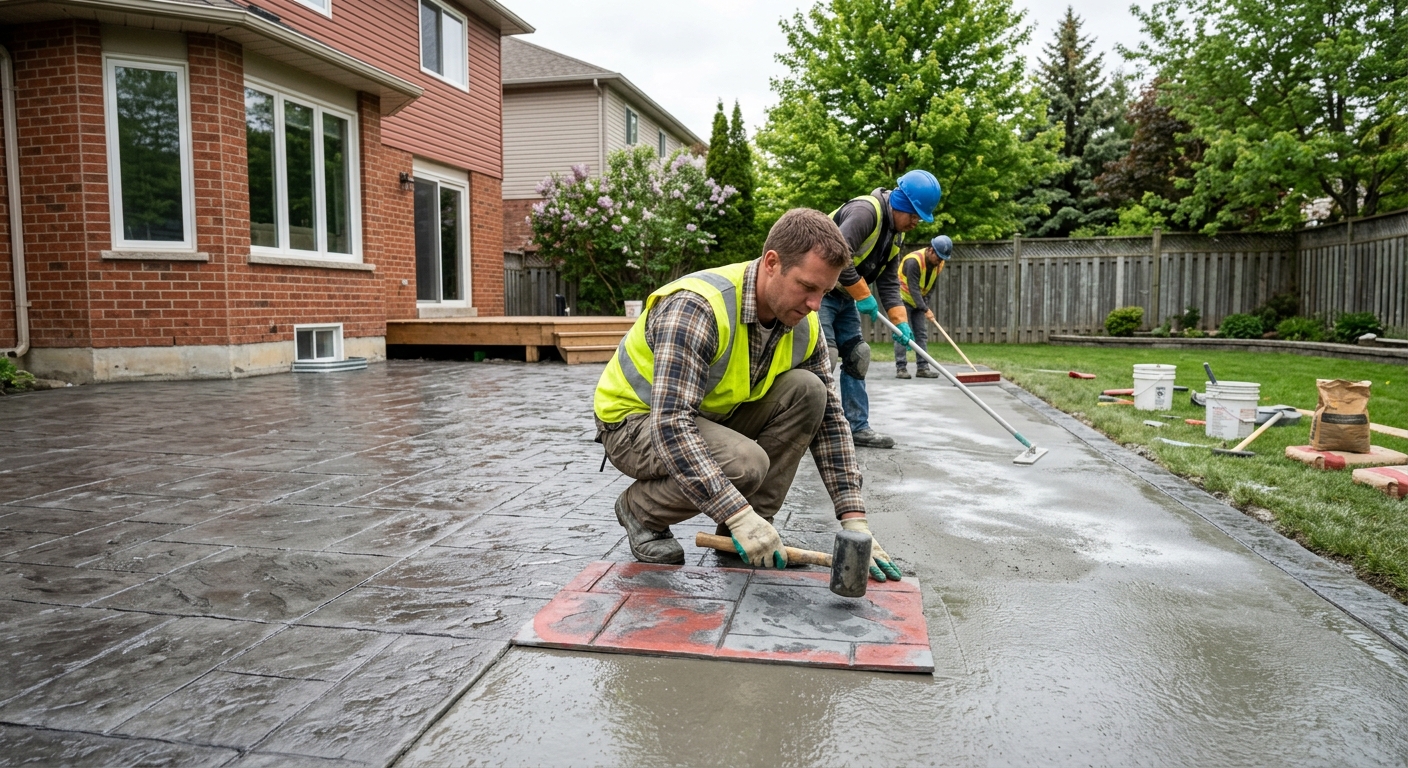
Concrete work options and costs in Baden
Baden, Ontario is a practical place to plan concrete—most homeowners want driveways, patios and walkways that can handle Toronto-area freeze–thaw while still looking good for years. Baden’s small population (4,940 people per the Statistics Canada, 2021 Census) also means many concrete crews serve a wider catchment, so availability can tighten when the weather turns favourable. The housing base is largely dominated by family neighbourhoods where single-detached homes are common, and those households typically invest in exterior flatwork sooner—especially on properties near the downtown core and along the larger residential streets where access can be tight.
In the Toronto economic region, pricing is shaped by how deep structural footings must go and how exterior slabs are built to resist frost heave. Local specs generally require most structural footings to extend at least 1.2 m (about 4 ft) below grade, and exterior work relies on air-entrained mixes plus drainage and compacted granular base to prevent saturated soils from expanding and contracting each winter. The GTA also has a shorter reliable pour season: contractors often prioritize pours in the warmer months to protect curing, and they may include cold-weather protection if temperatures trend near 10 °C or below. That combination—deeper prep, more robust mix design, and tighter scheduling—helps explain why Baden quotes often land within the Ontario price bands below.
Here are typical options and budget ranges for Baden so you can compare proposals side-by-side before you ask for a site visit.
| Application |
Typical Size |
Key Spec |
Finish Option |
Price Range |
| Concrete driveway (standard broom finish) |
400–600 sq. ft. |
Air-entrained exterior mix; reinforced as needed; proper slope and drainage |
Broom finish |
$7,200 – $16,800 |
| Exposed aggregate driveway |
400–600 sq. ft. |
Air-entrained exterior mix; well-compacted granular base; curing protected |
Exposed aggregate |
$9,600 – $22,800 |
| Stamped concrete driveway or patio |
300–500 sq. ft. |
Air-entrained mix; control joints planned; release agent and curing sequence |
Stamped (pattern + colour) |
$7,200 – $20,000 |
| Plain concrete patio or walkway |
200–400 sq. ft. |
Compact base; air-entrained exterior mix; edges protected and jointed |
Float/trowel or broom |
$3,200 – $10,400 |
| Garage floor (interior slab) |
400–650 sq. ft. |
Interior slab; vapour control as applicable; mesh or rebar as required |
Plain broom/steel-trowel finish |
$7,200 – $18,200 |
| Foundation footings (structural, below frost) |
Varies by home |
Engineered layout; excavation and forming; concrete placed below design frost depth |
Reinforced footing concrete |
$180 – $300 |
Prices are estimates only and vary by project scope, site access and material selection.
What affects the price of concrete work in Baden
In Baden, you can see the same type of project quoted 30–50% apart across the Toronto economic region, even when the drawings look similar. The big driver is that contractors are pricing for risk: frost depth, freeze–thaw exposure, and how well they can control curing and drainage. Ontario’s requirements effectively mean exterior work and structural elements must perform through winter movement. Structural footings generally extend below the design frost depth to prevent frost heave; that depth requirement influences excavation volume, forming height, and labour time. On the flatwork side, exterior slabs are typically specified with air-entrained concrete so they can survive repeated freeze–thaw cycles without premature spalling.
Quotes also vary because of seasonal constraints. In the GTA corridor, the most reliable pour windows are warmer months, and contractors often plan longer cure protection when temperatures slip toward 10 °C or below. If a job must be scheduled late fall or early spring, you may pay for insulating blankets, heaters, and added coordination. De-icing salt usage is another Ontario reality—salt accelerates surface scaling if you don’t use the right mix, cure properly, and plan for sealing after the pour.
Local conditions can raise or lower cost quickly. For example, if your driveway in a neighbourhood like the Baden South residential streets has limited truck access, placing and finishing can require extra equipment and labour. If the property has soft subgrade or poor drainage, contractors may increase the granular base depth and compaction effort. Those are the jobs where the price difference between a standard broom-finished driveway and an exposed aggregate driveway can be justified. Likewise, upgrading to stamped concrete can run more than plain concrete (often aligning with the $24–$40 per sq. ft. stamped range), but it’s sometimes the best value when you’re replacing multiple sections like an entry pad plus walkway at the same time.
| Price Factor |
Why It Matters |
Cost Impact |
| Frost line depth — determines footing depth and form height |
Deeper frost protection means more excavation, forming, and concrete volume |
Can add significant labour and materials cost; typically a major driver for foundations |
| Site preparation — excavation, grading, compacted granular base |
Prevents settlement and reduces water infiltration under slabs |
Higher if subgrade is soft, drainage is poor, or haul-away/disposal is needed |
| Reinforcement — rebar or wire mesh requirement |
Controls cracking and improves slab performance under load |
Adds material and labour; can be worth it for driveways and larger patios |
| Mix design — air-entrainment and compressive strength spec |
Air-entrainment helps resist freeze–thaw; strength supports long-term durability |
More expensive than basic mixes but often cheaper than repairs after spalling |
| Finish type — broom vs. stamped vs. exposed aggregate |
Different processes, labour time, and material systems (stamps/colour/exposure) |
Stamped and exposed aggregate typically increase cost versus plain finishes |
| Pour size and concrete truck access to site |
Access affects pumping, finishing manpower, and pour sequencing |
Costs rise with limited access, long carries, or need for pumping |
| Cold-weather curing precautions — heating and blankets |
Protects strength gain and reduces cracking risk during temperature swings |
Can add line items if scheduling slips toward colder nights |
| Control joint pattern and sealing cost |
Joints manage cracking; sealing helps protect against moisture and de-icing salts |
Small material cost but requires correct labour timing and product |
Permits & regulations in Ontario
In Ontario, structural concrete work is more regulated than flatwork. Concrete that typically DOES require a building permit includes: foundation footings and foundation walls, grade beams, retaining walls, and any structural slab work connected to the building’s support system. In many Baden projects, engineered drawings are reviewed and the permit process helps ensure reinforcement, sizes, and placement meet the Ontario Building Code and local municipal requirements.
Concrete flatwork like patios, walkways and driveways usually does NOT require a building permit by itself. However, there are common exceptions: if the work changes lot grading, affects stormwater flow, increases impervious surface coverage beyond what’s allowed, ties into municipal right-of-way requirements, or involves reworking major drainage features, the municipality may require approvals. Always confirm before you start digging.
To verify a contractor for a Baden project, follow a simple step-by-step checklist. First, ask for their certificate of insurance (liability) and ensure the policy is current and includes your project address or class of work. Second, confirm worker coverage under WSIB (or equivalent provincial coverage as applicable) and request proof/certification documentation. Third, check their business registration and any required Ontario concrete-related licensing/qualifications through official online resources, then compare the company name on the quote to the insured name on the certificate. Finally, request references for similar-scale jobs in the Toronto region—driveway and flatwork references are especially important for freeze–thaw durability.
Getting concrete right in Baden's freeze-thaw climate
Concrete failures in Baden usually come down to three controllable problems: water movement, improper base support, and poor freeze–thaw resistance. If the granular base isn’t compacted to the correct depth, or if drainage is off, water collects under the slab. When temperatures swing through winter, freeze–thaw cycles stress the slab and can lead to spalling and scaling, especially where de-icing salts are used. The spec choices that prevent this are straightforward—when done properly.
Start with base preparation: compacted granular sub-base sized to your soil and frost expectations, with slope toward drainage. Next, require an air-entrained exterior mix (commonly 5–7% air content for exterior flatwork) and a minimum 32 MPa compressive strength target so the concrete can handle repeated freeze–thaw. Then plan control joints to limit random cracking—cracks will still happen in concrete, but the goal is to direct them into joints where they’re easier to manage. Curing matters just as much: protect the pour so it achieves proper strength gain, with minimum 7 days of curing under suitable conditions. Finally, seal with a penetrating sealer after the cure window (often around 28 days post-pour) to repel moisture and reduce salt-related surface damage.
For budget clarity: an exposed aggregate driveway typically costs more than a broom-finished driveway, but the extra price can be justified when you’re already replacing a failing base or dealing with active surface scaling. If you’re paying a premium to go from a standard broom finish into a decorative system, you want the same attention to base, joints, and air-entrainment—otherwise you’re paying more for the finish while risking the same durability issues.
| Spec |
Why It Matters in Baden |
What to Ask For |
Impact if Skipped |
| Compacted granular base (depth?) |
Supports the slab and reduces water trapped under concrete during freeze–thaw |
Confirm base depth, subgrade condition evaluation, and compaction method |
Increased settlement and cracking; higher risk of pumping/voids and slab failure |
| Air-entrained concrete mix (target air %?) |
Air void system helps concrete resist freeze–thaw damage |
Request air content target (typically 5–7% for exterior flatwork) and exterior-rated mix design |
Higher chance of spalling/scaling after winters with salt exposure |
| Compressive strength (MPa rating) |
Ensures strength gain for long-term performance in Ontario conditions |
Minimum 32 MPa rating (or project-specific engineered requirement) |
Surface wear and premature failure, especially under vehicle loads |
| Control joints (spacing per ACI guidelines) |
Controls where cracks form during seasonal movement |
Ask for a joint layout plan and spacing aligned with good practice |
Random cracking that can widen and invite moisture intrusion |
| Minimum 7-day curing period |
Reliable strength development reduces cracking risk during temperature swings |
How they protect the slab in the first week (wind protection, temperature plan) |
Weaker concrete and higher likelihood of surface defects and early cracking |
| Penetrating sealer (when applied after cure) |
Helps resist water and de-icing salt-driven surface damage |
Penetrating sealer applied after cure—commonly around 28 days post-pour |
Faster deterioration, staining, and increased salt-related spalling |
How to choose a concrete work contractor in Baden
Choosing the right concrete contractor in Baden is mostly about verifying proof and matching the quote to the real freeze–thaw requirements. Start by verifying Ontario coverage documentation. Ask for their liability insurance certificate and make sure it’s active and properly written for concrete work. Next, request WSIB coverage documentation (or the appropriate provincial worker coverage proof) and confirm it covers workers on your site. For contractor eligibility, also ensure their legal business details match the name on the quote and invoices. When possible, confirm they’ve done comparable projects in the Toronto region—driveways and exterior flatwork face different stresses than interior slabs.
Then, get 2–3 written quotes that are itemized—labour and materials separated, not one lump sum. You should see what’s included for excavation, granular base, reinforcement, concrete mix type, joint cutting, and curing protection. Watch for exclusions like disposal/haul-away, saw-cutting timing, sealing, and what happens if temperatures drop unexpectedly. If a quote says “concrete only,” clarify whether site prep and base work are included, because base deficiencies are a major cause of early cracking in Ontario.
Warranty is another must. Ask for a workmanship warranty length and whether product/manufacturer warranties apply to decorative coatings, sealers, or admixtures. Confirm whether warranties are transferable if you sell your home. For payment, never pay more than 10–15% upfront; use a holdback until the job is complete and cleaned up. Finally, require a start date and completion estimate in writing so you’re not left exposed during Baden’s seasonal pour window.
- Provide liability insurance certificate (active and for concrete work).
- Provide WSIB/worker coverage proof for workers on your job.
- Ask for 3 references from similar exterior flatwork in the Toronto region.
- Require itemized quotes: excavation/base, reinforcement, concrete mix, finishing, joints, curing, sealing.
- Clarify disposal/haul-away for excess soil and concrete waste.
- Confirm whether permits are required and whether the contractor will pull them if applicable.
- Ask what concrete mix type is planned (air-entrained exterior mix) and the target strength.
- Ask for the joint plan (spacing and depth) and whether joints will be saw-cut on schedule.
- Confirm curing protection plan for first week, including cold snap contingencies.
- Confirm sealing product type (penetrating sealer) and the timing (after cure, commonly around 28 days).
- Get a written schedule: pour date, finish date, and sealing date (if included).
- Agree on payment milestones with a holdback until completion and acceptance.
Concrete contractor red flags I commonly see in Baden include: quotes that don’t mention air-entrainment or curing protection, inconsistent scope that treats base prep as “minor,” lack of a written joint layout, crews that rush saw-cutting and curing after late-day pours, and no proof of insurance/worker coverage before work begins.
Frequently asked questions — concrete work in Baden
What is the difference between concrete and cement?
In Baden and across Ontario, people often use “concrete” and “cement” as if they’re the same, but they’re not. Cement is one ingredient—typically Portland cement—that acts like the binder. Concrete is the full mix: cement plus water, sand/fine aggregates, larger stone (coarse aggregate), and sometimes admixtures (like air-entraining agents for exterior freeze–thaw durability). For exterior driveways, patios and walkways in the Toronto economic region, contractors usually specify an air-entrained concrete mix for better performance through winter cycling and salt exposure. When you get a quote, ask what air-entrained mix they’re using and whether it meets the minimum strength requirements; that’s the practical “concrete” spec that determines how it survives Baden winters. (Statistics Canada, 2021 Census)
How much does concrete work cost in Baden?
Concrete pricing in Baden typically lands within the local Ontario price bands depending on finish, thickness, and site conditions. For example, a standard concrete driveway budget is commonly in the $18–$28 per sq. ft. range for the driveway/slab tier, while a stamped driveway or patio usually runs higher (often aligning with $24–$40 per sq. ft. for stamped & decorative). The final number also depends on excavation, granular base depth and compaction, whether reinforcement is specified, and how accessible your property is for a concrete truck. If you’re replacing existing flatwork, disposal and grading can add cost quickly. For foundation work, structural footings are often priced per linear/area basis depending on design, and local contractors commonly reference a $180–$300 range for foundation/footings work tied to typical structural scopes.
How deep must footings be for Baden's frost line?
For Baden homes, the key is that footings extend below the design frost depth to prevent frost heave and differential movement. In Ontario’s Toronto region, structural footings are commonly required to extend at least about 1.2 m (roughly 4 ft) below grade, consistent with local building requirements that account for freeze risk. Your exact footing depth should follow your engineer’s foundation design or local permit drawings, because soil conditions and foundation system details can change what’s appropriate. If a contractor proposes shallow footings “because the ground is solid,” that’s a serious durability risk in the GTA climate with repeated freeze–thaw cycles. For homeowners, the right move is to request to see the engineered footing plan or foundation drawings tied to your permit approval before work begins.
Why does concrete crack in Baden and how is it prevented?
Concrete cracking in Baden isn’t automatically a sign of poor quality—concrete shrinks as it cures and moves with temperature and moisture changes. The bigger problem in Ontario is when cracking is uncontrolled and lets water infiltrate, then freeze–thaw expands that damage. Prevention comes from correct base prep, air-entrained exterior mixes, the right thickness, and a deliberate control joint pattern. Contractors also manage curing: minimum 7 days under proper protection, and they plan for cooler temperatures so the slab gains strength instead of weakening at the surface. Sealing after cure (often around 28 days post-pour) helps repel moisture and de-icing salts. Ask your contractor to provide a joint layout and confirm the air-entrained mix specification—spalling linked to inadequate air-entrainment is one of the most common durability complaints in freeze–thaw conditions.
Stamped vs broom-finish concrete — cost difference?
Stamped concrete costs more than broom-finish because it requires additional materials and steps: stamp mats, release agent, colouring/finishing workflow, and more labour time to maintain pattern quality. In the Baden price bands, a standard concrete driveway/slab often sits around $18–$28, while stamped & decorative concrete is commonly higher at about $24–$40 per sq. ft. That difference can be worthwhile if you’re replacing a larger area like a driveway plus entry walkway at the same time, since you’re paying mobilization and base prep once. But the best value depends on durability: a cheaper broom finish poured with poor base prep and weak mix will underperform, while a higher-end stamped pour still needs air-entrainment, proper joints, and curing protection for long-term survival through Toronto-area freeze–thaw cycles.
When is the best time to pour concrete in Baden?
For Baden, the best time to pour exterior concrete is during the warmer months when temperatures stay stable enough for reliable curing. In the GTA area, contractors commonly concentrate pours in periods when daytime temperatures are warm and night lows don’t force extra heating/blanket protection. When temperatures trend toward 10 °C or below, curing management becomes critical—heating, insulated blankets, and schedule adjustments add cost and complexity. Even if the slab is poured successfully, cold-weather conditions can increase surface defects or reduce strength gain if protection isn’t planned. If you’re coordinating around a landscaping schedule, ask the contractor to outline their weather plan and curing protection timeline, not just the pour date. In a tight seasonal window, getting your site prep (grading and base) done early is often what protects quality.