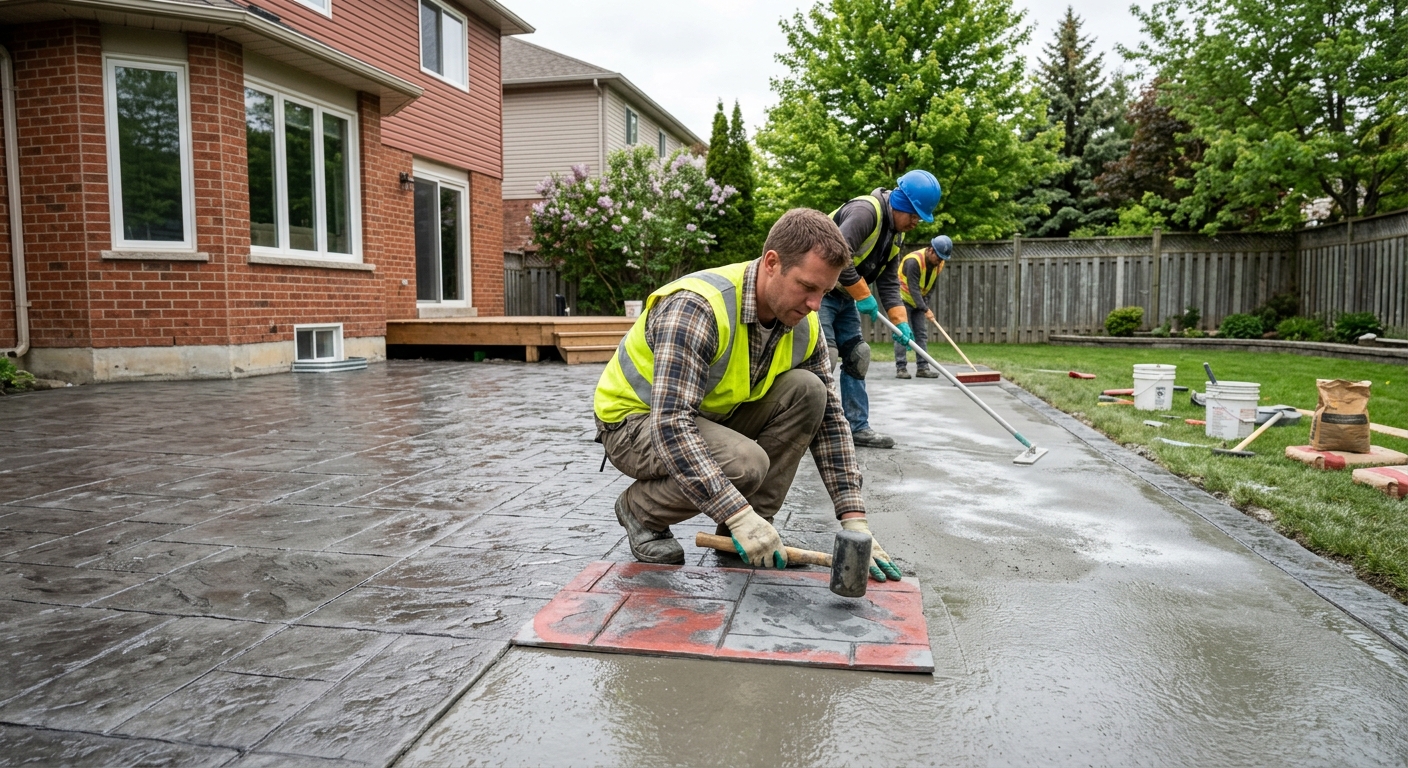
Concrete work options and costs in Scarborough Village
In Scarborough Village, most homeowners choose concrete because it handles winter properly when it’s built right—especially for driveways, patios and walkways. The local housing mix matters: Scarborough Village has a large share of single-detached homes, which is typical where front- and back-yard concrete upgrades are common. With a population of 16,724 (Statistics Canada, 2021 Census), you’ll also see steady demand in nearby commercial-and-residential corridors like Morningside Avenue, where property maintenance and curb appeal projects are frequent.
Toronto-area concrete pricing is shaped by freeze–thaw cycles and frost depth. Structural work typically needs footings to extend at least about 1.2 m (roughly 4 ft) below grade to limit frost heave and differential movement. For exterior slabs, contractors generally specify air-entrained mixes and plan the pour timing so concrete cures correctly—because once temperatures drop toward 10 °C or below, curing slows and surface protection becomes more important. That same climate also affects availability: crews are busiest in the warmer months, so last-minute scheduling can add cost.
Below is a practical comparison of common concrete options you’ll hear about in Scarborough Village, with the key specs and realistic price ranges based on Toronto-area production costs and the regional frost-and-drainage approach.
| Application |
Typical Size |
Key Spec |
Finish Option |
Price Range |
| Concrete driveway (standard broom finish) |
12 m x 3 m (36 m²) |
Air-entrained mix; compacted granular base; control joints; good edge drainage |
Broom finish |
$6,000 – $10,000 |
| Exposed aggregate driveway |
12 m x 3 m (36 m²) |
Air-entrained mix; heavier finishing steps; proper curing to expose aggregate cleanly |
Exposed aggregate |
$7,500 – $13,500 |
| Stamped concrete driveway or patio |
10 m x 4 m (40 m²) |
Air-entrained mix; base prep; release agent; curing and joint pattern |
Stamped pattern |
$10,000 – $16,000 |
| Plain concrete patio or walkway |
6 m x 3 m (18 m²) |
Compacted sub-base; thickness sized for foot traffic; jointing and drainage |
Plain finish |
$2,800 – $5,000 |
| Garage floor (interior slab) |
6 m x 6 m (36 m²) |
Vapour barrier/insulation where needed; reinforced slab; smooth flat finishing |
Power-trowel or broom edge finish |
$6,500 – $12,000 |
| Foundation footings (structural, below frost) |
Per linear metre allowance |
Reinforced footings designed for soil bearing; below-frost depth; excavation and formwork |
Structural concrete |
$180 – $300 |
Prices are estimates only and vary by project scope, site access and material selection.
What affects the price of concrete work in Scarborough Village
In Toronto and across Ontario, quotes for the “same” concrete job can swing by 30–50% because the real cost drivers are site conditions and how well the contractor follows freeze–thaw specs. Two driveways can look identical on day one, but one might have a properly compacted granular base, air-entrained mix and correctly spaced control joints—while the other is built on thinner base, weaker mix targets or incomplete curing protection. Those differences show up fast as scaling, spalling or uneven settlement after the first few winters.
Frost line depth and freeze–thaw cycles dictate every spec in the Toronto economic region. Exterior footings and structural elements must extend below design frost depth (often around 1.2 m in Ontario) to prevent frost heave and differential movement. For slabs, contractors generally use air-entrained concrete and appropriate thickness so the mix survives repeated freezing and thawing. Also, Ontario’s pour season is less forgiving than milder regions: crews concentrate exterior work in warmer months to ensure proper curing. When temperatures fall toward 10 °C or below, contractors may need blankets, insulating coverings and additional planning for scheduling—costing more but protecting durability. De-icing salt in winter can accelerate surface deterioration if the mix and sealing plan isn’t right, so sealing is a smart add-on for many homeowners.
In Scarborough Village, costs often rise when access is tight (long wheelbarrow distances) or when the existing grade is poor and drainage must be corrected before any concrete is poured. Costs may be lower on a straightforward backyard patio if soil is already well-drained and excavation is minimal; however, even then, homeowners paying near the $16,000 – $26,000 or $18,000 – $28,000 driveway/flatwork bands still benefit from proper base prep because it reduces future repairs. Many older homes—built before modern drainage expectations—require additional grading changes, which can add thousands but prevent repeat failures.
| Price Factor |
Why It Matters |
Cost Impact |
| Frost line depth |
Determines footing depth and form height |
$1,500 – $5,000 difference on partial foundation/access changes |
| Site preparation |
Excavation, grading, compacted granular base |
$800 – $4,000 depending on soil removal and haul distance |
| Reinforcement |
Rebar or wire mesh requirement |
$600 – $2,500 based on slab thickness and load |
| Mix design |
Air-entrainment and compressive strength spec |
$300 – $1,200 for the right exterior durability targets |
| Finish type |
Broom vs. stamped vs. exposed aggregate |
$1,000 – $6,000 for decorative systems and extra labour |
| Pour size and concrete truck access to site |
Truck line distance and placement efficiency |
$500 – $2,000 if pumping or extended placement time is needed |
| Cold-weather curing precautions |
Heating and blankets |
$400 – $2,500 depending on temperature window and coverage |
| Control joint pattern and sealing cost |
Crack control and protection from de-icing salts |
$250 – $1,600 depending on layout and sealer type |
Permits & regulations in Ontario
In Ontario, structural concrete work—like foundation footings, foundation walls and grade beams—typically requires a building permit, and many municipalities also expect engineered drawings for structural elements depending on the scope. Concrete flatwork (patios, walkways and most driveways) usually does not require a permit by default. That said, a permit can become necessary when the project affects lot grading, changes drainage patterns, or impacts impervious surface coverage limits, or when it touches municipal right-of-way conditions. When in doubt, confirm with your local building department before breaking ground; fixing non-compliance after the fact is expensive.
Before signing with any Scarborough Village contractor, verify they’re properly covered. Step one: ask for proof of liability insurance and request it directly from their certificate of insurance, ensuring it includes your address/job site and appropriate coverage limits. Step two: confirm they carry WSIB coverage (or WCB equivalent coverage requirements that apply in your scenario) and keep the clearance documentation on file. Step three: confirm references for similar-scale concrete work, ideally in the Toronto area with comparable freeze–thaw conditions.
For checking Ontario licence eligibility, use the contractor registration/verification processes available through provincial and municipal online resources, then match the business name to the documentation they provide. A licensed, insured crew won’t mind taking you through their paperwork—especially for structural concrete. If the contractor can’t provide insurance and clearance quickly, that’s a red flag.
Getting concrete right in Scarborough Village's freeze-thaw climate
Concrete doesn’t fail in Scarborough Village because “concrete is weak”—it fails when the base, mix and curing don’t match the local freeze–thaw reality. The most common exterior failure is spalling and scaling caused by water getting into concrete and freezing. That’s why base preparation and mix design are non-negotiable. First, get the base right: a properly compacted granular sub-base to the right depth for local soil and the slab/footing thickness helps control movement and drainage. Second, specify an air-entrained mix; for exterior flatwork, contractors typically target around 5–7% air content so the concrete can tolerate freeze–thaw cycles. Third, plan control joints to limit random cracking and keep cracks where you want them to be. Fourth, cure properly—at least 7 days under suitable conditions—and protect the surface when temperatures drop. Fifth, seal after the concrete has cured (commonly 28 days) using a penetrating sealer to help repel de-icing salts and reduce moisture ingress.
Ask the contractor pointed questions: what air-entrainment target are they using, what curing plan applies if the forecast drops, and what joint spacing will they follow? If you’re comparing a plain patio versus stamped concrete, the extra cost can be justified—but only if the durability steps are already done. For example, if a stamped patio lands at about $24,000 – $40,000 for decorative finishes, you should expect thorough base prep and correct mix; you shouldn’t pay for aesthetics while sacrificing durability. On the other hand, a simple broom-finished driveway in the $18 – $28 band can still last decades when the contractor controls joints, drainage and curing.
| Spec |
Why It Matters in Scarborough Village |
What to Ask For |
Impact if Skipped |
| Compacted granular base (depth?) |
Controls settlement and keeps water from saturating the slab through freeze–thaw seasons |
“What base depth are you compacting to, and how are you verifying compaction?” |
Uneven cracking, pumping, and early slab failure |
| Air-entrained concrete mix (target air %?) |
Creates freeze–thaw tolerance in Toronto-area winters |
“What air content are you targeting (about 5–7% for exterior flatwork) and how is it measured?” |
Spalling/scaling, especially with winter salt exposure |
| Compressive strength (MPa rating) |
Helps concrete resist wear, impact and surface deterioration |
“What minimum 28-day strength are you specifying (typically at least 32 MPa for exterior work)?” |
Surface abrasion, cracking and reduced service life |
| Control joints (spacing per ACI guidelines) |
Limits random cracking from shrinkage and temperature movement |
“What joint spacing will you cut or form, and where will joints land?” |
Wider, irregular cracks and more water infiltration |
| Minimum 7-day curing period |
Ensures strength development before the worst weather hits |
“How will you protect and cure the slab for at least 7 days?” |
Lower strength, increased cracking and surface weakness |
| Penetrating sealer (when applied after cure) |
Reduces moisture and salt penetration during repeated freeze–thaw cycles |
“Will you apply penetrating sealer after full cure—around 28 days—and what product?” |
More scaling over winters and faster surface degradation |
How to choose a concrete work contractor in Scarborough Village
Start with documentation. In Ontario, verify the contractor’s Ontario registration/licensing status, then confirm liability insurance and WSIB/WCB coverage. You can check licensing/registration through the relevant provincial online contractor verification tools and match the exact business name you see on the quote. For insurance, ask for a current certificate of insurance before work begins; the certificate should list your address/project and show adequate liability limits. For WSIB/WCB, ask for clearance or proof of coverage for the individuals and work being performed—contractors who won’t provide it are taking risk that becomes your problem.
Next, get 2–3 written itemised quotes (not just a lump sum). A good quote breaks labour and materials so you can compare apples to apples: concrete supply, reinforcement, excavation, granular base, forms, finishing, saw cutting/jointing, disposal, sealing, and any cold-weather curing precautions. Read the scope closely: is the permit included if needed, what exactly is excluded (cart away of removed soil, disposal fees, traffic control), and who is responsible for site protection during curing? Ask about warranty details: separate workmanship warranty length from product/manufacturer warranty, and clarify whether warranties are transferable if you sell.
Payment schedule matters. Never pay more than 10–15% upfront. Use milestone payments and hold back until the job is complete and curing/cleanup requirements are met. Finally, insist on a start date and estimated completion timeline in writing—Toronto’s seasonal pour window is real, and planning protects both quality and cost.
- Request licence/registration details and verify them via Ontario’s online contractor lookups.
- Get a certificate of liability insurance and confirm it covers the job site.
- Confirm WSIB/WCB coverage and ask for current clearance documentation.
- Insist on an itemised quote (labour + materials + excavation + disposal + finishing).
- Ask who provides reinforcement (rebar/wire mesh) and what slab thickness is specified.
- Confirm base prep requirements (granular type, depth, grading and compaction approach).
- For exterior work, ask about air-entrainment and how it’s verified.
- Ask for the joint plan: where joints go and expected spacing.
- Ask how the crew handles cold snaps (blankets/heating) if temperatures drop.
- Confirm curing steps and that they’ll protect the slab for at least 7 days.
- Ask when/if penetrating sealer will be applied after cure (commonly around 28 days).
- Clarify payment milestones and keep a holdback until cleanup and final inspection.
Concrete contractor red flags in Scarborough Village: (1) no proof of insurance or WSIB/WCB, (2) quotes that don’t specify air-entrainment, reinforcement, or joint spacing, (3) vague curing promises like “we’ll finish and you’re good to go,” (4) asking for large upfront payments beyond 10–15%, and (5) refusing to provide itemised line-by-line pricing or comparable local references.
Frequently asked questions — concrete work in Scarborough Village
Stamped vs broom-finish concrete — cost difference?
In Scarborough Village, stamped concrete costs more than broom-finish because it requires extra steps: release agents, texture mats, more labour time, and careful finishing to control impressions and joint lines. As a ballpark, a plain concrete patio or walkway often lands in the $16 – $26 per m² style band (finish-dependent), while stamped concrete commonly sits higher—often aligning with the $24 – $40 decorative band. If you compare two quotes and the stamped option is only slightly higher, ask what’s included: base depth, air-entrained mix, reinforcement, joint pattern, and curing protection. In GTA weather, durability steps matter just as much as the look.
When is the best time to pour concrete in Scarborough Village?
The best time is late spring through early fall when daytime temperatures stay steady and curing conditions are reliable. In Toronto-area freeze–thaw conditions, crews often plan exterior pours when temperatures are comfortably above roughly 10 °C to avoid slow strength gain and extra heating/blanketing costs. Scarborough Village contractors also schedule around rain and forecasted cold snaps, because surfaces left unprotected during temperature drops are more likely to experience early scaling or weak top layers. If you’re scheduling a driveway, patio or walkway, aim to lock the pour date early so the contractor can manage curing properly instead of rushing production near colder weather.
How long does concrete take to cure?
Concrete curing has two parts: strength development and surface readiness. Contractors typically plan for a minimum 7-day curing period with proper protection (moist cure and/or curing methods) so the slab reaches enough early strength to resist damage. Full design strength is commonly assessed at 28 days, and that’s also when penetrating sealers are often applied for exterior flatwork—especially important in Scarborough Village where de-icing salts and moisture fuel freeze–thaw damage. If a contractor schedules traffic over the slab too soon or skips curing steps, you may not see problems right away, but the likelihood of cracking and scaling increases over the first few winters.
Do I need a permit for concrete work in Ontario?
In Ontario, structural concrete work such as foundation footings, foundation walls and grade beams typically requires a building permit and may involve engineered drawings reviewed through the municipal process. Concrete flatwork—like patios, walkways and most driveways—often does not require a permit unless it affects lot grading, drainage, impervious surface coverage limits, or connects to municipal right-of-way conditions. For Scarborough Village homeowners, the safest approach is to ask your contractor what they’re planning and confirm with the local authority before excavation. Also verify the contractor has the right liability insurance and WSIB/WCB coverage, because permit status and compliance don’t protect you if the contractor is uninsured.
Concrete vs pavers for a patio in Scarborough Village?
Both can work, but concrete is often the best value when you want a smooth, low-maintenance surface with fewer joint lines (as long as the concrete is jointed correctly). Pavers can be attractive if you want easier replacement of small sections or more visual variety, but they still require compacted base prep and proper edge restraint to prevent shifting. In Scarborough Village, freeze–thaw and moisture control matter for both systems; saturated soils expand and contract. For pricing, concrete patios commonly fall around the $16 – $26 band, while decorative choices can climb higher. If you expect snowplow/vehicle contact or heavy salt use, ask how each option handles drainage and sealing so water doesn’t get trapped under surfaces.
How long does a concrete driveway last?
A well-built concrete driveway in Scarborough Village can last decades because the durability can be engineered for freeze–thaw—if base prep, air-entrainment, reinforcement and joints are done right. Many failures trace back to poor drainage, under-compacted base, inadequate air content, or weak curing practices rather than concrete “wearing out” immediately. If your driveway is exposed to winter salt and you skip sealing where appropriate, the surface can scale faster over repeated winters. Cost-wise, homeowners who invest closer to the driveway bands—commonly in the $18 – $28 range per m² depending on scope and finish—often get better spec adherence, which is what drives longer service life.