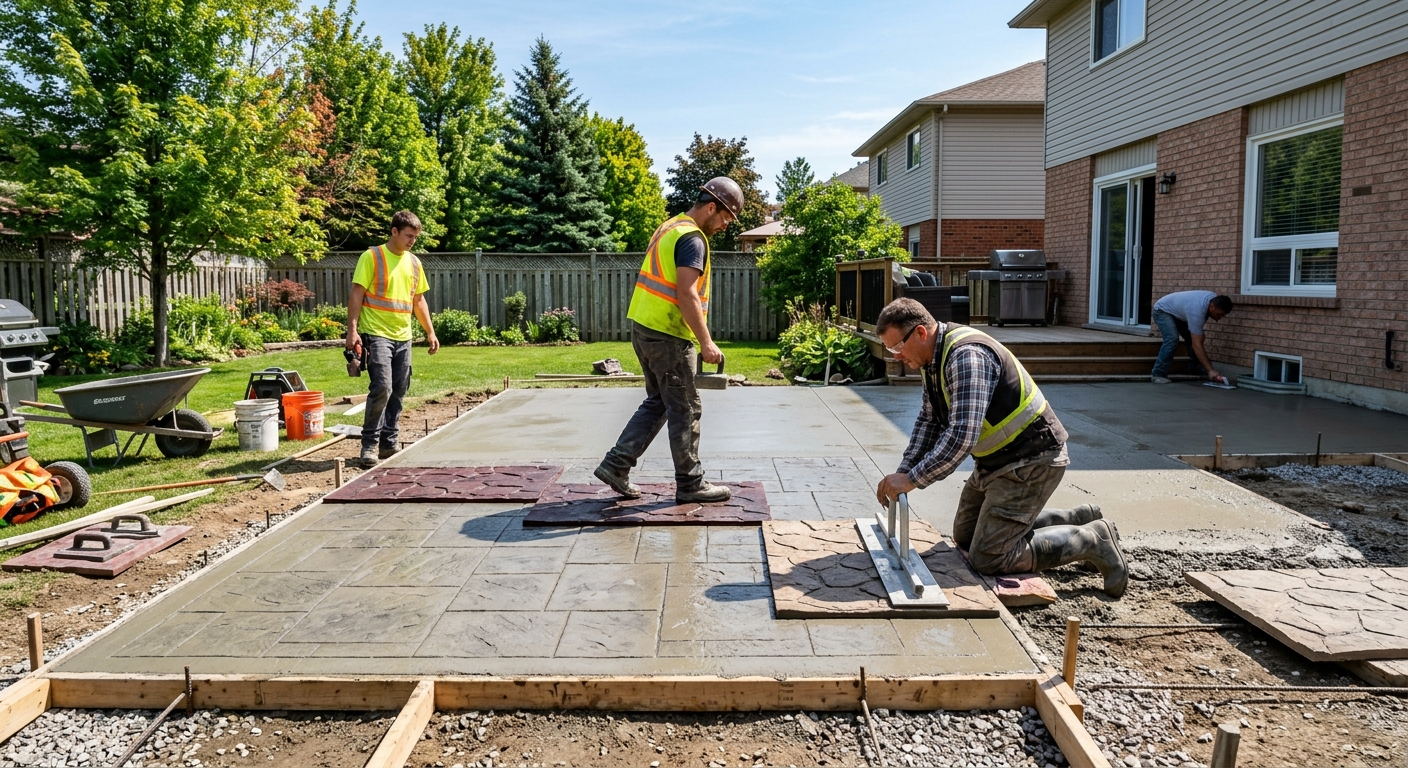
Concrete work options and costs in Lively
Concrete work in Lively is a practical upgrade for the home you already have—especially when you’re dealing with driveway, patio, and walkway traffic that’s pushed through another long Toronto-winter freeze–thaw cycle. With a population of 5,608 people (Statistics Canada, 2021 Census), Lively’s market is smaller than central Toronto, so pricing is often influenced by how easily contractors can schedule crews and source materials. Most demand comes from established residential pockets where homeowners are improving curb appeal and drainage around single-family properties. In Lively and across the Toronto economic region, costs also reflect the “real-world” requirements of the Ontario Building Code: exterior concrete and structural elements are planned for frost protection, and workmanship has to hold up once winter salts start hitting the surface.
In practice, that means contractors spec air-entrained mixes for exterior flatwork, plan control joints to manage cracking, and build a well-compacted granular base so saturated soils don’t expand and contract against the slab. The Toronto area also has a shorter reliable pour window in shoulder seasons; when temperatures dip toward 10 °C or below, curing management (blankets, protection, and longer timelines) becomes part of the job—whether you’re pouring a simple patio or a thicker driveway. For many Lively homeowners, high season scheduling around places like the downtown area and nearby residential corridors can affect availability, but the upside is better crew productivity and smoother pours.
Below are typical price ranges you can use to compare contractor estimates before you book a site visit and confirm measurements.
| Application |
Typical Size |
Key Spec |
Finish Option |
Price Range |
| Concrete driveway (standard broom finish) |
400–600 sq. ft. |
Air-entrained mix, compacted granular base, control joints |
Broom-finish, saw-cut joints |
$7,200 – $15,500 |
| Exposed aggregate driveway |
400–600 sq. ft. |
Air-entrained mix, base prep, sealer-ready surface |
Exposed aggregate (bush-hammer or retarder method) |
$9,000 – $18,900 |
| Stamped concrete driveway or patio |
300–500 sq. ft. |
Air-entrained mix, rebar where required, joint pattern planned |
Stamps + release + colour integral |
$9,000 – $20,000 |
| Plain concrete patio or walkway |
200–400 sq. ft. |
Well-compacted base, slope for drainage, joints as needed |
Float/smooth with broom or lightly textured finish |
$3,200 – $9,800 |
| Garage floor (interior slab) |
300–600 sq. ft. |
Vapour barrier (as applicable), fibre or mesh, proper thickness |
Smooth trowel finish; options for edging/accents |
$5,400 – $16,800 |
| Foundation footings (structural, below frost) |
Per linear foot equivalent |
Structural pour, below-grade frost depth, engineered requirements |
Plain structural concrete |
$180 – $300 |
Prices are estimates only and vary by project scope, site access and material selection.
What affects the price of concrete work in Lively
In Lively, two contractors can quote the “same” driveway and still land 30–50% apart once you compare the details—thickness, base prep, reinforcement, drainage, and how they plan for the Toronto region’s freeze–thaw. The Toronto economic region is shaped by frost depth and the relentless winter cycling that expands and contracts moisture in the soil. That’s why structural footings typically need to extend at least 1.2 m (about 4 ft) below grade in Ontario to reduce frost heave risk, and why exterior slabs almost always use air-entrained concrete.
Cold-weather realities also affect labour and scheduling. When temperatures drop toward 10 °C or below, crews need additional protection (insulating blankets, maintaining curing conditions) and longer timelines so the concrete reaches early strength reliably. Surface deterioration is another Ontario factor: de-icing salts can accelerate spalling if the mix and air content aren’t right, so sealing is often recommended for exterior flatwork to help repel moisture and salt-driven damage.
Local site conditions in Lively can raise or lower costs quickly. A driveway on soft or saturated soil usually needs deeper excavation and more granular base; that can push standard driveway pricing toward the top end (for example, concrete driveway / slab work is commonly in the $18–$28 per sq. ft. range for this tier). Conversely, a straightforward re-pour on a well-drained site with good access can keep pricing closer to the lower end. If you choose decorative finishes, you’re paying for prep and finishing labour—stamped & decorative concrete commonly sits around $24–$40 per sq. ft., but the upgrade can be justified on visible areas where curb appeal matters most.
| Price Factor |
Why It Matters |
Cost Impact |
| Frost line depth — determines footing depth and form height |
Controls how far below grade structural concrete must go to prevent frost heave |
Higher depth increases excavation, forming, and concrete volume (often a major driver for foundations) |
| Site preparation — excavation, grading, compacted granular base |
Good drainage and compaction reduce voids and soil movement under the slab |
Soft subgrade or poor drainage raises costs; clean, stable sites keep them lower |
| Reinforcement — rebar or wire mesh requirement |
Improves performance for thicker slabs, edges, and areas with higher loads |
Adding reinforcement and proper chairs/ties can increase material and labour |
| Mix design — air-entrainment and compressive strength spec |
Air-entrainment helps concrete resist freeze–thaw; strength targets support durability |
Better specified mixes cost more but reduce the chance of early cracking/spalling |
| Finish type — broom vs. stamped vs. exposed aggregate |
Finishes require different labour time, tools, and curing/protection handling |
Stamped/exposed work typically adds a premium over standard broom-finish |
| Pour size and concrete truck access to site |
Access affects equipment needs and how efficiently the crew can place/finish concrete |
Limited access may require smaller pours, pump costs, or additional labour |
| Cold-weather curing precautions — heating and blankets |
Ensures early strength gain when temperatures are near or below key thresholds |
Protection and slower production can add labour and material costs |
| Control joint pattern and sealing cost |
Controls where cracks occur and adds protection against salt/moisture exposure |
Proper jointing may add layout labour; sealing adds material cost but improves longevity |
Permits & regulations in Ontario
In Ontario, structural concrete work in Lively—such as foundation footings, foundation walls, and grade beams—typically requires a building permit, and many projects need engineered drawings that get reviewed by the municipality. If your concrete scope is supporting the structure (bearing elements, below-grade work, beams, or new structural walls), plan on permitting and inspection steps.
Concrete flatwork (driveways, patios, walkways) often does not require a permit as a standalone job, unless it affects lot grading, impervious surface coverage limits, drainage direction, or the municipal right-of-way. Even when a permit isn’t required, good contractors still follow municipal guidelines for slopes, eavestrough discharge, and runoff pathways.
Step-by-step, here’s how a homeowner can verify a contractor in Ontario before work starts:
- Confirm contractor licence status using the appropriate online registry for Ontario (ask the contractor for their licence number first).
- Request a current certificate of liability insurance; verify the coverage is active and includes your project address.
- Ask for WSIB/WCB clearance (or proof of registration/coverage) so you’re not exposed if a worker is injured.
- Get the permit/engineering details in writing: who pulls permits (if required), and who schedules inspections.
- Check references for similar-scale jobs in the Toronto area, not just basement pours.
For any scope that touches foundation elements, ask whether an engineer’s involvement is required and whether the municipality will require footing inspection prior to backfill.
Getting concrete right in Lively's freeze-thaw climate
Concrete failures in Lively are usually predictable: water gets in, freezing expands it, and the slab or surface deteriorates around weak points. The five biggest drivers are base preparation, mix design, jointing, curing, and sealing. If you want a durable driveway or patio through Toronto’s humid, often wet fall and spring, spec the job like a cold-climate assembly—not just “pour and smooth.”
(1) Base preparation: concrete only performs well when it sits on properly graded, compacted granular sub-base to the right depth for local soil and frost movement. Poor base compaction is one of the fastest routes to settlement and cracking. (2) Mix design: for exterior flatwork, specify an air-entrained mix (commonly around 5–7% air content for exposed exterior work) and a minimum 32 MPa compressive strength target, with proper cement/fly ash content as the mix design calls for. (3) Control joints: joints need a planned pattern and spacing so random cracking doesn’t “choose” the worst locations near edges and corners. (4) Curing: minimum 7-day curing under proper conditions is critical, especially if temperatures fall and the crew must protect the pour. (5) Sealing: apply a penetrating sealer after the concrete has cured—commonly 28 days post-pour—to help repel de-icing salts and moisture-driven damage.
To show how choices affect cost: if you’re budgeting for stamped concrete, you may pay more than a broom-finish driveway (stamped & decorative concrete often falls around $24–$40 per sq. ft., while standard driveway/slab work is commonly $18–$28 per sq. ft.). That premium is usually justified when the contractor also nails the basics—right base, correct air-entrainment, and a joint plan—because it protects your investment against spalling and premature wear.
| Spec |
Why It Matters in Lively |
What to Ask For |
Impact if Skipped |
| Compacted granular base (depth?) |
Reduces pumping and settlement from freeze–thaw moisture movement |
Confirm excavation depth and granular base thickness; compaction testing approach if available |
Uneven settling, cracked edges, and accelerated deterioration |
| Air-entrained concrete mix (target air %?) |
Helps concrete resist freeze–thaw and surface scaling |
Specify air-entrainment target (commonly 5–7% for exterior flatwork) and approved mix design |
Higher risk of spalling, scaling, and early surface failure |
| Compressive strength (MPa rating) |
Supports durability and early strength gain during Ontario cure conditions |
Ask for minimum 32 MPa (or higher if engineered/spec’d) and documentation of mix |
Soft, vulnerable concrete and higher chance of damage from loads and moisture |
| Control joints (spacing per ACI guidelines) |
Limits uncontrolled cracking from thermal movement |
Joint layout plan showing spacing and orientation before the pour |
Random cracks that can open wider and admit water |
| Minimum 7-day curing period |
Ensures strength development through cold snaps common around the shoulder seasons |
Confirm curing/protection plan and when formwork is removed (if applicable) |
Reduced strength and increased susceptibility to scaling and early cracking |
| Penetrating sealer (when applied after cure) |
Repels moisture and helps manage de-icing salt exposure |
Apply after curing—commonly 28 days post-pour—and confirm product type |
Faster salt damage, higher maintenance, and shorter service life |
How to choose a concrete work contractor in Lively
Choosing a concrete contractor in Lively is mostly about verification and clarity. Start with Ontario licensing: ask the contractor for their licence number and confirm it in the applicable online registry. Next, protect yourself with insurance proof—request a current certificate of liability insurance and make sure the project address is covered. For worker safety, ask for WSIB/WCB coverage or clearance documentation; you want to see they’re compliant so liability doesn’t fall on you if something goes wrong on site.
Then, get 2–3 itemised written quotes, ideally broken down into labour and materials (concrete supply, base prep/grading, reinforcement, forming, finish labour, saw cuts/joints, disposal, and sealing if included). A good quote clearly states what’s excluded—especially demolition, hauling away debris, and whether disposal and permits (if needed) are included. For structural work like footings and foundation elements, confirm who pulls the permit and who schedules inspections.
Warranty matters too. Ask for the workmanship warranty length in plain language, and whether any product/manufacturer warranty applies to the concrete supply or coating/sealer. Check if anything is transferable if you sell your home. For payment, don’t hand over the majority up front—never pay more than 10–15% upfront, and hold back payment until the job is complete and cleaned up. Finally, insist on a written start date and a completion estimate tied to weather and curing conditions common in the Toronto area.
- Confirm Ontario licence number and scope on the quote matches your project.
- Verify liability insurance is current and covers your address.
- Get proof of WSIB/WCB clearance/coverage for workers.
- Request itemised pricing (labour vs materials) rather than one lump sum.
- Ask what demolition and disposal costs are included (and where debris goes).
- Confirm base prep specs: excavation depth, granular type, and compaction expectations.
- Ask about reinforcement: when mesh/rebar is used and where chairs/ties go.
- Confirm mix design: air-entrainment plan for exterior exposure.
- Review the joint plan (locations, spacing, and how they’ll finish around joints).
- Ask how curing will be protected if temperatures drop near 10 °C or below.
- Clarify sealing: whether it’s included, product type, and timing (often 28 days).
- Ensure the warranty is in writing and covers workmanship, not just materials.
Concrete contractor red flags in Lively include: offering a “standard” mix for all exterior pours without discussing air-entrainment, skipping base prep details in the quote, rushing joints/control line layout after the pour starts, asking for most payment up front (beyond 10–15%), and avoiding written schedules tied to curing and weather protection.
Frequently asked questions — concrete work in Lively
Stamped vs broom-finish concrete — cost difference?
In Lively and across the Toronto economic region, stamped concrete costs more than a broom-finish driveway because it takes extra labour time and finishing steps (forms for stamp patterns, colour steps, and careful joint placement so the design doesn’t hide crack points). A typical “standard” concrete driveway or slab often lands around $18,000 – $28,000 (as a per-project budget range depending on size and site conditions), while stamped & decorative concrete commonly falls in the higher tier around $24 – $40 per sq. ft. for material and finish work.
The best comparison is apples-to-apples: ask both contractors to list thickness, base prep, reinforcement, air-entrainment, and joint pattern on paper. If stamped pricing looks close to broom-finish, the contractor may be cutting corners on base, joints, or curing protection—those are the items that decide whether you’ll get years of good performance or early surface issues after salts and freeze–thaw.
When is the best time to pour concrete in Lively?
The best time to pour exterior concrete in Lively is during the warmer months when you can maintain proper curing conditions. In the Toronto region, crews often prefer the spring-to-early-fall window because concrete needs consistent temperature for proper strength gain. Once temperatures trend down toward about 10 °C, the risk increases that curing slows down unless protection is added (insulating blankets, wind barriers, and additional attention to keeping the slab warm enough early on).
That’s also why you can see higher overall scheduling pressure in peak season: contractors are best able to complete prep, formwork, and finishing efficiently when weather cooperates. If you’re flexible, scheduling a pour earlier in the season can reduce the added cost for cold-weather precautions and help you avoid delays that push work into colder nights and wetter days. For planning, confirm the pour date plus a cure/protection plan in writing.
How long does concrete take to cure?
Concrete curing is a two-part process: it develops early strength within days, but it keeps strengthening over time. For Ontario exterior flatwork, a practical benchmark is minimum 7-day curing under proper conditions so the slab reaches early strength before heavy exposure and traffic. After that, concrete continues to gain strength for weeks.
For sealing, it’s typically best to wait until the concrete has cured longer—commonly around 28 days—so moisture levels drop enough for the sealer to work effectively. This matters in Lively because de-icing salts and wet freeze–thaw can punish surfaces that aren’t properly cured or protected. If a contractor proposes sealing too early, ask why and what product they’re using. A good crew will also protect the pour if temperatures fall, which can affect the curing timeline and the final durability.
Do I need a permit for concrete work in Ontario?
In Ontario, structural concrete work—like foundation footings, foundation walls, and grade beams—usually requires a building permit, and engineered drawings are often reviewed by the municipality. For concrete flatwork (driveways, patios, and walkways), permits are commonly not required when the work doesn’t change lot grading, drainage direction, or impervious surface limits, and doesn’t interfere with the municipal right-of-way.
Because rules can be project-specific in Lively, the safest approach is to ask the contractor to confirm whether a permit is needed before demolition starts. Also verify in your written quote who is responsible for pulling the permit (if required) and who schedules inspections. Finally, confirm the contractor carries liability insurance and has WSIB/WCB coverage clearance or proof—this isn’t optional good practice, it’s how you protect yourself during concrete work that involves heavy pours and equipment.
Concrete vs pavers for a patio in Lively?
Concrete and pavers both work for patios in Lively, but they handle Ontario freeze–thaw differently. A properly installed concrete patio (with compacted granular base, drainage slope, air-entrained mix, and a good joint plan) tends to be lower maintenance as one continuous surface. Pavers can be easier to repair locally if a section fails, but they depend heavily on base layers and edge restraints staying true after freeze–thaw.
Cost-wise, broom-finish concrete patio or walkway work often falls around $16 – $26 per sq. ft. in this local tier, while pavers can vary widely depending on thickness, pattern, base build-up, and labour. If your site has drainage constraints or you expect frequent seasonal saturation, both can perform well—but concrete durability hinges on air-entrainment, control joints, and curing. If a quote for concrete doesn’t clearly address base depth and air content, that’s a warning sign in our climate.
How long does a concrete driveway last?
A concrete driveway is commonly designed to last decades when it’s built for Ontario’s freeze–thaw exposure: a solid compacted granular base, correct thickness, air-entrained concrete, and properly placed joints. In Lively, the real longevity factor is how well the driveway manages moisture and salt. De-icing salts can increase surface scaling/spalling if the mix design isn’t right or if the surface stays unsealed and keeps absorbing water each winter.
If you’re comparing quotes, don’t just focus on the driveway price band (often $18 – $28 per sq. ft. for concrete driveway/slab work). Instead, ask about the contractor’s air-entrainment approach for exterior exposure, their joint pattern, and whether they recommend sealing (often after full curing, around 28 days). A well-built broom-finish driveway generally holds up very well, while shortcuts—like shallow base prep—usually show up first as cracking and settling, then water intrusion.