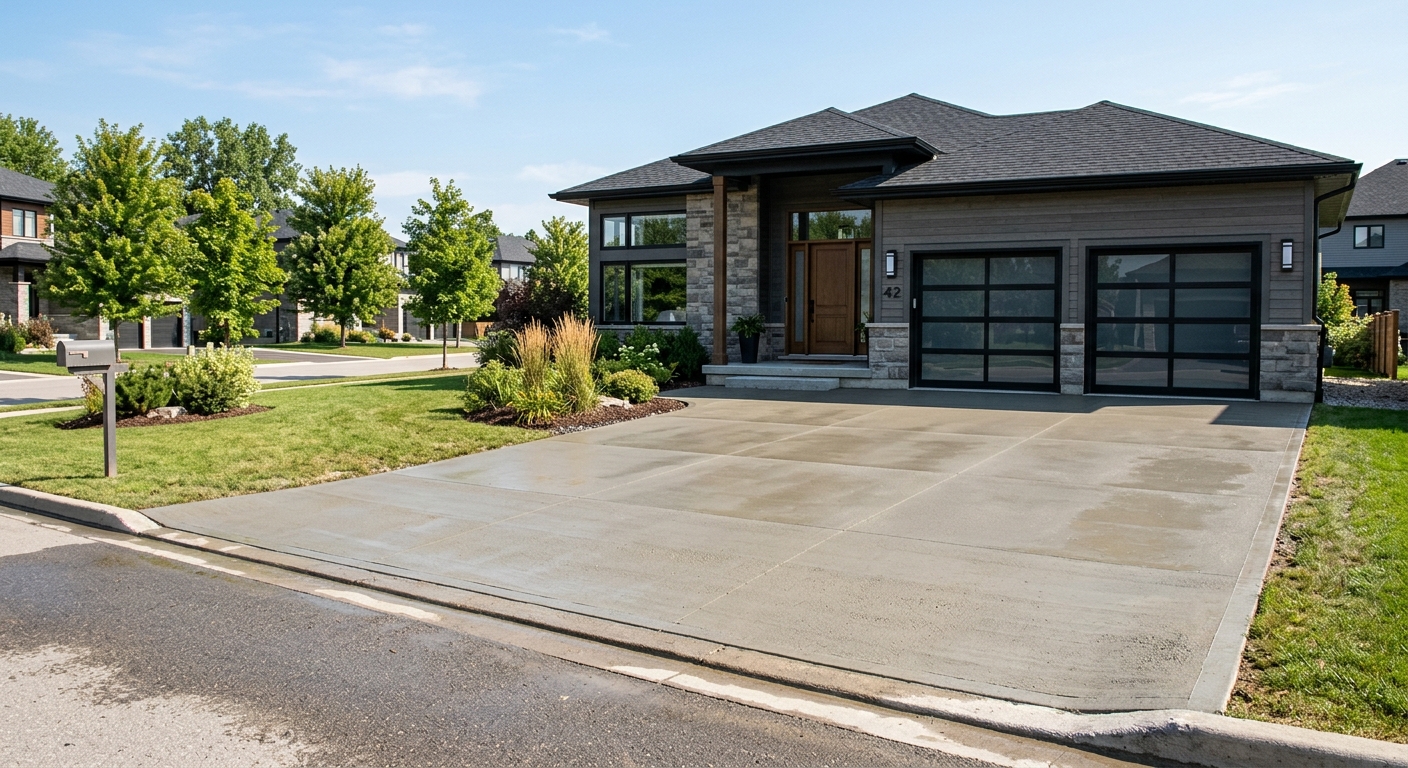
Concrete work options and costs in East Gwillimbury
In East Gwillimbury, concrete work is a year-round conversation because the town has a lot of older housing stock—27.9% of homes were built before 1981 (Statistics Canada, 2021 Census)—and many driveways and walkways were poured decades ago. The demand is also tied to the local housing mix: 81.2% of dwellings are single-detached homes, which typically means homeowners need concrete for driveways, patios, and entry walks on a regular maintenance cycle. With 9,640 homeowner households (84.2% of households own), you’ll commonly see repeat work as properties upgrade landscaping, re-grade around foundations, or replace cracked flatwork.
In the Toronto economic region, pricing is strongly influenced by frost depth and repeated freeze–thaw cycles. For structural work, Ontario practices generally require footings to extend below the design frost depth, which drives excavation and concrete volume. For exterior flatwork, contractors typically use air-entrained mixes, plan control joints, and schedule pours in warmer months so curing happens reliably. In neighbourhoods like Mount Albert, concrete contractors are especially busy in spring and early summer because that’s when homeowners schedule driveway and walkway replacements before wet fall weather returns.
Because concrete is labour-heavy (base prep, steel placement, forming) and weather-dependent (curing protection), “same-size” projects can land in different price bands. Use the table below to compare common options and understand where finish choice and structural requirements tend to move the budget.
| Application |
Typical Size |
Key Spec |
Finish Option |
Price Range |
| Concrete driveway (standard broom finish) |
400 sq ft |
4 in slab, compacted granular base, air-entrained mix |
Broomed, edges formed, control joints |
$7,200–$11,200 |
| Exposed aggregate driveway |
400 sq ft |
4 in slab, base prep, air-entrained mix |
Acid wash or retarder + exposed stone |
$9,500–$14,600 |
| Stamped concrete driveway or patio |
300 sq ft |
4 in slab, reinforcement as required, air-entrained mix |
Stamp mats + colour hardener/release agent |
$7,500–$12,000 |
| Plain concrete patio or walkway |
200 sq ft |
4 in slab (patios), compacted base, air-entrained mix |
Broom or light float + joints |
$3,200–$5,200 |
| Garage floor (interior slab) |
400 sq ft |
4 in slab, vapour barrier where appropriate, proper sub-base |
Light broom, standard finishing |
$6,800–$10,600 |
| Foundation footings (structural, below frost) |
Varies by foundation |
Excavation to design frost depth, rebar, concrete below grade |
Engineered spec |
$180–$300 |
Prices are estimates only and vary by project scope, site access and material selection.
What affects the price of concrete work in East Gwillimbury
In the Toronto economic region, it’s common to see quotes for the same concrete job vary by 30–50%. The reasons usually come down to how each contractor handles the “non-visible” parts: excavation to the right depth, the granular base thickness and compaction, steel or mesh placement, mix design, and how they protect curing when temperatures slide. Labour availability also changes during peak pour season, so a late-summer replacement can cost more than a spring schedule—especially when crews are booked across the corridor.
For concrete pricing in Ontario, frost depth and freeze–thaw cycles dictate every major decision. Structural footings must extend below the design frost depth (Ontario is typically in the 1.5–2.4 m range, depending on location and design) to prevent frost heave and differential movement. Exterior slabs—driveways, patios, and walkways—should be built with air-entrained concrete to survive repeated freeze–thaw. When a pour starts near the end of the season, crews often add cold-weather curing precautions (insulating blankets, heat management, longer protection time). That can push costs up compared with milder months when curing is easier and more predictable. Also, de-icing salts can accelerate surface spalling if the mix, air content, and sealing plan aren’t right—so sealing is often a worthwhile add-on for longevity.
In East Gwillimbury, you’ll often see real cost swings from site conditions. A driveway replacement on a tight access lot may require more labour for forming and moving materials; conversely, a flat, open lot with clean drainage can stay closer to the lower end of the driveway bands (for example, $18–$28 per sq ft for concrete driveway work). Likewise, upgrading to stamped concrete (often $24–$40 per sq ft) might look expensive, but it can be justified when you’re matching stone or brickwork at the entry or replacing a larger patio footprint.
| Price Factor |
Why It Matters |
Cost Impact |
| Frost line depth — determines footing depth and form height |
Deeper frost requirements mean more excavation and concrete volume |
Higher excavation and forming can add tens of percent on structural work |
| Site preparation — excavation, grading, compacted granular base |
Proper base prevents settlement and pumping during freeze–thaw |
Unstable soils or thick removal can raise costs significantly |
| Reinforcement — rebar or wire mesh requirement |
Controls cracking and improves performance on exterior loads |
Steel and placement time can increase material and labour |
| Mix design — air-entrainment and compressive strength spec |
Air entrainment helps manage freeze–thaw durability |
Higher-spec mixes can move the job to the upper price band |
| Finish type — broom vs. stamped vs. exposed aggregate |
Finish impacts labour steps and material needs |
Stamped or exposed aggregate generally costs more per sq ft |
| Pour size and concrete truck access to site |
Access affects hose length, labour, and whether line-pumping is needed |
Poor access can add extra labour and delays |
| Cold-weather curing precautions — heating and blankets |
Cold slows strength gain; protection improves results |
When needed, increases labour and material for curing |
| Control joint pattern and sealing cost |
Joints manage shrinkage cracking; sealing helps repel de-icing salts |
Skipping joints/sealer reduces upfront cost but increases risk of spalling |
Permits & regulations in Ontario
In Ontario, structural concrete work typically requires a building permit. That includes footings, foundation walls, and grade beams, where the depth, rebar size, and structural design must match engineered drawings and local requirements. For many concrete flatwork projects—driveways, patios, and walkways—a permit often isn’t required unless the work affects lot grading, stormwater drainage, impervious surface coverage limits, or the municipal right-of-way (for example, any work near the curbline or required access changes). The safe path is to confirm with the local authority before you break ground.
Homeowners should also verify the contractor is properly insured. Ask for proof of liability insurance and WSIB/WCB coverage (if applicable to their business and staff). Then confirm the contractor’s standing with the appropriate Ontario registry for contractor licensing and compliance—requirements can vary by trade and scope.
Step-by-step, here’s how to verify before you sign: (1) request their certificate of insurance and check that it’s current and matches the job address; (2) ask for WSIB/WCB clearance or proof of coverage; (3) confirm their licensing/registration status using Ontario’s public listings; (4) obtain written references for similar-scope projects (driveways, patios, or structural pours); and (5) ensure the contract clearly states what drawings, inspections, or permit-related items are included.
Getting concrete right in East Gwillimbury's freeze-thaw climate
Concrete failures in East Gwillimbury are usually tied to freeze–thaw durability and water management. The most common problems I see are surface scaling/spalling, random cracking, and early settling—often because the base wasn’t compacted correctly, the mix didn’t have enough air, or the contractor didn’t protect curing when temperatures dropped. In this Toronto area, you’re dealing with humid conditions, wet fall/spring shoulder seasons, and repeated temperature swings, so the spec matters as much as the finish.
To spec the job correctly, start with base preparation. Ask for a compacted granular sub-base sized to the project and local soil conditions, with proper drainage so the slab doesn’t sit on saturated material. Next, specify an air-entrained mix for exterior work, typically targeting about 5–7% air, plus a minimum 32 MPa compressive strength for durable performance. Then address control joints: joint spacing must be set to limit random cracking and manage shrinkage, especially in driveways where vehicles impose cyclic stresses. Plan curing properly—minimum 7 days under favourable conditions, and longer protection if it’s cold (insulation blankets/heating if crews are pouring near cooler temperatures). Finally, request a penetrating sealer applied after full cure—often around 28 days post-pour—to help repel de-icing salts.
Here’s where money is (and isn’t) justified: upgrading from plain broom finish to stamped concrete can be a meaningful jump—on a 300 sq ft patio, stamped work often lands near the $24–$40 per sq ft band (about $7,500–$12,000). That price makes sense when you’re correcting the look of an entry and replacing an existing worn surface. But if the contractor is cutting corners on air-entrainment or base prep to hit a low price, you risk spalling that costs more later.
| Spec |
Why It Matters in East Gwillimbury |
What to Ask For |
Impact if Skipped |
| Compacted granular base (depth?) |
Prevents settlement and reduces water saturation under the slab during freeze–thaw |
Base depth (inches), compaction method, and drainage plan |
Uneven slabs, cracking from movement, faster deterioration |
| Air-entrained concrete mix (target air %?) |
Air bubbles protect concrete from freeze–thaw expansion pressure in exterior exposure |
Target air content (commonly 5–7% for exterior flatwork) |
Spalling/scaling, surface pop-outs, reduced service life |
| Compressive strength (MPa rating) |
Strength gain supports durability and load capacity in cold cycles |
Minimum 32 MPa specified for exterior flatwork |
Lower performance, increased cracking and abrasion damage |
| Control joints (spacing per ACI guidelines) |
Manages shrinkage cracking so it occurs where repairs are planned |
Joint spacing and pattern on the drawing/scope |
Random cracking, higher chance of water infiltration and widening cracks |
| Minimum 7-day curing period |
Ensures strength development before exposure to cold snaps and moisture |
Protection requirements (tarps/blankets) if temps drop |
Weak surface, scaling, poor long-term durability |
| Penetrating sealer (when applied after cure) |
Helps repel salts and water that drive freeze–thaw surface damage |
Sealer type and application timing (often around 28 days post-pour) |
Faster surface breakdown from de-icing and spring thaw water |
How to choose a concrete work contractor in East Gwillimbury
Choosing the right contractor in East Gwillimbury comes down to proof, process, and clarity. Start with Ontario requirements: request their liability insurance certificate and confirm the coverage is active for your project address. Ask for WSIB/WCB clearance or proof of coverage so you’re not left paying if a worker is injured on-site. For contractor licensing/registration, use Ontario’s public listings to confirm the business name and whether the scope you need is covered by their credentials.
Next, get 2–3 itemised written quotes—not just a lump sum. You want line items that separate labour and materials, including excavation/disposal, granular base, reinforcement, concrete supply, forming, finish work, and curing/protection measures. Also check what’s excluded: is permit pull included (if required for structural work), and is any hauling/disposal of excess soil stated? A quote that “sounds cheap” often makes up the difference later with change orders.
Warranty matters too. Ask for the workmanship warranty length and what it covers (and doesn’t), whether the concrete product/manufacturer warranty is separate, and whether any warranty is transferable if you sell the home. For payment schedule, a responsible approach is typically not paying more than 10–15% upfront; hold back enough until the job is complete and final grading/cleanup are verified. Finally, require a written timeline with a start date window and a completion estimate.
- Written quote with itemised labour + materials (no only one line number)
- Scope includes base preparation depth and compaction approach
- Exterior work specifies air-entrained concrete
- Reinforcement plan is stated (rebar/mesh and where it’s placed)
- Control joint locations and spacing are included
- Curing and protection plan is included (especially if pouring near cooler weather)
- Sealing is listed (for driveways/patios where salt use is expected)
- Disposal/hauling of excess soil is either included or clearly excluded
- Permit responsibility is clear for structural scope
- Concrete truck access plan is discussed for your driveway width/turn radius
- Insurance and WSIB/WCB proof provided before starting
- Warranty terms in writing with call-back process
Concrete red flags I see in East Gwillimbury are: “no need for air-entrained mix” on exterior work, vague specs like “standard concrete” without strength/air targets, skipping control joint planning, offering a very low price that doesn’t show base depth/compaction details, and asking for a large upfront payment before any materials are scheduled.
Frequently asked questions — concrete work in East Gwillimbury
When is the best time to pour concrete in East Gwillimbury?
For East Gwillimbury and the broader Toronto economic region, the best time to pour exterior concrete is typically late spring through early fall, when daytime temperatures stay favourable for curing. This timing helps contractors avoid the extra costs and risk that come with cold-weather curing—heating, insulating blankets, and extended protection time—when temperatures trend toward the low teens and near 10 °C or below. Homeowners often schedule driveway and walkway work in neighbourhoods with heavy spring demand, like Mount Albert, right before wet shoulder seasons. If you’re aiming for a patio, a plain broom-finish pour often stays closer to the lower band (for example, $16–$26 per sq ft), but finishing and curing requirements become more critical as temperatures drop.
How long does concrete take to cure?
Concrete gains strength over time, but the practical “wait period” matters. For most exterior flatwork in Ontario, you should plan for a minimum curing period of about 7 days before you expose the slab to heavy wear. Full strength development continues well beyond that, often reaching design strength at later ages, but 7 days is the common workmanship benchmark used to manage early risks like surface scaling and weakened edges. If conditions are cool or damp, contractors may extend curing and keep protection in place longer. This is especially important in East Gwillimbury where freeze–thaw can start affecting surfaces as weather swings in spring and fall. Good sealing is another step: many contractors apply penetrating sealer around 28 days post-pour to better repel de-icing salts.
Do I need a permit for concrete work in Ontario?
In Ontario, structural concrete work—like footings, foundation walls, and grade beams—usually requires a building permit, often supported by engineered drawings reviewed through the municipal process. Concrete flatwork such as patios, walkways, and standard driveway replacements often does not require a permit, unless your work affects lot grading, drainage, impervious surface coverage limits, or involves municipal right-of-way concerns. Because requirements can vary based on scope and how the project ties into stormwater and grading, confirm with the local authority before you pour. For safety, also verify your contractor’s liability insurance and WSIB/WCB coverage before work starts; that’s a homeowner step you can control regardless of permits. If you’re unsure, ask the contractor to list who is responsible for any permit items in the written scope.
Concrete vs pavers for a patio in East Gwillimbury?
Concrete and pavers can both work well in East Gwillimbury, but they fail differently in freeze–thaw climates. Concrete patios generally provide a monolithic surface with fewer joints, and when built with air-entrainment, correct base prep, and control joints, they can perform consistently over time. Pavers rely on a well-drained granular base and consistent edge restraints; if water infiltrates and the base shifts, you can see settling or unevenness. Concrete is also often easier to match to slopes and drainage when your design is straightforward. On cost, plain concrete patios commonly fall in the $16–$26 per sq ft band, while stamped finishes move higher (often around $24–$40 per sq ft). If your priority is quick, durable maintenance with a smooth finish, concrete is usually the simpler choice.
How long does a concrete driveway last?
A properly built concrete driveway in Ontario can last decades, but the lifespan depends heavily on what’s underneath. In East Gwillimbury’s freeze–thaw climate, the two biggest durability drivers are a properly compacted granular base and correct exterior mix design with air-entrainment. Control joints must be planned so cracking happens where it can be managed, and sealing helps reduce surface damage from de-icing salts. If you’re replacing a driveway in a homeowner-dense area—remember, single-detached homes make up a large share of dwellings—most failures show up at the edges, around garage transitions, or where water pools. If those issues aren’t corrected during replacement, the new slab may deteriorate faster. A mid-range driveway budget often lands in the $18–$28 per sq ft band, but you’re really paying for base prep and durability details that protect the service life.
What is air-entrained concrete and why does it matter here?
Air-entrained concrete is mixed with tiny, evenly distributed air bubbles that give water within the concrete room to freeze and expand without damaging the paste. This is crucial in Ontario’s repeated freeze–thaw cycles, including East Gwillimbury’s wet spring/fall conditions and winter temperature swings. Without enough air, concrete is more vulnerable to surface scaling and spalling—often called “popping” or flaking—especially on exterior flatwork exposed to de-icing salt. You should ask your contractor what air content they’re targeting; for exterior flatwork, a common spec is roughly 5–7% air. Air-entrainment is one of the reasons local contractors won’t treat “cheap mix” and “durable exterior mix” as interchangeable. It may cost slightly more than basic mixes, but it’s typically cheaper than repairs and premature replacement.