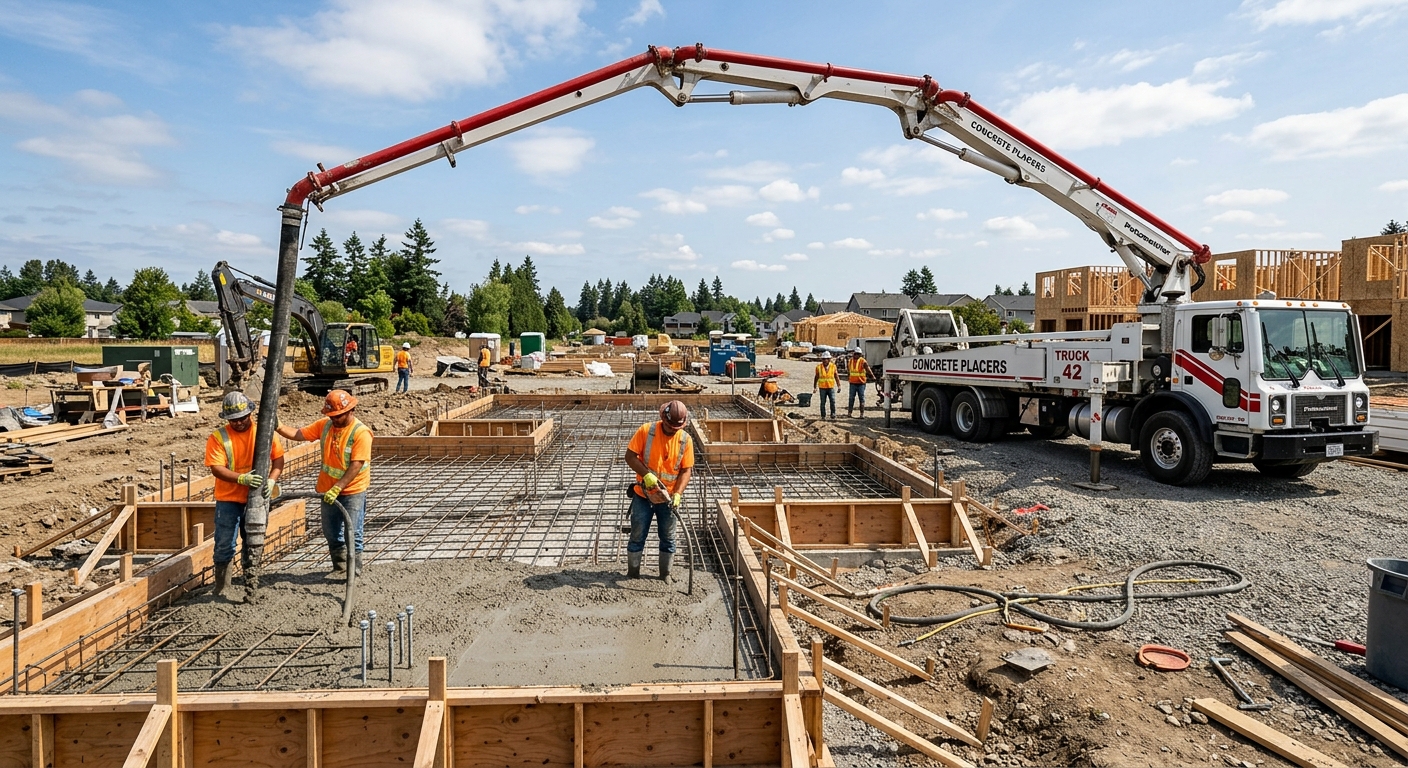
Concrete work options and costs in Silver Heights
In Silver Heights, most homeowners think about concrete when they’re upgrading driveways, adding a patio, or replacing worn walkways. With a population of 8,235 (Statistics Canada, 2021 Census), you’ll find steady demand for exterior flatwork in the Toronto region, especially around established residential pockets such as the older neighbourhood streets near the downtown core. Concrete is also a common choice because many homes in the area are single-family and built for long-term usability—so residents expect smooth surfaces, good drainage, and minimal seasonal cracking.
Pricing here is influenced by the Toronto economic region’s freeze–thaw cycles and local foundation practice. In this corridor, contractors typically plan exterior pours for warmer months to support proper curing, and they specify air-entrained mixes and control joints to reduce random cracking. Work can cost more when soil is saturated or when access is limited for concrete trucks, because excavation, granular base prep, and finishing time all increase.
Below is a practical comparison of common concrete projects and what they usually cost in Silver Heights. Use these bands to sanity-check a quote—then we’ll get into what pushes prices up or down, including frost depth, base preparation, and finishing choices.
| Application |
Typical Size |
Key Spec |
Finish Option |
Price Range |
| Concrete driveway (standard broom finish) |
16 ft × 24 ft (approx. 384 sq ft) |
Air-entrained mix, compacted granular base, control joints |
Broom (light texture) |
$18,000 – $28,000 |
| Exposed aggregate driveway |
16 ft × 24 ft (approx. 384 sq ft) |
Air-entrained mix, proper curing window, consistent aggregate exposure |
Exposed aggregate finish |
$24,000 – $36,000 |
| Stamped concrete driveway or patio |
12 ft × 20 ft (approx. 240 sq ft) |
Air-entrained mix, thicker section where required, integral colouring |
Stamped pattern (e.g., stone/brick look) |
$7,500 – $12,000 |
| Plain concrete patio or walkway |
10 ft × 16 ft (approx. 160 sq ft) |
Drainage slope, air-entrained mix, joints where needed |
Broom or smooth finish (non-stamped) |
$2,600 – $4,200 |
| Garage floor (interior slab) |
20 ft × 20 ft (approx. 400 sq ft) |
Vapour barrier, proper base, mesh or rebar depending on loads |
Float/sheen finish; optional densifier |
$4,800 – $9,000 |
| Foundation footings (structural, below frost) |
Per linear foot typical excavation and concrete volume |
Structural concrete, steel as required, depth below grade for frost protection |
Unfinished (structural) |
$180 – $300 |
Prices are estimates only and vary by project scope, site access and material selection.
What affects the price of concrete work in Silver Heights
In Silver Heights and the wider Toronto area, you can easily see a 30–50% spread for the “same” concrete job. That’s usually not because one contractor is guessing—it’s because base preparation depth, reinforcement decisions, mix design, and finishing complexity change the labour and materials, and those choices are heavily influenced by freeze–thaw performance requirements.
Here’s the core driver: frost depth and freeze–thaw cycles dictate what happens below and at the surface. Footings for structural work must extend below the design frost depth (Ontario commonly lands in the 1.2–2.4 m range depending on the scenario), which affects excavation volume, form height, and overall time on site. For exterior flatwork—driveways, patios and walkways—air-entrained concrete is standard to survive repeated winter cycling. When temperatures drop toward 10 °C or below, contractors also need cold-weather curing precautions (insulating blankets, sometimes heaters), which can add cost but protect the final strength.
Costs also move up or down based on local conditions. A wet, soft driveway approach or poorly drained backyard often means more granular base, additional sub-base compaction, and improved drainage—pushing exterior flatwork above the low end of the $18–$28 driveway band. On the other hand, a straightforward patio on stable soil with easy truck access may land closer to the $16–$26 patio/walkway band, especially if jointing and drainage details are planned early.
Housing stock matters too. Older Silver Heights homes often have settled grades and mismatched drainage, so you may see higher scope costs—sometimes several thousand dollars more—because regrading and removal of failing concrete is part of “site prep,” not just the pour.
| Price Factor |
Why It Matters |
Cost Impact |
| Frost line depth |
Determines footing depth and form height |
Higher excavation and concrete volume typically add major cost on structural work |
| Site preparation |
Excavation, grading, compacted granular base |
Saturated soils and poor drainage can increase labour and granular material quantities |
| Reinforcement |
Rebar or wire mesh requirement |
More steel and proper placement (chairs/spacers) adds cost but reduces failure risk |
| Mix design |
Air-entrainment and compressive strength spec |
Higher-spec mixes and documentation can add per-m3 cost, especially for exterior durability |
| Finish type |
Broom vs. stamped vs. exposed aggregate |
Stamped and exposed work increases finishing labour and material handling |
| Pour size and concrete truck access to site |
Distance from truck, paving on slopes, staging time |
Tighter access or long carry distances can require extra crew time or smaller loads |
| Cold-weather curing precautions |
Heating and blankets |
Temporary protection can add line-item costs but helps ensure strength development |
| Control joint pattern and sealing cost |
Crack control and protection from de-icing salts |
Proper saw-cut joints and sealer add cost but reduce long-term spalling risk |
Permits & regulations in Ontario
In Ontario, structural concrete work—such as footings, foundation walls, and grade beams—normally requires a building permit and is commonly supported by engineered drawings that the municipality reviews as part of the permitting process. Concrete flatwork like patios, walkways and driveways usually does not require a permit by default, unless it affects lot grading, drainage routing, or impervious surface coverage limits, or touches municipal right-of-way conditions. Before any breaking ground in Silver Heights, confirm what your specific scope triggers with your local authority.
Equally important: verify your contractor is properly insured and set up to work on Ontario sites. Ask for proof of liability insurance and WSIB/WCB coverage, and request references for projects with similar square footage and ground conditions (especially exterior flatwork in freeze–thaw climates).
Step-by-step, here’s how a homeowner can verify before signing:
- Check the contractor’s business licence/registration details with the municipality (when available) and confirm it matches the legal name on your quote.
- Request a Certificate of Insurance (COI) for general liability showing the project address or, at minimum, the named insured and coverage limits.
- Ask for WSIB/WCB clearance (or equivalent proof) and confirm the coverage type applies to the employees involved in your job.
- Confirm the work will be coordinated with required permits (if your job is structural) and ask who submits permit paperwork.
- Review references and ask for photos of exterior flatwork performance after winters.
When in doubt—especially if you’re doing foundation work, adding a basement window well, or reworking drainage—get the permit path clarified first. It’s cheaper than redoing work that doesn’t meet Ontario requirements.
Getting concrete right in Silver Heights's freeze-thaw climate
Concrete failures in Silver Heights almost always come back to water and temperature. In a freeze–thaw cycle, water that gets under or within concrete expands, lifting edges or widening micro-cracks. Over time, de-icing salts accelerate surface breakdown (spalling), and freeze action can turn a cosmetic crack into a maintenance headache. The fix is not just “better concrete”—it’s correct base preparation, mix design, joints, curing, and sealing.
For exterior flatwork, start with base prep: excavate to the right depth and install a compacted granular sub-base with proper drainage slope. Then specify an air-entrained mix—typically 5–7% air content for exterior flatwork—so the concrete has space for freeze expansion. For strength, require a minimum 32 MPa compressive strength for typical exterior applications. Control joints should be laid out to limit random cracking; in our region, joint placement is a big predictor of how tidy the cracking pattern stays. Curing should be protected for at least 7 days, and when temperatures drop, additional insulating blankets and careful curing procedures prevent premature strength loss. Finally, apply a penetrating sealer around 28 days after the pour to repel water and reduce salt-driven surface deterioration.
When you’re comparing options, ask what you’re paying for. For example, moving from a basic broom-finish patio to stamped decorative concrete may push a typical project from the $16–$26 patio/walkway band into the $24–$40 stamped range. That price jump is justified when the contractor also provides better drainage slopes, proper jointing, and consistent curing—otherwise stamped finishes can look good initially but still fail from the same moisture issues.
| Spec |
Why It Matters in Silver Heights |
What to Ask For |
Impact if Skipped |
| Compacted granular base (depth?) |
Controls frost movement and prevents pumping of fine soil |
Confirm excavation depth, granular type, moisture condition, and compaction test method |
Settlement, cracking, and edge lifting during freeze–thaw winters |
| Air-entrained concrete mix (target air %?) |
Protects against freeze expansion and salt scaling |
Require target air content (typically 5–7% for exterior flatwork) and mix documentation |
Higher risk of spalling and premature surface deterioration |
| Compressive strength (MPa rating) |
Ensures durability and strength gain under local curing conditions |
Specify minimum 32 MPa and ensure proper curing temperature |
Surface wear, cracking, and reduced long-term performance |
| Control joints (spacing per ACI guidelines) |
Limits random cracking from shrinkage and temperature swings |
Ask for planned joint layout and saw-cut timing |
Uncontrolled cracks that let water in and worsen freeze damage |
| Minimum 7-day curing period |
Allows strength development before water and salt exposure |
Ask what curing method is used and how protection is handled in cooler weather |
Weaker surface, dusting, and increased cracking risk |
| Penetrating sealer (when applied after cure) |
Repels water and slows de-icer salt damage |
Confirm sealer type and application timing (about 28 days post-pour) |
More water absorption, faster scaling/spalling, and higher maintenance costs |
How to choose a concrete work contractor in Silver Heights
Choosing the right concrete contractor in Silver Heights is mostly about verification and clarity. Start by confirming Ontario coverage and compliance. Ask for (1) proof of liability insurance via a Certificate of Insurance (COI), (2) WSIB/WCB coverage clearance for the workers who will be on your site, and (3) the contractor’s business information that matches the quote and invoicing. A legitimate crew should be comfortable providing documentation quickly, not after repeated calls.
Next, get 2–3 itemised written quotes. Don’t accept a single lump-sum without breakdown. You want labour vs. materials, and line items for excavation, granular base, reinforcement, concrete supply, finishing, saw-cut joints, and any sealing. For projects that require a permit (typically structural work like footings or foundation walls), ensure the quote states whether permit pulling and engineered drawing work are included or excluded.
Read the scope carefully for exclusions: is disposal of excavated concrete included? Are load-in/load-out fees for small sites included? What’s the timeline for curing protection in cooler weeks? Warranty matters too—ask for the workmanship warranty length, what it covers (cracks and spalling treatment specifics), whether any product/manufacturer warranty applies, and if it transfers to you as the homeowner.
Finally, protect your cash flow: never pay more than about 10–15% upfront. Hold back a portion until final grading is accepted, forms are removed, joints are cut/sealed as specified, and the site is cleaned.
- Request itemised labour/material breakdown, not just totals.
- Confirm how thick the slab is and what base depth is proposed.
- Ask for the mix spec: air entrainment and minimum compressive strength.
- Verify reinforcement placement (chairs/spacers) rather than just “mesh included.”
- Confirm control joint spacing and saw-cut timing.
- Ask how curing is protected for at least 7 days in cool weather.
- Clarify sealer type and timing (around 28 days post-pour).
- Check who supplies and places granular material and whether compaction testing is done.
- Confirm concrete truck access plan and maximum pour staging distance.
- Make sure the quote states disposal and any haul-away fees.
- Get warranty details in writing (length, exclusions, and remedy process).
- Require a written schedule: start date, major milestones, and completion date.
Concrete red flags in Silver Heights: a quote that skips air-entrainment details for exterior work; “we’ll pour when we can” with no cold-weather curing plan; no mention of joints or sealing even though the project is in a freeze–thaw, salt-exposed driveway or walkway; unclear base depth and compaction expectations; and vague warranties (or none) that don’t address cracking and spalling repair.
Frequently asked questions — concrete work in Silver Heights
Can concrete be poured in cold weather in Silver Heights?
Yes, concrete can be poured in Silver Heights in cold weather, but it has to be done correctly. Once temperatures start dropping toward about 10 °C or below, you need cold-weather curing precautions so the mix develops strength reliably—typically insulating blankets, temporary heat, and tighter temperature monitoring during the first critical days. In the Toronto region, this is a real cost driver because protection materials and extra labour are added to keep curing on track. If a contractor says they can pour “as usual” without a curing plan, that’s a problem. For homeowners, it’s also smart to align expectations with timing: the most affordable season is warmer months, which is why many driveway pours fall into the $18–$28 band. If you’re scheduling off-season, ask specifically how curing temperature and duration will be maintained.
How do I maintain concrete in Silver Heights's freeze-thaw climate?
Maintenance in Ontario (including Silver Heights) is mostly about keeping water out and reducing salt damage. Start by using proper drainage: don’t let soil or mulch build up against slab edges, and keep downspouts directing water away from the driveway or patio. After a new exterior pour, seal it with a penetrating sealer about 28 days post-pour to repel water and slow de-icer salt effects. During winter, use de-icing products carefully—over-salting accelerates scaling and can expose the surface to freeze–thaw stresses. For small cracks, monitor first; many hairline cracks are manageable if the drainage is correct and the slab was built with control joints. If spalling starts, address it early with targeted repair rather than waiting for widespread surface loss. A well-installed broom finish patio or driveway often holds up well, especially when joints and sealing are done correctly.
What causes concrete to spall in Silver Heights winters?
Spalling is typically caused by water getting into the concrete surface or along poorly detailed edges, then freezing and expanding. In Silver Heights and the broader Toronto region, de-icing salts intensify the problem: the salts pull moisture through the surface, weakening it over repeated cycles. The biggest preventable cause is inadequate air-entrainment and poor curing, which leave the concrete less able to handle freeze expansion—this is why GTA contractors generally specify air-entrained mixes for exterior flatwork. Another common contributor is skipping proper control joints or sealing, which allows small cracks to admit water. Finally, insufficient base prep or drainage can cause water to remain beneath or at the slab surface, increasing freeze action. If your contractor’s quote doesn’t clearly state air content, joint plan, and sealing timing, that’s a key gap to address—spalling is an expensive failure compared with including those line items upfront.
What is rebar and when is it required in Ontario?
Rebar (reinforcing steel) is steel bar placed inside concrete to improve tensile strength and help control cracking under load. Whether you need rebar depends on the design, slab thickness, soil conditions, and the structural purpose. For structural concrete like foundation footings and walls in Ontario, reinforcement is typically engineered and required to meet building code and structural requirements. For exterior slabs such as driveways and patios, some projects use wire mesh or reinforcement depending on thickness, load expectations (vehicles vs. foot traffic), and base conditions. The key homeowner takeaway is to avoid “one-size-fits-all” assumptions: ask your contractor what reinforcement method they propose (rebar vs. mesh), where it’s placed (middle of the slab, not on the ground), and what thickness and support conditions justify that decision. A properly reinforced, correctly drained slab built with freeze–thaw specs generally performs much better over Ontario winters.
How long does a concrete project take in Silver Heights?
Timelines vary by project size, base prep conditions, and weather. For a typical exterior flatwork job in Silver Heights, the work usually involves: excavation/grading and granular base compaction, form setup, reinforcing placement (if applicable), the pour, finishing, and then curing protection. While the concrete itself may be poured in one day, the schedule often spans several days. For example, a driveway replacement or a patio/walkway upgrade commonly takes about 3–7 calendar days depending on access, thickness, and whether cold-weather curing precautions are needed. If sealing is part of the plan, the sealer is generally applied around 28 days after the pour, which doesn’t stop structural readiness but does affect final “maintenance ready” status. If your contractor expects to start and finish quickly without addressing curing and protection, that’s a red flag—especially during cooler stretches when curing needs extra attention in the Toronto region.
What is a concrete overlay and is it suited to Silver Heights?
A concrete overlay is a new layer poured or placed over an existing slab to improve appearance or restore a surface. It can be a good option when the existing concrete is generally sound and the main issues are surface wear or minor cracking—not major structural settlement or extensive base failure. In Silver Heights’ freeze–thaw climate, overlay suitability depends heavily on what’s causing the deterioration. If water is trapped underneath or the slab is moving, an overlay may fail prematurely because it can still be affected by freeze action and moisture pathways. A contractor should evaluate drainage, detect voids or delamination, and confirm the bonding system. If the base and drainage are corrected, overlays can sometimes be more cost-effective than full removal. But if the old driveway is already pumping or has widespread spalling, removal and rebuild usually offers the best long-term durability—often aligning closer to the $18–$28 driveway band rather than repeatedly paying for surface fixes.