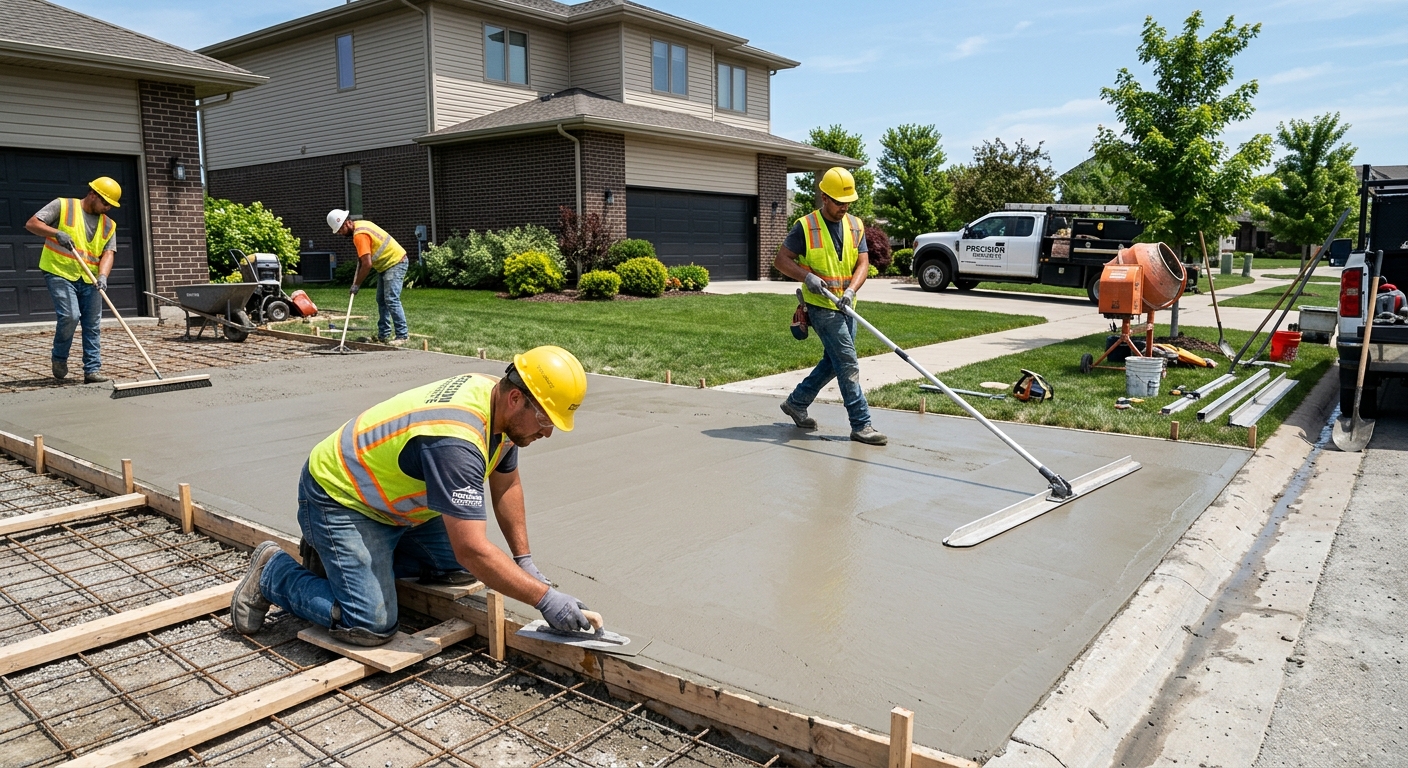
Concrete work options and costs in Dryden
Concrete work in Dryden, Ontario tends to be busiest for homeowners because most housing stock is detached and the community has a strong base of owner-occupants. With 76.6% of dwellings being single-detached homes and 73.1% of households owning their property, driveways, patios, walkway replacements, and garage floors are the projects we see most often. That “small-but-steady” demand is why you’ll find reliable local crews, especially in areas with older housing where upgrades are common.
In the Northwest, cost is shaped by long winters and repeated freeze–thaw cycles. Because frost penetration can run deep, exterior foundations and footings are usually placed about 4–6 ft below grade to help avoid heave. Exterior flatwork also needs air-entrained mixes and good drainage details, and contractors often price with the reality of a shorter pour season (late spring through early fall) and the extra time needed for proper curing. In Dryden, trades are especially in demand around McKenzie Avenue and nearby residential blocks where older driveways and entrances are frequently replaced to improve both appearance and drainage.
Below is a practical comparison of common concrete options and typical pricing you can use to benchmark quotes for your specific scope (size, access, and finish all matter).
| Application |
Typical Size |
Key Spec |
Finish Option |
Price Range |
| Concrete driveway (standard broom finish) |
24 ft x 10 ft (240 sq ft) |
Air-entrained mix, control joints, compacted granular base |
Broom finish |
$3,360–$5,280 |
| Exposed aggregate driveway |
24 ft x 10 ft (240 sq ft) |
Air-entrained mix, proper curing and surface retarding/cleaning |
Exposed aggregate |
$4,080–$6,480 |
| Stamped concrete driveway or patio |
20 ft x 12 ft (240 sq ft) |
Air-entrained mix, release agent, joints planned for shrinkage |
Stamped pattern + sealer |
$4,800–$7,680 |
| Plain concrete patio or walkway |
12 ft x 10 ft (120 sq ft) |
Air-entrained mix, drainage grade, control joints |
Steel-trowel or light broom |
$1,440–$2,400 |
| Garage floor (interior slab) |
22 ft x 20 ft (440 sq ft) |
Reinforcement as required, vapour considerations, proper base |
Plain float/finish |
$6,160–$10,120 |
| Foundation footings (structural, below frost) |
Varies by plan (typ. 2 ft x depth of 4–6 ft) |
Below-frost depth, rebar per engineer, proper granular bearing |
Structural concrete |
$180–$260 |
Prices are estimates only and vary by project scope, site access and material selection.
What affects the price of concrete work in Dryden
In Northwestern Ontario, you can see the same “type” of concrete job priced 30–50% apart, even when the finished surface looks similar. The difference is usually in the items that don’t show in photos: excavation depth, granular base and compaction requirements, reinforcement, mix design, and how crews handle cold-weather strength gain. In larger parts of Ontario, the economics of mobilizing equipment and the labour availability during the short pour season also shift pricing.
The biggest driver here is the frost line depth and the region’s freeze–thaw behaviour. Exterior footings and foundations must extend below the design frost depth so the ground doesn’t heave and lift the concrete. That means additional excavation and higher formwork costs in Dryden compared with many southern markets. Exterior slabs also need air-entrained concrete to resist scaling and spalling when water repeatedly freezes and thaws; de-icing salt makes the surface deterioration faster, which is why sealing is often a smart add-on.
Local conditions can raise or lower cost quickly. For example, a driveway built on poor drainage or clay-heavy soil may require deeper granular replacement and extra base, pushing your job toward the higher end of the driveway bands (for many projects, driveway pricing commonly lands in the $14–$22 per sq ft range). A stamped patio can cost more, but the premium can be justified where you want longevity and curb appeal—typical stamped pricing is often in the $20–$32 per sq ft band when the crew needs proper surface preparation and sealing.
Homes built before 1981 are common in Dryden (67.2% of dwellings), and older drainage patterns often contribute to early cracking—so replacements can involve not only new concrete, but also grading corrections that affect the total quote.
| Price Factor |
Why It Matters |
Cost Impact |
| Frost line depth — determines footing depth and form height |
Deeper frost protection prevents heave and settlement |
Higher excavation + formwork can add significant cost on structural pours |
| Site preparation — excavation, grading, compacted granular base |
Weak sub-base leads to settlement and early cracking |
More truckloads and labour push unit cost upward |
| Reinforcement — rebar or wire mesh requirement |
Controls cracking and improves slab durability under load |
Material + placement labour increases the total |
| Mix design — air-entrainment and compressive strength spec |
Air helps resist freeze–thaw scaling in exterior exposure |
Higher-spec materials can raise per-sq-ft pricing |
| Finish type — broom vs. stamped vs. exposed aggregate |
Finish methods require extra steps, tools, and curing/sealing coordination |
Stamped/exposed typically move the project into higher price bands |
| Pour size and concrete truck access to site |
Access limits increase pumping or handwork |
Pumping, extra labour, and waiting time can add cost |
| Cold-weather curing precautions — heating and blankets |
Cold can slow strength gain and increase cracking risk |
Sometimes adds a day of setup and materials (blankets/heaters) |
| Control joint pattern and sealing cost |
Joints manage shrinkage; sealing improves salt resistance |
Proper jointing and sealer typically add line-item cost but reduce failures |
Permits & regulations in Ontario
In Ontario, structural concrete work such as footings, foundation walls, and grade beams generally requires a building permit, and projects are commonly supported by engineered drawings reviewed by the municipality. In most cases, that’s because these elements carry structural loads and must meet code requirements for strength, reinforcement, and below-frost protection.
Concrete flatwork—like driveways, patios, and walkways—typically does not require a permit on its own. However, there are common exceptions where you may need to confirm with the municipality: if the work affects lot grading, impacts impervious surface coverage limits, or changes drainage toward a neighbouring property or municipal right-of-way. Always verify details before you break ground.
For homeowners in Dryden, a solid verification process is worth doing before signing. Step-by-step: (1) ask the contractor for their clearance/insurance documentation and confirm they carry liability insurance; (2) request proof of WSIB/WCB coverage (or exemption where applicable) and verify it matches the legal name on their contract; (3) ask for recent project references similar in scope (driveways and slabs in older neighbourhoods often need extra base correction); and (4) confirm whether any permit is required for your specific drawings and scope with the municipality before scheduling excavation.
Getting concrete right in Dryden's freeze-thaw climate
Concrete failures in Dryden usually come from two places: the ground under the slab and the concrete’s ability to handle freeze–thaw and de-icing salts. If the base isn’t properly compacted and drained, the slab settles and cracks, and water gets under edges during snowmelt. If the mix isn’t air-entrained for exterior exposure, freeze–thaw can cause surface scaling and spalling, which is one of the most expensive and visible problems to repair.
To spec the job correctly for Dryden’s conditions, focus on five things. (1) Base preparation: excavate to the right depth for local soils and frost protection, then place and compact granular base with good drainage. (2) Mix design: for exterior flatwork, use air-entrainment (commonly 5–7% air content) and a minimum 32 MPa compressive strength unless your engineer specifies otherwise. (3) Control joints: cut joints early enough and at proper spacing so shrinkage cracking is controlled. (4) Curing: plan for at least 7 days curing under proper conditions; in cold or wet stretches of the season, crews may need insulating blankets or curing compounds to achieve strength. (5) Sealing: apply a penetrating sealer after cure (often at about 28 days) to help repel salt and moisture.
One dollar example: upgrading a standard broom driveway into stamped concrete may move you from roughly $14–$22 per sq ft toward the $20–$32 per sq ft stamped band. That premium is justified when the contractor also budgets for the correct jointing plan, surface prep, and sealing schedule—otherwise you pay extra for appearance without the durability you need in Dryden.
| Spec |
Why It Matters in Dryden |
What to Ask For |
Impact if Skipped |
| Compacted granular base (depth?) |
Prevents settlement and helps manage water around the slab |
Specify excavation depth and granular thickness + compaction test/verification |
Cracking, uneven settling, and faster deterioration |
| Air-entrained concrete mix (target air %?) |
Improves freeze–thaw resistance and reduces scaling/spalling |
Ask for target air content (commonly 5–7% for exterior exposure) |
Surface damage and early failure from salt + freeze–thaw |
| Compressive strength (MPa rating) |
Ensures adequate strength gain in Dryden’s variable weather |
Confirm minimum 32 MPa (or engineered requirement) |
Lower durability and increased risk of cracking |
| Control joints (spacing per ACI guidelines) |
Controls shrinkage cracking so it happens where you can manage it |
Ask for joint spacing plan and timing of saw-cut |
Random cracks that let water in and accelerate breakdown |
| Minimum 7-day curing period |
Cold conditions can slow strength gain without protection |
Ask how they cure in shoulder-season temps (blankets/heaters if needed) |
Reduced strength and higher chance of early surface defects |
| Penetrating sealer (when applied after cure) |
Helps repel de-icing salt moisture intrusion |
Confirm sealer type and timing (often after cure, around 28 days) |
More salt damage and faster surface deterioration |
How to choose a concrete work contractor in Dryden
Choosing a concrete contractor in Dryden is mainly about verifying that they can deliver cold-weather durability, not just pour concrete. In Ontario, before any work starts, confirm the contractor’s liability insurance (ask for a current certificate of insurance showing your project address if possible) and verify WSIB/WCB coverage—you want proof that workers are covered in case of injury. Then check that the contractor is set up to handle the scope you’re buying: exterior flatwork needs the right mix design and curing plan for freeze–thaw, and structural jobs need the right engineered documentation.
Get 2–3 itemised written quotes so you can compare apples-to-apples: ask for a breakdown of labour, materials (including air-entrained mix spec), excavation and base, reinforcement, finish materials (stamps/aggregate), and sealing if included. Read the scope carefully for exclusions like disposal, replacement of topsoil, saw-cutting and joint sealing, and whether permit pulls are included (usually not needed for simple flatwork, but can apply where drainage/grade changes trigger review).
On warranty, insist on both: a workmanship warranty length and any manufacturer warranty that applies to sealers or specialty products, including whether it’s transferable to you. For payment, never pay more than about 10–15% upfront; hold back payment until the work is complete, inspected, and cleaned up. Ask for a written timeline with a start date and realistic completion estimate based on weather and curing needs.
- Confirm insurance certificate and WSIB/WCB documentation before signing.
- Request at least two references for driveways/patios done in similar freeze–thaw conditions.
- Ask for the mix design details: air-entrainment and minimum strength (e.g., 32 MPa).
- Require a written base prep scope: excavation depth, granular thickness, and compaction method.
- Verify reinforcement plan (mesh vs. rebar) and where it applies (especially garage slabs).
- Clarify control joint layout and saw-cut timing.
- Ask how they handle cold nights and curing (blankets/heaters if needed).
- Get clarity on sealing: product type, when it’s applied, and whether it’s included.
- Check whether disposal, trucking, and spoils removal are included in the quote.
- Confirm concrete truck access and whether pumping or additional labour is required.
- Ensure the quote is itemised, not a single “lump sum” number with missing details.
- Review warranty terms in writing, including what’s excluded (e.g., homeowner-applied chemicals).
Concrete red flags we see in Dryden include: quotes that don’t mention air-entrainment for exterior work, vague wording like “finish as required” without joint spacing, starting pours without a curing plan for cold nights, omitting base preparation details, and requiring large upfront payments with no written schedule or warranty.
Frequently asked questions — concrete work in Dryden
How long does a concrete driveway last?
In Dryden, a well-built concrete driveway often lasts 20–30 years, and sometimes longer, but only if the job is designed for freeze–thaw and salt exposure. The biggest durability factors are a properly compacted granular base, air-entrained concrete, correctly spaced control joints, and a plan for sealing. Dryden’s older housing stock is common—67.2% of homes were built before 1981—so many existing driveways fail sooner because drainage and ground conditions weren’t corrected during original installs. If your contractor is offering a “lowest bid” without specifying air content and jointing, expect earlier scaling and random cracking. Pricing typically aligns with the surface finish: standard broom driveways often fall around the $14–$22 per sq ft band, while stamped options typically move higher due to more steps and finishing.
What is air-entrained concrete and why does it matter here?
Air-entrained concrete is designed with tiny, evenly distributed air bubbles that give freezing water a place to expand. That dramatically reduces surface scaling and spalling when the slab repeatedly experiences freeze–thaw cycles—exactly what we see in Dryden’s Northwest climate. For exterior flatwork, contractors usually target about 5–7% air content and specify adequate strength (often 32 MPa minimum). If a mix isn’t air-entrained, the concrete may look fine at first, but it can degrade quickly once winter starts and de-icing salts get applied. When comparing quotes in Ontario, don’t just compare “square foot price.” Ask the contractor to state the mix spec in writing. Even if the job price lands on the lower end of the driveway band, you may pay more later if durability details are skipped.
How do I prepare the base for a concrete slab?
Base prep is where durable results are won or lost in Dryden. The typical process is: excavate to the required depth, remove topsoil and organic material, then place a compacted granular sub-base with appropriate grading and drainage. The key is not just the thickness, but compaction—weak or poorly compacted base leads to settlement, cracking, and water pathways under edges. For many residential slabs and walkways, the contractor will also include a subgrade inspection before pouring. If you’re replacing an older driveway in neighbourhoods near McKenzie Avenue, expect that drainage issues may be part of the problem, not just the concrete. Ask for the quote to include excavation and granular base details (depth and compaction method). If sealing is planned, confirm it’s applied after adequate curing, often around 28 days for best salt resistance.
How do I compare concrete quotes?
Comparing quotes in Dryden is easiest when they’re itemised. Start by requesting a labour/materials breakdown, not just a single lump-sum number. Make sure each quote includes the same scope: excavation and disposal, granular base thickness, compacted sub-base, reinforcement (mesh/rebar if required), air-entrained mix spec, formwork, and control joint layout. Finish matters too—standard broom is usually less expensive than stamped or exposed aggregate, which is why you might see driveway quotes vary within the $14–$22 per sq ft range for standard work, and higher within the $20–$32 per sq ft band for stamped. Check whether cold-weather curing precautions are included if you’re pouring near the end of the season. Finally, confirm warranty terms and what’s included in sealing (and when it’s applied). If a quote skips these details, it’s not a true like-for-like comparison.
Can concrete be poured in cold weather in Dryden?
Concrete can be poured in colder weather in Dryden, but it’s not “business as usual.” The limiting factor is strength gain: cold slows hydration, and if concrete freezes early, it can weaken and crack. A reputable contractor will use cold-weather procedures like insulating blankets, curing compounds, or heated enclosures when conditions require it. They should also discuss timing—Dryden’s pour season is typically late spring through early fall, and crews may charge a premium if they have to mobilize equipment and take extra curing precautions. When comparing quotes, ask specifically how they’ll protect the pour, how long curing is protected, and whether they’ll adjust mix design or placement practices to achieve required strength. If your quote is unusually low and doesn’t mention curing blankets/heating or cold-weather planning, that’s a risk factor—especially for exterior slabs that will face freeze–thaw and de-icing salt immediately through the first winter.
How do I maintain concrete in Dryden's freeze-thaw climate?
Maintenance is about limiting water and salt contact and keeping edges and joints behaving. In Dryden’s freeze–thaw climate, start by sealing your driveway or patio after the slab has cured (often around 28 days) using a penetrating sealer that repels moisture. Reapply based on the sealer’s label and visual condition. Keep snowmelt and runoff from pooling near slab edges by maintaining a clean drainage grade. When using de-icing products, use them as directed and avoid aggressive treatment that can rapidly accelerate surface wear—especially on older concrete that may already be scaling. Check joints and crack lines seasonally; sealed joints help keep water from migrating under the slab. If you’re planning upgrades, remember that sealing is commonly priced as an add-on and is most effective when paired with proper air-entrained concrete and control joints. Proper construction is why most homeowners get the full value out of their original $14–$22 per sq ft driveway investment.