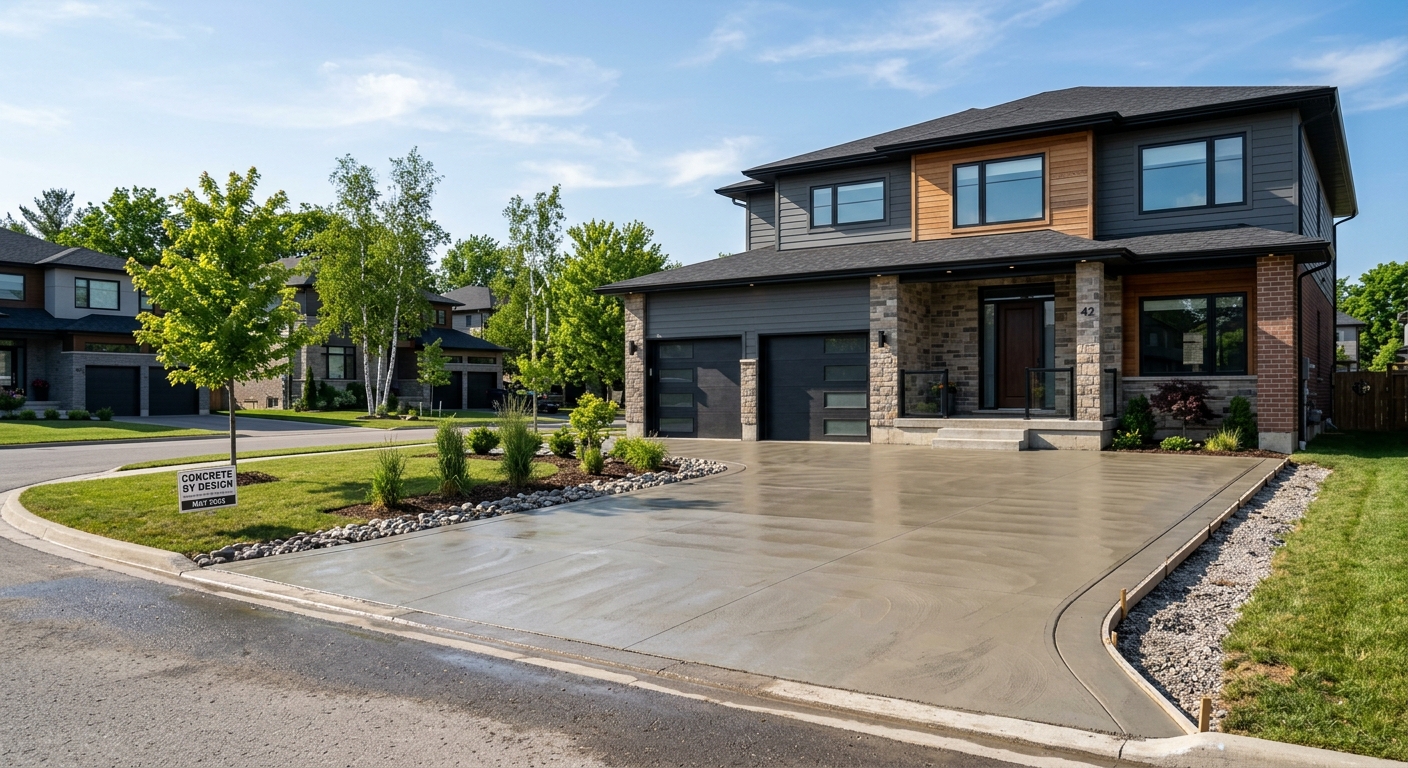
Concrete work options and costs in Newtonbrook East
In Newtonbrook East, concrete work is a year-round discussion but a seasonal reality: homeowners plan pours around Toronto’s freeze–thaw swings, and local trades concentrate work in the warmer months to protect curing. With a population of 16,097 (Statistics Canada, 2021 Census), the area’s steady owner-occupied market keeps demand high for driveways, patios, walkways, and the occasional garage slab replacement. Concrete flatwork is especially common in established pockets where older lots still have driveways that buckle over time from saturated sub-base and repeated winter cycles.
Toronto’s climate shapes the cost more than most people expect. Ontario Building Code expectations for structural durability push most foundation footings to extend at least 1.2 m below grade in typical requirements, and exterior slabs still need an air-entrained mix, proper thickness, and reliable drainage to resist frost heave and surface scaling. In practice, contractors also build in time and labour for base prep, formwork, and jointing so the slab can perform for years rather than seasons.
In Newtonbrook East—particularly around the wider arterial corridors and the family neighbourhoods near Finch Avenue East where lots often have older drainage patterns—concrete contractors tend to get booked quickly for driveway and patio work. If you’re comparing options, the key is not just the look; it’s the mix, base depth, joint layout, and protection during curing. Use the table below to benchmark typical homeowner pricing, then we’ll break down what drives those differences.
| Application |
Typical Size |
Key Spec |
Finish Option |
Price Range |
| Concrete driveway (standard broom finish) |
400 sq. ft. |
Air-entrained mix, compacted granular base, control joints |
Broom finish |
$7,200–$11,200 |
| Exposed aggregate driveway |
400 sq. ft. |
Air-entrained mix, improved curing protection, base prep |
Exposed aggregate finish |
$9,000–$13,500 |
| Stamped concrete driveway or patio |
350 sq. ft. |
Air-entrained mix, colour hardener, sealing-ready surface |
Stamped pattern |
$10,200–$15,400 |
| Plain concrete patio or walkway |
250 sq. ft. |
Drainage slope, compacted granular base, control joints |
Plain finish |
$4,000–$6,500 |
| Garage floor (interior slab) |
420 sq. ft. |
Vapour barrier where needed, reinforcement, 32 MPa concrete |
Broom or smooth finish |
$7,600–$12,600 |
| Foundation footings (structural, below frost) |
Per linear ft. (allowance) |
Excavation + formwork, rebar, concrete to frost-depth spec |
N/A |
$180–$300 |
Prices are estimates only and vary by project scope, site access and material selection.
What affects the price of concrete work in Newtonbrook East
In the Toronto economic region, it’s common to see concrete quotes for the “same” driveway or patio vary by 30–50% once you compare the real scope: base depth, reinforcement, the concrete mix design, and the finishing system. Two contractors can both say “concrete driveway,” but one may include deeper granular base, air-entrained concrete, and joint sealing provisions—while the other may not. When you’re working in Newtonbrook East, the freeze–thaw cycle and local soil moisture are what separate low-cost shortfalls from long-lasting performance.
Frost depth and temperature swings dictate specs everywhere. Exterior footings and structural elements must be placed below the design frost depth to prevent frost heave and differential movement—Ontario typically expects about 1.2 m below grade minimum for many structural applications, with deeper solutions depending on conditions. Driveways, patios, and walkways also require air-entrained concrete mixes so the slab can survive repeated freezing and thawing. In colder shoulder periods, contractors may need cold-weather curing precautions such as insulation blankets and, in some cases, temporary heating—labour and equipment that increase costs. De-icing salt is another issue in winter; if the surface isn’t sealed properly, you can get spalling and faster wear.
Cost can go up in Newtonbrook East when excavation is harder (tight access, tree roots, or poor drainage requiring additional grading), or when you need reinforcement and thicker sections. Costs can be lower when site access is easy and the base is already stable. For example, a plain patio might sit closer to the $16–$26 per sq. ft. range, while a stamped driveway often lands in the $24–$40 per sq. ft. bracket because of colour systems, release agents, and additional finishing labour.
| Price Factor |
Why It Matters |
Cost Impact |
| Frost line depth — determines footing depth and form height |
Proper depth reduces frost heave and movement |
Higher excavation and formwork; can add major cost on constrained lots |
| Site preparation — excavation, grading, compacted granular base |
Base stability controls settlement and cracking |
More granular removal/placement can swing pricing by dozens of percent |
| Reinforcement — rebar or wire mesh requirement |
Controls shrinkage and loading-related cracking |
Materials + placement labour increase unit cost |
| Mix design — air-entrainment and compressive strength spec |
Protects against freeze–thaw damage and scaling |
Specialty mix can raise concrete material costs and affects curing strategy |
| Finish type — broom vs. stamped vs. exposed aggregate |
Finish systems affect labour time and materials |
Stamped/exposed finishes typically cost more per square foot |
| Pour size and concrete truck access to site |
Access limits affect pump/placement method |
Pump charges, longer travel, and staging can increase total labour costs |
| Cold-weather curing precautions — heating and blankets |
Maintains strength gain and durability below ~10 °C |
Added equipment and labour can raise project costs significantly |
| Control joint pattern and sealing cost |
Joints steer cracking and sealer protects against de-icing salts |
More layout time and sealing materials; usually worth it for exterior flatwork |
Permits & regulations in Ontario
In Ontario, structural concrete work generally requires a building permit, and in many cases engineered drawings are reviewed by the municipality. This includes foundation walls, grade beams, structural footings, and any structural slab components tied to the building’s load path. For example, footing and foundation work typically falls under the “permit-required” side because it affects structural integrity and frost protection.
Concrete flatwork such as patios, walkways, driveways and garage slabs often do not require a permit on their own. However, you can still need municipal approvals if the work affects lot grading, changes drainage, or increases impervious surface coverage beyond municipal allowances, or if it impacts the municipal right-of-way (e.g., driveway approach changes). Always confirm before breaking ground—even a small change to slope can affect how water is managed.
To verify an Ontario contractor in Newtonbrook East, check three things in this order. First, verify their licence status through the appropriate online registry sources used in Ontario for construction trades (and confirm they’re authorized for the exact scope). Second, request a certificate of insurance for general liability and verify the coverage limits match the project size; ask for WSIB clearance if they have workers (or appropriate coverage documentation for their workforce). Third, ask for recent references on similar exterior flatwork—driveways and patios exposed to GTA freeze–thaw—so you can see how their jointing, sealing, and curing match the climate challenges in your neighbourhood.
Getting concrete right in Newtonbrook East's freeze-thaw climate
Concrete failures in Newtonbrook East usually follow a familiar pattern: water gets into the slab system, freezes, expands, and then the surface starts scaling or spalling—especially where drainage is poor or air content in the mix is inadequate. The fix is not cosmetic. You spec the job correctly: (1) base preparation so water has somewhere to go and the slab has a stable foundation; (2) mix design tuned for freeze–thaw resistance; (3) control joints placed to control where cracks occur; (4) curing handled carefully, particularly if temperatures fall toward 10 °C or below; and (5) sealing applied after the concrete has properly cured to repel de-icing salts.
For base prep, you want a compacted granular sub-base to the required depth for local soil conditions and frost movement considerations, along with proper slope and drainage. For the mix, exterior flatwork should use air-entrainment—typically around 5–7% air content—to reduce freeze–thaw damage, plus a minimum 32 MPa compressive strength specification. Control joints should be spaced to limit random cracking and coordinate with expansion considerations around edges and posts. Curing should be at least 7 days under suitable conditions, with additional protection if cold weather threatens early strength gain. Finally, penetrating sealer applied 28 days after the pour helps protect the surface from salt intrusion and moisture movement.
When choosing between options, the price difference is justified when it improves durability. For instance, a plain patio might come in around the $16–$26 per sq. ft. band, while stamped work is typically higher (often $24–$40 per sq. ft.). If the contractor also includes the same proper base, air-entrained mix, and jointing plan on both jobs, the higher cost buys aesthetics; but if the cheaper option cuts corners on base or air content, the “savings” usually comes back as repairs. In Newtonbrook East, that’s a costly trade when freeze–thaw and wet springs shorten the window for acceptable curing.
| Spec |
Why It Matters in Newtonbrook East |
What to Ask For |
Impact if Skipped |
| Compacted granular base (depth?) |
Stable base prevents settlement and reduces cracking from moisture/expansion |
Granular sub-base depth and compaction method (and drainage slope) |
Uneven settling, wider cracks, premature surface wear |
| Air-entrained concrete mix (target air %?) |
Freeze–thaw protection reduces scaling and spalling |
Target air content for exterior flatwork (typically 5–7%) and air test plan |
Higher risk of spalling within a few winters |
| Compressive strength (MPa rating) |
Strength gain supports durability under snow loads, vehicles, and de-icing |
Minimum 32 MPa compressive strength specification |
Weaker surface; increased abrasion and cracking |
| Control joints (spacing per ACI guidelines) |
Directs cracking so joints take the movement, not random fractures |
Planned joint layout and spacing (including edge conditions) |
Random cracking and harder-to-repair damage pattern |
| Minimum 7-day curing period |
Early strength gain is critical in Toronto-area swings and wet spring conditions |
Curing plan and how temperature protection is handled when cold snaps occur |
Reduced strength, higher shrinkage cracking and surface weakness |
| Penetrating sealer (when applied after cure) |
Repels de-icing salts and limits moisture movement into the surface |
Penetrating sealer application at 28 days after pour (or per product specs) |
Faster deterioration and more frequent need for patching |
How to choose a concrete work contractor in Newtonbrook East
Start by verifying the contractor’s Ontario compliance and proof you can document. For licensing, confirm the contractor is authorized for the exact work scope they’re offering (especially if they’re doing structural components). For liability insurance, ask for a certificate of insurance naming you as an interested party where applicable, and verify it’s active for the project dates. For workforce coverage, request WSIB coverage or a clearance letter when they have employees—if they don’t, ask how they cover the labour risk. These checks matter in Newtonbrook East because exterior flatwork failure is often tied to labour choices on base prep, joints, and curing, not just materials.
Next, request 2–3 itemised written quotes. You want a breakdown that separates labour and materials, and clearly lists what’s included: base excavation and disposal, granular placement and compaction, reinforcement, concrete mix design, formwork, finishing, joint layout, sealing, and any permit coordination if needed. Avoid “all-in” lump sums that don’t describe exclusions. Ask whether permit pull (if required) is included, and what happens with spoil disposal, site protection, and any necessary excavation beyond the slab footprint.
Warranty matters in concrete. Look for a workmanship warranty length, understand whether it covers labour only or materials as well, and ask whether it transfers if you sell the home. For payment, don’t pay more than 10–15% upfront; hold back a portion until the final cleanup, sealing (if included), and any punch-list items are completed. Finally, insist on a start date and a completion estimate in writing, so weather-driven curing protection and protection of the fresh surface are planned rather than improvised.
- Provide a written scope that lists thickness, base depth, and reinforcement details.
- Confirm they use air-entrained concrete for exterior flatwork.
- Ask how they handle curing if temperatures drop toward 10 °C or below.
- Request a joint layout plan (not “we’ll add some joints”).
- Ensure they state whether penetrating sealer is included and when it will be applied (28 days after pour).
- Ask what is included for excavation, grading, and removal of unsuitable soil.
- Confirm disposal and cleanup are included (not paid extra later).
- Verify liability insurance coverage and request the current certificate.
- Request WSIB clearance or proof of coverage for any employees.
- Get price quotes that itemise labour vs materials (not just one lump number).
- Make sure they provide a workmanship warranty and name what it covers.
- Use a payment schedule with a holdback until you approve final completion.
In Newtonbrook East, concrete contractor red flags include: quotes that skip or underspecify base preparation; no mention of air-entrained mix or jointing; charging large upfront payments without a detailed contract; unwillingness to provide insurance/WSIB proof; and vague timelines that don’t account for curing protection during cold snaps.
Frequently asked questions — concrete work in Newtonbrook East
How long does a concrete driveway last?
In Newtonbrook East and across Ontario’s Toronto region, a properly built concrete driveway commonly lasts 20–30 years, and sometimes longer, when the base is well-prepared, the mix is air-entrained for freeze–thaw, and control joints are installed and maintained. The biggest durability factors are drainage and curing: if the granular base is under-compacted or water can sit under/around the slab, the freeze–thaw cycle accelerates cracking and surface scaling. Salt also plays a role, which is why a penetrating sealer after the concrete has cured (often around 28 days) helps protect the surface. As a reference point, many standard broom-finished driveways fall into the $18–$28 per sq. ft. band; lower pricing often means shortcuts in preparation or mix specs, which reduces lifespan.
What is air-entrained concrete and why does it matter here?
Air-entrained concrete is a freeze–thaw resistant mix that intentionally includes tiny air bubbles throughout the concrete paste. Those micro-bubbles give space for expanding water when temperatures drop below freezing, reducing scaling and spalling on exterior flatwork—exactly the kind of damage seen during Ontario’s winter cycles. In Newtonbrook East, where wet spring thaws and repeated freeze–thaw can stress the surface, air content is one of the most important specs you can ask a contractor to confirm. Contractors should also plan curing protection when temperatures trend lower toward about 10 °C or below. If you’re comparing quotes, don’t accept “we use good concrete” as an answer—ask for the air-entrainment specification (commonly around 5–7% air content for exterior flatwork) and whether they test and document it.
How do I prepare the base for a concrete slab?
Base preparation is where long-term performance is won or lost. For a slab in Newtonbrook East, the contractor should excavate to remove topsoil and any unsuitable material, then grade for slope and drainage so water can’t pool. Next comes a compacted granular sub-base to the design depth that fits local soil conditions and frost considerations; compaction matters as much as the thickness, because poor compaction leads to settlement and random cracking. Proper base prep also reduces the chance that the slab will pump fine material during wet cycles. When you compare quotes, ensure the scope explicitly includes excavation, granular supply and compaction, and any necessary drainage grading. If you see exclusions, you can end up paying for “extra base” later, even if the initial driveway price looked competitive in the $16–$26 per sq. ft. or $18–$28 per sq. ft. bands.
How do I compare concrete quotes?
To compare concrete quotes in Newtonbrook East, focus on apples-to-apples scope, not just the total price. Ask for itemised labour + materials: base excavation and disposal, granular base depth and compaction, reinforcement type and coverage, concrete mix spec (including air-entrainment for exterior), thickness, finishing method, joint layout, and sealing (if included). Confirm whether the contractor plans for cold-weather curing—blankets, insulation, and timing—when temperatures drop toward 10 °C or below. Also check exclusions: is permit work included if it’s required, is site protection included, and are clean-up and waste removal included? Two bids can differ by 30–50% when one includes deeper base prep and proper exterior durability measures and the other doesn’t. A good benchmark: stamped work often sits higher (often near $24–$40 per sq. ft.), while plain patios/sidewalks commonly align with the $16–$26 per sq. ft. band.
Can concrete be poured in cold weather in Newtonbrook East?
Yes, concrete can be poured in cold weather in Ontario, including around Newtonbrook East, but it must be done with proper temperature control and curing protection. The contractor should monitor ambient and slab temperatures and use cold-weather precautions when conditions are near or below the effective curing range (often discussed around 10 °C). That can include insulating blankets, protecting the slab surface, and sometimes temporary heating—so the concrete can achieve early strength gain and not freeze during the first critical period. The goal is consistent curing, because skipping protection increases the risk of early shrinkage cracking and reduced durability. Ask the contractor for their cold-weather curing plan in writing. If they can’t explain how they’ll protect the pour timeline and curing duration, you’re taking avoidable risk—especially for exterior flatwork exposed to GTA freeze–thaw cycles and de-icing salts.
How do I maintain concrete in Newtonbrook East's freeze-thaw climate?
Maintenance in Newtonbrook East is about keeping water out and protecting the surface from de-icing salts. Start with sealing: a penetrating sealer applied after proper curing (commonly 28 days post-pour) helps repel moisture and reduce salt-driven deterioration. Keep the driveway and walkway clear of debris and ensure edges drain properly; if you notice standing water or damp areas, that’s a sign the grading or base drainage may be off. In winter, use de-icers carefully—overuse and harsh chemicals increase surface scaling, especially on unsealed or low-air content concrete. Repair small cracks early with appropriate crack fillers so movement doesn’t turn them into larger failures. Finally, avoid using salt-heavy mixes too aggressively right after a thaw; consistent, moderate treatment is better than repeated heavy applications.