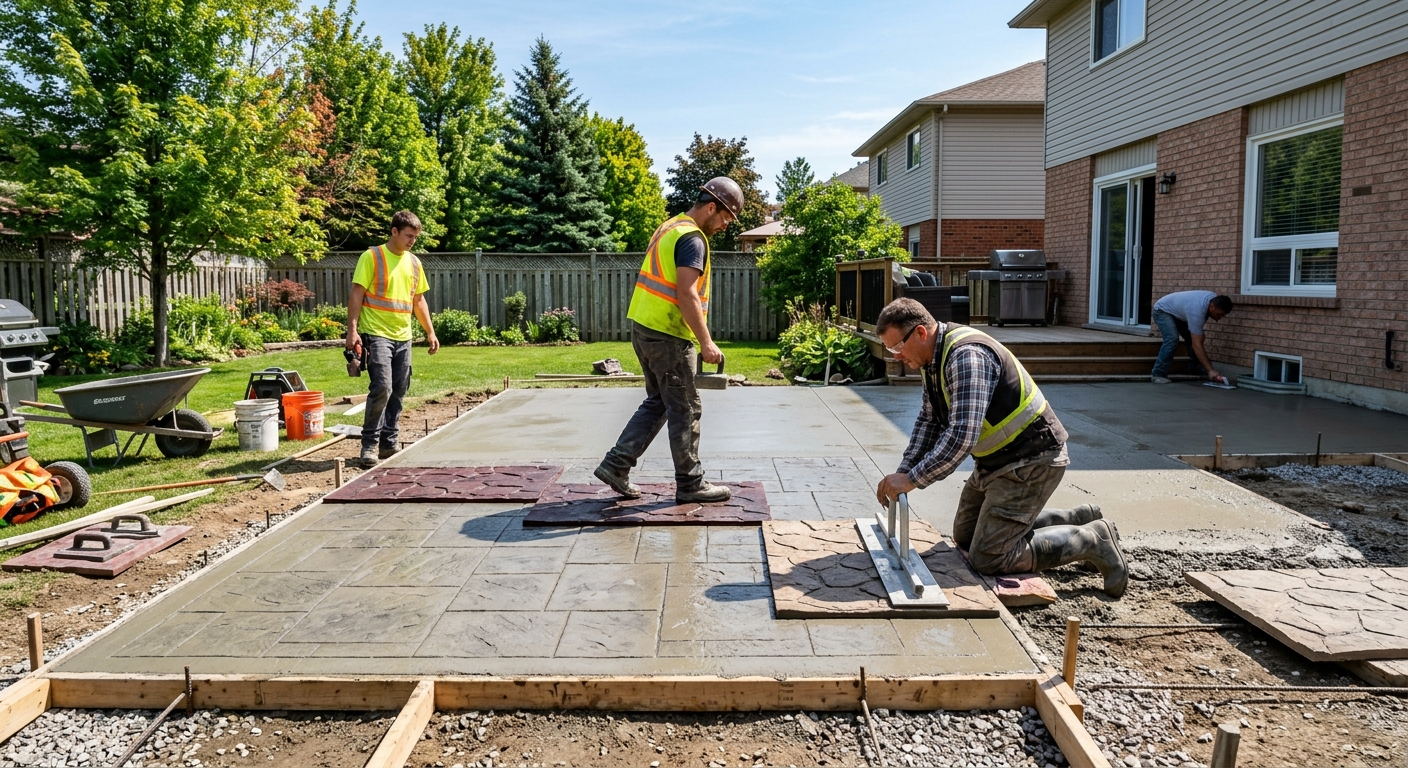
Concrete work options and costs in Bedford Park-Nortown
Concrete work in Bedford Park-Nortown, Ontario is mostly driven by one thing: freeze–thaw. With winter cycles and frequent temperature swings around freezing, exterior flatwork needs the right mix design, a well-compacted granular base, and control joints that are cut and sealed at the right times. Bedford Park-Nortown’s housing stock is a strong fit for driveways, patios and walkway work—there are 23,236 people in the area (Statistics Canada, 2021 Census)—so when homeowners renovate, concrete is one of the trades that stays busy. A lot of the demand is tied to typical family neighbourhood streets near Bedford Park and the Nortown area, where properties often get curb-appeal upgrades and back-yard patio replacements.
Toronto-market pricing also reflects contractor capacity and scheduling. Pours are concentrated in the warmer months because curing slows and surface risk increases when temperatures drop toward about 10 °C or below. That seasonal window, combined with requirements for frost-protected footings (often extending at least 1.2 m below grade for many structural applications), helps explain why quotes for “the same” slab can still vary across the GTA. For example, a basic broom-finish driveway sits on a relatively predictable scope, while stamped or exposed aggregate requires extra finishing time and specialist labour. The section below breaks down typical options and realistic price bands so you can compare proposals apples-to-apples.
| Application |
Typical Size |
Key Spec |
Finish Option |
Price Range |
| Concrete driveway (standard broom finish) |
400–500 sq. ft. |
Compacted granular base, air-entrained mix for exterior |
Broom finish + joints |
$18,000 – $28,000 |
| Exposed aggregate driveway |
400–500 sq. ft. |
Air-entrained mix, proper mix timing for wash/expose |
Exposed aggregate |
$22,000 – $34,000 |
| Stamped concrete driveway or patio |
300–450 sq. ft. |
Air-entrained mix, integral colour, release agent |
Stamped pattern + sealer |
$24,000 – $40,000 |
| Plain concrete patio or walkway |
180–300 sq. ft. |
Granular base + drainage, control joints |
Broom or smooth finish |
$16,000 – $26,000 |
| Garage floor (interior slab) |
300–450 sq. ft. |
Vapour barrier (if specified), proper thickness and finishing |
Standard broom finish or smooth trowel |
$8,500 – $14,000 |
| Foundation footings (structural, below frost) |
Per linear footing, typical home |
Structural concrete, rebar, below frost depth |
Structural formwork + reinforcement |
$180,000 – $300,000 |
Prices are estimates only and vary by project scope, site access and material selection.
What affects the price of concrete work in Bedford Park-Nortown
In Toronto and the wider Ontario market, it’s common to see concrete quotes for the same general project vary by 30–50%. The difference usually isn’t “who’s cheaper,” it’s scope and spec details: base depth and compaction, the exact concrete mix (especially air-entrainment for freeze–thaw), reinforcement requirements, and how much concrete has to be transported and placed without damaging landscaping. In Bedford Park-Nortown, those choices are influenced by frost depth and the region’s freeze–thaw cycles. Structural footings typically need to extend below design frost depth—often at least 1.2 m for many structural applications—so the soil doesn’t heave and create differential settlement. For exterior slabs and flatwork, an air-entrained mix is standard because it helps concrete survive repeated freezing and thawing.
Quotes also change with timing. When temperatures drop toward about 10 °C or below, contractors need cold-weather curing precautions like insulated blankets or temporary heating to keep hydration on track. That adds labour time and consumables, which is why a driveway pour booked later in the season often costs more. De-icing salt accelerates surface wear and can increase risk of spalling; sealing and proper curing reduce that risk.
Concrete examples in Bedford Park-Nortown: (1) If your driveway replacement requires removing an older slab and hauling away broken material, disposal and excavation can add thousands; (2) if the subgrade is clayey or waterlogged, the granular base depth and drainage correction increase material and compaction time; (3) if you want stamped concrete, the labour and colour/sealer system push you from the base driveway band into the higher stamped & decorative range (for reference, stamped work is commonly in the $24,000 – $40,000 band, while broom-finish driveway work is often in the $18,000 – $28,000 band). Even neighbourhood specifics matter—many homes were built decades ago, so older service lines or undersized drainage can surface during excavation, changing the final price by design.
| Price Factor |
Why It Matters |
Cost Impact |
| Frost line depth — determines footing depth and form height |
Controls how far below grade the concrete must go to prevent frost heave |
Higher depth increases excavation, rebar, and concrete volume |
| Site preparation — excavation, grading, compacted granular base |
Stable base prevents settlement and cracking |
More removal and deeper granular base increases material and labour |
| Reinforcement — rebar or wire mesh requirement |
Improves crack control for slabs and structural elements |
Extra steel and placement labour adds cost, especially for driveways |
| Mix design — air-entrainment and compressive strength spec |
Freeze–thaw resistance depends on correct air content and strength |
Higher-spec concrete costs more but reduces long-term repairs |
| Finish type — broom vs. stamped vs. exposed aggregate |
Finishing time and materials differ |
Stamped/exposed systems can add substantial labour and sealer costs |
| Pour size and concrete truck access to site |
Placement method changes labour and logistics |
Limited access can require additional equipment/hand placement |
| Cold-weather curing precautions — heating and blankets |
Concrete needs controlled conditions for proper strength gain |
Adds labour hours, insulation blankets, and sometimes equipment rental |
| Control joint pattern and sealing cost |
Joints manage shrinkage cracking and sealing protects edges |
Better jointing and sealing typically adds a small upfront cost with big durability payoff |
Permits & regulations in Ontario
In Ontario, most structural concrete work needs a building permit. That includes foundations and below-grade structural elements such as footings, foundation walls, grade beams, and other structural concrete. These projects are often reviewed with engineered drawings, particularly where loads, reinforcement, or soil conditions affect design. For concrete flatwork—driveways, patios, and walkways—a permit is often not required as long as you’re not changing lot grading, adding or changing drainage in a way that affects municipal approvals, or altering impervious surface coverage/right-of-way requirements. Still, the safest approach in Bedford Park-Nortown is to confirm with the local authority before you break ground.
Before hiring, verify three things step-by-step: (1) contractor credentials—use the Ontario online registry or the contractor’s licence number to confirm the business is active and eligible for the scope; (2) liability insurance—ask for a Certificate of Insurance showing current coverage and the effective dates; (3) WSIB/WCB coverage—request proof of coverage/clearance so you’re not stuck with exposure if someone is injured on your property. Also ask for references on similar-scale projects (exterior slabs with freeze–thaw specs, not just interior floors). A reputable crew should readily provide paperwork before work starts, not after.
Getting concrete right in Bedford Park-Nortown's freeze-thaw climate
Concrete can fail quickly in Bedford Park-Nortown when the base is wrong, the mix isn’t truly air-entrained for exterior exposure, or curing and joints are treated as “optional.” The most common problem I see in this region is spalling and early surface deterioration caused by inadequate air-entrainment and poor finishing/cure timing. In a freeze–thaw cycle, water gets into the slab or near-surface pores; if the concrete isn’t built to tolerate that expansion, you’ll see scaling and flaking, especially where de-icing salt contacts the surface.
To spec the job correctly, focus on five essentials. (1) Base preparation: provide a properly graded, compacted granular sub-base to the design thickness so the slab doesn’t move. (2) Mix design: use air-entrained concrete (typically 5–7% air content for exterior flatwork) and a minimum compressive strength such as 32 MPa for the job spec. (3) Control joints: plan the joint spacing so shrinkage cracking happens where it’s designed. (4) Curing: protect and cure for at least 7 days under appropriate conditions; when temperatures fall toward about 10 °C or below, curing blankets or other cold-weather precautions may be necessary to keep strength development on track. (5) Sealing: apply a penetrating sealer after the concrete has cured—often around 28 days—to help repel salt and moisture at the surface.
As a dollar example: if your driveway is being replaced, spending to ensure correct air-entrainment and a properly compacted base is usually more cost-effective than “saving” a few thousand up front and dealing with surface scaling later. When you compare a standard broom-finish driveway in the $18,000 – $28,000 band to stamped concrete in the $24,000 – $40,000 band, the higher price for decorative work is justified by labour-intensive finishing plus colour and sealer systems—just make sure those basics (air, base, joints, cure) are never skipped.
| Spec |
Why It Matters in Bedford Park-Nortown |
What to Ask For |
Impact if Skipped |
| Compacted granular base (depth?) |
Stable base prevents settlement and cracking under freeze–thaw |
Documented excavation depth and granular base thickness with compaction testing |
Uneven settlement, cracking, and early edge failure |
| Air-entrained concrete mix (target air %?) |
Air pockets help concrete tolerate freeze–thaw expansion |
Specify target air content (typically 5–7%) and exterior exposure mix |
Scaling/spalling and fast surface deterioration |
| Compressive strength (MPa rating) |
Strength gain supports durability and reduces surface wear |
Minimum 32 MPa (or project-specific engineered value) |
Lower strength, increased cracking and wear |
| Control joints (spacing per ACI guidelines) |
Controls where shrinkage cracks occur during cure |
Joint spacing plan and joint-cut timing |
Random cracking, water infiltration, joint failure |
| Minimum 7-day curing period |
Cold or wet conditions slow hydration and affect strength development |
Protection plan; cold-weather curing method if needed |
Reduced strength and higher risk of early damage |
| Penetrating sealer (when applied after cure) |
Helps repel moisture and de-icing salts that attack surfaces |
Penetrating sealer after curing (commonly around 28 days) |
Faster scaling and staining, especially near edges and traffic lanes |
How to choose a concrete work contractor in Bedford Park-Nortown
Start by verifying the contractor’s Ontario credentials and coverage. For licensing, use the contractor’s licence number (if provided) to check it through Ontario’s online resources for active status. For liability insurance, request a current Certificate of Insurance naming you as an interested party if possible, with coverage that fits the project value. For WSIB/WCB, ask for proof of coverage or clearance—this is especially important on outdoor work where crews are exposed to wet ground, cutting tools, and equipment movement.
Next, get 2–3 itemised written quotes, not just a single lump sum. Ask for a breakdown showing excavation and disposal, granular base depth and compaction approach, reinforcement (if included), concrete mix and finishing, jointing, and sealing. Also read the exclusions: is the permit pull included where required, is material haul-away included, and who manages protection of landscaping? A good quote lists what happens if you find poor subgrade, old fractured concrete, or drainage issues during demo.
Warranty matters too. Ask for a clear workmanship warranty length and what it covers (for example, workmanship-related cracking or spalling within a defined period) and confirm whether any product/manufacturer warranty applies to sealer or decorative systems and whether it’s transferable. Keep payments sensible: never pay more than 10–15% upfront; use a holdback until the job is complete and cleaned up. Finally, get the timeline in writing with a start date, expected curing protection period, and finish dates.
- Confirm licence/registration status before signing anything.
- Request Certificate of Insurance with current effective dates.
- Provide WSIB/WCB proof or clearance letter.
- Ask for 2–3 recent local references with similar freeze–thaw exterior work.
- Get itemised quotes (base, excavation/disposal, reinforcement, concrete supply, finishing, joints, sealing).
- Make sure air-entrainment and minimum strength (e.g., 32 MPa) are stated.
- Ask how they handle cold-weather curing if temperatures drop.
- Verify joint pattern: where joints go and when they’ll be cut.
- Clarify sealing plan (penetrating sealer) and when it’s applied after cure.
- Confirm truck access plan and whether any equipment is needed for placement.
- Check protection measures for landscaping, sidewalks, and driveways during curing.
- Agree on payment schedule: small deposit, then progress payments with a holdback.
Concrete red flags in Bedford Park-Nortown: vague scope (“we’ll pour concrete”), no mention of air-entrained mix for exterior, missing details on base depth/compaction, quotes that don’t address disposal or drainage corrections, and contractors who want the full payment up front or won’t show insurance/WSIB paperwork.
Frequently asked questions — concrete work in Bedford Park-Nortown
Stamped vs broom-finish concrete — cost difference?
In Bedford Park-Nortown, stamped concrete is usually more expensive than broom-finish because it requires more labour time (forms/release agent, pressing tools, and careful finishing), plus typically decorative colour and a more protective sealing routine. For a driveway or patio, broom-finish work often lands around the $18,000 – $28,000 band (scope dependent), while stamped & decorative concrete commonly sits in the $24,000 – $40,000 range. The right comparison is always “same base, same thickness, same air-entrained mix, same joint plan”—decorative work shouldn’t replace the fundamentals that protect against freeze–thaw spalling. If a quote for stamped concrete doesn’t clearly include air-entrainment, control joints, and proper curing, it’s not a fair apples-to-apples comparison.
When is the best time to pour concrete in Bedford Park-Nortown?
The best time in Ontario’s Toronto economic region is late spring through early fall when you can maintain curing conditions. In Bedford Park-Nortown, exterior flatwork is sensitive to temperature drops; when conditions move toward around 10 °C or below, contractors may need insulating blankets or heating to keep the concrete developing strength properly. That seasonal reality affects availability too—Crews often prioritize projects when the forecast supports a reliable pour and protection window. If you’re planning a driveway, patio, or walkway replacement, schedule early enough that you can pour before fall weather becomes unpredictable. If work must happen in cooler weeks, ask how they’ll protect the slab and how long they’ll keep it insulated for proper curing.
How long does concrete take to cure?
For most exterior concrete in Bedford Park-Nortown, plan for minimum curing time of about 7 days for basic strength development, with continued hydration after that. Even when concrete feels hard quickly, it’s not fully mature. That’s why good contractors protect the surface during the early period—especially in GTA conditions where damp weather and temperature swing can interrupt curing. For sealer, many homeowners ask about timing: penetrating sealers are typically applied after the concrete has cured sufficiently, often around the 28-day mark, so the sealer bonds properly and doesn’t trap moisture. Ask your contractor to specify curing protection (including cold-weather precautions if needed) and to include curing duration in the schedule.
Do I need a permit for concrete work in Ontario?
In Ontario, structural concrete work generally requires a building permit. That includes footings, foundation walls, grade beams and other structural concrete elements. Concrete flatwork like patios, walkways, and driveways often does not require a permit unless it impacts lot grading, drainage approvals, impervious surface coverage limits, or the municipal right-of-way. For a Bedford Park-Nortown homeowner, the practical step is to confirm with the local authority before you start excavation—especially if you’re modifying drainage patterns or changing how water runs off your property. Also verify your contractor’s coverage and paperwork (liability insurance and WSIB/WCB proof). If you’re unsure whether your scope triggers permitting, ask the contractor to outline exactly what they’re planning and what they’ve handled successfully on comparable jobs.
Concrete vs pavers for a patio in Bedford Park-Nortown?
Concrete and pavers can both work well in Bedford Park-Nortown, but freeze–thaw is the deciding factor for long-term performance. A concrete patio done correctly—air-entrained mix, compacted granular base, control joints, and proper curing—typically offers a consistent surface and fewer gaps that can collect debris. Pavers can be excellent too, especially if you want flexibility in repairs, but they depend heavily on proper base layers and edge restraint; if the bedding isn’t right, pavers can heave or shift over time. Cost-wise, concrete patios often fall into the $16,000 – $26,000 band depending on size and finish, while paver costs vary widely with material selection and labour intensity. Ask both contractors to describe base design, drainage, and jointing details before choosing.
How long does a concrete driveway last?
A well-built concrete driveway in Bedford Park-Nortown commonly lasts decades, but that lifespan hinges on the freeze–thaw-ready design: air-entrained exterior mix, correct base compaction, proper joint patterning, and sealing after cure. If your driveway is exposed to road salt and is placed on a weak or poorly drained sub-base, you can see scaling and spalling earlier. As a baseline expectation, many homeowners plan for long service life when the spec is right; when it’s not, you may be dealing with repairs far sooner. Cost and finish matter too—standard broom-finish driveways tend to be more predictable (often around $18,000 – $28,000), while decorative finishes can cost more but still require the same durability fundamentals. During quoting, insist on details for base depth, air content, curing protection, and whether sealing is included.