Concrete work options and costs in Northward
In Northward, concrete work is one of the most common exterior upgrades homeowners tackle, especially as families age in place and want lower-maintenance yards. With a small population of 1,003 residents (Statistics Canada, 2021 Census), you tend to see fewer crews available locally at peak season, so scheduling and access can affect pricing. That matters because concrete flatwork—driveways, patios and walkways—is most often installed on the housing stock typical to the broader Toronto area, where single-detached properties drive demand for durable outdoor surfaces and garage upgrades. In the Toronto economic region, costs are strongly shaped by frost depth and freeze–thaw cycles. The Ontario Building Code and local permit requirements typically push structural footings down to at least 1.2 m below grade to reduce frost heave and differential movement, and that alone changes excavation, form height, and restoration scope. For exterior slabs, contractors also price for air-entrained concrete, adequate thickness, and proper drainage so saturated soils don’t expand and contract against the slab every winter.
In neighbourhoods with older, more established lots—where drainage problems and shallow existing bases are common—contractors often spend more time on demo, grading and base rebuilds before placing concrete. In Northward, that’s why you’ll often see variance between a “same-size” patio quote and what the final invoice reflects: the soil condition and access are usually the real drivers. Use the comparison table below to anchor your expectations before you ask for an itemised quote.
| Application |
Typical Size |
Key Spec |
Finish Option |
Price Range |
| Concrete driveway (standard broom finish) |
16 m2 (approx. 12 ft x 14 ft) |
Air-entrained mix, compacted granular base, control joints |
Broom finish |
$2,000–$3,500 |
| Exposed aggregate driveway |
16 m2 (approx. 12 ft x 14 ft) |
Air-entrained mix, carefully timed wash/expose, thicker wear surface |
Exposed aggregate |
$2,800–$4,300 |
| Stamped concrete driveway or patio |
28 m2 (approx. 10 ft x 30 ft patio/entry section) |
Air-entrained mix, integral colour, release agent, sealing |
Stamped pattern |
$3,700–$6,800 |
| Plain concrete patio or walkway |
12 m2 (approx. 6 ft x 20 ft) |
Proper drainage slope, compacted base, air-entrained concrete |
Plain broom or smooth-trowel top |
$1,200–$2,900 |
| Garage floor (interior slab) |
34 m2 (approx. 18 ft x 18 ft) |
Interior-ready mix, vapour control measures if required, rebar/wire mesh |
Broom finish or light trowel (per use) |
$1,900–$4,400 |
| Foundation footings (structural, below frost) |
Per home footprint segment (typical short-form scope) |
Excavate to design depth (commonly 1.2 m+), reinforced structural concrete |
Formwork and rebar (engineered) |
$1,800–$3,800 |
Prices are estimates only and vary by project scope, site access and material selection.
What affects the price of concrete work in Northward
If you ask three contractors for the “same” driveway or patio in Ontario, it’s not unusual to see bids differ by 30–50%. In the Toronto economic region, that spread comes from how each crew estimates the parts homeowners don’t see: excavation to the right footing depth, hauling away unsuitable soil, base prep and compaction, reinforcement requirements, and whether they include cold-weather protections for curing. Frost depth and freeze–thaw cycles dictate the specs. Structural footings must extend below design frost depth (commonly at least about 1.2 m in Ontario) so water doesn’t freeze under the slab and push it upward. Exterior slabs also rely on air-entrained mixes to handle repeated freezing and thawing. When temperatures drop toward 10 °C or below, curing becomes slower and more sensitive, so contractors may need insulating blankets, timed pour strategies, and extra protection—those steps add labour and material costs.
De-icing salts add another Ontario-specific stressor: they can accelerate surface spalling if the concrete and curing aren’t right, which is why sealing is often recommended. In Northward, costs can rise when you find soft, wet areas that require deeper granular base replacement before pouring, or when an existing driveway needs partial demo and regrading to achieve proper drainage. Conversely, costs can come down when the site is level, access is easy for a concrete truck, and the old slab is already at the correct elevation for a grind-and-overlay approach (only when conditions allow). As a quick anchor, a plain concrete patio often sits around the $16–$26 per m2 band, while stamped work typically lands in the $24–$40 per m2 range because it needs colour, stamps and more finishing labour.
| Price Factor |
Why It Matters |
Cost Impact |
| Frost line depth |
Determines footing depth and required form height to reduce frost heave |
Higher depth = more excavation, reinforcement, and concrete volume |
| Site preparation |
Excavation, grading, and compacted granular base prevent water-driven movement |
Soft soil or poor drainage can add several days and added base material |
| Reinforcement |
Rebar or wire mesh controls cracking in restrained slabs |
Material + labour to place and support reinforcement |
| Mix design |
Air-entrainment and compressive strength affect freeze–thaw durability |
Specialty mix can cost more but reduces premature spalling |
| Finish type |
Broom vs. stamped vs. exposed aggregate changes labour and material steps |
Stamped/exposed finishes add colour, equipment, and time |
| Pour size and concrete truck access to site |
Large pours need efficient scheduling; limited access can force smaller loads |
Access issues can increase labour, wait times, and delivery costs |
| Cold-weather curing precautions |
Heating and blankets protect strength gain when temps drop |
More protection = higher material and crew time |
| Control joint pattern and sealing cost |
Joints manage cracking; sealing helps repel de-icing salts |
Proper jointing reduces random cracking; sealing adds a post-pour step |
Permits & regulations in Ontario
In Ontario, structural concrete work typically needs a building permit. That includes footings, foundation walls, grade beams, and any foundation elements that form part of the structure. Many of these projects also require engineered drawings that the municipality (and your designer/engineer) review before work begins. For concrete flatwork like driveways, patios and walkways, a permit is often not required by itself—however, you still need to confirm whether the work affects lot grading, changes surface water runoff, or impacts municipal rules around impervious surface coverage or drainage/servicing. If your slab ties into a foundation, alters drainage patterns, or requires work close to municipal right-of-way, ask your building department before breaking ground.
Before you hire anyone in Northward, verify the contractor carries liability insurance and WSIB/WCB coverage. Here’s a homeowner-friendly step-by-step process: (1) request a certificate of insurance and confirm the coverage amount and effective dates; (2) ask for WSIB/WCB clearance details (or the applicable coverage documentation) and ensure it matches the work type; (3) verify the licence/registration information through the appropriate provincial registry or the contractor’s posted documentation; (4) check references on comparable projects (same finish type and roughly the same site conditions) and ask to see photos taken in freeze–thaw seasons. If they can’t produce documentation quickly, that’s a red flag—concrete failures are expensive, and you want the protection in place before the first load arrives.
Getting concrete right in Northward's freeze-thaw climate
Concrete fails in Northward mainly when it can’t handle water movement during freeze–thaw cycles. The most common problems we see are spalling and surface scaling from inadequate air-entrainment, plus cracking from a weak or poorly drained base that allows movement under the slab. The right way to spec the job in the Toronto region is to build from the ground up: (1) base preparation—excavate to the correct depth and place a compacted granular sub-base sized for local soil and frost conditions; (2) mix design—require air-entrainment and a minimum compressive strength rating appropriate for exterior exposure; (3) control joints—place and finish joints so cracking happens where you planned it, not randomly; (4) curing—allow proper curing time and protect the concrete when temperatures drop, because strength gain slows quickly when conditions get cold; and (5) sealing—apply a penetrating sealer after the slab has cured so water and de-icing salts don’t aggressively attack the surface.
For exterior flatwork, ask for a mix with 5–7% air content and a minimum 32 MPa compressive strength. For control joints, you want spacing that limits random cracking—then sealing 28 days post-pour helps protect against winter salt exposure. If you skip these steps, you might “save” money up front on materials, but the repairs in freeze–thaw Ontario are rarely minor. For example, upgrading from a basic broom-finish patio to a more durable exposed aggregate or properly detailed stamped finish can move you toward the $24–$40 per m2 band versus the plain $16–$26 band. That difference is justified when the contractor also improves base prep, jointing and curing—otherwise you pay for aesthetics without buying durability.
| Spec |
Why It Matters in Northward |
What to Ask For |
Impact if Skipped |
| Compacted granular base (depth?) |
Ensures the slab doesn’t move as soils expand/contract in freeze–thaw |
Depth to match soil/frost exposure plus proof of compaction |
Settlement, rocking, and early cracking |
| Air-entrained concrete mix (target air %?) |
Protects concrete from freeze–thaw damage from trapped water |
Exterior air content of 5–7% |
Spalling and scaling, especially near edges |
| Compressive strength (MPa rating) |
Gives enough strength for durability under winter conditions and loads |
Minimum 32 MPa for exterior flatwork |
Reduced abrasion resistance and premature surface wear |
| Control joints (spacing per ACI guidelines) |
Controls where cracks form as the slab shrinks/expands |
Joint pattern and spacing consistent with the slab size and details |
Random cracking that’s harder to repair cleanly |
| Minimum 7-day curing period |
Curing helps strength development before winter exposure |
Confirm protection plan when temperatures fall; cure to at least 7 days |
Weak early-age concrete and higher risk of surface damage |
| Penetrating sealer (when applied after cure) |
Repels moisture and slows salt intrusion in freeze–thaw years |
Apply penetrating sealer after full cure, typically at 28 days |
More scaling/spalling and faster deterioration |
How to choose a concrete work contractor in Northward
Choosing the right concrete contractor in Northward comes down to documentation, clarity, and how they manage risk in a freeze–thaw climate. First, verify Ontario licensing/registration details (where applicable), then confirm liability insurance is active and adequate for the job size. Ask for WSIB/WCB coverage information for the crew who will be on-site—don’t rely on a verbal “we’re covered.” Next, request 2–3 itemised written quotes that break out labour and materials separately. You want line items for excavation and disposal, granular base and compaction, reinforcement, concrete supply (including mix design/air entrainment), forming and finishing, and—if included—sealing.
Read the scope carefully. What’s excluded (old slab demo, tree root removal, snow cover protection, or repairs if the base is unstable)? Is the permit pull included when structural elements or grade-related issues apply? Disposal included? If they’re vague, you can end up paying for “extras” mid-pour. Also confirm warranty terms: workmanship warranty length, how long they stand behind cracking and settlement, and whether the product/manufacturer warranty applies to the finish materials and sealer. Payment schedule matters: never pay more than 10–15% upfront, and use a holdback until the job is fully completed and cleaned up.
Finally, insist on a written timeline with a start date and completion estimate. In Ontario, pour scheduling can shift with weather and curing needs; reputable contractors will explain how they’ll protect concrete when temperatures fall and what “cold-weather plan” they use.
- Ask for proof of liability insurance (certificate) and verify dates and coverage limits.
- Request WSIB/WCB coverage documentation for the workers who will be on-site.
- Confirm contractor registration/licence information and that it matches the legal entity on the quote.
- Get 2–3 itemised quotes with labour and material line items (not just one lump sum).
- Require explicit base scope: excavation depth, granular type, and compaction proof.
- Confirm concrete mix details: air-entrainment for exterior work and minimum strength spec.
- Ask about reinforcement: when rebar or mesh is used and how it’s supported.
- Require a jointing plan: spacing and where joints will be placed.
- Clarify curing and cold-weather protection plan, including blankets/heating if needed.
- Ask whether sealing is included, and if not, confirm product type and timing (after cure).
- Review protection and cleanup: site safeguarding, washout location, and debris removal.
- Set payment terms in writing: limit upfront to 10–15% and hold back until final completion.
Concrete red flags in Northward include: (1) quotes that don’t mention air-entrainment or control joints for exterior flatwork; (2) contractors who want large upfront payments (well above 15%) without a clear contract; (3) vague promises like “we’ll fix the cracks later” without a warranty; (4) missing insurance/WSIB documentation; and (5) no plan for curing protection when temperatures drop toward the low teens or below.
Frequently asked questions — concrete work in Northward
How do I seal concrete to protect it in Northward?
In Northward (and across Ontario), sealing is about keeping water and de-icing salt from aggressively soaking into the concrete surface during freeze–thaw cycles. For best results, use a penetrating sealer (not just a surface film) applied after the slab has fully cured—typically about 28 days post-pour for new concrete. Before sealing, the surface should be clean and dry: remove dust, construction residue and any curing compounds that could interfere with adhesion. If you’ve already got spalling or active scaling, sealing won’t “repair” it; the contractor should assess and address the cause (often air-entrainment, curing, or base/drainage issues). For planning, sealing is usually a separate step, and it’s commonly paired with exterior jobs that also need proper jointing to limit cracking.
What is the difference between concrete and cement?
In everyday conversation people use the words interchangeably, but they’re not the same. Cement is one ingredient: a fine powder that reacts chemically with water to create strength. Concrete is the full manufactured product—cement plus water, sand, gravel (or stone), and (for exterior Ontario work) air-entraining admixtures to handle freeze–thaw. That’s why a good quote will specify mix design or performance requirements like air-entrainment and minimum compressive strength, not just the word “cement.” In Northward, the most important distinction for durability is that the mix properties (especially air content and strength gain during curing) determine whether you get spalling in the first few winters or long-term surface stability.
How much does concrete work cost in Northward?
Concrete pricing in Northward generally follows the Toronto region’s cost drivers: deeper/required specs for structural work, air-entrained mixes for exterior slabs, and more careful curing and protection when temperatures fall. As a quick anchor, patios and walkways commonly fall within the $16–$26 per m2 range, while exterior stamped/decorative work often lands within the $24–$40 per m2 band because it includes colour, stamping labour and extra finishing steps. Driveways in the Toronto market typically range around the $18–$28 per m2 band for standard broom-finish work, and foundation footings (structural, below frost) are usually quoted by scope within the $180–$300 per m of footing line items depending on engineering and excavation conditions. Your final number depends heavily on soil/base condition and access for concrete trucks.
How deep must footings be for Northward's frost line?
For Northward in Ontario, structural footings generally need to extend below the design frost depth to prevent frost heave and differential movement. In practice across the region, local requirements commonly target at least about 1.2 m (roughly 4 ft) below grade for many footing designs, but the exact depth should follow the building permit drawings and local frost protection assumptions. That’s why you should not rely on a “neighbour’s footing depth” as your spec—engineering and site conditions can change the answer. If a contractor proposes shallow footings without referencing the approved design, that’s a serious quality and compliance concern. Deeper excavation can raise costs, but it protects against movement that leads to cracks and structural issues over the years.
Why does concrete crack in Northward and how is it prevented?
Concrete cracks are common in Ontario because the slab shrinks as it cures and then moves during freeze–thaw and moisture changes. In Northward, the prevention strategy focuses on controlled cracking and durability: proper base prep and drainage, air-entrained mix for exterior exposure, and a planned joint layout. Control joints are designed so cracks form where you planned them and can be maintained, rather than splitting randomly through the field. Contractors also protect curing—especially when conditions cool—because inadequate curing can leave early-age concrete weaker and more vulnerable. Sealing helps repel water and salt intrusion that can worsen surface damage. If you keep hearing “concrete always cracks,” the real question is whether the contractor designed joints and specs to manage those cracks predictably.
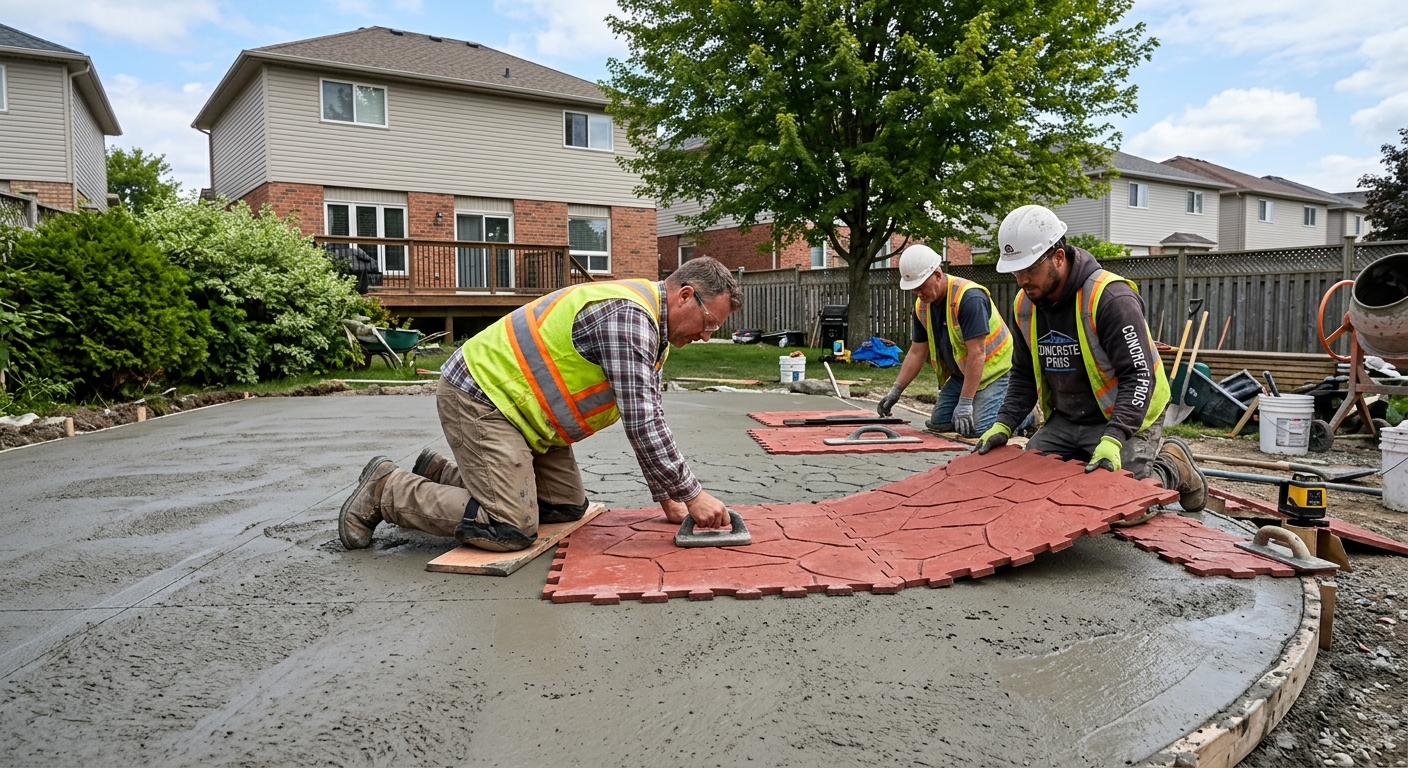
Stamped vs broom-finish concrete — cost difference?
Stamped concrete typically costs more than broom-finish because the process is labour- and material-intensive. Broom-finish flatwork is straightforward: you place concrete, strike, finish, and add broom texture plus joints. Stamped work adds integral colour (or colour hardener/antique treatments depending on the system), release agent, stamping mats, extra labour to get consistent pattern depth, and a sealing step designed for exterior wear. In Ontario pricing terms, broom-finish driveways and slabs often sit closer to the $18–$28 per m2 band, while stamped/decorative work commonly falls in the $24–$40 per m2 band. The best value comes when the contractor doesn’t cut corners on base prep, air-entrainment, joint spacing and curing—those durability specs matter as much as the appearance in Northward’s winter conditions.