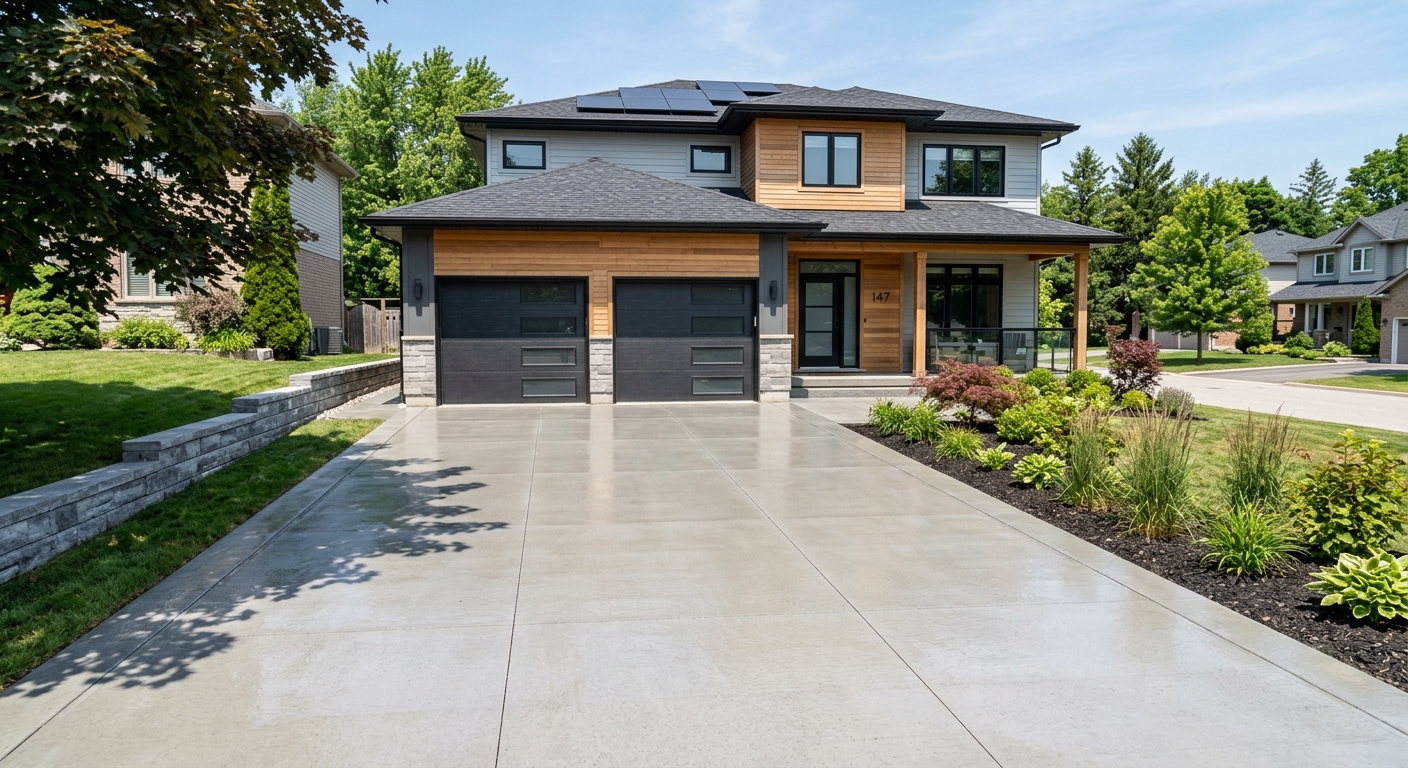
Concrete work options and costs in North Riverdale
Concrete work in North Riverdale, Ontario is in high demand because this part of Toronto has a steady mix of older neighbourhood housing and long-established properties where driveways, patios and walkways are routinely renewed. With a 2021 population of 11,916 residents (Statistics Canada, 2021 Census), the area’s renovation pace is enough to keep concrete crews busy, particularly around busy corridors and side streets where access can be tight. North Riverdale also tends to have a lot of single-family homes and laneway-style property layouts, which means homeowners commonly upgrade exterior flatwork for better curb appeal and drainage control.
In the Toronto economic region, pricing is strongly shaped by frost depth and freeze–thaw cycles. Local specifications often require structural footings to extend at least 1.2 m (about 4 ft) below grade to reduce frost heave and differential movement. Exterior slabs also need air-entrained concrete, proper thickness, and well-planned control joints; otherwise, repeated winter expansion and spring thaw can lead to cracking and surface scaling. Because Toronto’s fall and spring can be damp and humid, contractors manage curing carefully so the concrete reaches strength before temperatures drop toward 10 °C. Most exterior pours are concentrated in the warmer months to avoid cure problems and to keep schedules predictable.
If you’re on or near areas like Cabbagetown-style streetscapes just east of Parliament Street, it’s especially common to see driveway and patio replacements in the same season—often because homeowners are coordinating drainage fixes and landscaping. Use the table below as a practical benchmark, then get an itemised quote so your final number matches your site conditions.
| Application |
Typical Size |
Key Spec |
Finish Option |
Price Range |
| Concrete driveway (standard broom finish) |
16 ft x 18 ft (288 sq. ft.) |
Air-entrained mix, compacted granular base, control joints |
Broom finish, simple saw cuts |
$4,900 – $7,900 |
| Exposed aggregate driveway |
16 ft x 18 ft (288 sq. ft.) |
Air-entrained mix, proper retarder/wash timing |
Exposed aggregate, sealed |
$6,200 – $9,800 |
| Stamped concrete driveway or patio |
16 ft x 16 ft (256 sq. ft.) |
Air-entrained mix, thickness matched to load, joints |
Stamp pattern + release powder + sealer |
$6,100 – $10,200 |
| Plain concrete patio or walkway |
12 ft x 16 ft (192 sq. ft.) |
Air-entrained mix where exterior, base prep + drainage |
Light broom or trowel finish, saw-cut joints |
$3,100 – $5,400 |
| Garage floor (interior slab) |
20 ft x 20 ft (400 sq. ft.) |
Vapour barrier, reinforced slab where required |
Steel-trowel or broom finish, optional sealer |
$4,900 – $8,300 |
| Foundation footings (structural, below frost) |
Example: 40 linear ft |
Engineered footing dimensions, below-grade depth |
Concrete/formed footing walls as per drawings |
$7,200 – $12,000 |
Prices are estimates only and vary by project scope, site access and material selection.
What affects the price of concrete work in North Riverdale
In Toronto, you can see the same “driveway replacement” end up 30–50% apart between quotes, even when the square footage looks similar. The biggest drivers are the hidden line items: depth of compacted base, drainage details, reinforcement strategy, mix design for freeze–thaw durability, and whether the contractor plans for curing and temperature protection. In short, one quote may build for longevity, while another may cut back on specs that cost money but prevent failure in Ontario winters.
Every outdoor concrete job in this region is dictated by frost depth and freeze–thaw cycles. Footings typically must extend below the design frost depth—at least about 1.2 m in Ontario for many structural applications—to prevent frost heave and differential movement. Exterior slabs should use air-entrained concrete because it helps manage internal freezing stresses. When pours happen late in the season, crews may need cold-weather curing precautions such as insulated blankets or temporary heat to protect early strength gain; that adds labour and materials. Also, de-icing salt can accelerate spalling on poorly built slabs, so sealing and proper jointing become more than “cosmetic.”
In North Riverdale specifically, a backyard walkway that ties into older landscaping might require extra excavation and removal of unsuitable fill—raising cost—while a straightforward front driveway with good access may land closer to the mid-band. If your driveway is stamped, you’re typically closer to the $24,000 – $40,000 decorative band (when you’re comparing full driveway-scale projects), while a broom-finished driveway is often closer to the standard $18–$28 per-sq.-ft tier. As a practical dollar example: increasing base prep and adding the right reinforcement for a heavier vehicle can push you from a “basic” pour toward the upper end, but it can be cheaper than re-lifting and replacing the slab after 2–3 winters.
| Price Factor |
Why It Matters |
Cost Impact |
| Frost line depth — determines footing depth and form height |
Deeper, properly formed footings resist frost heave and movement |
Can add significant excavation and concrete volume; upcharge if deeper than expected |
| Site preparation — excavation, grading, compacted granular base |
Bad sub-base leads to settlement and early cracking |
Often a top variable; poor soils can increase granular supply and labour |
| Reinforcement — rebar or wire mesh requirement |
Controls crack widths and improves slab capacity under load |
Moderate material cost plus placement labour; higher if chairs/spacers are needed |
| Mix design — air-entrainment and compressive strength spec |
Air helps resist freeze–thaw scaling and spalling |
Small per-yard increase but meaningful durability; typically worth paying for |
| Finish type — broom vs. stamped vs. exposed aggregate |
Texture and finishing complexity affect time and materials |
Stamped/exposed usually costs more due to forms, stamping gear and finishing labour |
| Pour size and concrete truck access to site |
Access affects hose/pumping, labour planning, and how much waste you manage |
Restricted access can increase labour and coordination costs |
| Cold-weather curing precautions — heating and blankets |
Protects strength gain when temperatures drop toward 10 °C or lower |
Can add daily costs; may also shift schedule into warmer window |
| Control joint pattern and sealing cost |
Proper joints limit random cracking; sealing helps repel salt and moisture |
Usually a modest line item; skipping can reduce longevity and increase repairs |
Permits & regulations in Ontario
In Ontario, structural concrete work—like footings, foundation walls, and grade beams—typically requires a building permit, and in many cases engineered drawings are reviewed as part of the permit package by the municipality. Concrete flatwork such as patios, walkways and many driveways usually does not require a permit on its own, but it can trigger permitting if the work affects lot grading, changes drainage patterns, involves interlock/yard reconfiguration, or alters impervious surface considerations or municipal right-of-way conditions. Because rules can vary with the exact location and scope, you should confirm with the local authority before breaking ground, especially if you’re changing slopes, adding catch basins, or altering how water sheds away from the foundation.
For homeowners in North Riverdale, your contractor should be able to provide proof of liability insurance and proper WSIB/WCB coverage (as applicable for the work and worker status). Step-by-step, you can verify credentials like this: (1) ask the contractor for their certificate of insurance and check the policy is current and includes general liability with suitable coverage; (2) request their WSIB clearance or proof of coverage; (3) confirm they’re registered/licensed as required for the scope of concrete and related work (and that their staff are covered); and (4) check their references on similar-scale Ontario projects, ideally exterior flatwork exposed to freeze–thaw cycles.
If your project includes structural changes, ask whether the permit pull is included in the quote and who is responsible for inspections.
Getting concrete right in North Riverdale's freeze-thaw climate
Concrete failures in North Riverdale usually come down to water movement and freeze–thaw stress: inadequate base preparation allows settlement, poor drainage keeps soil saturated, and insufficient air entrainment makes it more likely the surface will scale or spall during winter cycling. To spec a job correctly in the Toronto market, start with base preparation: a compacted granular sub-base to the right depth for the local soil and frost considerations, not just “level and pour.” Next is mix design—exterior flatwork should use air-entrained concrete (commonly around 5–7% air content) and meet a minimum compressive strength requirement such as 32 MPa so it can withstand traffic loads and temperature cycling. Then address control: control joints placed to a proven pattern limit random cracking and help keep water out of cracks. Finally, curing and sealing matter: aim for at least 7 days of proper curing, and apply a penetrating sealer after the concrete has cured (commonly around 28 days) to repel de-icing salts.
If you want to avoid spalling, ask very specific questions. For example: “What air content are you targeting for this exterior pour?” and “How do you plan to manage curing if you’re starting near the shoulder season?” In practice, a standard broom-finished walkway may land around the lower end of the exterior band, while stamped or exposed work costs more because finishing is more labour-intensive. The money difference is justified when the contractor also builds a durable base, uses air-entrained mix, and installs joints correctly—those elements protect both simple broom finishes and decorative surfaces.
| Spec |
Why It Matters in North Riverdale |
What to Ask For |
Impact if Skipped |
| Compacted granular base (depth?) |
In freeze–thaw, a solid base prevents settlement that opens cracks for water |
“How deep is the granular sub-base and what compaction target will you meet?” |
Settlement, cracking, and accelerated deterioration within 1–3 winters |
| Air-entrained concrete mix (target air %?) |
Air entrainment reduces freeze–thaw damage and scaling on exterior slabs |
“What air content are you targeting—5–7% for exterior flatwork?” |
Higher risk of spalling and surface scaling after cold cycles |
| Compressive strength (MPa rating) |
Strength affects resistance to wear, load, and durability under Toronto conditions |
“What is the minimum strength spec—32 MPa or higher—and is it documented?” |
Premature wear, surface dusting, and poor long-term performance |
| Control joints (spacing per ACI guidelines) |
Joints guide cracking so water doesn’t infiltrate randomly formed fractures |
“What joint spacing are you planning and what’s your saw-cut schedule?” |
Random cracking, wider cracks, and faster freeze–thaw damage |
| Minimum 7-day curing period |
Curing is when early strength develops; cold nights can slow strength gain |
“How will you protect the slab if temperatures drop near 10 °C?” |
Lower early strength, more cracking risk, and reduced durability |
| Penetrating sealer (when applied after cure) |
Repels moisture and de-icing salts that drive surface breakdown |
“When will you apply penetrating sealer—typically 28 days post-pour—and what product?” |
More salt/surface damage and faster spalling at edges and joints |
How to choose a concrete work contractor in North Riverdale
Choosing the right contractor in Ontario comes down to verification plus details. Start by confirming Ontario licensing/registration as required for the scope, then check liability insurance: ask for a current certificate of insurance showing general liability limits appropriate for the job and the correct insured name. Next, confirm WSIB/WCB coverage: request their clearance letter or proof of coverage (and ensure it matches the workers who will be on site). If a contractor won’t provide these documents up front, that’s a major warning sign.
Then get 2–3 written, itemised quotes that separate labour and materials rather than a single lump sum. Make sure they spell out what’s included: demolition and disposal, site grading, granular base depth, reinforcement (if any), concrete type (air-entrained), reinforcement placement, curing methods, joint cutting, and sealing. Ask whether permits are included if your scope triggers them—structural footings and foundation work often does. For warranty, request the workmanship warranty length in writing, and also clarify whether there’s a manufacturer/product warranty and whether it’s transferable to you as the homeowner.
Payment schedule should be sensible: never more than 10–15% upfront, with a holdback until key milestones are complete (base inspection, placement, curing window, and final seal if included). Finally, insist on a written start date and completion estimate so you can plan around Toronto’s freeze–thaw season and curing requirements.
- Ask for proof of liability insurance before signing anything.
- Request WSIB/WCB clearance or coverage documentation for workers.
- Get 2–3 itemised quotes (labour + materials, not just a total).
- Confirm air-entrained concrete is included for exterior flatwork.
- Verify base preparation: excavation depth and compacted granular specification.
- Confirm reinforcement approach (mesh/rebar) if the slab sees vehicle loads.
- Ask about joint pattern and saw-cut timing to control cracking.
- Clarify curing protection plan for cooler days (heating/blankets if needed).
- Ask whether penetrating sealer is included and when it will be applied after cure.
- Check who handles permit pulls/inspections for structural scopes.
- Ensure disposal and haul-away are included if demolition is required.
- Confirm warranty terms: workmanship duration and what defects are covered.
Concrete red flags I see in North Riverdale: (1) quotes that don’t specify base depth or granular compaction, (2) “one-size-fits-all” mix statements with no mention of air-entrainment for exterior work, (3) pressure to pay large deposits upfront, (4) no clear jointing plan or no scheduled saw cuts, and (5) avoidance of insurance/coverage paperwork or vague warranty language.
Frequently asked questions — concrete work in North Riverdale
How do I prepare the base for a concrete slab?
For concrete slabs in North Riverdale, Ontario, the base preparation is what determines whether the slab will crack or settle prematurely. A proper base usually starts with excavation to the required depth, removal of topsoil/soft material, and then placing a compacted granular sub-base in lifts. The contractor should describe the granular type, the target compaction, and how they’ll ensure consistent thickness—especially near edges where settlement often starts. Because Toronto’s freeze–thaw cycles push against saturated soils, drainage and proper base thickness matter as much as the concrete mix.
Ask your contractor to explain how they will handle water: for driveways and walkways, they should build the slope so water sheds away from the foundation and won’t pool under the slab. If your quote is only “pour concrete” with no base scope, that’s a common reason bids can differ by 30–50%. A durable driveway in this area often costs closer to the standard driveway band (for example, $18–$28 per sq. ft. depending on spec and finish), but savings without base prep can lead to expensive replacement.
How do I compare concrete quotes?
Comparing concrete quotes is easiest when you insist on itemised scope so you can see what’s included—and what isn’t. Ask each contractor to break down labour and materials (demolition, excavation, granular base, reinforcement, concrete type, finishing, joints, curing protection, sealing, and disposal). For North Riverdale exterior work, make sure every quote explicitly includes an air-entrained concrete mix and a joint plan; those are key for Ontario freeze–thaw durability. Also check whether they mention concrete thickness, reinforcement placement, and base depth/compaction.
It’s normal for price to vary 30–50% across Toronto due to differences in prep and mix spec, not because “concrete is mysterious.” For example, if one bid for stamped work lands near the decorative band (often $24–$40 per sq. ft.), and another is much lower, the lower number may be missing air-entrainment, base thickness, or curing details. Don’t compare only totals—compare the technical line items. Finally, ask whether permits are included for structural scopes and whether sealing is scheduled after proper cure (not immediately).
Can concrete be poured in cold weather in North Riverdale?
Yes, concrete can be poured in cold weather in North Riverdale, Ontario, but it requires more careful planning and protection. The Toronto area often sees conditions where overnight temperatures drop and curing slows; if the concrete can’t gain strength properly, you can end up with weaker surfaces and higher cracking risk. A reputable contractor will discuss temperature forecasts, protection methods, and cold-weather curing measures such as insulating blankets, wind protection, and sometimes temporary heating to maintain suitable curing conditions during the early days.
Ask for a cold-weather plan in writing, including how they’ll protect the slab until it reaches sufficient early strength. If temperatures approach the typical “protect/plan” threshold around 10 °C and below, expect additional labour and materials. Many exterior pours are scheduled for the warmer months to avoid these costs and reduce uncertainty. Even then, proper curing and jointing are non-negotiable. If you’re aiming for a driveway or walkway in a narrow window, make sure the quote reflects realistic curing protection—not just “we’ll pour and see.”
How do I maintain concrete in North Riverdale's freeze-thaw climate?
Maintenance in North Riverdale is about keeping moisture and salts from stressing the slab during freeze–thaw cycles. First, keep an eye on joints: if sealant is missing or cracked, water can enter and widen cracks over winter. Avoid using aggressive de-icing practices; use recommended de-icers and apply them appropriately. That said, some exposure to salt is unavoidable in Toronto, which is why sealer selection and timing matter.
Penetrating sealer (applied after the concrete has fully cured—commonly around 28 days post-pour) helps repel moisture and reduces surface breakdown from salt exposure. For exterior flatwork, re-check the slab after the first winter and top up sealing if the product calls for it. Also, address drainage early: if water pools near the edges after rain, concrete will experience more cycles of wetting and freezing. The better the drainage and joint upkeep, the longer even a standard broom-finished driveway can hold up. If you paid for decorative work, sealing is even more important to preserve appearance and reduce winter damage.
What causes concrete to spall in North Riverdale winters?
Spalling is the flaking or scaling of the concrete surface, and in Ontario winters it’s usually tied to freeze–thaw stress plus moisture and de-icing salts. In North Riverdale, repeated wetting from rain or meltwater and then freezing is the trigger. The most common spec-related cause is inadequate air entrainment—without the right air content, water inside the paste can expand during freezing and damage the surface. Another frequent contributor is poor base preparation or drainage, which keeps the slab edge and joints wet. If the contractor doesn’t plan control joints properly, random cracks form and become pathways for water entry.
Less obvious but important causes include curing problems (pouring too cold without insulation/blankets) and skipping sealing. Sealing won’t fix structural failures, but it can reduce salt and moisture penetration that accelerates surface damage. If you’re comparing quotes, look for explicit mention of air-entrained mix for exterior flatwork and a joint and sealing schedule. A driveway in the standard band (like $18–$28 per sq. ft. for broom-finished work) should still include those durability basics; if a quote skips them, you’re effectively betting against winter.
What is rebar and when is it required in Ontario?
Rebar is steel reinforcement bars placed inside concrete to increase strength and control cracking under load. In Ontario, when rebar is required depends on the structural design, slab thickness, soil conditions, and whether the concrete is a structural element. For typical residential exterior flatwork, you may see wire mesh or rebar based on expected loads—especially if a driveway will carry heavy vehicle weight or if the slab is thicker and engineered for it. For foundation footings and foundation walls, reinforcement is commonly required because the concrete is part of the structure that supports the home.
To get the right answer for your project in North Riverdale, ask the contractor to reference the drawings or specifications they’re building to and to explain the reinforcement plan in their scope. If the job involves structural concrete (like footings/grade beams/foundation walls), expect permits and engineered requirements—rebar and dimensions are typically governed by design. For non-structural patios and walkways, reinforcement might not be the default, but it can still be used as part of a durability strategy. A good contractor will match the reinforcement to the load and frost environment instead of using one universal method.