Concrete work options and costs in Walkerton
Walkerton homeowners typically plan concrete with the seasons in mind, because exterior flatwork here lives through winter freeze–thaw and spring wet conditions. Walkerton’s population is 4,724 (Statistics Canada, 2021 Census), and the local demand is heavily driven by typical single-family housing patterns and frequent upgrades to driveways, patios and walkways around established neighbourhoods. On top of that, Toronto’s wider economic region strongly influences availability and pricing of crews, equipment and materials, even though you’re pouring in Walkerton. Contractors price to reflect deeper frost-protection requirements and the extra steps needed to ensure proper curing when temperatures drop toward 10 °C or below. That means more attention to base preparation, air-entrained mixes, and control joints for crack management.
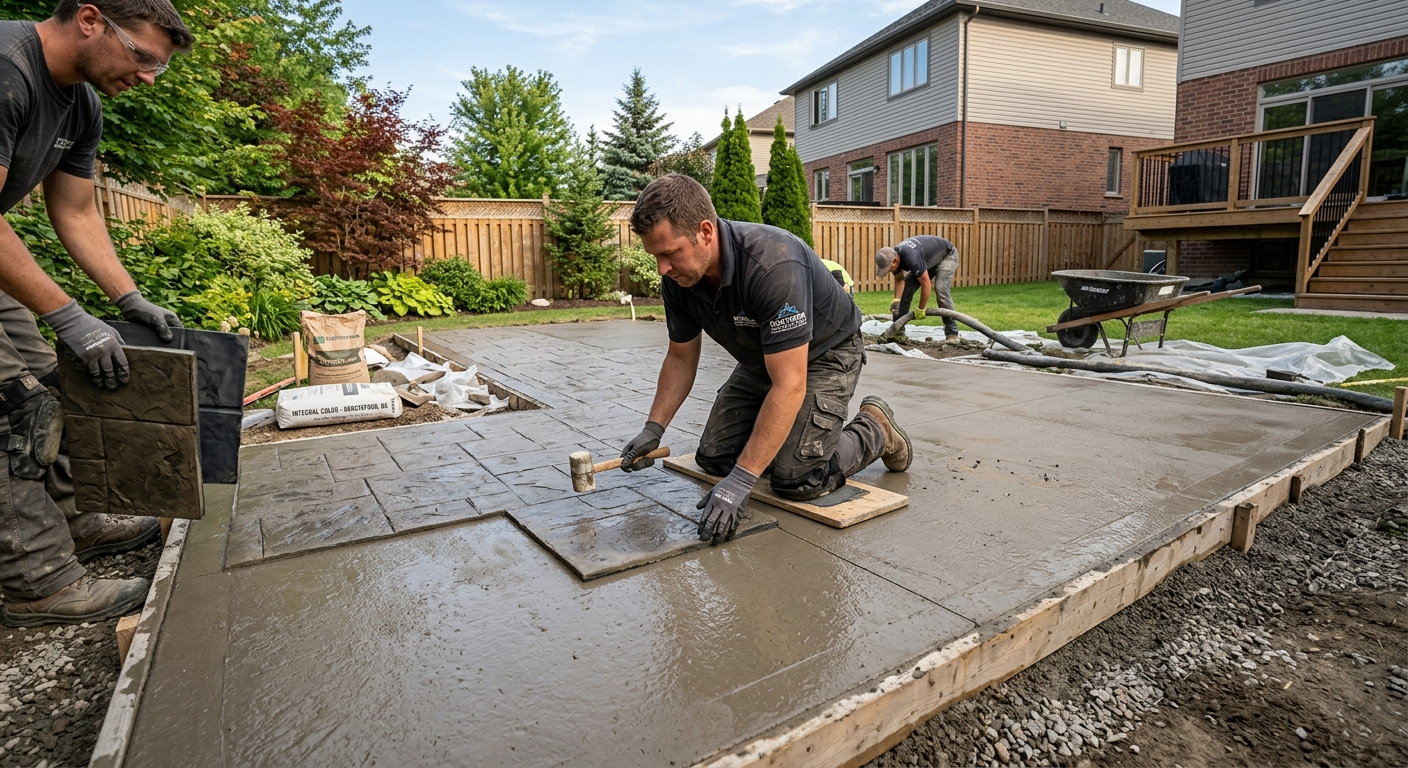
In Walkerton, you’ll often see especially high trade activity in the more established areas near downtown and along Highway 10 where properties are older and require driveway rework, drainage fixes and replacement of settled or spalled slabs. If you’re comparing options, it helps to look at typical scope differences: a standard broom-finished driveway is usually a “best value” starting point, while exposed aggregate and stamped concrete add finishing time and more materials. Even when the concrete thickness looks similar on paper, the base, reinforcement, jointing plan and cure protection can shift total cost meaningfully.
Use the table below as a practical starting range for Walkerton, then we can narrow it with your exact dimensions, soil conditions and access constraints before you choose a finish.
| Application |
Typical Size |
Key Spec |
Finish Option |
Price Range |
| Concrete driveway (standard broom finish) |
320 sq. ft. |
Air-entrained exterior mix, proper granular base, edge forms and joints |
Broom finish + control joints |
$5,800 – $8,900 |
| Exposed aggregate driveway |
320 sq. ft. |
Air-entrained exterior mix, uniform thickness and curing protection |
Exposed aggregate with sealer |
$7,300 – $10,900 |
| Stamped concrete driveway or patio |
320 sq. ft. |
Stamped system + air-entrained mix, jointing plan to control pattern cracking |
Stamp + release + sealer |
$7,700 – $12,900 |
| Plain concrete patio or walkway |
160 sq. ft. |
Sloped grade for drainage, granular base and control joints |
Float or broom finish |
$2,600 – $4,200 |
| Garage floor (interior slab) |
520 sq. ft. |
Vapour barrier where needed, mesh or fibres, proper sub-base |
Light broom or smooth trowel |
$9,400 – $15,000 |
| Foundation footings (structural, below frost) |
Typical 1-home scope |
Concrete footings designed by engineer, below required frost depth, rebar and forms |
Structural concrete only (no decorative finish) |
$1,900 – $3,500 |
Prices are estimates only and vary by project scope, site access and material selection.
What affects the price of concrete work in Walkerton
In Walkerton, two quotes for what sounds like the same concrete job can differ by 30–50% because the “hidden” work usually isn’t hidden to the contractor—it’s hidden to the homeowner. In the Toronto economic region, crews plan around frost depth and freeze–thaw cycles, so the base prep, mix design and jointing plan often become the deciding cost items. A basic driveway might start near the regional band of $18–$28 per sq. ft., but if your soil is saturated, if forms are complicated, or if reinforcement and drainage corrections are needed, pricing moves quickly.
The key Ontario driver is frost depth and repeated freeze–thaw: structural footings generally need to extend below design frost depth to prevent frost heave and differential movement. Exterior slabs also need air-entrained concrete so the freeze–thaw cycling won’t pop or spall the surface over time. When colder weather threatens, contractors in the GTA area often manage curing with protective blankets and—when required—temporary heating. Those precautions cost more, but they protect the slab from weak early strength. And because de-icing salt accelerates surface damage, sealing and correct finishing timing are part of long-term durability decisions.
In Walkerton, these differences show up fast in real examples. If a backyard slope forces regrading and drainage improvements, you’ll pay for more excavation and better compacted base—often pushing the project toward the higher end of the $16–$26 per sq. ft. patio/walkway band. If your driveway involves a larger pour with a tight access lane or removal of an older slab, truck access and waste disposal can add meaningful labour. On foundation work, engineered reinforcement and the need for formwork below frost commonly aligns with typical footing ranges of $180–$300 per linear foot, so the “same house model” can still price differently depending on bearing conditions.
| Price Factor |
Why It Matters |
Cost Impact |
| Frost line depth — determines footing depth and form height |
Deeper excavation and more formwork reduce frost-related movement risks. |
Major swing; can materially increase labour and material volume |
| Site preparation — excavation, grading, compacted granular base |
Well-compacted base prevents settlement and cracking pathways. |
Common 10–25% variance depending on soil and removal needs |
| Reinforcement — rebar or wire mesh requirement |
Reinforcement supports crack control and load distribution. |
Moderate increase; higher if additional bars/chairs are required |
| Mix design — air-entrainment and compressive strength spec |
Air-entrainment is essential for freeze–thaw durability outdoors. |
Moderate increase; essential for exterior longevity |
| Finish type — broom vs. stamped vs. exposed aggregate |
Stamps and aggregates add labour steps and finishing materials. |
Higher for decorative systems; typically raises unit pricing |
| Pour size and concrete truck access to site |
Smaller pours and restricted access can require pump or extra labour. |
Can add overhead and time; often significant for tight driveways |
| Cold-weather curing precautions — heating and blankets |
Cold delays strength gain and increases surface defects if unmanaged. |
Small-to-large increase depending on forecast and timing |
| Control joint pattern and sealing cost |
Joints reduce random cracking; sealing helps manage salt scaling. |
Moderate increase; usually worth it for exterior flatwork |
Permits & regulations in Ontario
In Ontario, structural concrete work—anything that supports the building—almost always needs a building permit. That includes concrete footings, foundation walls, grade beams, and other load-bearing components. For those areas, municipalities may request or require engineered drawings and inspections at hold points. Concrete flatwork like patios, walkways and driveways usually does not require a permit, unless your work affects lot grading, ties into existing drainage plans, changes impervious surface coverage limits, or impacts municipal right-of-way requirements.
Before breaking ground in Walkerton, confirm requirements with the local authority and make sure your contractor can provide documentation. Also verify the contractor carries liability insurance and WSIB/WCB coverage (as applicable) because these protect you if there’s a workplace injury or property damage. Ask for references on similar-scale projects—especially exterior flatwork where freeze–thaw performance is the real test.
Here’s a homeowner-friendly step-by-step to verify a contractor in Ontario:
- Request the contractor’s certificate of insurance and confirm it includes general liability for your job address.
- Ask for proof of WSIB/WCB coverage (and check that the certificate is current).
- Verify licensing and standing through Ontario’s online licensing/registry tools (use the company legal name).
- Request a clearance letter if their documentation includes it for their trade category.
- Confirm who pulls any required permit and whether it’s included in the quote (structural concrete typically requires it).
Getting concrete right in Walkerton's freeze-thaw climate
Concrete failures in Walkerton usually come from the same chain: water gets in, the base doesn’t drain, the slab moves, and the freeze–thaw cycle amplifies damage until you see cracking, scaling or spalling. In our climate shaped by the Toronto region’s freeze–thaw pattern, the biggest preventable issue is inadequate air-entrainment or poor base preparation—both lead to spalling and surface deterioration when de-icing salt hits the top layer in winter. Specifying the right materials and detailing is what keeps exterior flatwork looking good past the first few winters.
To spec your job correctly, start with base prep: use a compacted granular sub-base at the right depth for your soil and frost conditions, then grade so water sheds away from your house. Next is mix design: exterior flatwork should use air-entrained concrete (commonly targeting about 5–7% air content) and a minimum 32 MPa compressive strength for reliable performance. Control joints are non-negotiable—planned spacing limits random cracking, especially on larger driveways and patios. After pouring, curing should be protected for at least 7 days; when nights drop and daytime temps sit near 10 °C or below, contractors may need insulation blankets or heating to support strength gain. Finally, sealing matters: a penetrating sealer applied after the concrete cures (typically 28 days post-pour) helps repel moisture and reduce salt-driven scaling.
Price-wise, the right specs often cost less than the “fix later” approach. For example, moving from a basic broom-finish driveway toward a stamped or exposed aggregate finish might push you from the standard band (around $18–$28 per sq. ft.) into the higher finishing band, but it’s still only worthwhile if the base, air-entrainment and jointing are already correct. A poorly spec’d broom-finish slab can fail early—decorative finish won’t hide that.
| Spec |
Why It Matters in Walkerton |
What to Ask For |
Impact if Skipped |
| Compacted granular base (depth?) |
Reduces settlement and movement that drives cracking during freeze–thaw. |
Granular base thickness stated in the proposal and compacted to spec; confirm drainage grade |
More cracking, uneven surfaces, early slab failure |
| Air-entrained concrete mix (target air %?) |
Helps the concrete tolerate freeze–thaw without spalling. |
Air content target typically 5–7% for exterior flatwork; confirm “air-entrained” on the ticket/spec |
Surface scaling/spalling in 1–3 winters in harsh freeze–thaw conditions |
| Compressive strength (MPa rating) |
Ensures adequate strength gain and durability for outdoor exposure. |
Minimum 32 MPa rating specified |
Lower strength, increased vulnerability to salt and temperature cycling |
| Control joints (spacing per ACI guidelines) |
Controls where cracks form instead of allowing random cracking. |
Planned joint layout and spacing stated; confirm sealant details where joints are used |
Random cracks and accelerated moisture intrusion |
| Minimum 7-day curing period |
Strength development is critical before the slab is exposed to weather. |
Protection plan for curing, especially if temps approach 10 °C or below |
Weak early-age concrete, scaling and reduced service life |
| Penetrating sealer (when applied after cure) |
Improves water repellency against wet springs and salty winters. |
Penetrating sealer applied after cure (commonly 28 days post-pour) |
More salt scaling and faster surface deterioration |
How to choose a concrete work contractor in Walkerton
Choosing a concrete contractor in Walkerton comes down to proof and process, not just the price per square foot. Start by verifying Ontario requirements: ask for their liability insurance certificate (make sure the coverage applies to your work address), and confirm WSIB/WCB coverage for workers handling excavation, forms and concrete delivery. For licensing and standing, use Ontario’s online registry/verification tools and confirm the business legal name matches the quote. If they can’t provide current certificates quickly, that’s a practical red flag.
Next, get 2–3 itemised written quotes. You want a breakdown that shows labour and materials—not just one lump sum—so you can compare base thickness, reinforcement type, formwork, jointing, finishing, sealing, and whether permit handling is included. Also read the scope for exclusions: is old concrete removal included, is disposal included, and is drainage correction part of the work? For warranties, ask for workmanship warranty length and whether product warranties apply to the specific materials used (and whether any transfer is allowed if you sell your home).
For payment scheduling, never pay more than about 10–15% upfront. Use a holdback until the job is fully complete and reviewed, especially where curing and sealing timelines apply. Finally, insist on a timeline in writing with a start date and completion estimate, because in Walkerton you may lose your pour window if forecast temps swing or curing protection isn’t planned.
- Provide proof of liability insurance before work begins.
- Provide current WSIB/WCB coverage documentation.
- Match quote scope to your measurements (driveway width, patio area, thickness assumptions).
- Confirm base prep depth and compacted granular base material.
- Ask what air-entrained mix and compressive strength will be used for exterior pours.
- Confirm reinforcement plan (mesh vs rebar, and chairs/spacers if needed).
- Get the joint plan in writing (layout, spacing, and sealant where applicable).
- Ask how they protect curing in cold snaps and who supplies blankets/heaters if required.
- Ask when sealing is scheduled (often 28 days post-pour for penetrating sealer).
- Confirm whether demolition and haul-away/disposal are included.
- Request a construction schedule and weather-protection contingency plan.
- Use a payment schedule with a holdback for final inspection and cleanup.
Concrete contractor red flags in Walkerton: vague “assumed thickness” without base specs; no mention of air-entrainment for exterior slabs; skipping joint layout or not discussing curing protection; asking for large upfront payments (beyond 10–15%); and offering decorative finishes without explaining how they’ll handle cracking control and sealing for freeze–thaw durability.
Frequently asked questions — concrete work in Walkerton
What is the difference between concrete and cement?
In plain terms for Ontario homeowners in Walkerton, “cement” is one ingredient, while “concrete” is the finished building material. Cement is the powder that reacts chemically with water to bind everything together. Concrete is cement mixed with water, sand and gravel (and sometimes air-entrainment, fibres, or other additives). When contractors quote exterior flatwork, what matters for freeze–thaw performance isn’t just the cement—it’s the full mix design, especially whether the concrete is air-entrained. That air content helps the concrete tolerate repeated winter freezing and thawing. So, even if two quotes sound similar, ask what mix ticket and air-entrainment target they’ll use for driveways and patios.
How much does concrete work cost in Walkerton?
Walkerton pricing follows the broader Toronto economic region’s labour and material rates, and it’s also shaped by how much base work and protection is needed for freeze–thaw. For a typical concrete patio or walkway, many projects land around the regional band of $16–$26 per sq. ft., while a standard broom-finished driveway often comes in around $18–$28 per sq. ft. Decorative finishes cost more: stamped concrete or exposed aggregate frequently pushes the pricing upward due to additional finishing steps and sealer. As a quick example, a 320 sq. ft. driveway at $18–$28 per sq. ft. would commonly be budgeted roughly in the $5,800–$8,900 range, before any site-specific issues like excavation, reinforcement upgrades, or drainage changes.
How deep must footings be for Walkerton's frost line?
For structural concrete in Ontario, footings generally must extend below the design frost depth to reduce frost heave and protect against differential movement. The exact depth is determined by the building design and soil conditions, but Ontario typically requires footings around 1.2 m (about 4 ft) below grade as a baseline for structural applications—so you’re below the frost line. In practice in Walkerton, your drawings (often engineered) govern the final depth, because local soils and loading affect requirements. If you’re budgeting, structural footing scopes commonly run in the $180–$300 per linear foot band, depending on excavation depth, steel placement complexity and formwork conditions. Always confirm the footing depth with the engineer and permit documents.
Why does concrete crack in Walkerton and how is it prevented?
Concrete can crack in Walkerton mainly because it’s exposed to repeated freeze–thaw and seasonal moisture movement, and because slabs also shrink as they cure. The most common exterior cracking pattern is “random” cracking when jointing and base conditions aren’t planned. Prevention starts with proper base preparation—compact granular sub-base and good drainage so the slab isn’t riding on unstable or saturated soil. Second, use air-entrained concrete outdoors so freeze–thaw doesn’t cause spalling and surface breakdown that weakens the slab. Third, control joints must be placed and timed so cracks form where you planned them. In Walkerton, sealing also matters for salt protection: a penetrating sealer applied after proper curing (often 28 days) helps reduce moisture and de-icer scaling. Cracks are far less likely when these specs are consistent.
Stamped vs broom-finish concrete — cost difference?
Stamped concrete costs more than a standard broom-finish because it adds extra labour steps (forms/texture, finishing workflow, and often more careful joint coordination) and uses a stamped system and release materials. For homeowners in Walkerton, a standard broom-finished driveway typically sits around the $18–$28 per sq. ft. band, while stamped concrete usually climbs into the $24–$40 per sq. ft. range because the decorative process and finishing time are higher. You also need to budget for durability details—air-entrainment, correct thickness, and the right sealing schedule—because decorative concrete still must survive Toronto-region freeze–thaw cycles. If your sub-base and joint plan are weak, stamped concrete won’t prevent early failure; it only changes how the surface looks.
When is the best time to pour concrete in Walkerton?
The best time to pour concrete in Walkerton is when temperatures allow proper curing—generally in the warmer months when concrete can gain strength reliably. In the Toronto economic region, contractors concentrate exterior pours in warmer weather for that reason, and they add cold-weather protection when temperatures drop toward 10 °C or below. Practical timing matters because early-age concrete can be damaged if it freezes or dries too fast before it develops strength. If you need work in colder shoulder seasons, ask the contractor how they’ll heat, insulate with blankets, and protect the surface during curing. While the driveway or patio may look fine on day one, curing quality is what determines long-term performance under freeze–thaw and de-icing salt exposure in Walkerton winters.