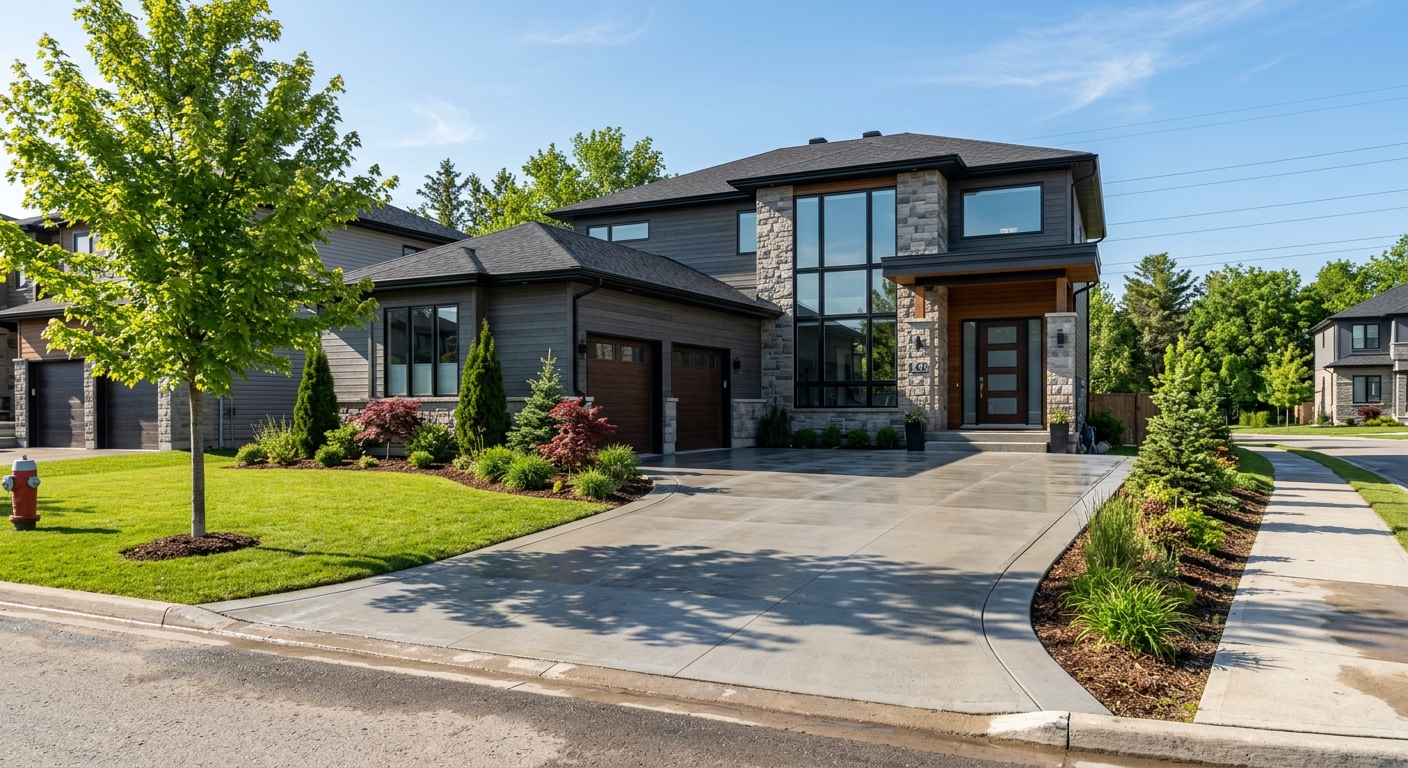
Concrete work options and costs in Stonegate-Queensway
Stonegate-Queensway is a classic Toronto neighbourhood setting where homeowners commonly upgrade driveways, add patios, and renew walkways around older homes. With a population of 25,051 (Statistics Canada, 2021 Census), there’s steady demand for exterior concrete contractors—especially in the busier pockets near the Queensway corridor and other established residential streets. In this area, concrete flatwork is a big part of curb appeal; most of the work starts with a driveway or front entrance refresh, then expands to patios and steps. Toronto’s freeze–thaw cycles are the reason budgets can’t be compared apples-to-apples: the colder stretches and repeated winter thawing demand air-entrained mixes, robust base prep, and well-planned control joints. That’s also why properly installing drainage and a compacted granular base isn’t optional—saturated soils expand and contract against the slab every winter.
It’s also a timing and labour availability story. Contractors typically concentrate exterior pours into the warmer months to protect curing quality. When temperatures trend down toward 10 °C or below, cold-weather protection (insulating blankets, curing blankets, and sometimes temporary heat) becomes a cost driver for both new slabs and any associated patches.
The table below gives realistic starting price bands for common options in Stonegate-Queensway, so you can compare quotes more confidently before selecting a finish or scope.
| Application |
Typical Size |
Key Spec |
Finish Option |
Price Range |
| Concrete driveway (standard broom finish) |
~35 m² (approx. 12 ft x 30 ft) |
Air-entrained exterior mix, adequate granular base, control joints |
Broom-finish |
$18,000–$28,000 |
| Exposed aggregate driveway |
~35 m² |
Air-entrained exterior mix, proper curing to support wash/expose |
Exposed aggregate |
$22,000–$34,000 |
| Stamped concrete driveway or patio |
~25 m² (approx. 10 ft x 25 ft) to ~35 m² |
Stamped system, air-entrained mix, jointing plan to control cracking |
Stamped (stone/brick pattern) |
$24,000–$40,000 |
| Plain concrete patio or walkway |
~15 m² (approx. 8 ft x 18 ft) |
Compacted base, air-entrained mix for exterior exposure |
Plain broom or smooth-trowel (lightly textured) |
$16,000–$26,000 |
| Garage floor (interior slab) |
~30 m² (approx. 20 ft x 14 ft) |
Vapour barrier (if specified), properly reinforced slab, flatness |
Plain, trowel-finish or light broom |
$10,500–$18,500 |
| Foundation footings (structural, below frost) |
Varies by house footprint |
Reinforced footings designed below required frost depth |
Structural concrete work |
$180,000–$300,000 |
Prices are estimates only and vary by project scope, site access and material selection.
What affects the price of concrete work in Stonegate-Queensway
In Stonegate-Queensway, two contractors can price the “same” concrete job differently because concrete isn’t a commodity in Ontario—it’s a system: excavation, compaction, frost protection, mix design, placement, finishing, and curing. It’s common to see quotes vary by 30–50% across the Toronto economic region for driveways and patios because one estimate may include a full engineered base and proper jointing, while another takes shortcuts that show up as early cracking or surface scaling. Labour rates and crew availability in the GTA also matter; during peak warm-season weeks, scheduling pressure can raise costs.
The Toronto freeze–thaw environment drives the key specs. Structural footings must be placed below design frost depth (Ontario typically requires at least about 1.2 m, and some projects end up deeper depending on soil and design). Exterior slabs also need air-entrained concrete mixes to survive repeated freeze–thaw cycles. When temperatures drop toward about 10 °C or below, cold-weather curing precautions—curing/insulating blankets, temperature monitoring, and sometimes temporary heat—add real labour and material. On top of that, de-icing salt in winter accelerates surface spalling, so sealing and surface protection become more important than many homeowners expect.
Here are a few Stonegate-Queensway examples that reliably move the price. A driveway on softer subgrade or with poor drainage can require extra granular base and regrading (pushing costs toward the higher end of driveway bands like $18,000–$28,000). A stamped patio with multiple colours and a complex pattern is priced higher—often closer to the $24,000–$40,000 stamped/decorative band—because it requires more prep, careful finishing timing, and more labour-intensive crack control planning. Older housing stock also affects access: narrow side yards can add trucking time and placement complexity, which increases labour.
| Price Factor |
Why It Matters |
Cost Impact |
| Frost line depth — determines footing depth and form height |
Below-freezing ground movement can heave or crack structures if footings aren’t deep enough |
Higher excavation and rebar/formwork can increase foundation/footing costs materially |
| Site preparation — excavation, grading, compacted granular base |
Frozen moisture and weak soils lead to settlement and early cracking |
Extra base and proper compaction move pricing toward the upper band |
| Reinforcement — rebar or wire mesh requirement |
Controls cracking and improves durability, especially for driveways and structural scopes |
Materials and labour add cost, but reduce callbacks |
| Mix design — air-entrainment and compressive strength spec |
Freeze–thaw resistance depends on air void structure and strength |
Proper mix design can raise cost vs. “lowest bid” mixes |
| Finish type — broom vs. stamped vs. exposed aggregate |
Finishes require different tools, timing, and workmanship standards |
Stamped/exposed aggregate typically prices above plain broom-finish flatwork |
| Pour size and concrete truck access to site |
More distance from the truck increases labour time and placement efficiency issues |
Access problems can add labour and sometimes equipment or extra batches |
| Cold-weather curing precautions — heating and blankets |
Concrete must cure at the right temperatures to achieve strength and durability |
Blankets, heaters, monitoring and delays increase total project cost |
| Control joint pattern and sealing cost |
Joints manage cracking and sealing helps resist salt scaling |
Skipping or under-specing joints/sealants reduces initial cost but increases failure risk |
Permits & regulations in Ontario
In Ontario, the general rule is that structural concrete work requires more oversight than exterior flatwork. For Stonegate-Queensway homeowners, concrete scopes that typically DO require a building permit include footings and foundation walls, grade beams, and other structural elements associated with a foundation system or supporting structure. These are often tied to engineered drawings and municipal plan review, especially when you’re changing loads or building below grade.
Concrete flatwork like driveways, patios, and walkways usually does not require a permit by default. However, permits or approvals can be required if the work affects lot grading, drainage, impervious surface coverage limits, or the municipal right-of-way (for example, modifications near curb/sidewalk areas). Always confirm with your local authority before breaking ground, particularly if you’re reworking drainage patterns or changing how water is directed across your property.
Step-by-step, here’s how to verify your contractor in Ontario: first, ask for their liability insurance certificate (COI) and confirm it matches the correct legal entity and job address. Next, verify WSIB/WCB coverage and clearance—your contractor should provide proof; don’t accept “we’ll get to it later.” Then, check licensing/registrations applicable to the contractor through provincial/industry-facing directories and the contractor’s business details. Finally, request references for similar-scale jobs in the GTA (driveway or patio work in a freeze–thaw climate), and confirm the project was completed without rework related to base prep or cracking.
Getting concrete right in Stonegate-Queensway's freeze-thaw climate
Concrete failures in Stonegate-Queensway usually come down to one of five things: poor drainage/base preparation, insufficient frost protection, the wrong mix for freeze–thaw exposure, weak or skipped control-joint planning, and curing/finishing mistakes. In the GTA, the freeze–thaw cycle works like a stress test every winter. Moisture gets into the slab and micro-cracks; then it freezes and expands, which can lead to scaling and spalling if the concrete isn’t air-entrained correctly.
To spec the job correctly, start with base preparation: use a properly compacted granular sub-base to the required depth for local soil and frost considerations, and ensure water has a route to drain away instead of sitting beneath the slab. Next is mix design: for exterior flatwork, request air-entrainment (commonly about 5–7% air content) and a minimum 32 MPa compressive strength so the slab can handle freeze–thaw exposure. Then plan control joints to limit random cracking—joints should be cut/formed at a spacing appropriate for the slab size and expected stresses. Curing matters just as much: plan for at least 7 days curing under proper conditions, and if you pour when temperatures are trending down, insist on cold-weather curing protection. Finally, seal: apply a penetrating sealer after the concrete has fully cured (often around 28 days) so de-icing salts have less direct impact on the surface.
A practical pricing example: if one quote for a driveway is a few thousand dollars lower but doesn’t clearly include an air-entrained exterior mix, proper base compaction, jointing, and curing protection, the “savings” usually don’t hold—callbacks and re-surfacing become more expensive than doing it once. In contrast, spending within the local driveway band of $18,000–$28,000 is often justified when the scope includes a full base build and correct freeze–thaw specifications.
| Spec |
Why It Matters in Stonegate-Queensway |
What to Ask For |
Impact if Skipped |
| Compacted granular base (depth?) |
In Stonegate-Queensway, weak or wet subgrade leads to settlement and cracking under freeze–thaw stresses |
Confirm excavation depth, granular base thickness, compaction method, and drainage plan |
Uneven settling, pumping, and early slab cracking |
| Air-entrained concrete mix (target air %?) |
Freeze–thaw durability depends on correct air void structure in exterior concrete |
Request exterior air-entrained mix with 5–7% air content and documented mix design |
Higher risk of scaling and spalling within a few winters |
| Compressive strength (MPa rating) |
Strength gain supports durability and helps resist surface wear |
Confirm at least 32 MPa minimum compressive strength per the project spec |
Surface deterioration, scaling, and reduced performance under load |
| Control joints (spacing per ACI guidelines) |
Joints manage shrinkage and temperature movement common in Ontario seasons |
Ask for a joint layout plan (spacing and sealing schedule for exterior joints) |
Random cracking that’s harder and more expensive to repair |
| Minimum 7-day curing period |
Proper curing is crucial before the slab is exposed to winter conditions |
Confirm curing method and protection plan; extend if cold weather affects cure |
Reduced strength and increased risk of early cracking |
| Penetrating sealer (when applied after cure) |
Sealing helps limit salt and water penetration during Ontario winters |
Apply penetrating sealer after cure, commonly around 28 days |
Faster surface scaling and spalling from de-icing chemicals |
How to choose a concrete work contractor in Stonegate-Queensway
Choosing a concrete contractor in Stonegate-Queensway is mostly about verification and clarity. First, confirm Ontario licensing/registration where applicable, then insist on current proof of liability insurance and WSIB/WCB coverage. How to check: (1) request the certificate of insurance and confirm the named insured matches the company quoting you; (2) verify WSIB/WCB coverage and clearance/coverage details through the documentation they provide; (3) ask for a copy of their standard contract and scope sheet so you can see what’s included.
Second, get 2–3 itemised written quotes—not a vague lump sum. You want a breakdown separating labour and materials (concrete supply, reinforcing, excavation/base, forming, finishing, and any sealing). Make sure exclusions are spelled out: is disposal included? Are you paying extra for sawcutting, joint sealing, or traffic control? Is the permit application included where needed (for structural work, it should be handled through the proper process)?
Third, warranty: ask for the workmanship warranty length and whether it covers cracking related to finishing/jointing, and confirm product/manufacturer warranty details. Clarify whether warranties are transferable if you sell your home.
Finally, payment schedule and timeline. Never pay more than about 10–15% upfront; hold back a meaningful portion until the work is complete and cleaned up. Get a written start date window and completion estimate.
- Confirm liability insurance COI matches the quoting legal name and covers the project type
- Verify WSIB/WCB coverage with current documentation before any work starts
- Ask whether their concrete mix is air-entrained for exterior exposure
- Require base prep details: excavation depth, granular thickness, compaction method
- Confirm reinforcement plan: rebar/wire mesh where required
- Get joint layout in writing: spacing, location, and sealing for exterior work
- Ask how they handle cold weather curing (blankets/heating/temperature monitoring)
- Request a concrete truck access plan and placement method if your yard is tight
- Ensure disposal, sawcutting waste removal, and cleanup are included or listed
- Make sure sealing is included if it’s a de-icing salt-exposed area
- Check their warranty terms and what failures are covered vs excluded
- Avoid contractors who accept full payment before completion or refuse holdbacks
Concrete contractor red flags in Stonegate-Queensway include: quotes that don’t mention air-entrained mix for exterior slabs, vague base prep (“we’ll level it”) without granular depth/compaction, no written joint plan (or “don’t worry about cracking”), refusal to provide WSIB/WCB or insurance proof, and pressure to pay most of the amount upfront before curing/sealing is done.
Frequently asked questions — concrete work in Stonegate-Queensway
How deep must footings be for Stonegate-Queensway's frost line?
In Stonegate-Queensway and across Ontario, footing depth is set by the design frost depth and soil conditions so the foundation doesn’t move from frost heave. In practice, most structural footings are required to extend at least about 1.2 m (roughly 4 ft) below grade to stay below the effective frost zone for the design intent. Your exact depth depends on engineering and local soil and drainage details, so the permit set and engineered drawings control the final number. If someone quotes foundation footings without discussing frost depth (or without referencing the engineered spec), that’s a major red flag. Also remember that wetter subgrade and poor drainage can increase movement, so proper site prep affects long-term performance even when footing depth is correct. (Statistics Canada, 2021 Census)
Why does concrete crack in Stonegate-Queensway and how is it prevented?
Concrete cracking in Stonegate-Queensway is common because the slab undergoes shrinkage, temperature movement, and freeze–thaw stresses. Ontario’s seasonal swings mean slabs expand in warm periods and contract when temperatures drop; moisture then freezes beneath or within the concrete. The prevention strategy is a system: correct base prep and drainage to limit movement, air-entrained exterior mix to protect from freeze–thaw damage, and a deliberate control joint pattern to “tell” the concrete where to crack. Proper curing is also essential—at least 7 days under good conditions. When contractors skip joint planning or don’t cut/finish to the right timing, random cracking becomes more likely and repairs cost more than doing it right the first time.
Stamped vs broom-finish concrete — cost difference?
Stamped concrete costs more than broom-finish because it takes more labour, different finishing steps, and more time to achieve consistent patterns in exterior conditions. In Stonegate-Queensway, it’s typical to see stamped driveways or patios priced in the decorative band of about $24,000–$40,000, while standard broom-finish driveways typically fall around $18,000–$28,000 for comparable sizes and scopes. The best comparisons come from quotes that include the same base depth, reinforcement, joint layout, and curing protections—otherwise you can’t judge the “finish premium.” If a stamped quote is much cheaper, ask where the savings come from; often it’s an underbuilt base or incomplete sealing and jointing, which can shorten service life in Ontario’s freeze–thaw winters.
When is the best time to pour concrete in Stonegate-Queensway?
The best time to pour concrete in Stonegate-Queensway is during the warmer, more stable part of the year when temperatures stay within a workable curing range. In the Toronto region, exterior pours are typically concentrated in the warmer months because cold nights and early spring/fall drops toward around 10 °C or below can slow curing and reduce final strength if protection isn’t used. If you must pour late in the season, a reputable contractor will plan cold-weather curing: heating/insulating blankets, temperature monitoring, and schedule adjustments to ensure the concrete cures properly before it’s exposed to winter. Ask your contractor what the temperature plan is for the specific pour date, not just what “season” they prefer. A good timeline protects both durability and appearance.
How long does concrete take to cure?
Concrete curing has a “minimum protective period” and a “strength development” timeline. For most exterior work in Ontario, you should plan for at least 7 days of curing under appropriate conditions so the slab reaches sufficient early strength and can resist early damage. Full strength development continues beyond that; many specifications and best practices reference around 28 days for treatments like penetrating sealer because the concrete has had time to complete hydration. If you’re sealing a driveway, patio, or walkway, ask your contractor to schedule sealing after the concrete has cured long enough. In Stonegate-Queensway’s climate, curing matters more than many homeowners think because moisture and de-icing salts in winter can damage surfaces that didn’t cure properly.
Do I need a permit for concrete work in Ontario?
In Ontario, structural concrete work typically requires a building permit. For example, footings, foundation walls, and grade beams usually fall into permit-requiring scopes, often tied to engineered drawings and municipal review. Concrete flatwork like driveways, patios, and walkways typically does not require a permit unless it affects lot grading, impervious surface coverage limits, drainage patterns, or work within/near the municipal right-of-way. For Stonegate-Queensway homeowners, the safest approach is to confirm with your local authority before you start excavation—especially if you’re changing drainage routes or slopes. Also verify your contractor carries liability insurance and WSIB/WCB coverage so you’re protected if there’s an issue during the permitted or non-permitted work.