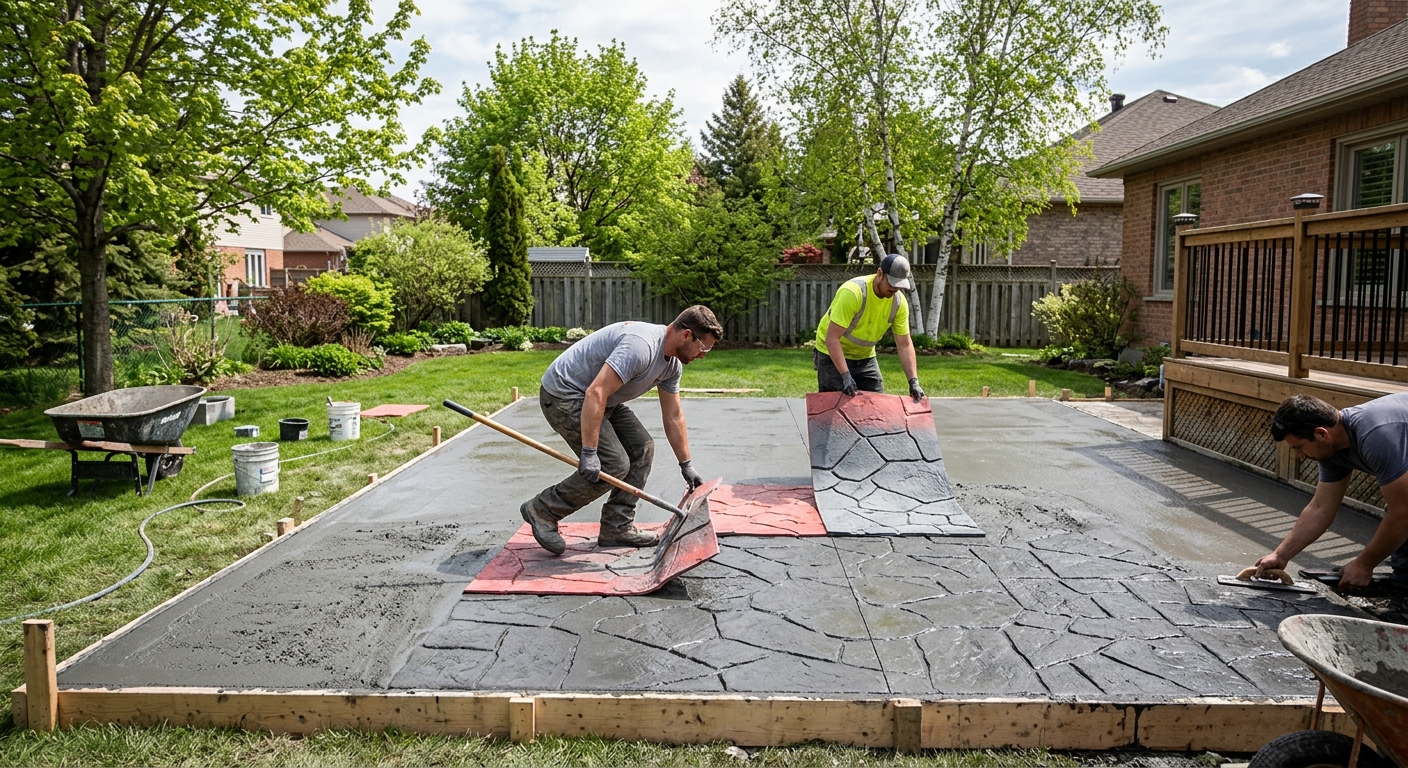
Concrete work options and costs in Lawrence Park South
Concrete work in Lawrence Park South, Ontario is all about building for longevity on tough clay and freeze–thaw cycles. With a population of 15,179 (Statistics Canada, 2021 Census), this neighbourhood is a steady market for driveways, patios, walkways and garage slabs—especially because many homes are family-oriented and prioritize durable exterior flatwork. The Toronto region’s demand is also reflected in how quickly contractor schedules can fill after winter, when homeowners start planning spring projects.
Prices in Lawrence Park South tend to be shaped less by “just concrete” and more by site prep and protection during curing. In the GTA, structural footings generally have to go below design frost depth (Ontario commonly requires around 1.2 m to help prevent frost heave), and exterior slabs need air-entrained mixes plus a proper base and drainage plan to limit saturation. Freeze–thaw shows up as surface scaling, spalling, and random cracking if the mix, thickness, joints, or curing aren’t handled correctly.
In practical terms, contractors are most in demand around the older pockets of Lawrence Park South where landscaping changes often trigger driveway or patio replacements, and where access can be tighter due to mature trees and established grading. If you’re budgeting, it helps to compare like-for-like finishes—standard broom versus exposed aggregate or stamped systems—and to carry a realistic range for truck access, excavation depth, and reinforcing.
Use the table below as a starting point for planning your project scope and comparing quotes.
| Application |
Typical Size |
Key Spec |
Finish Option |
Price Range |
| Concrete driveway (standard broom finish) |
400–600 sq. ft. |
Air-entrained exterior mix; compacted granular base; control joints |
Broomed surface, simple edges |
$18,000–$28,000 |
| Exposed aggregate driveway |
400–600 sq. ft. |
Air-entrained mix; controlled wash exposure; slip-resistant finish |
Exposed aggregate (wash) |
$22,000–$34,000 |
| Stamped concrete driveway or patio |
300–500 sq. ft. |
Air-entrained mix; colour hardener + release agent; proper jointing |
Stamped patterns + integral colour |
$24,000–$40,000 |
| Plain concrete patio or walkway |
150–350 sq. ft. |
Air-entrained exterior mix; granular base + drainage |
Broom finish or light trowel |
$16,000–$26,000 |
| Garage floor (interior slab) |
300–550 sq. ft. |
Smooth finish; joint layout; optional sealer |
Broom or trowel-finish |
$10,000–$18,000 |
| Foundation footings (structural, below frost) |
Per linear foot / crew job |
Footings below design frost; engineered dimensions; proper base and excavation |
Structural concrete, no decorative finish |
$180–$300 |
Prices are estimates only and vary by project scope, site access and material selection.
What affects the price of concrete work in Lawrence Park South
In Lawrence Park South and across the Toronto economic region, the same “type” of concrete job can land 30–50% apart because the biggest cost drivers are site conditions and specifications—not the pour itself. Contractors price for excavation depth, base preparation, reinforcement needs, and the added labour for proper curing and weather protection during the seasonal swing from mild spells to cold snaps. When demand is high after winter, scheduling and crew availability can also tighten margins and push pricing upward.
Frost depth and freeze–thaw cycles dictate the spec in the region. Structural footings typically must extend at least about 1.2 m below grade in Ontario to reduce frost heave and differential movement, and exterior slabs need air-entrained concrete to survive repeated cycles. When temperatures drop toward 10 °C or below, the pour window shortens and contractors may add cold-weather curing precautions (insulating blankets, temporary heat, extended protection), which adds cost. Even if the work looks “done” on pour day, proper curing and jointing are what prevent long-term spalling and surface scaling. De-icing salt makes this even more important—sealing and a correctly air-entrained mix help resist damage.
Local examples that shift pricing in Lawrence Park South: (1) a sloped lot or poor drainage often requires deeper base and more grading adjustments, which can move a patio from the plain band toward the higher end of the driveway/flatwork ranges; (2) tight access near established trees or narrow driveways can increase labour time and concrete handling; (3) if you choose stamped systems, the material and forming complexity typically pushes costs well above standard broom work—often justifying the upgrade versus a plain patio when you want a decorative, joint-correct surface that still performs.
As a baseline, plain exterior flatwork often aligns with ranges like $16–$26, while stamped & decorative concrete frequently lands in the $24–$40 band depending on pattern area and prep.
| Price Factor |
Why It Matters |
Cost Impact |
| Frost line depth — determines footing depth and form height |
Deeper footings mean more excavation, forms, and concrete volume |
Higher excavation and forming can add thousands on structural work |
| Site preparation — excavation, grading, compacted granular base |
Concrete durability depends on a stable, well-compacted base and drainage |
More haul-off and granular depth raises labour and materials costs |
| Reinforcement — rebar or wire mesh requirement |
Controls cracking and improves structural capacity where needed |
Material + tying/install labour can significantly increase price |
| Mix design — air-entrainment and compressive strength spec |
Air-entrainment supports freeze–thaw durability for exterior flatwork |
Higher-spec concrete and quality control can raise per-cubic-metre costs |
| Finish type — broom vs. stamped vs. exposed aggregate |
Finishes require different labour intensity and steps (colour, stamps, wash) |
Stamped/exposed typically costs more than standard broom |
| Pour size and concrete truck access to site |
Access affects pumping, carrying distance, and scheduling |
Extra labour and equipment can add costs even for similar square footage |
| Cold-weather curing precautions — heating and blankets |
Protection helps concrete reach strength before freeze events |
Shorter pour season and added equipment/temps increases total price |
| Control joint pattern and sealing cost |
Joints manage shrinkage cracking; sealing helps resist salt-driven spalling |
More saw cuts, planning, and sealer application add to the scope |
Permits & regulations in Ontario
In Ontario, structural concrete work—like foundation footings, foundation walls, and grade beams—typically requires a building permit, and you often need engineered drawings that are reviewed by the municipality as part of the permit process. Concrete flatwork (patios, walkways and driveways) usually does not require a permit by itself, but it can trigger requirements when it affects lot grading, stormwater flow, impervious surface coverage limits, or municipal right-of-way conditions (for example, if it ties into curb/sidewalk areas or changes drainage toward a public asset). Always confirm with your local authority before breaking ground.
For contractor readiness, start with basic compliance: ask for proof of liability insurance and WSIB coverage (or the correct provincial equivalent where applicable), and verify they have experience with similar-scale concrete removals and builds. A reputable Lawrence Park South contractor will also walk you through logistics (protection of lawns, tree roots, forms, and disposal).
How to check in a practical order:
1) Licensing: confirm the contractor’s Ontario business status and credentials using the appropriate online registry resources they provide, and ensure the company name matches their quote paperwork. 2) Certificate of insurance: request a current COI and ensure liability limits are appropriate for concrete removals and work near driveways and structures. 3) WSIB clearance: ask for the clearance letter/documentation (or equivalent proof of coverage) before work starts. 4) References: request 2–3 similar projects with photos—especially exterior flatwork that survived multiple winters.
Getting concrete right in Lawrence Park South's freeze-thaw climate
Concrete fails in Lawrence Park South mainly when water meets vulnerable material through the freeze–thaw cycle. The most common problems are spalling and scaling (surface flaking), random cracking, and edge deterioration—usually caused by insufficient air-entrainment, a weak or saturated base, poor drainage, or rushed curing. The fix is to spec the job for Ontario conditions from day one: build the base correctly, use an air-entrained mix designed for freeze–thaw, plan control joints, and protect curing through cold snaps common around the shoulder seasons.
Base preparation: place compacted granular sub-base to the right depth for local soil conditions and frost considerations, then grade for positive drainage so water doesn’t pond against the slab. Mix design: specify air-entrained concrete (commonly 5–7% air content for exterior flatwork) and a minimum 32 MPa compressive strength to meet durability expectations. Control joints: install joints on a spacing pattern that limits random cracking and aligns with where shrinkage is likely. Curing: plan minimum 7-day curing under proper conditions, and add protection if temperatures drop. Sealing: apply a penetrating sealer after curing (typically around 28 days post-pour) to repel de-icing salts.
Ask yourself one technical question: “If this driveway gets salted every winter, how will you prevent spalling?” A correct air-entrained mix is the answer—not just aesthetics. For example, switching from a basic broom-finish patio to a higher-spec exterior option can be worth it when you’re comparing a plain patio in the $16–$26 band versus a stamped/decorative system around $24–$40; you pay more for labour steps, but you’re also paying to get the correct mix, joints, and finishing control that reduces early failure.
| Spec |
Why It Matters in Lawrence Park South |
What to Ask For |
Impact if Skipped |
| Compacted granular base (depth?) |
A stable base prevents settlement and reduces water pumping under freeze–thaw |
Confirm granular depth, compaction method, and drainage grade |
Uneven cracking, edge spalling, and premature surface failure |
| Air-entrained concrete mix (target air %?) |
Air voids allow freezing water to expand without damaging the paste |
Target air content (commonly 5–7% for exterior flatwork) |
Higher risk of spalling and scaling after a few winters |
| Compressive strength (MPa rating) |
Strength supports wear resistance and structural performance in tough freeze cycles |
Minimum 32 MPa (or higher per engineered design) |
More cracking, surface wear, and reduced long-term durability |
| Control joints (spacing per ACI guidelines) |
Joints manage shrinkage so cracking doesn’t wander randomly |
Joint layout plan and sawcut timing |
Random cracks and difficult-to-repair cosmetic and drainage issues |
| Minimum 7-day curing period |
Concrete needs time to gain strength before freezing stresses hit |
How they maintain curing conditions if temps fall |
Reduced strength gain and brittle, failure-prone concrete |
| Penetrating sealer (when applied after cure) |
Repels salt and moisture to reduce deterioration of exterior surfaces |
Sealer type and timing (often around 28 days post-pour) |
Faster scaling from salt exposure and more frequent repairs |
How to choose a concrete work contractor in Lawrence Park South
Choosing the right contractor in Lawrence Park South starts with verifying compliance and workmanship—not just the best price on a quote sheet. In Ontario, confirm the contractor’s credentials and ask for proof of liability insurance. You should also request evidence of WSIB/WCB coverage for the people on your site. Where to look: the insurance certificate (COI) should list your company correctly and show coverage in effect for the job period; WSIB coverage is typically supported by a current clearance document or proof of active account coverage.
Then, compare quotes properly. Get 2–3 itemised written quotes where labour and materials are separated (concrete volume, base/gravel, rebar/mesh, forms, sawcutting, disposal). A fair quote will also specify whether a permit is required and whether the contractor includes their permit handling (when applicable). Clarify exclusions like removal and disposal, site restoration, tree protection, and any upgrades for drainage or reinforcement.
For warranty, ask for two things: a workmanship warranty length (for example, cracking related to installation), and any product/manufacturer warranty coverage for sealers or special additives. Verify whether warranty is transferable if you sell the home.
Payment schedule matters. Never pay more than 10–15% upfront. Use a holdback tied to completion and punch-list sign-off. Finally, insist on a written timeline with a start date target and completion estimate—freeze–thaw doesn’t wait, and a late-season pour may need extra curing protection.
- Ask for a site visit and written base/reinforcement plan (not just “we’ll pour what you need”).
- Confirm exterior mix is air-entrained and ask for target air range (commonly 5–7%).
- Require joint spacing and sawcut timing to manage cracking.
- Check they will grade for drainage so water doesn’t pool against the slab.
- Request details on disposal/haul-away for old concrete and excess soil.
- Get line-by-line pricing for excavation, granular base, rebar/mesh, and finishing.
- Confirm whether sealing is included and what type of sealer is proposed.
- Review their cold-weather curing approach if temperatures drop.
- Ask for at least 2 references from similar Lawrence Park South projects.
- Ensure liability insurance and WSIB coverage proof are provided before work starts.
- Agree on a payment schedule with a holdback until final acceptance.
- Make the permit responsibility clear: included vs. homeowner-led vs. “as required.”
In Lawrence Park South, red flags to watch for: quotes with no breakdown of base depth or reinforcement, “too-good-to-be-true” low pricing that skips air-entrainment or joints, vague cure/seal timelines, no proof of insurance/coverage, and contractors who want large upfront payments without an agreed holdback.
Frequently asked questions — concrete work in Lawrence Park South
How do I prepare the base for a concrete slab?
Base preparation is where most concrete longevity is won or lost in Lawrence Park South. You generally need to excavate to the right elevation, remove topsoil/organics, and place compacted granular base to the specified depth so the slab can resist settlement and avoid water saturation. The granular layer should be compacted in lifts to reach the required compaction level, then graded for drainage so water doesn’t pond. For exterior work, this matters even more because Ontario’s freeze–thaw cycles expand and contract saturated soils, which can telegraph into cracking and edge spalling. When comparing quotes, ask specifically for base depth, compaction method, and whether they include drainage adjustments—not just a per-square-foot concrete price.
How do I compare concrete quotes?
Start by comparing like-for-like scopes. Ask each contractor for an itemised quote that separates excavation, granular base, reinforcement (rebar or mesh), concrete supply, finishing, joints, and cleanup/disposal. Confirm the concrete is air-entrained for exterior flatwork and that there’s a plan for proper curing in Ontario’s cooler months. Look at the finish line: standard broom work is often priced in the driveway/slab band of about $18,000–$28,000 for typical projects, while stamped/decorative work commonly moves into the $24,000–$40,000 range depending on area and complexity. If one quote is much lower, it may be skipping base prep depth, reinforcement, air-entrainment, joint planning, or sealing—those are the pieces that protect you through winter.
Can concrete be poured in cold weather in Lawrence Park South?
Concrete can sometimes be poured in colder conditions in Ontario, but it requires the right cold-weather procedures and protection. In Lawrence Park South, the Toronto region often sees temperatures drop quickly around fall and early spring, and if conditions fall into a range where curing slows or freezing occurs early, you can lose strength development and increase the risk of early cracking or surface damage. A contractor should use cold-weather curing precautions such as insulating blankets and/or temporary heating where appropriate, protect the slab/footings from freezing, and keep curing conditions stable for long enough to reach strength. Ask for their written cold-weather method and how they monitor temperatures. If a quote assumes “pour and it’s fine,” treat it as a red flag—especially for exterior slabs exposed to freeze–thaw.
How do I maintain concrete in Lawrence Park South's freeze-thaw climate?
Maintenance is mostly about keeping moisture and salts from attacking the surface. For exterior flatwork, ensure you apply a penetrating sealer after the concrete has cured—often around 28 days post-pour—so water and de-icing salt don’t soak in and accelerate deterioration. In Ontario winters, use de-icing products carefully; over-salting can speed up scaling and spalling even with a good mix. Keep gutters and downspouts directed away from the slab so runoff doesn’t saturate edges. After freeze events, inspect for small chips and cracks early—early repairs are far cheaper than replacing a whole section. When you discuss maintenance with your contractor, also ask whether sealing is included in the quote or offered as an add-on, since sealing timing affects performance.
What causes concrete to spall in Lawrence Park South winters?
Spalling in Lawrence Park South is usually tied to freeze–thaw stress combined with water and inadequate material protection. The biggest driver is often an incorrectly specified or poorly proportioned air-entrained mix. If there aren’t enough air voids (or if air-entrainment isn’t maintained consistently), freezing water can expand inside the paste and break down the surface layer—leading to flaking or scaling. Another common cause is a weak or saturated base: if water has a path into the slab edges through poor drainage or insufficient base preparation, repeated freezing expands that moisture and worsens damage. Salt intensifies the issue by increasing surface degradation. A proper joint pattern and curing also matter. When you compare quotes, ask directly how they ensure air-entrainment and how they plan joints and curing for exterior work.
What is rebar and when is it required in Ontario?
Rebar (reinforcing steel) is used to add tensile strength to concrete, helping control cracking and improving performance under loads. In Ontario, whether rebar is required depends on the application and design: structural elements like foundation walls and engineered footings will typically be designed to include reinforcement as required by the drawings and applicable structural requirements. For exterior flatwork like driveways and patios, many contractors include reinforcement when the slab thickness, soil conditions, and intended use call for it, especially where thicker slabs, heavier loads, or challenging ground conditions are present. The key is that reinforcement decisions aren’t “one size fits all.” Ask for the reinforcement spec in writing—rebar size, spacing, or wire mesh type—and confirm it matches the project’s thickness, base, and intended loads.