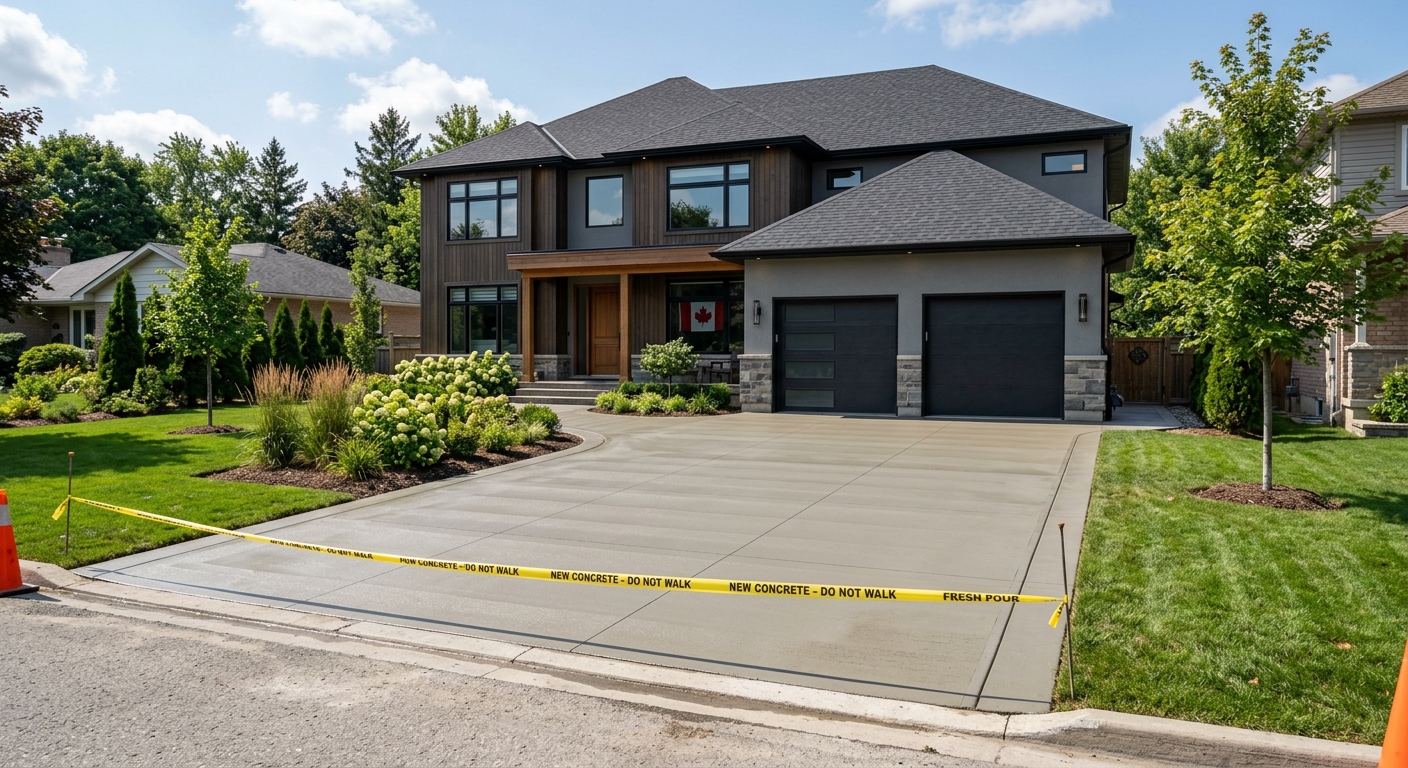
Concrete work options and costs in Bancroft
Bancroft concrete projects are typically driven by homeowners maintaining and upgrading older properties—many of them built before 1981—and by the fact that a large share of homes are single-detached (71.9% of dwellings). With about 1,180 homeowner households (65.6% of households own) in the Kingston–Pembroke economic region, there’s steady demand for exterior flatwork such as driveways, patios and walkways, plus occasional structural repairs and new foundation work. In Bancroft, pricing often comes down less to “the slab” and more to the site conditions: frozen subgrades, drainage issues, and the labour cost of getting pours done within the shorter warm-weather windows. Freeze-thaw cycles also mean footings typically need to be set below the design frost depth, and exterior slabs should use air-entrained concrete to reduce spalling risk over time.
Concrete contractors are busiest in neighbourhoods where lots are older and grading work is common; around Hastings Highlands Road and the more established residential areas near the downtown core, you’ll often see seasonal scheduling pressure for driveway and walkway replacements. If you’re comparing options, it helps to look at what you’re actually buying—base prep and reinforcement, the finish system, and whether the job needs cold-weather curing protection.
Below are typical cost ranges for common concrete applications so you can benchmark the quotes you receive for Bancroft projects.
| Application |
Typical Size |
Key Spec |
Finish Option |
Price Range |
| Concrete driveway (standard broom finish) |
16 ft x 30 ft (480 sq. ft.) |
Air-entrained mix, compacted granular base, control joints |
Broom finish |
$60,000–$86,000 |
| Exposed aggregate driveway |
16 ft x 30 ft (480 sq. ft.) |
Air-entrained mix, exposed-aggregate process, sealed after cure |
Exposed aggregate |
$70,000–$96,000 |
| Stamped concrete driveway or patio |
12 ft x 24 ft (288 sq. ft.) |
Air-entrained mix, integral colour, release agent, control joints |
Stamped + sealed |
$46,000–$80,000 |
| Plain concrete patio or walkway |
10 ft x 16 ft (160 sq. ft.) |
Air-entrained mix, compacted base, edges formed |
Float/finish + light broom or trowel depending on slope |
$14,000–$24,000 |
| Garage floor (interior slab) |
22 ft x 24 ft (528 sq. ft.) |
4-inch slab typical, reinforcement or fibres, vapour barrier if required |
Steel trowel + light broom for traction |
$25,000–$38,000 |
| Foundation footings (structural, below frost) |
Typical perimeter footing for small to medium home |
Below frost depth, excavation, formwork, reinforcement as engineered |
Structural concrete only (no decorative finish) |
$18,000–$34,000 |
Prices are estimates only and vary by project scope, site access and material selection.
What affects the price of concrete work in Bancroft
In Bancroft and across the Kingston–Pembroke region, you can see the same general concrete scope come back 30–50% apart because contractors price the “invisible work” differently—excavation depth, base preparation, reinforcement decisions, and how weather impacts scheduling. Concrete isn’t just material; it’s also logistics. Frost line depth and repeated freeze-thaw cycles dictate every exterior specification, because footings must extend below the design frost depth to prevent frost heave. In Ontario, that’s commonly around 1.2 m below grade for many footing designs, with colder or engineered situations going deeper. Exterior slabs should use air-entrained concrete mixes so the freeze-thaw cycle doesn’t break down the surface.
Cost also shifts with the shorter pour season. In late fall or early spring shoulder weeks, contractors may need cold-weather curing precautions (insulating blankets, heated enclosures, or staged placement), which adds labour and consumables. De-icing salt accelerates surface wear and can contribute to spalling if the mix design or air entrainment isn’t right—so sealing discipline becomes part of the real cost of long-term performance. If you’re comparing a standard driveway versus something like stamped work, remember decorative finishes cost more due to tighter finishing tolerances, colouring, and sealing requirements; stamped and decorative concrete is typically priced at the higher end of the $120–$180 / $160–$280 style driveway band logic, depending on size and complexity.
In Bancroft specifically, older housing stock (60.0% built before 1981) often means you’ll pay for removal/disposal, patching transitions, and sometimes drainage corrections before new concrete goes down. For example, if a driveway replacement includes regrading and extending downspout routes so water won’t pond at the slab edge, that added site work can push a “plain” project toward the mid-range pricing—while avoiding premature cracking and lifting that can cost far more to fix later.
| Price Factor |
Why It Matters |
Cost Impact |
| Frost line depth |
Footings must be below frost to prevent heave and foundation movement |
Can add excavation time and form height; increases structural scope |
| Site preparation |
Accurate grading and compacted granular base prevent settlement and cracking |
Extra trucking for clean fill, labour for grading/compaction |
| Reinforcement |
Controls cracking and improves durability when engineered or required by base conditions |
Rebar labour, mesh placement, chairs/supports |
| Mix design |
Air-entrainment and strength spec drive freeze-thaw and long-term surface durability |
Higher-spec concrete and stricter placement/curing requirements |
| Finish type |
Broom is simpler; stamped/exposed aggregate requires extra materials and skilled finishing |
Stamps/colour, additional finishing labour, sealing products |
| Pour size and concrete truck access to site |
Access limits can slow placement and require pumping or multiple staging |
Truck/pump fees, longer setup and labour |
| Cold-weather curing precautions |
Temperature control protects strength gain and reduces surface defects |
Insulating blankets/heaters and extra monitoring time |
| Control joint pattern and sealing cost |
Joints reduce random cracking; sealing repels salt and moisture damage |
Saw-cut timing, extra labour, and sealer materials |
Permits & regulations in Ontario
In Ontario, structural concrete work usually triggers permitting and/or engineered design review. For Bancroft homeowners, expect permits for foundation-related concrete such as footings, foundation walls, grade beams, and other structural elements that affect the building’s structural integrity. Municipal review is often tied to engineered drawings because the design must account for loads and site conditions. In contrast, concrete flatwork—patios, walkways and typical driveways—often does not require a permit unless it changes lot grading, affects impervious surface coverage limits, or impacts drainage and how water is managed near your property lines or within municipal right-of-way areas. When in doubt, confirm with the local authority before breaking ground, especially if you’re altering swales, adding new culverts, or changing runoff direction.
No matter which permit category your project falls into, verify the contractor is properly covered. Ask for a certificate of insurance showing liability coverage and evidence of WSIB/WCB coverage for workers performing the concrete work. Then verify the contractor’s Ontario licence/registration using the provincial licensing lookup relevant to their trade category (your contractor can point you to the correct number). Request references from similar-scale projects in the same season—Bancroft’s freeze-thaw conditions make workmanship and curing discipline part of the outcome, not just the finish. If the contractor can’t provide documentation promptly, that’s a sign to pause and ask for an updated quote and proof before scheduling.
Getting concrete right in Bancroft's freeze-thaw climate
Concrete can fail in Bancroft most often due to three issues: inadequate base preparation, the wrong mix design for freeze-thaw exposure, and curing that’s rushed or compromised by cool damp weather. The Kingston–Pembroke region sees repeated freeze-thaw cycles that expand and contract moisture inside concrete. If the sub-base isn’t compacted properly to the correct depth, the slab can settle and crack. If the concrete isn’t air-entrained, water can freeze within the paste and cause spalling—small surface flakes that eventually become broader damage. That’s why Bancroft projects should start with a properly engineered granular base and correct drainage, not just “a good-looking finish.”
For specifications, insist on an air-entrained mix for exterior work (target air content is typically in the 5–7% range for many exterior flatwork applications) and a minimum compressive strength of at least 32 MPa, aligned with your contractor’s mix design and the exposure class for your location. Control joints matter because they limit random cracking; the right spacing keeps cracks where they’re meant to be. Curing is also critical: minimum 7-day curing under proper conditions helps the concrete develop strength and reduces early surface damage. Finally, apply a penetrating sealer after the concrete has fully cured—typically at about 28 days—to help repel de-icing salts and reduce salt-driven deterioration.
When asking questions, connect the spec to performance: “What’s the target air content for my driveway? How deep is your granular base and how is it compacted? What’s your control joint spacing and how soon are joints cut?” A common example: a broom-finish driveway might land in the $120–$180 style band, but adding proper reinforcement and drainage corrections can move a quote closer to the upper end. That difference is often justified because the alternative—surface scaling, cracking, and rework—usually costs far more over a Bancroft freeze-thaw season.
| Spec |
Why It Matters in Bancroft |
What to Ask For |
Impact if Skipped |
| Compacted granular base (depth?) |
Prevents settlement and frost-related movement under the slab |
Base thickness and compaction method (e.g., granular depth and how it’s compacted/checked) |
Cracking, dips, and premature edge failure |
| Air-entrained concrete mix (target air %?) |
Reduces freeze-thaw damage and spalling in Ontario winters |
Target air content (typically 5–7% for exterior flatwork) confirmed in the mix ticket/spec |
Surface scaling and spalling within a few seasons |
| Compressive strength (MPa rating) |
Supports durability and strength gain through cool conditions |
Minimum 32 MPa rating stated for your exposure and application |
Weaker concrete, higher wear and surface defects |
| Control joints (spacing per ACI guidelines) |
Limits random cracking caused by shrinkage and temperature swings |
Joint spacing plan and when saw-cutting will happen |
Wider random cracks and costly patching |
| Minimum 7-day curing period |
Ensures strength development before traffic and seasonal temperature drops |
What curing protection is used in cool damp weather and traffic restrictions |
Surface damage, curling, and reduced long-term performance |
| Penetrating sealer (when applied after cure) |
Repels moisture and de-icing salts that accelerate deterioration |
Penetrating sealer timing (commonly after 28 days) and product type |
Faster scaling/spalling and higher maintenance costs |
How to choose a concrete work contractor in Bancroft
Start by verifying contractor coverage and Ontario compliance the same way you’d verify a structural trade. Ask for proof of liability insurance (certificate of insurance) and evidence that they and their subcontractors carry WSIB/WCB coverage for workers. In practice, you’ll check the certificate for coverage limits and expiry dates, and confirm the name(s) on the policy match the contracting company on your quote. Then verify the contractor’s Ontario licence/registration for their trade category using the appropriate provincial registry lookup—your contractor should be able to provide their registration number and the company legal name exactly as it appears on the policy and quote.
Next, get 2–3 itemised written quotes with labour and materials clearly separated (base/granular supply, concrete supply and delivery, reinforcement, excavation, formwork, finishing, saw-cut control joints, and sealing if included). Don’t accept a vague lump sum that hides whether disposal, grading corrections, or permit support (if required) are included. Read the exclusions section for “dangerous surprises” like pump fees, extra excavation for unsuitable soil, or saw-cutting timing. Also confirm warranty terms: workmanship warranty length, any product/manufacturer warranty for materials, and whether warranty coverage is transferable if you sell your home.
For payment, never pay the majority upfront. A good rule is keeping upfront deposits to no more than 10–15%, with a holdback retained until the work is complete and cleaned, and any curing/sealing steps are finished as stated. Finally, insist on a written timeline with a start date and estimated completion date, since Bancroft scheduling often shifts with cool shoulder-season weather.
- Request mix details (air entrainment target, strength spec) for exterior work.
- Ask how thick the compacted granular base is and how it’s compacted.
- Confirm reinforcement plan (mesh vs rebar, chairs/spacers, and where it’s used).
- Get the control joint spacing plan and saw-cut timing in writing.
- Ask how they protect pours during cool or damp weather (blankets/heating).
- Verify sealing: product type and whether it’s included 28 days after pour.
- Ensure disposal and concrete removal are itemised (no “assume you’ll figure it out”).
- Check if permits/engineer drawings are included when structural work requires them.
- Confirm concrete delivery distance and truck access logistics (avoid delays and cold joints).
- Ask about surface prep at tie-ins (existing asphalt/sidewalk junctions).
- Confirm cleanup and final grading at edges and transitions.
- Review warranty start date and what workmanship defects are covered.
Concrete red flags in Bancroft include: promising “no need for joints,” refusing to discuss air entrainment for exterior slabs, offering the cheapest quote with limited excavation/base prep, starting a pour during cold damp conditions without curing protection, and avoiding proof of liability/WSIB/WCB coverage or providing outdated insurance documents.
Frequently asked questions — concrete work in Bancroft
How deep must footings be for Bancroft's frost line?
In Bancroft and across Ontario, footing depth is set below the design frost depth to prevent frost heave and movement. As a general rule of thumb used in Ontario practice, you’ll often see footing depths around 1.2 m below grade, but the exact depth for your property can be higher depending on soil conditions, exposure, and how your foundation is engineered. Because Bancroft sites can vary, don’t rely on a neighbour’s footing depth—ask your contractor what your engineered drawing (if required) specifies and confirm the excavation depth before they pour. If you’re planning foundation / footings work, the structural scope typically lands in the $180–$320 style band depending on excavation complexity and reinforcement needs. (Statistics Canada, 2021 Census)
Why does concrete crack in Bancroft and how is it prevented?
Concrete cracks are common in freeze-thaw climates like Bancroft because slabs shrink as they cure and then expand/contract with temperature swings. The real goal isn’t “no cracks,” it’s reducing random cracking and protecting the slab’s edges. The prevention starts with a properly compacted granular base so the slab can’t settle, then correct air-entrainment for durability, and finally a control joint pattern that matches the slab dimensions. Joints should be planned and cut on schedule to give cracks a predictable path. Proper curing also matters: rushing traffic can lead to early surface defects and wider cracking. If you’re comparing options, a plain broom-finish driveway might be closer to the $120–$180 band, but investing in base prep and joint discipline is what keeps those cracks tight and manageable.
Stamped vs broom-finish concrete — cost difference?
Stamped concrete costs more than broom-finish because the process includes integral colour (or other colouring systems), stamping materials, release agents, and tighter finishing control to achieve the pattern cleanly. You also typically want sealing as part of the long-term protection plan, especially in Ontario winters with de-icing salt. In practical homeowner terms in Bancroft, a broom-finish driveway may fall into the lower-to-mid end of the driveway pricing (the market’s common $120–$180 per sq. ft.-type range is used as a benchmark), while stamped work often aligns with the higher decorative pricing band (commonly $160–$280 per sq. ft.-type pricing logic). The “why” is labour and finishing tolerance—if a quote is similar, ask whether the stamped scope includes proper jointing, curing discipline, and sealing 28 days after the pour.
When is the best time to pour concrete in Bancroft?
The best time is typically when you can maintain workable temperatures for placing and curing—most successful projects land in the late spring through early fall window. In Bancroft, cool damp weather can slow strength gain, which increases the risk of surface damage if concrete is opened to traffic too early. If a pour must happen near shoulder season, a reputable contractor should plan cold-weather curing precautions such as insulating blankets and, when needed, heating enclosures—then keep traffic off the slab per the cure plan. The short pour season also affects scheduling, so booking earlier often reduces premium costs. As a budgeting reference, you’ll still see typical driveway pricing in the $120–$180 band, but weather-related labour can move a job toward the higher end if extra protection is required.
How long does concrete take to cure?
Concrete curing has two related timelines: strength development and practical readiness for traffic. Many mixes reach significant early strength within the first few days, but the standard homeowner-friendly rule is minimum 7 days curing under proper conditions before you treat the surface as fully reliable for typical use. Full curing and strength gain continue well beyond that, which is why sealing is commonly applied about 28 days after the pour to maximize performance against Ontario de-icing salt and moisture. In Bancroft’s freeze-thaw climate, curing discipline matters because cold or damp conditions slow strength gain and can affect the surface if opened too soon. Your contractor should provide a clear traffic restriction plan and curing protection steps. If you plan sealing, budget time for the 28-day window—skipping it tends to show up as faster scaling and surface wear.
Do I need a permit for concrete work in Ontario?
In Ontario, structural concrete work—like footings, foundation walls, and grade beams—typically requires a building permit and often engineered drawings reviewed by the municipality. Concrete flatwork such as patios, walkways and standard driveways often does not require a permit unless it changes lot grading, impacts impervious surface coverage limits, or affects drainage and municipal right-of-way concerns. Because every Bancroft lot is different, the safest approach is to ask your contractor what category your project falls under and then confirm with the local authority before starting excavation. Also verify coverage: a licensed contractor should carry liability insurance and WSIB/WCB coverage for workers. Don’t let a “permit-not-needed” claim replace confirmation—especially if the job affects drainage routes or involves structural foundation changes.