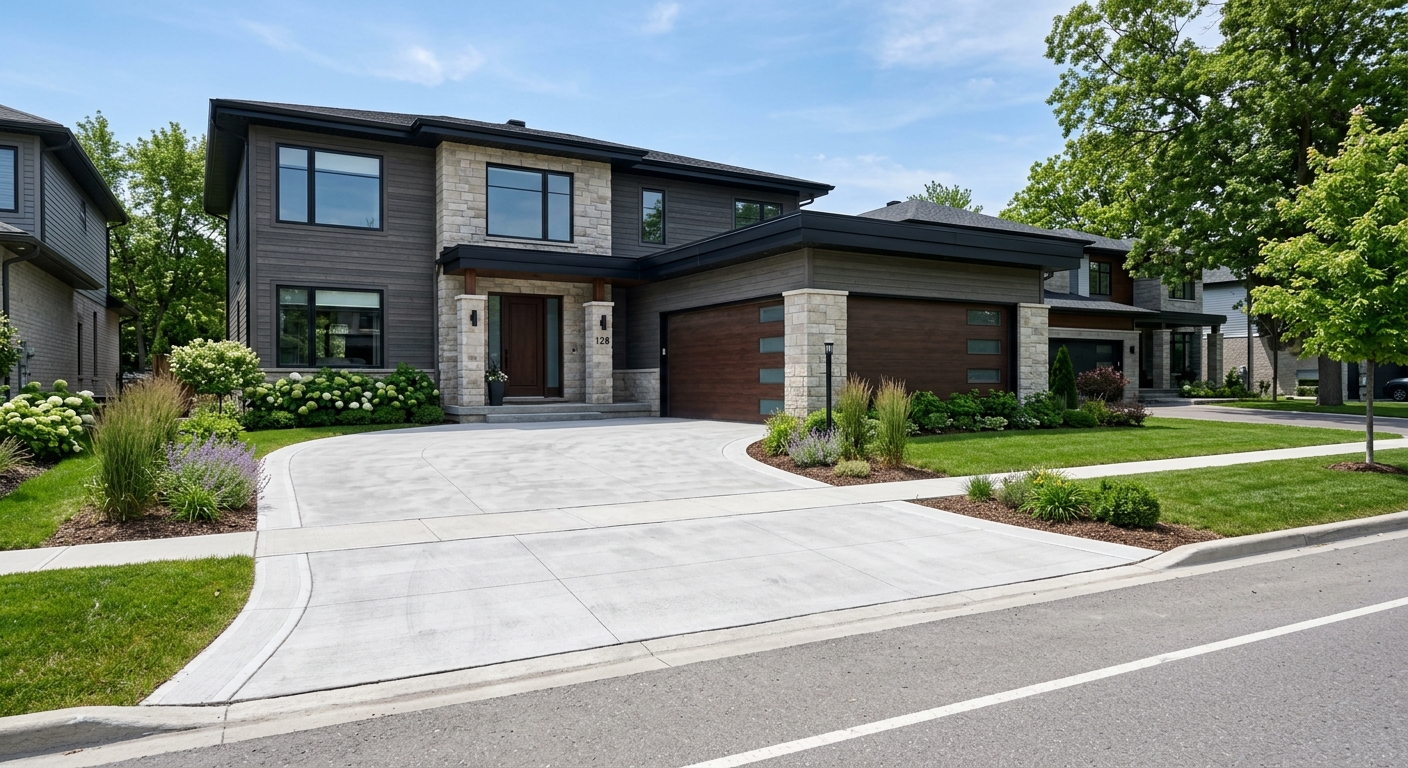
Concrete work options and costs in Neebing
Neebing is a small but active community in the Northwest, and concrete flatwork—driveways, patios, and walkways—fits the way most homes are built and maintained. With 94.1% of homeowner households owning their property and 98.9% of dwellings being single-detached houses, most of the local demand is for long-lasting exterior slabs that can handle snow storage, plough traffic, and de-icing salts. (Statistics Canada, 2021 Census)
In the Northwest, pricing is shaped by climate more than in southern Ontario. Long winters bring repeated freeze–thaw cycles, and frost penetration can reach 5–6 ft in some areas. That means contractors typically build foundations and footing systems to about 4–6 ft below grade to reduce frost heave risk, and they design exterior slabs with air-entrained mixes, proper base drainage, and correctly spaced control joints. The pour season is also shorter—late spring through early fall—so mobilizing crews at the right time can add cost when weather compresses schedules.
Trade work is often especially in demand around the Thunder Bay–area corridor near Neebing, where many homeowners plan new driveways and patios at the same time as landscaping and roofing upgrades, and where access to ready-mix trucks and excavation staging affects labour. If you’re weighing options, the table below compares typical sizes and common spec choices you’ll see in local estimates.
| Application |
Typical Size |
Key Spec |
Finish Option |
Price Range |
| Concrete driveway (standard broom finish) |
400–600 sq. ft. |
Air-entrained exterior mix, compacted granular base, control joints as needed |
Broom finish, edge forms, optional rebar/wire mesh depending on design |
$14,000–$22,000 |
| Exposed aggregate driveway |
400–600 sq. ft. |
Higher cement content and proper curing to support weather durability |
Exposed aggregate, deeper surface texture for traction |
$18,000–$28,000 |
| Stamped concrete driveway or patio |
300–500 sq. ft. |
Air-entrained mix, colour hardener, integral or surface colour system |
Stamped pattern with sealer |
$20,000–$32,000 |
| Plain concrete patio or walkway |
200–400 sq. ft. |
Compacted granular base, proper slope, joints for shrinkage control |
Smooth or broom-smooth finish |
$2,400–$8,000 |
| Garage floor (interior slab) |
400–600 sq. ft. |
Vapour barrier as needed, granular base, typically reinforced |
Broom finish or steel-trowel finish depending on use |
$10,000–$18,000 |
| Foundation footings (structural, below frost) |
Typical single-detached footing perimeter for light framing |
Below frost depth (often ~4–6 ft), designed reinforcement, air-entrained where exposed |
Normal finish (structural) |
$180,000–$260,000 |
Prices are estimates only and vary by project scope, site access and material selection.
What affects the price of concrete work in Neebing
In Northwestern Ontario, it’s common to see quotes for the same concrete scope swing by 30–50%. That gap usually isn’t “random”—it’s the result of how each contractor handles frost risk, base preparation, truck access, and finishing choices during a short pour season. Even when the finish looks similar, the specs behind it (air content, reinforcement, joint layout, and curing) can change significantly, especially in a climate where freeze–thaw cycles and de-icing salts punish weak concrete surfaces.
Every exterior spec is tied to frost movement. Footings must extend below the design frost depth to avoid heave, and residential and light commercial footings in the region are commonly taken to about 4–6 ft below grade. Exterior slabs also need air-entrained concrete to resist scaling and cracking from repeated freezing. Then there’s timing: the late spring through early fall window means cold, wet, or windy days can slow strength gain, and cold-weather curing precautions—like insulating blankets or heated enclosures—add labour and material cost. De-icing salt accelerates surface spalling, so sealing is often recommended, which can add a modest line item cost but protect the slab.
In Neebing, a driveway that needs significant re-grading or deeper granular base can push the job toward the higher end of the $14–$22 per sq. ft. driveway range, while a straight replacement on firm, well-drained ground may land closer to the mid-range. Newer neighbourhoods with more driveway renewals can also mean higher mobilization and scheduling costs when crews are booked. Homes built before 1981 make up 40.4% of the housing stock, and many of those sites have older drainage patterns or settled grades that require extra excavation and base correction (Statistics Canada, 2021 Census).
| Price Factor |
Why It Matters |
Cost Impact |
| Frost line depth — determines footing depth and form height |
Deeper excavation and more formwork reduce frost heave risk |
High potential increase; can swing foundation/footing costs materially |
| Site preparation — excavation, grading, compacted granular base |
Proper sub-base drainage and compaction reduce voids and settlement |
Moderate to high; surprises from poor soil or drainage |
| Reinforcement — rebar or wire mesh requirement |
Helps control cracking and improves slab durability |
Moderate; depends on design loads and slab type |
| Mix design — air-entrainment and compressive strength spec |
Targets freeze–thaw resistance and long-term strength |
Moderate; quality mix prevents failure and rework |
| Finish type — broom vs. stamped vs. exposed aggregate |
Finishes require extra labour, materials, and careful curing |
Can be the difference between “basic slab” and premium options ($20–$32 stamped) |
| Pour size and concrete truck access to site |
Smaller pours may need more mobilizations; limited access slows work |
Moderate; staging and waiting time can add up |
| Cold-weather curing precautions — heating and blankets |
Protects early-age strength gain in shoulder-season conditions |
Moderate; becomes important near cold snaps |
| Control joint pattern and sealing cost |
Joints manage shrinkage cracking; sealing helps resist salt-driven spalling |
Low to moderate; often a wise value addition |
Permits & regulations in Ontario
In Ontario, concrete work splits into two practical buckets: structural items that almost always require municipal review, and flatwork that usually doesn’t—unless it changes drainage or grading. For Neebing homeowners, structural concrete such as footings, foundation walls, and grade beams generally requires a building permit, and many projects involve engineered drawings reviewed through the permitting process.
Concrete flatwork like driveways, patios, and walkways typically does not require a permit by default. However, you should confirm with the local authority if the work affects lot grading, stormwater flow, or impervious surface/coverage rules, or if it involves work within a municipal right-of-way. When in doubt, ask before breaking ground—retrofits for drainage errors are expensive.
Before signing, verify your contractor is set up properly: they should carry liability insurance and have WSIB/WCB coverage. Step-by-step: (1) ask for their current certificate of insurance and confirm it matches the legal name on the quote; (2) request proof of WSIB coverage or clearance; (3) confirm the contractor’s licensing/registration status through Ontario’s public listings (using the contractor’s legal business name). Then ask for references on similar-scope concrete in the North (same season type and exterior exposure).
Getting concrete right in Neebing's freeze-thaw climate
Concrete can fail in Neebing’s winters when water gets into the slab and then freezes, expanding and pushing apart the surface. That’s why the “right mix” and “right build” matter as much as the finish you can see. The first layer is base preparation: you need a compacted granular sub-base to the correct depth and a drainage-correct subgrade so meltwater doesn’t sit under the slab. In the Northwest, frost can penetrate deeply, so specs must account for movement and prevent heave that can crack or lift pavement.
Second is mix design. Exterior flatwork should be made with air-entrainment (commonly 5–7% air for durability) and a minimum 32 MPa compressive strength spec. Third, plan control joints to limit random shrinkage cracking. Fourth, curing is critical: even if the slab looks dry quickly, early-age concrete needs protection. A practical rule is at least 7 days of curing under proper conditions; in cold or shoulder-season weather, blankets or temporary enclosure heat may be needed to keep strength gain on track. Finally, apply a penetrating sealer after cure (often around 28 days post-pour) to repel de-icing salts that accelerate spalling.
Ask contractors to explain how they’ll handle those steps. If you’re choosing between a plain patio and a stamped option, the cost jump can be justified: a basic patio may fall closer to the lower end of the concrete patio band (around $12–$20 per sq. ft. in this tier), while stamped work tends to land at the $20–$32 level due to colour hardeners, stamping labour, and enhanced finishing/sealing care. Where it’s not justified is when a contractor cuts corners on base drainage or air-entrainment—those are the failures that show up the next winter.
| Spec |
Why It Matters in Neebing |
What to Ask For |
Impact if Skipped |
| Compacted granular base (depth?) |
Reduces settlement and water trapping that leads to freeze–thaw damage |
Documented excavation depth, granular type, compaction testing approach, drainage/slope plan |
Settlement, cracking, and early surface scaling |
| Air-entrained concrete mix (target air %?) |
Improves freeze–thaw resistance and reduces scaling/spalling |
Target air content (commonly 5–7% for exterior), and mix delivery ticket specs |
Higher risk of spalling during Neebing winters |
| Compressive strength (MPa rating) |
Strength supports durability under traffic loads and freeze–thaw exposure |
Minimum 32 MPa spec and confirmation of the exposure classification used |
Weaker concrete that deteriorates faster |
| Control joints (spacing per ACI guidelines) |
Controls shrinkage cracking so it cracks “where planned,” not randomly |
Planned joint layout and cutting schedule (cut on time after finishing) |
Random cracking pathways and water ingress |
| Minimum 7-day curing period |
Ensures strength gain before winter exposure accelerates deterioration |
Curing method (blankets/compound as needed) and temperature protection plan |
Surface weakness and reduced long-term performance |
| Penetrating sealer (when applied after cure) |
Repels de-icing salts and slows moisture movement into pores |
Application after cure (commonly around 28 days), and surface prep requirements |
Faster salt-driven spalling and staining |
How to choose a concrete work contractor in Neebing
Choosing the right concrete contractor in Neebing starts with verification, not photos. In Ontario, confirm three things: (1) the contractor’s Ontario licensing/registration status (use the contractor’s legal business name), (2) liability insurance with current coverage, and (3) WSIB/WCB coverage (ask for a clearance letter or proof). If they can’t provide these promptly, keep looking—concrete jobs are labour-intensive and site conditions are unpredictable in the North.
Next, request 2–3 itemised written quotes, not a single lump sum with vague wording. Good quotes break out labour and materials (excavation/base, formwork, reinforcement, concrete supply, finishing, joints, sealing, and disposal). Check what’s excluded: is permit pulling included for structural work, and is dump/disposal included or “by owner”? Also ask who supplies rebar/wire mesh, chairs/spacers, and whether they’ll provide mix specs for air-entrainment and strength.
Warranty matters in a freeze–thaw climate. Ask for a workmanship warranty length, whether product/manufacturer warranties apply to sealers/admixtures, and whether any warranty is transferable if you sell the property. For payment, avoid large deposits: a typical safe approach is no more than 10–15% upfront, then hold back until completion and cleanup. Finally, get the start date, weather contingency plan, and completion estimate in writing—because in Neebing, scheduling must respect cold snaps and the short pour season.
- Verify licensing/registration using the contractor’s legal name.
- Confirm current liability insurance (ask for certificate of insurance).
- Request WSIB/WCB proof or a clearance letter.
- Get itemised quotes (labour vs materials) for every line item.
- Ask for mix design details: air-entrainment and minimum compressive strength.
- Confirm reinforcement plan (where required) and placement (chairs/spacers).
- Review base prep: excavation depth, granular type, and compaction approach.
- Ask about joint spacing and cutting timing for shrinkage control.
- Clarify curing methods and who provides blankets/heaters if needed.
- Confirm sealing scope (product, application timing after cure, coverage).
- Check exclusions: disposal, topsoil replacement, grading, and permit responsibility.
- Match payment schedule to milestones; hold back until final acceptance.
Red flags in Neebing include contractors who promise exterior durability without discussing air-entrainment and curing, quotes that omit base depth/compaction and joint layout, requests for large upfront payments, vague “we’ll figure it out later” weather plans, and any refusal to provide insurance/WSIB proof or reference projects done in similar freeze–thaw conditions.
Frequently asked questions — concrete work in Neebing
How do I compare concrete quotes?
Start by comparing quotes line-by-line, not just the total. For Neebing and the broader Northwest, the big differences are usually (1) base preparation depth and compaction approach, (2) whether the mix is air-entrained for freeze–thaw durability, and (3) the reinforcement/joint plan for crack control. Ask each contractor to itemise labour and materials, and confirm inclusions like disposal, formwork, and sealing. For reference, driveway pricing in this tier commonly sits around $14–$22 per sq. ft. depending on prep and finish, while stamped concrete often lands around $20–$32 per sq. ft. If one quote is far lower, look for exclusions or missing specs—those are the items that typically cause winter spalling and early cracking.
Can concrete be poured in cold weather in Neebing?
Yes, concrete can be poured in cold weather in Ontario, but it’s not “set and forget.” The key is early-age temperature control so strength gain isn’t slowed too much. Contractors may use heated enclosures or insulating blankets and adjust scheduling so they can protect the slab until it reaches adequate strength. In Neebing, shoulder-season cold and repeated freeze–thaw cycles make curing and protection especially important for exterior slabs. A reputable contractor should explain their cold-weather plan and curing method, including how they’ll monitor conditions. If a contractor only says “we can pour any time,” without talking about curing protection, air-entrainment, and timing, that’s a major concern—those omissions can lead to weak surfaces and future scaling/spalling.
How do I maintain concrete in Neebing's freeze-thaw climate?
Maintenance in Neebing is mostly about controlling moisture and limiting salt exposure. After installation, allow proper cure time and then consider a penetrating sealer after cure (often around 28 days) to help repel de-icing salts. Use de-icers that are less aggressive when possible, and avoid letting water sit in low spots—re-grading drainage is far cheaper than replacing a slab after repeated freeze–thaw. For driveways and patios, keep an eye on early hairline cracks; sealed joints and correct joint behaviour reduce water pathways. If you have an exposed aggregate or stamped surface, follow the product manufacturer’s cleaning guidance and re-seal timing. The goal is to prevent water ingress so freeze–thaw doesn’t cycle through the surface and break it down.
What causes concrete to spall in Neebing winters?
Spalling usually comes from moisture entering the concrete, then freezing and expanding, which breaks off the surface paste. In Neebing and the Northwest, the main contributors are inadequate air-entrainment, insufficient curing, and water management issues from poor base drainage or low spots. De-icing salts make the surface chemistry more aggressive, accelerating deterioration once freezing begins. Control joint mistakes can also increase random cracking, creating more routes for water. The fix isn’t only “more sealer later”—it’s getting the right air content (often 5–7% for exterior), correct base compaction, and proper curing so the slab is durable from day one. If a quote doesn’t mention air-entrainment or the curing plan, that omission is a strong predictor of winter surface failure.
What is rebar and when is it required in Ontario?
Rebar is steel reinforcement placed inside concrete to help control cracking and improve load capacity. Whether it’s “required” depends on the engineered design and the type of slab/structure. For structural concrete (like foundation elements), reinforcement requirements are driven by structural loads, soil conditions, and Ontario building design requirements—typically handled through engineered drawings and permits. For exterior flatwork, some projects use wire mesh or rebar depending on slab thickness, intended loads (e.g., heavier driveway use), and cracking control needs. In Neebing’s freeze–thaw climate, reinforcement works best when combined with a proper base and joints; reinforcement can’t compensate for water intrusion or poor air-entrainment. Ask your contractor to state what they’ll install (rebar vs mesh), where it sits (chairs/spacers), and how it matches the design.
How long does a concrete project take in Neebing?
Timing depends on scope, weather, and curing conditions. In Neebing’s Northwest climate, the actual pour day might be only part of the schedule—excavation, forms, base preparation, and finishing usually take most of the time. As a rough example, small flatwork like a walkway can be completed in a few days total (prep and pour), while a driveway or patio often takes longer due to base correction, form setup, joint cutting, and sealing coordination. Cold-weather precautions can extend timelines because crews may need blankets or heated enclosures and a protection window to achieve safe strength gain. Even if finishing happens in a day, proper curing continues beyond that. If you’re planning around the short pour season, lock your schedule early with weather contingencies to avoid mid-job delays.