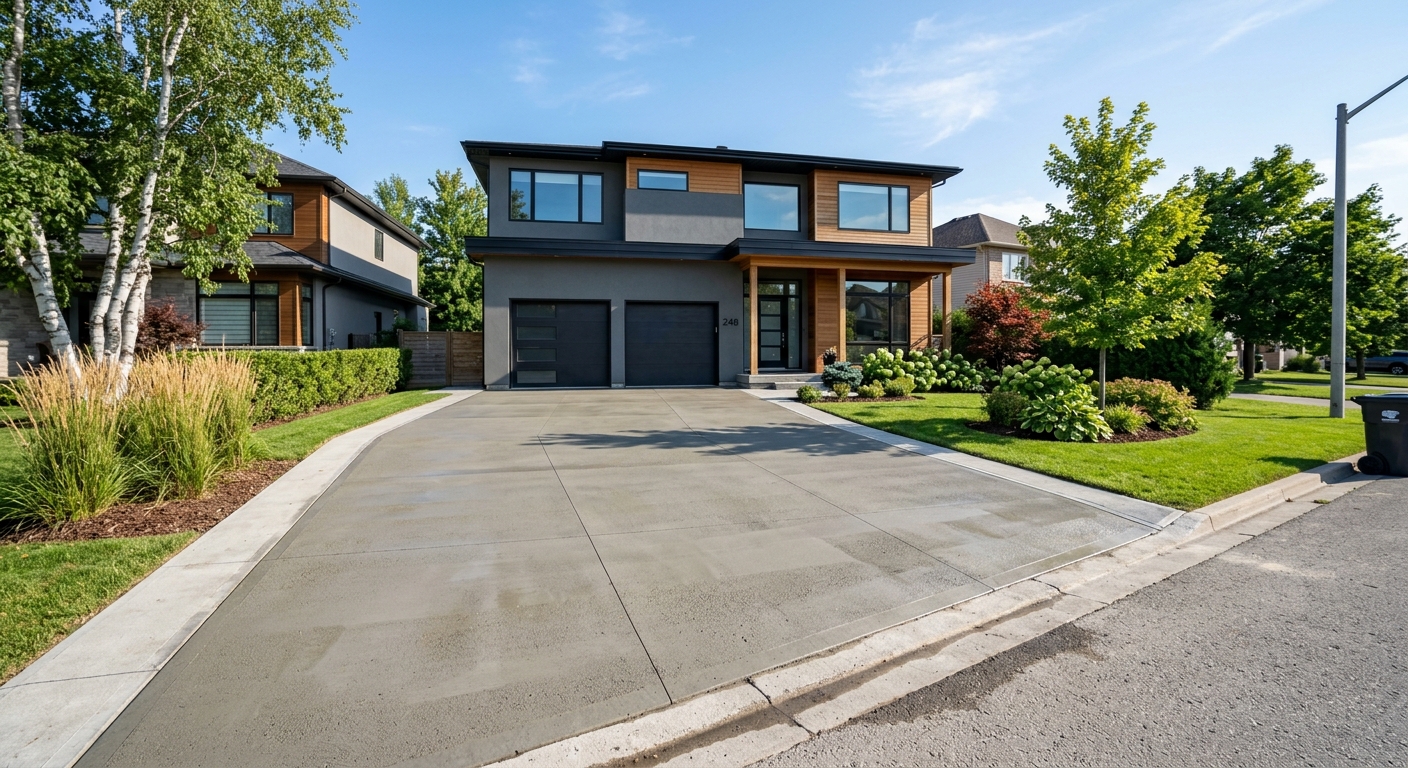
Concrete work options and costs in Bowmanville
In Bowmanville, concrete work is a year-round need, especially for the many homeowners maintaining driveways, patios, and walkways around their properties. With a population of 39,371 (Statistics Canada, 2021 Census), the demand is steady across the Toronto economic region, where trades are busy during the short, reliable pour season. Bowmanville’s housing stock is dominated by single-detached homes and low-rise neighbourhoods—exactly the kind of properties that typically need new exterior flatwork and periodic replacements as surfaces age and freeze–thaw damage shows up. In areas like Newcastle Street/Regional Road corridors and the east end near Courtice Road, you’ll often see concrete replacement and expansion work scheduled to keep pace with spring and early-fall landscaping.
Pricing in Bowmanville is influenced by Toronto-area frost-depth and freeze–thaw realities. Local specs generally require exterior footings below grade to limit frost heave and differential movement, and most exterior slabs are placed with air-entrained concrete. In practice, that means more prep time, a stronger mix, better curing protection, and control-joint planning—especially when temperatures drop toward 10 °C or below. Contractors also compete heavily for crews during warmer weeks, so “good timing” can reduce labour surcharges, while tight access (narrow lots, retaining walls, or limited truck turn-around) can raise costs.
To help you compare like-for-like, the table below outlines typical Bowmanville options and realistic price bands, including both standard and premium finishes.
| Application |
Typical Size |
Key Spec |
Finish Option |
Price Range |
| Concrete driveway (standard broom finish) |
12 ft × 20 ft (240 sq ft) |
Air-entrained mix, compacted granular base |
Broom-finished |
$18,000 – $28,000 |
| Exposed aggregate driveway |
12 ft × 20 ft (240 sq ft) |
Air-entrained mix, proper curing & wash timing |
Exposed aggregate |
$21,000 – $33,000 |
| Stamped concrete driveway or patio |
12 ft × 16 ft (192 sq ft) |
Air-entrained mix, integral colour, release agent |
Stamped patterns |
$24,000 – $40,000 |
| Plain concrete patio or walkway |
10 ft × 12 ft (120 sq ft) |
Air-entrained mix, edge forms, drainage plan |
Broom or light trowel |
$16,000 – $26,000 |
| Garage floor (interior slab) |
20 ft × 20 ft (400 sq ft) |
Vapour barrier, reinforcement as required |
Smooth or broom finish |
$28,000 – $45,000 |
| Foundation footings (structural, below frost) |
Varies by foundation design |
Engineered size & rebar, below frost depth |
Structural concrete only |
$180 – $300 |
Prices are estimates only and vary by project scope, site access and material selection.
What affects the price of concrete work in Bowmanville
It’s common to see quotes for “the same” driveway or patio vary by 30–50% across the Toronto area because concrete pricing isn’t just about the volume of concrete—it’s about how much prep, reinforcement, and curing management the job requires. In Bowmanville, the cost drivers are highly consistent: frost-depth requirements dictate footing depth and form height, while freeze–thaw cycles dictate the mix design and finishing details. Most exterior slabs are placed with air-entrained concrete so the water in the paste has room to expand when it freezes, reducing surface and near-surface damage over time.
For structural work, Ontario Building Code requirements generally push footings to extend below design frost depth (often in the range of 1.2 m or more below grade). That means extra excavation, trucking, and disposal. For flatwork, the Toronto/Midtown to Durham corridor has a shorter window for “easy” curing once nights cool; contractors often spend more on heating, insulated blankets, and protecting fresh concrete when temperatures trend toward 10 °C or below. Plus, de-icing salts used by many Bowmanville households can accelerate spalling if the surface chemistry and air content weren’t done right—so sealing and surface protection become part of the long-term cost equation.
Two practical examples: a standard broom-finished slab can fit the lower end of the $18–$28 range, but going to stamped concrete often adds integral colour, release agents, and more labour time, pushing costs closer to the $24–$40 band. Similarly, a small walkway on stable, well-drained ground might stay near the lower $16–$26 range, while a driveway over saturated soil can require deeper granular base and more time for proper drainage—adding dollars even if the surface area looks similar. Homeowners in older neighbourhood pockets (more established drainage patterns and occasional settlement issues) often see higher prep costs, because base failures and soft spots must be corrected before any concrete can perform.
| Price Factor |
Why It Matters |
Cost Impact |
| Frost line depth — determines footing depth and form height |
Controls how deep structural elements must sit to prevent frost heave |
Higher excavation & rebar placement; can add significant labour and disposal |
| Site preparation — excavation, grading, compacted granular base |
Correct base thickness prevents pumping, settlement, and cracking |
More material and machine time; common swing factor in pricing |
| Reinforcement — rebar or wire mesh requirement |
Improves crack control and supports heavier loads |
Cost increases when engineering calls for rebar grids or thicker slabs |
| Mix design — air-entrainment and compressive strength spec |
Air-entrainment protects concrete through freeze–thaw cycles |
Premium mix and tighter QA can raise material costs |
| Finish type — broom vs. stamped vs. exposed aggregate |
Finishing affects labour time, curing protection, and material handling |
Stamped/exposed work usually sits near the upper bands |
| Pour size and concrete truck access to site |
More trucks/longer carries increase placement time and scheduling complexity |
Access problems can add labour and additional equipment fees |
| Cold-weather curing precautions — heating and blankets |
Ensures strength gain before freeze conditions interrupt hydration |
Blankets, heaters, and extra time can noticeably increase total price |
| Control joint pattern and sealing cost |
Jointing controls cracking; sealing improves resistance to salts and water ingress |
More layout time and added sealer material/return visit |
Permits & regulations in Ontario
In Ontario, structural concrete work typically needs a building permit, and in many cases engineered drawings reviewed by the municipality. That includes work like foundation walls, grade beams, structural footings, and other items that support the building’s load path. For concrete flatwork—patios, walkways, and most driveways—permits are often not required when the work is staying within the normal scope (for example, replacing existing concrete where the lot grading and drainage aren’t changed). However, permits and municipal approvals can be triggered if your project affects lot grading, alters drainage patterns, or changes impervious surface coverage in a way that impacts approvals or municipal right-of-way requirements. If you’re tying into a walkway that runs along a driveway apron area or you’re close to municipal services, always confirm first.
For Bowmanville homeowners, the safest approach is to verify the contractor before you sign. Step 1: ask for their WSIB clearance letter (or proof of coverage) and confirm coverage is current. Step 2: request their certificate of insurance (liability) showing current limits appropriate for concrete work and include you as the certificate holder where applicable. Step 3: confirm licensing/registration requirements relevant to the contractor’s business and trades; then check online for business validity. Step 4: review references on similar-sized jobs—especially exterior flatwork with frost-exposed performance—and ask who pulls the permit when one is required.
Finally, don’t rely on “we always do this.” Confirm permit responsibility in writing: who applies, what drawings are needed, and when inspections occur.
Getting concrete right in Bowmanville's freeze-thaw climate
Concrete failures in Bowmanville usually come down to water management and freeze–thaw exposure. The concrete paste expands and contracts repeatedly when moisture is trapped and then freezes, and that’s how you get spalling, scaling, and premature cracking. The fix starts before the truck arrives: base preparation and drainage must be correct, with a compacted granular sub-base to the depth required for the local soil and frost movement. If the base is soft or improperly graded, the slab can settle unevenly and joints can’t do their job.
Next is mix design. For exterior flatwork, air-entrainment is essential; a typical target is about 5–7% air content to provide freeze–thaw resistance. Pair that with a minimum 32 MPa compressive strength so the concrete achieves adequate durability and early strength. Control joints also matter: they need a planned pattern (not random) to keep shrinkage and temperature cracking in predictable locations. Curing is the silent make-or-break step—plan for at least 7 days under proper curing conditions, and when temperatures fall toward the lower teens at night or below about 10 °C, ask about curing blankets or temporary heating so hydration isn’t interrupted.
Finally, sealing helps protect the surface against de-icing salts; a penetrating sealer is typically applied after the concrete has cured (often around 28 days post-pour). If you skip sealing in salt-heavy driveways, you’re more likely to see surface breakdown sooner than expected.
As a pricing example, if a standard broom-finished patio is closer to the lower $16–$26 range and the stamped option is closer to $24–$40, the extra cost is justified when the design includes proper air-entrainment, joint planning, and curing protection—not just colour and pattern. If those basics aren’t handled, paying for a premium finish won’t prevent the spalling that shows up after a couple of winters.
| Spec |
Why It Matters in Bowmanville |
What to Ask For |
Impact if Skipped |
| Compacted granular base (depth?) |
Reduces settlement and allows proper drainage under freeze–thaw conditions |
Confirm base thickness and compaction method for your soil/site |
Uneven support leads to cracking and joint failure |
| Air-entrained concrete mix (target air %?) |
Protects against freeze–thaw scaling and spalling from trapped moisture |
Ask for target air content (typically 5–7% for exterior flatwork) |
More spalling risk during Bowmanville winters |
| Compressive strength (MPa rating) |
Ensures durability and adequate strength gain during cold-season exposure |
Confirm minimum 32 MPa rating (as specified for exterior use) |
Weaker concrete can wear and scale sooner |
| Control joints (spacing per ACI guidelines) |
Keeps cracks where you want them, limiting random cracking |
Ask for joint layout and spacing plan before pouring |
Random cracking and more water intrusion paths |
| Minimum 7-day curing period |
Allows hydration to develop strength before freeze conditions return |
Ask how they protect the slab during cool or damp weather |
Reduced strength gain; surface defects increase |
| Penetrating sealer (when applied after cure) |
Repels moisture and reduces salt-driven surface damage |
Confirm sealing schedule (often around 28 days post-pour) |
Faster surface deterioration and staining |
How to choose a concrete work contractor in Bowmanville
Choosing the right concrete contractor in Bowmanville is about verification and clarity. Start with Ontario-required checks: ask for their liability insurance certificate and confirm WSIB/WCB coverage before any work begins. For the homeowner, the best practice is to get the WSIB clearance letter (or equivalent proof) directly from the contractor, then verify the certificate dates are current. Next, confirm the business is properly registered for the scope they’re offering, and that the company can support exterior concrete work with crew experience in freeze–thaw climates.
Get 2–3 itemised written quotes—ideally with labour and materials separated—so you can compare apples to apples. Look for what’s included: excavation and hauling, disposal, granular base type and depth, reinforcement type, air-entrained mix confirmation, joint layout, and whether permit support is included when required. A true comparison also lists exclusions like snow removal, site restoration beyond the pour limits, or tree root removal if encountered.
Warranty matters. Ask for a workmanship warranty length and what it covers (commonly issues like surface scaling from finishing/curing problems, not normal wear). Confirm whether product/manufacturer warranties apply and if they’re transferable. For payment scheduling, never agree to pay more than 10–15% upfront; hold back the remainder until completion and final cleanup are verified.
Finally, insist on a written timeline with a start date window and a completion estimate. In the Bowmanville area, even a small weather shift can affect cure protection, so a contractor should explain how they handle cold snaps and what they’ll do if night temperatures drop.
- Ask for proof of WSIB/WCB coverage and request the clearance letter before work starts.
- Request current liability insurance and confirm appropriate project coverage limits.
- Verify business status/registration and ask for proof of Ontario-appropriate licensing/qualification for the work.
- Get itemised quotes (labour + materials) instead of a single lump sum.
- Confirm air-entrained mix use for any exterior slab or driveway.
- Confirm base depth, granular type, and compaction method for your site.
- Ask for reinforcement details: mesh vs rebar, and tie-in to footings if applicable.
- Review joint layout: spacing and sealant plan for exterior flatwork.
- Ask how they handle curing protection if temperatures drop toward 10 °C or below.
- Clarify disposal/haul-away, including what happens with excess soil.
- Check whether permit pulling (when required) is included or assigned to you.
- Get warranty terms in writing and confirm warranty limitations and any exclusions.
Concrete red flags in Bowmanville include: vague specs (“we use regular concrete”), no mention of air-entrainment for exterior work, missing base-prep details, finishing right before heavy rain with no curing plan, and quotes that don’t explain joint layout or sealing for salt exposure.
Frequently asked questions — concrete work in Bowmanville
Can concrete be poured in cold weather in Bowmanville?
Yes, concrete can be placed in cold weather in Bowmanville, but it has to be done with the right precautions. In the Toronto economic region, freeze–thaw cycles are the enemy of poor curing, so contractors usually need temperature management and protection so the concrete achieves early strength before it freezes. That often means insulation blankets, heaters, wind protection, and tighter scheduling so the surface isn’t exposed to freezing conditions too soon. Many homeowners plan around the warmer portion of the season because proper curing is easier, and concrete delivered and finished at the wrong time can cost more later to repair. For budgeting, a standard broom-finished driveway typically lands around the $18,000–$28,000 range, but cold-weather curing measures can push the project toward the upper end when extra protection time is required. Always ask your contractor to state the cure plan in writing, including how long protection will stay in place.
How do I maintain concrete in Bowmanville's freeze-thaw climate?
Maintenance in Bowmanville is mostly about keeping water and salts from finding weaknesses. Start with drainage: keep downspouts directing water away from the slab, and avoid letting snowmelt pool at the edges. If your driveway or walkway is sealed, maintain the seal coating as recommended by the product (typically after the first season and then as needed), because penetrating sealers help reduce salt-driven surface wear. Use de-icing products carefully—some are harsher, and too much salt too fast can accelerate scaling and spalling. Visually inspect joints and edges each spring and touch up failed sealant where it’s designed to remain flexible. Also, avoid heavy impacts (like dropping a generator or throwing ice chunks) that can chip corners. If you’re budgeting for a new patio or walkway, the typical range for plain concrete work is often $16,000–$26,000, but maintenance and sealing protect that investment against two or three winters of moisture cycling.
What causes concrete to spall in Bowmanville winters?
Spalling usually happens when water gets into the concrete and then freezes repeatedly. In Bowmanville and the wider Toronto area, humid fall/spring conditions and repeated freeze–thaw cycles drive that process, especially when exterior slabs are placed without adequate air-entrainment or without proper curing. If the concrete mix doesn’t have the right air content, freezing water can build pressure and break the near-surface paste, leading to scaling/spalling. Poor base preparation can also contribute by allowing movement or settlement, which opens pathways for water intrusion. Another common cause is insufficient joint planning or skipping sealing—then de-icing salt gets into micro-paths and speeds deterioration. The practical takeaway: when you compare quotes, confirm air-entrained mix requirements, a minimum 32 MPa concrete spec for exterior durability, a planned control-joint pattern, and a sealant schedule after cure. Those basics are why premium finishes alone won’t solve the problem if the freeze–thaw specs weren’t followed.
What is rebar and when is it required in Ontario?
Rebar is short for reinforcing steel bars used inside concrete to increase tensile capacity and control cracking in structural elements. In Ontario, whether rebar is required depends on the design loads and the component you’re building. Structural items like foundation footings, foundation walls, and grade beams commonly include reinforcement based on engineered drawings, soil conditions, and building loads. For exterior flatwork like driveways and patios, reinforcement may be used (mesh or rebar grids), but the decision is often tied to slab thickness, sub-base condition, and the expected traffic loads—especially for driveways supporting vehicles. Because freeze–thaw movement can magnify weak points, contractors in Bowmanville typically recommend proper base prep and the right reinforcement strategy rather than guessing. When you request a quote, ask for the slab thickness and reinforcement details, and confirm the engineer or contractor is specifying for durability in Ontario’s frost-depth environment. If it’s structural, assume permits and engineering involvement are more likely.
How long does a concrete project take in Bowmanville?
Timelines in Bowmanville depend on scope, access, and weather-cure conditions, not just pour day. For example, a standard exterior flatwork project might include excavation and base prep, then reinforcement installation, then the pour, and finally protection/curing. Even though concrete is placed quickly, proper curing and protection are what govern how soon you can use the surface. Cold or damp weather can extend schedules because crews may need heating blankets and additional waiting time to reach adequate strength before early freeze conditions return. As a ballpark, simple walkways can move through quickly if the site is ready, while driveways and stamped work usually take longer due to forms, finishing, and careful curing management. If you’re comparing budgets, remember that workmanship and protection time affect total cost—so a driveway in the $18,000–$28,000 band may include standard cure expectations, whereas winter protection measures can push it higher even if the pour volume stays the same. Ask the contractor for a start window, pour day plan, and completion estimate that accounts for curing and weather protection.
What is a concrete overlay and is it suited to Bowmanville?
A concrete overlay is a new layer placed over an existing slab to restore the surface and improve appearance. Whether it’s suited to Bowmanville depends on the condition of the existing concrete. If the old slab is lifting, heavily cracked with active movement, or has widespread base failure (common when drainage was poor), an overlay can fail sooner because the movement carries through. Overlays tend to work best when the underlying concrete is structurally sound, the surface can be properly prepared (cleaning, grinding/profiling), and the project includes a compatible bonding system. In freeze–thaw climates like Bowmanville’s, overlays still need good water management and—critically—proper mix design for durability. If the existing slab is failing due to spalling or moisture pathways, you may be better off removing and replacing with air-entrained concrete and correct base drainage. For homeowners, overlay quotes should specify prep steps, bonding method, thickness range, and how joints and edges are handled, since those details determine whether you’ll be looking at a near-term repair or a long-lasting surface.