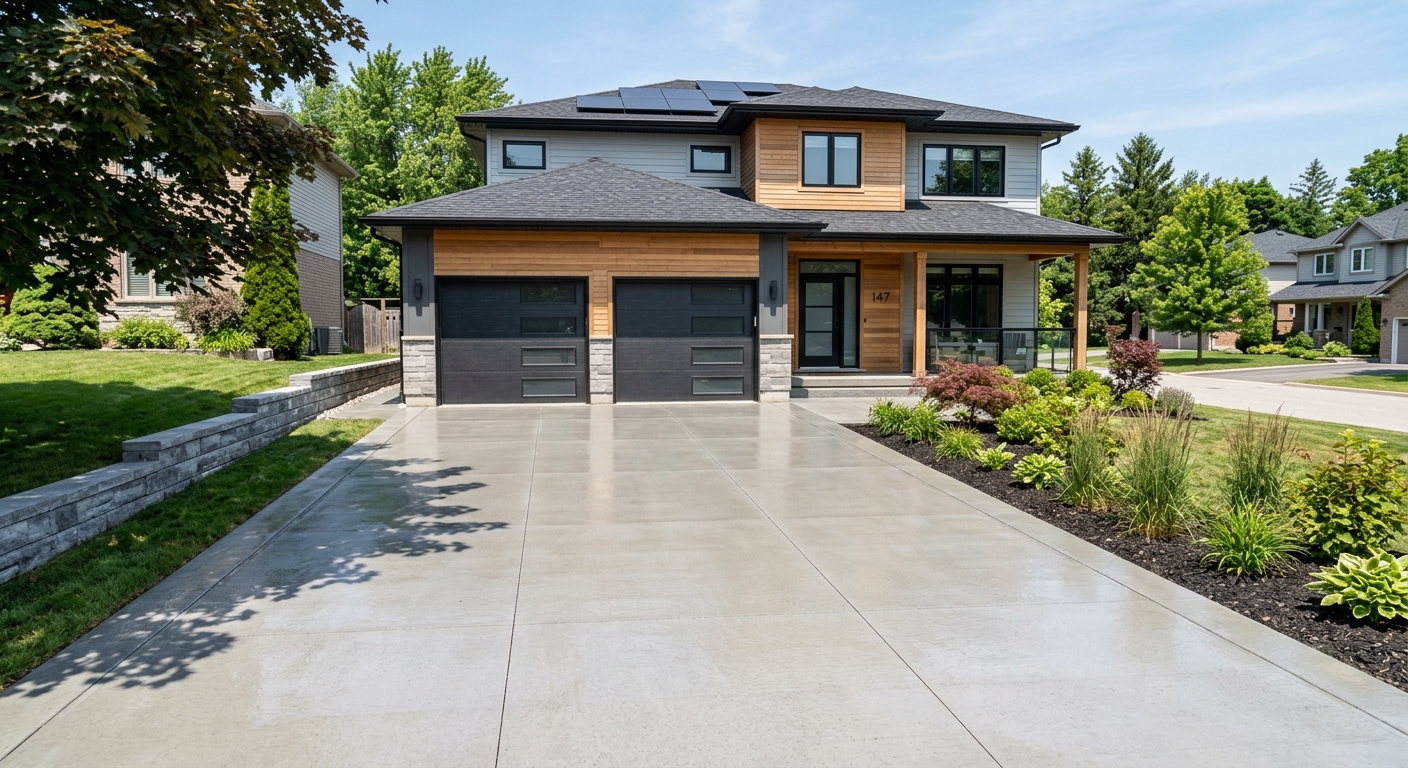
Concrete work options and costs in Burlington
Burlington homeowners are often comparing concrete options for driveways, patios and walkways because this city is built largely on family homes—single-detached houses account for 50.3% of dwellings—and many neighbourhoods have older foundations and flatwork that are now due for renewal. With 54,955 homeowner households (75.1% of all households) in the area (Statistics Canada, 2021 Census), there’s steady demand for exterior concrete that looks good, drains properly, and lasts through the Hamilton–Niagara Peninsula freeze-thaw cycle.
In Burlington, concrete pricing is shaped by the cold, wet Great Lakes corridor. Frost depth and freeze-thaw stress push footings to be designed below frost, typically resulting in deeper excavations and taller formwork than you might see in milder climates. Exterior flatwork also needs air-entrained concrete, tighter control joint planning, and more stone base and drainage details to reduce heave, cracking and surface deterioration. Pour scheduling matters too: most exterior and structural work is planned roughly May–October, and winter work usually requires hoarding, heating and curing protection—which adds labour and material costs.
Trade demand is especially strong around the Northwest and Appleby/Waterdown-adjacent areas where turnover and renovation cycles are common, and where homeowners want upgrades that blend with older streetscapes. The table below compares typical Burlington job sizes and specs so you can line up apples-to-apples when you review quotes.
| Application |
Typical Size |
Key Spec |
Finish Option |
Price Range |
| Concrete driveway (standard broom finish) |
400–600 sq ft |
Air-entrained mix; compacted granular base; drainage allowance |
Broom finish with control joints |
$14,000–$22,000 |
| Exposed aggregate driveway |
400–600 sq ft |
Air-entrained mix; proper base and finishing timing for exposure |
Exposed aggregate with sealer-ready surface |
$16,000–$26,000 |
| Stamped concrete driveway or patio |
300–600 sq ft |
Higher-quality mix; controlled finishing; joint pattern planning |
Stamp pattern + release + colour hardener (if selected) |
$22,000–$35,000 |
| Plain concrete patio or walkway |
150–350 sq ft |
Air-entrained mix; compacted sub-base; slope for drainage |
Steel-trowel float to smooth finish or broom finish |
$6,000–$14,000 |
| Garage floor (interior slab) |
300–600 sq ft |
Vapour barrier as needed; properly supported slab and joints |
Plain power-trowel or broom; optional hardener |
$7,500–$16,000 |
| Foundation footings (structural, below frost) |
Per linear foot varies by design |
Below-frost excavation, rebar, forms, proper backfill compaction |
Structural concrete; engineered rebar arrangement |
$60–$120 |
Prices are estimates only and vary by project scope, site access and material selection.
What affects the price of concrete work in Burlington
In Burlington and across the Hamilton–Niagara Peninsula, you can see the same “type” of concrete job come in 30–50% apart once site conditions and specs are compared. That’s because cold, wet Great Lakes conditions don’t just affect curing—they affect every decision from excavation depth to the air content in the mix. For example, frost depth requirements drive footing depth and formwork height, and repeated freeze-thaw cycles off Lake Ontario increase the need for well-drained, well-compacted granular base and a properly air-entrained exterior slab. If a contractor prices a driveway like a milder-climate pour, you’re paying later through cracking, spalling and uneven settlement.
Ontario also has a practical constraint: the exterior and structural pour season is shorter than in warmer regions. When we pour outside the ideal window, we may need insulating blankets, heaters and more controlled curing—which adds labour time and material cost. De-icing salts are another local reality; they can accelerate surface scaling if the mix and finishing aren’t built for durability. That’s why properly designed exterior air content and sealing at the right time matter.
Two examples from Burlington commonly change the budget. First, an older lot with soft subgrade or inadequate drainage can add significant excavation and granular replacement before any concrete is poured—often pushing driveway or walkway costs toward the higher end of the flatwork bands ($14–$22 per sq ft for driveway/slab projects, depending on scope). Second, if you’re replacing a section that ties into an existing foundation or adjusts elevations due to older drainage, we may need more reinforcement and more formwork, which can narrow the “cheapest” option quickly. Homes built before 1981 are common here, and older drainage patterns and settlement issues can require additional prep to get the flatwork to sit right and stay level (Statistics Canada, 2021 Census).
| Price Factor |
Why It Matters |
Cost Impact |
| Frost line depth — determines footing depth and form height |
Footings must extend below design frost to prevent frost heave and cracking |
Higher excavation and more concrete; can move foundation work toward the upper band |
| Site preparation — excavation, grading, compacted granular base |
Good base and drainage reduce settlement and frost-related movement |
Soft soils, poor drainage or tight access add labour and materials |
| Reinforcement — rebar or wire mesh requirement |
Controls cracking and supports slab performance |
Extra steel and tying time increases cost, but improves durability |
| Mix design — air-entrainment and compressive strength spec |
Air content and strength are key to surviving freeze-thaw cycles |
Premium materials raise cost; skipping this can lead to spalling |
| Finish type — broom vs. stamped vs. exposed aggregate |
Finish complexity impacts labour and curing/finishing timing |
Stamped and decorative typically cost more than standard broom |
| Pour size and concrete truck access to site |
Smaller pours or difficult access can require more handling and time |
Extra equipment and labour can raise per-sq-ft pricing |
| Cold-weather curing precautions — heating and blankets |
Protects strength gain when temperatures swing |
Seasonal premiums can add measurable cost to scheduling and consumables |
| Control joint pattern and sealing cost |
Controls shrinkage cracking and reduces salt-driven surface damage |
More joints and proper sealing are usually worth it versus premature repairs |
Permits & regulations in Ontario
In Ontario, the key theme is that structural concrete typically needs a permit, while most routine flatwork does not—unless it changes drainage, grading, or municipal surface requirements. For Burlington homeowners: footings, foundation walls, and grade beams are considered structural concrete work. That work generally requires a building permit and often engineered drawings reviewed through the municipality’s process. Concrete flatwork like patios, walkways and driveways usually does not require a permit, unless it affects lot grading, touches storm drainage decisions, changes impervious surface coverage limits, or encroaches on municipal right-of-way.
Before breaking ground, confirm what applies to your specific scope. Also verify the contractor carries liability insurance and has valid WSIB/WCB coverage for their workers—this protects you if something goes wrong during excavation, rebar installation, or the pour day. Ask for references on similar-scale Burlington projects, especially older-home sites where drainage and subgrade can be unpredictable.
How to check Ontario licensing and coverage (step-by-step): (1) request their WSIB clearance letter (or current account information) and insurance certificate—make sure the certificate lists the correct legal business name; (2) verify liability insurance is active and includes construction operations; (3) confirm any Ontario contractor registration requirements where applicable by using the relevant online registry tools available to the public; and (4) ensure their quote ties every item to the plan—footing depth, reinforcement, and access/excavation scope—so you don’t discover missing allowances after approval.
Getting concrete right in Burlington's freeze-thaw climate
Burlington concrete fails in predictable ways when it’s not spec’d for the freeze-thaw reality of the Hamilton–Niagara Peninsula. The most common problems I see are surface spalling and random cracking from inadequate air-entrainment, poor drainage/base preparation, and control joints that don’t match the pour size. Spalling is especially tied to freeze-thaw and de-icing salt exposure; if air content is too low or the mix isn’t designed for exterior exposure, water in the paste expands as temperatures swing, breaking down the surface.
To spec the job correctly, start with base preparation: excavate to the required depth, place compacted granular sub-base, and grade to keep water from ponding. Next, mix design: for exterior flatwork, target air-entrainment around 5–7% and specify minimum 32 MPa compressive strength so the slab achieves the durability you expect. Then joints: plan control joints to manage shrinkage and limit random cracks—especially important on driveways where length and wheel-load stress can magnify cracking patterns. For curing, aim for at least 7 days of proper curing under suitable conditions; cold snaps can slow strength gain, so in shoulder seasons we may use curing blankets and temperature protection. Finally, sealing: apply a penetrating sealer after the concrete has cured (commonly at about 28 days post-pour) to repel de-icing salt intrusion.
Where does this affect your dollars? For example, upgrading from a plain broom finish patio to stamped concrete might add roughly $22,000–$35,000 for stamped driveway/patio scopes versus the $12–$20 band for standard patios/walkways. If the goal is longevity, the most justified “extra” is usually not decorative colour—it’s the right air-entrained mix, base depth and joint/sealing plan that keep the surface intact through winter.
| Spec |
Why It Matters in Burlington |
What to Ask For |
Impact if Skipped |
| Compacted granular base (depth?) |
Controls settlement and reduces frost heave from water in the subgrade |
Ask for base depth by design/site, plus compaction method |
Uneven slab, cracks, and drainage failures after freeze-thaw |
| Air-entrained concrete mix (target air %?) |
Air bubbles provide room for freezing water expansion |
Ask for target 5–7% air for exterior flatwork |
Increased risk of spalling and scaling within a few winters |
| Compressive strength (MPa rating) |
Strength gain supports durability and surface wear resistance |
Ask for minimum 32 MPa |
Surface wear, reduced long-term performance, and early damage |
| Control joints (spacing per ACI guidelines) |
Regulates where shrinkage cracks occur and improves appearance |
Ask for joint spacing plan and joint saw-cut timing |
Random cracking and more difficult cosmetic repair |
| Minimum 7-day curing period |
Cold/wet conditions slow strength gain and increase risk if unprotected |
Confirm curing method and protection (blankets/heating if needed) |
Lower strength, higher cracking risk, and weaker surface |
| Penetrating sealer (when applied after cure) |
Helps repel de-icing salts and reduces moisture-driven deterioration |
Ask for application timing around 28 days post-pour |
Faster salt scaling and surface breakdown on exterior slabs |
How to choose a concrete work contractor in Burlington
Choosing the right concrete contractor in Burlington is mostly about verifying protection, clarity, and workmanship—not just the lowest number on the page. Start by confirming Ontario coverage. Ask for a current liability insurance certificate (and verify it matches the contractor’s legal business name) and confirm WSIB/WCB coverage with a clearance letter or proof of account status. If a contractor can’t provide documentation quickly, that’s a sign to pause.
Next, get 2–3 itemised written quotes. You want a labour + materials breakdown that includes excavation, granular base, reinforcement, formwork, concrete supply, finishing, joints, sealing (if included), and disposal/haul-away. Be wary of “lump sum” quotes that don’t spell out what’s excluded (for example, removal of existing concrete, trucking/line pumps, access limitations, or permits if structural work is required). Clarify whether a building permit is included when structural concrete is part of the scope.
Warranty matters: ask for the workmanship warranty length and what it covers (not just the product manufacturer warranty). Confirm whether the warranty is transferable if you sell your home, and keep in mind that workmanship coverage should align with durability concerns in Burlington’s freeze-thaw climate.
Payment schedule: never pay more than 10–15% upfront for start materials and mobilization; hold back funds until the job is complete and you’ve inspected the finished surfaces, joints, and any sealing plan. Also insist on a start date and completion estimate in writing so scheduling doesn’t drift—especially during the May–October pour window.
- Confirm liability insurance certificate is current and lists construction operations.
- Verify WSIB/WCB coverage with a clearance letter or proof.
- Request references from Burlington projects with similar footing depth, drainage, or slab size.
- Use itemised quotes (labour + materials) instead of one-line estimates.
- Check what’s included for excavation, granular base depth, reinforcement, and disposal/haul-away.
- Ask whether the quote includes proper joint spacing and saw-cut timing.
- Confirm mix design details: air-entrainment and minimum strength (especially for exterior slabs).
- Ask about curing protection plans for cold nights or shoulder-season pours.
- Confirm sealing: product type, application timing (often ~28 days) and coverage.
- Get the permit/engineering responsibilities in writing if structural concrete is involved.
- Review warranty: workmanship duration, exclusions, and transferability.
- Agree to payment terms that keep 85–90% for completion/acceptance.
Concrete red flags in Burlington include contractors who won’t discuss air-entrainment and joint layout, quotes that ignore drainage and granular base preparation, promises to “pour in any weather” without curing protection, vague exclusions around disposal/removal of existing concrete, and payment requests of large deposits before forms, base, and reinforcement are verified on site.
Frequently asked questions — concrete work in Burlington
What is a concrete overlay and is it suited to Burlington?
A concrete overlay is a new thin concrete layer poured over an existing slab after preparation. It can be suited to Burlington when the original driveway or patio is still structurally sound—meaning it isn’t heavily heaved, extensively delaminated, or failing at edges and joints. The key is surface preparation: removing weak concrete, profiling the surface, addressing moisture issues, and ensuring proper bonding. Burlington’s freeze-thaw and de-icing salt exposure can shorten overlay life if water can still get under the slab. In pricing, an overlay often lands below full replacement, but it still needs the right air-entrained mix and joint planning to control cracking. If you’re considering an overlay, ask for how they’ll prep the surface and whether the mix spec is designed for exterior exposure. For many homeowners, full removal plus new air-entrained flatwork in the $14–$22 driveway/slab band ends up more cost-effective over the long run.
How do I seal concrete to protect it in Burlington?
To protect concrete in Burlington, the goal is to repel moisture and reduce salt-driven deterioration. Typically, you use a penetrating sealer on exterior slabs after the concrete has cured—often around 28 days post-pour—so it can dry and accept the product. In Burlington’s cold, wet Great Lakes climate, sealing is especially important because de-icing salts can accelerate scaling if the concrete is porous. Before sealing, the surface must be clean and dry; pressure washing is common, but any oil/organic contamination should be removed. Confirm the sealer type in your quote (penetrating vs film-forming) and ask for an application schedule that aligns with seasonal temperatures. A properly sealed driveway or patio pairs best with the right air-entrained mix and control joint plan, since sealing can’t “fix” a slab that’s already compromised by poor base drainage or insufficient air content.
What is the difference between concrete and cement?
Concrete is the final building material you see on site. Cement is one ingredient inside concrete. Portland cement is the binder that reacts with water, while concrete typically also includes fine and coarse aggregates (sand and stone), water, and sometimes admixtures like air-entrainment for freeze-thaw durability. In Burlington, exterior flatwork needs air-entrained concrete because the Hamilton–Niagara Peninsula freeze-thaw cycles demand a mix that resists spalling and scaling. So when contractors talk about concrete specs, you’re really asking about the entire concrete mix design—air content, compressive strength (often minimum 32 MPa for durability), and admixtures—not just the cement brand. If your quote only mentions cement type but doesn’t discuss air-entrainment or strength requirements, ask follow-up questions. For context, exterior driveways in the $14–$22 band usually include those durability-minded mix choices and base preparation that plain cement alone can’t guarantee.
How much does concrete work cost in Burlington?
Concrete costs in Burlington depend heavily on excavation depth, granular base requirements, reinforcement, finish type, and access. As a guide, driveway/slab projects often fall in the $14–$22 range, while standard patios and walkways commonly land in the $12–$20 range. Decorative options increase labour and finishing complexity: stamped concrete driveway or patio scopes often budget in the $22–$35 range. For structural work, foundation/footings are usually quoted per linear foot based on engineering and below-frost excavation; a typical band is $60–$120. Climate and scheduling matter too: Burlington’s pour season is mostly May–October, and winter work may require heating, blankets, and longer curing protection. If your home is older—almost half of local housing stock was built before 1981—subgrade and drainage can be tougher to manage, and that prep work can push prices toward the higher end of the band. The best way to confirm your number is an itemised quote that matches the specs for air-entrainment, joints, and sealing.
How deep must footings be for Burlington's frost line?
In Burlington, footings are designed to extend below the local design frost depth to prevent frost heave. In Ontario, frost depth is typically in the range of about 1.5–2.4 m for design purposes, which is why contractors plan deeper excavations than homeowners often expect. Your actual footing depth should be confirmed by the engineered foundation design (and your soil conditions), because soil type, drainage, and buildability can change requirements. When you get a quote, ask for the footing depth shown on the drawings and how they’ll handle excavations, dewatering if needed, and backfill compaction. A contractor pricing foundation footings without discussing below-frost excavation is a concern. In terms of cost, structural footing work usually follows the $60–$120 band, but your final number is driven by excavation depth, reinforcement detailing, and how much granular and rebar the design calls for.
Why does concrete crack in Burlington and how is it prevented?
Concrete cracks for a few predictable reasons in Burlington: shrinkage as the concrete cures, thermal movement across seasons, and frost-related movement when moisture and weak subgrade conditions are present. The Hamilton–Niagara Peninsula’s repeated freeze-thaw cycles add stress, especially for exterior slabs exposed to meltwater and de-icing salts. Cracking prevention is not about “avoiding cracks” entirely—it’s about controlling where they occur. The two biggest levers are (1) proper base preparation and drainage so the slab isn’t moving unpredictably, and (2) a planned control joint pattern with correct timing for saw cuts. Air-entrainment doesn’t prevent cracking, but it strongly reduces spalling and surface loss that can worsen along cracks. Curing is also critical: minimum 7 days of proper curing is a common expectation so the slab gains strength before early freeze. If your quote doesn’t address air-entrainment, joint spacing, base depth, and curing protection, you’re missing the key steps that help keep Burlington concrete performing for years.