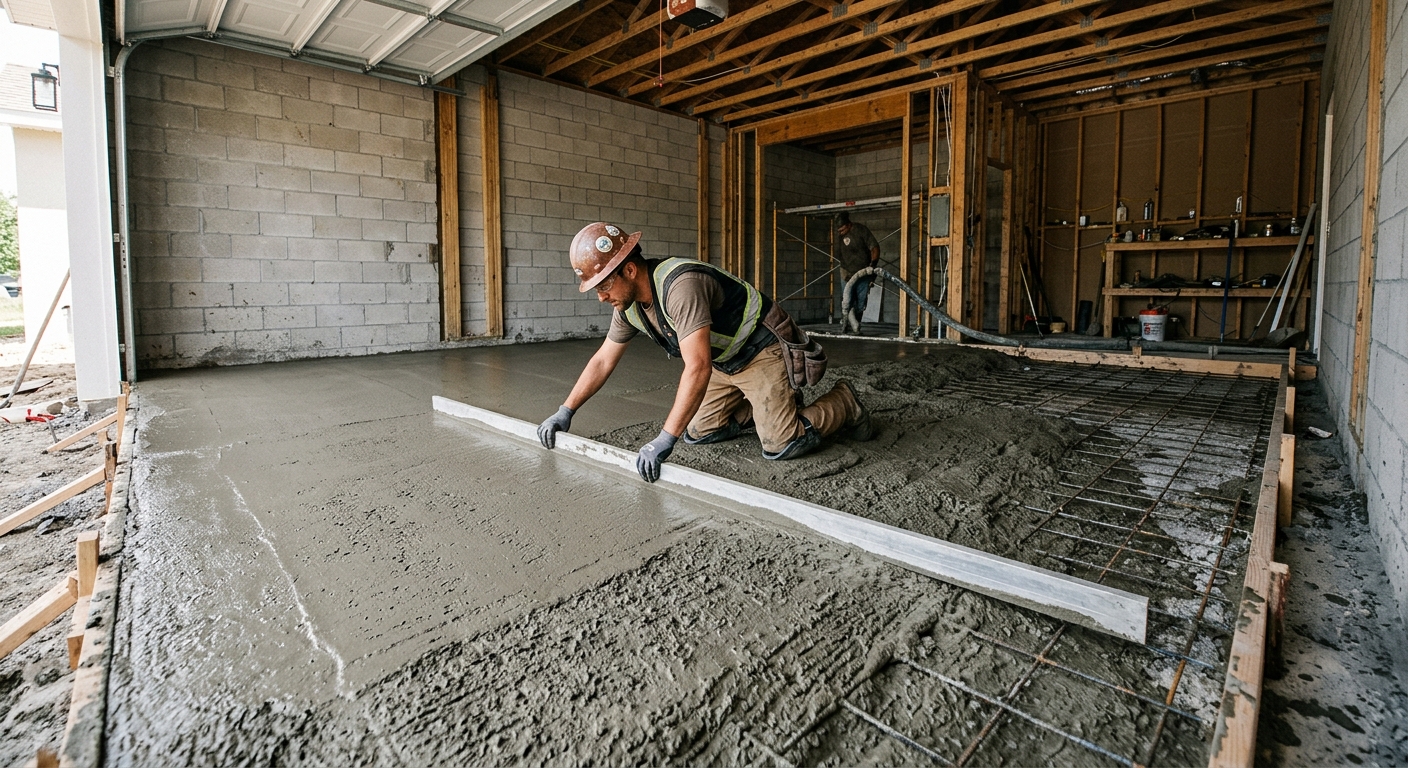
Concrete work options and costs in Dorchester
Dorchester, Ontario homeowners typically start their concrete plans with the flatwork that connects the driveway to the house—because it’s the first thing you see and the first area to show wear. With a population of 9,329 (Statistics Canada, 2021 Census), the town has a steady base of owner-occupied homes and steady renovation demand, especially around older pockets near the downtown core and along the Highway 401 corridor. In many local neighbourhoods, driveways and front walks are replaced when homeowners upgrade landscaping, add garage space, or improve drainage around the foundation. The Toronto economic region’s cold-weather schedule also affects how often trades are available for exterior pours, which can influence pricing when concrete crews are booked.
Cost in the Toronto region is driven by frost depth, freeze–thaw cycles, and the concrete specs that control cracking and spalling. Even when your project is “just a slab,” contractors typically design for exterior durability: proper granular base prep, air-entrained mixes, and correctly spaced control joints. Because temperatures can drop toward 10 °C or below during fall and spring shoulder weather, curing protection and planning matter—pouring in the right window can be cheaper than re-doing a surface that can’t develop strength reliably. That’s why a standard broom-finished driveway is usually the budget-friendly option, while stamped concrete or exposed aggregate costs more due to materials and additional finishing labour.
If you’re considering a driveway, patio, or walkway in Dorchester, the most common comparison is typically between a standard slab (with the right base and air mix) and decorative options like stamping. Below is a practical way to compare typical scope and price ranges before you request itemised quotes.
| Application |
Typical Size |
Key Spec |
Finish Option |
Price Range |
| Concrete driveway (standard broom finish) |
24 ft x 10 ft (240 sq ft) |
Excavate, compacted granular base, air-entrained exterior mix, control joints |
Standard broom |
$4,320 – $6,720 |
| Exposed aggregate driveway |
24 ft x 10 ft (240 sq ft) |
Excavate, compacted base, air-entrained mix, wash/expose process, sealed surface |
Exposed aggregate |
$5,040 – $7,680 |
| Stamped concrete driveway or patio |
20 ft x 12 ft (240 sq ft) |
Proper base, air-entrained mix, integral color, release agent system, control joints |
Stamped (decorative pattern) |
$5,760 – $9,600 |
| Plain concrete patio or walkway |
12 ft x 16 ft (192 sq ft) |
Compact base, drainage plan, air-entrained exterior mix, joints to manage cracking |
Plain trowel/broom edge |
$3,072 – $4,992 |
| Garage floor (interior slab) |
24 ft x 22 ft (528 sq ft) |
Vapor control (where required), reinforced slab or mesh, curing plan |
Broom finish |
$9,504 – $15,840 |
| Foundation footings (structural, below frost) |
Typical partial perimeter/area varies |
Engineered design, excavate/form, rebar placement, concrete below frost depth |
Structural concrete |
$180 – $300 |
Prices are estimates only and vary by project scope, site access and material selection.
What affects the price of concrete work in Dorchester
In Dorchester and across the Toronto economic region, it’s common to see quotes for the “same” concrete project land 30–50% apart. The sticker shock usually isn’t the concrete itself—it’s the hidden drivers: excavation depth and haul-off, the thickness and base build-up needed for local soil performance, reinforcement requirements, and the extra steps needed to survive freeze–thaw. Contractors also schedule pours around weather and curing performance. If a job can’t be finished in the planned window, crews may add labour for cold-weather protection and longer curing timelines to meet expected performance.
Frost depth and freeze–thaw cycles dictate specifications for Ontario concrete. Footings must extend below the design frost depth to reduce frost heave and differential movement. For exterior slabs, local contractors nearly always specify air-entrained mixes so the concrete has the durability to handle repeated freezing and thawing. When cold weather threatens curing—especially as temperatures trend down toward 10 °C or below—contractors may need insulating blankets, temporary protection, and tighter scheduling. De-icing salt in winter can also accelerate surface spalling, which is why sealing is often a cost-effective durability add-on.
Two examples from Dorchester-style residential lots: (1) If your driveway subgrade is soft or you have poor drainage, base depth and re-grading can increase—this pushes you toward the higher end of exterior work, even though you started with a “standard driveway.” (2) If you want stamped decorative concrete, the finishing labour and materials (release agent system and colour) move the project toward the $24, – $40, per sq ft category for decorative work, while a broom-finished driveway keeps you closer to the standard $18, – $28, band for exterior concrete.
| Price Factor |
Why It Matters | Why It Matters |
Cost Impact |
| Frost line depth — determines footing depth and form height |
Footings must be placed below design frost depth to limit heave and settlement |
Higher excavation and concrete volume; can shift structural footing costs upward |
| Site preparation — excavation, grading, compacted granular base |
Poor subgrade can lead to settlement and early cracking; base must be compacted to spec |
Unexpected soil removal/replace and longer labour drive pricing up |
| Reinforcement — rebar or wire mesh requirement |
Helps control crack widths and improve slab performance under load |
More steel and labour to install/secure reinforcement |
| Mix design — air-entrainment and compressive strength spec |
Air entrainment improves freeze–thaw durability for exterior concrete |
Typically modest material cost, but reduces expensive failures |
| Finish type — broom vs. stamped vs. exposed aggregate |
Finish methods require additional materials and specialized finishing labour |
Decorative finishes commonly add 20–50% over standard broom |
| Pour size and concrete truck access to site |
Concrete placement efficiency affects labour and re-handling needs |
Limited access can add forming, pumping, and extra crew time |
| Cold-weather curing precautions — heating and blankets |
Concrete needs stable curing conditions to reach strength reliably |
Blankets/heating and longer scheduling can add meaningful labour/materials |
| Control joint pattern and sealing cost |
Joints manage cracking; sealing helps repel de-icing salt damage |
Small-to-moderate add cost that can prevent costly surface repairs |
Permits & regulations in Ontario
In Ontario, the type of concrete work determines whether you need a permit. Structural concrete work—such as footings, foundation walls, grade beams, and structural foundation repairs—typically requires a building permit, and municipal review often expects engineered drawings for load and placement details. For concrete flatwork like driveways, patios, and walkways, permits are commonly not required by default, but they can become necessary if your work affects lot grading, stormwater/effluent management, impervious surface coverage limits, or if you’re changing something near a municipal right-of-way. Always confirm with the local authority before breaking ground—particularly if you’re raising the grade or rerouting drainage.
Before signing a contract in Dorchester, verify three things: (1) the contractor carries liability insurance and provides a current certificate of insurance; (2) the contractor has the correct WSIB/WCB coverage for workers; and (3) the contractor’s credentials are legitimate for the scope of work they’re selling you. Step-by-step, a homeowner should: ask for a certificate of insurance (and confirm dates and coverage limits), ask for proof of WSIB/WCB status (then cross-check the information they provide), and confirm business legitimacy through Ontario’s online contractor/business listings and any applicable trade licensing information that applies to your specific work.
For structural projects, don’t rely on verbal “we’ll handle it.” Request confirmation of who pulls the permit, who schedules inspections, and what drawings/engineering documents are included.
Getting concrete right in Dorchester's freeze-thaw climate
Concrete failures in Dorchester are most often climate-driven: water moves into the slab, freezes, expands, and then the surface chips (spalls) or cracks widen. The fix isn’t just “better concrete”—it’s getting the base, mix, joints, curing, and sealing aligned to the Toronto region’s freeze–thaw cycles. Start with base preparation: the slab needs a properly excavated subgrade and a compacted granular sub-base to the right depth so the concrete doesn’t settle or pump under freeze-related movement. Then lock in the mix design. For exterior flatwork, you want air-entrainment and a minimum compressive strength commonly around 32 MPa so the freeze–thaw cycle doesn’t break down the surface.
Next, control cracking with the right control joint pattern and realistic spacing. If joints are placed randomly or omitted, cracks still happen, but they happen where you don’t want them—often unsightly and hard to repair. Curing is equally important: in cold or shoulder-season conditions, plan for at least 7 days of curing under protective conditions so the concrete develops strength. Finally, sealing matters for winter durability: apply a penetrating sealer after the concrete has cured (often around 28 days post-pour) so de-icing salt exposure is less destructive.
Here’s where a dollar difference makes sense. A standard broom-finished driveway in Dorchester often falls around the $18, – $28, exterior band. Stamped concrete may move toward the $24, – $40, decorative band because of added finishing labour and materials. If you’re paying for decorative finish, you should also insist on the same freeze–thaw durability steps—because a great stamp over a weak base or wrong air mix will still fail faster than it should.
| Spec |
Why It Matters in Dorchester |
What to Ask For |
Impact if Skipped |
| Compacted granular base (depth?) |
Prevents slab settlement and reduces frost-related movement by keeping the base stable and well-drained |
Base depth and granular type; compacted to specified thickness with proof of compaction approach |
Uneven support leads to cracks, trip hazards, and premature replacement |
| Air-entrained concrete mix (target air %?) |
Improves freeze–thaw durability so water doesn’t damage the surface during winter cycles |
Target air content for exterior flatwork (commonly 5–7% air); confirm mix is designed for exposure |
Higher risk of spalling and surface scaling within a few winters |
| Compressive strength (MPa rating) |
Helps the slab achieve structural performance and durability under winter moisture exposure |
Minimum compressive strength (commonly 32 MPa for exterior flatwork); written mix spec |
Reduced strength development increases cracking and surface breakdown |
| Control joints (spacing per ACI guidelines) |
Manages where cracks form so they’re narrower and easier to seal/maintain |
Joint spacing and layout plan based on slab dimensions and thickness |
Random cracking, water intrusion, and more difficult cosmetic repairs |
| Minimum 7-day curing period |
Ensures proper strength gain; critical when temperatures drop toward cold-weather conditions |
Curings days and protection method if pouring in cooler weather |
Surface can weaken and fail early even if the slab “looks fine” initially |
| Penetrating sealer (when applied after cure) |
Helps repel de-icing salts and moisture movement that contribute to spalling |
Sealer type and timing (often applied around 28 days post-pour, after cure) |
Faster surface deterioration and more frequent maintenance |
How to choose a concrete work contractor in Dorchester
Choosing the right contractor in Dorchester starts with verifying basics that protect you if something goes wrong. For Ontario work, ask for the contractor’s liability insurance certificate (confirm it’s current and matches the project scope). Next, request proof of WSIB/WCB coverage—and don’t accept screenshots or outdated letters. Where to check: use the certificate of insurance provided directly, and verify the coverage status through the contractor documentation they provide; for business legitimacy and any applicable credentials, use Ontario’s online resources and the contractor’s own listing details. If they can’t provide documents promptly, treat that as a warning sign.
Then get 2–3 itemised written quotes instead of lump sums. You want labour and material lines separated (excavation, base, rebar/mesh, concrete supply, finishing, sealing, protection/cold-weather measures, disposal). Read the scope carefully: what’s excluded, what’s assumed, and who pays for permit fees if needed. Confirm whether permit pulling is included for structural work, and whether disposal/haul-off is in the price.
Warranty matters. Ask for the workmanship warranty length, how it’s applied, and whether it covers finish problems (scaling, cracking beyond normal shrinkage, joint sealing). Clarify the product/manufacturer warranty—and whether the warranty is transferable if you sell the home.
For payment, keep risk low: never pay more than 10–15% upfront for materials and mobilization, and hold back the balance until the job is complete and any sealant/cleanup items are done. Finally, get the start date and completion estimate in writing, including what happens if weather affects curing.
- Ask for a certificate of insurance and confirm expiry dates before signing.
- Request proof of WSIB/WCB coverage and ensure it matches the workforce size and job location.
- Get quotes that break down excavation, base, concrete supply, reinforcement, finishing, and disposal.
- Confirm whether cold-weather protection (blankets/heating) is included if temps fall.
- Insist on a written curing plan and minimum curing duration.
- Ask for the joint layout plan (where joints go and spacing strategy).
- Verify mix design details: air entrainment and compressive strength spec.
- Clarify the sealing scope: sealer type and timing after cure.
- Confirm reinforcement type (mesh vs rebar) and how it’s supported during placement.
- Check whether traffic management and clean-up/disposal are included.
- Ask about warranty terms in plain language (what’s covered, exclusions, claim process).
- Never accept “cash only” or vague payment terms—use a written payment schedule.
Red flags in Dorchester include contractors who won’t show insurance/WSIB documents, quotes that omit base preparation details, promises to “stamp over anything” without discussing drainage and compacted sub-base, skipping control joints to “avoid lines,” and vague weather/cold-curing plans—especially if they plan to pour in cooler shoulder-season conditions without protection.
Frequently asked questions — concrete work in Dorchester
How much does concrete work cost in Dorchester?
Concrete pricing in Dorchester is typically estimated by application and site conditions, but the Toronto region’s freeze–thaw requirements change what’s “included” in a fair quote. For example, a standard concrete driveway usually lands in the $18, – $28, exterior band (per sq ft basis), while decorative stamped concrete is commonly higher at $24, – $40,. Patios and walkways generally sit around $16, – $26, depending on thickness, base prep, and drainage. Structural footings are priced differently—often quoted as a foundation/footings rate range of $180 – $300 depending on scope and engineered requirements. The biggest cost swing tends to come from excavation depth, granular base thickness, reinforcement needs, and whether cold-weather curing protection is required.
How deep must footings be for Dorchester's frost line?
For Ontario homes in Dorchester, structural footings are typically designed to extend at least 1.2 m (about 4 ft) below grade to reduce the risk of frost heave and differential movement. Your exact required depth should follow the building design and local requirements, especially where soil and drainage differ across a lot. The practical takeaway for homeowners is that you shouldn’t accept a footing depth “estimate” without documentation—ask for the engineered drawing or the permit package that shows footing bottom elevations. Because Ontario winter freeze–thaw can repeatedly move moisture in and out of soils, shallow footings and inadequate bearing can lead to settlement and cracking later, which is far more expensive to correct than doing proper excavation up front.
Why does concrete crack in Dorchester and how is it prevented?
Concrete cracks are common in Dorchester because freeze–thaw cycles and moisture movement create stresses, and concrete naturally shrinks as it cures. Most cracking is controlled rather than eliminated: good base prep reduces settlement, air-entrained concrete improves durability, and control joints guide where shrinkage cracks occur. Contractors also need to manage curing—especially when pouring near cooler periods where temperatures drop toward 10 °C or below. The job should include a joint spacing plan and sealing strategy for exterior flatwork. If you’re only comparing finishes, don’t—also compare the specs for air entrainment and curing protection. Skipping air-entrainment is a frequent cause of spalling, where the surface chips from winter exposure, turning small issues into bigger repairs.
Stamped vs broom-finish concrete — cost difference?
In Dorchester, broom-finished concrete is usually the more economical option because it uses simpler finishing steps, less decorative material, and less labour time. Stamped concrete typically costs more because it requires integral colour and a release agent system, and the crew needs additional time to form the pattern and achieve consistent texture. In most Toronto-region residential applications, stamped concrete often falls near the $24, – $40, decorative band, while a standard driveway pour is more commonly in the $18, – $28, band. If you want stamped concrete, make sure the quote still includes freeze–thaw durability basics: compacted granular base, air-entrained mix, proper thickness, control joints, and sealing timing after cure.
When is the best time to pour concrete in Dorchester?
The best time to pour in Dorchester is typically during the warmer, stable months when concrete can cure properly without heavy cold-weather intervention. In the Toronto region, contractors plan exterior pours to avoid conditions where temperatures fall toward 10 °C or below soon after placement, because curing performance changes and may require insulating blankets or heating. Wet fall and spring weather can also affect base preparation and drainage—if the site can’t be properly graded and compacted, you’ll lose time and pay more. A good contractor will schedule based on weather forecasts, protect the surface during curing, and specify curing duration in the written scope.
How long does concrete take to cure?
Concrete gains strength over time, and the curing timeline matters more than many homeowners expect. For typical exterior flatwork in Dorchester, a minimum of about 7 days of proper curing is a common baseline for performance and strength development, with additional time needed for full durability. Temperature and protection are critical in Ontario’s freeze–thaw climate—especially when you’re near cooler conditions and the job needs blankets or heating. Sealing is usually done later: many crews apply penetrating sealer around 28 days after the pour (after sufficient cure) so it can better repel moisture and de-icing salts. If a contractor wants to rush sealing or traffic too soon, ask how they’re meeting curing conditions and whether their plan includes cold-weather protection when needed.