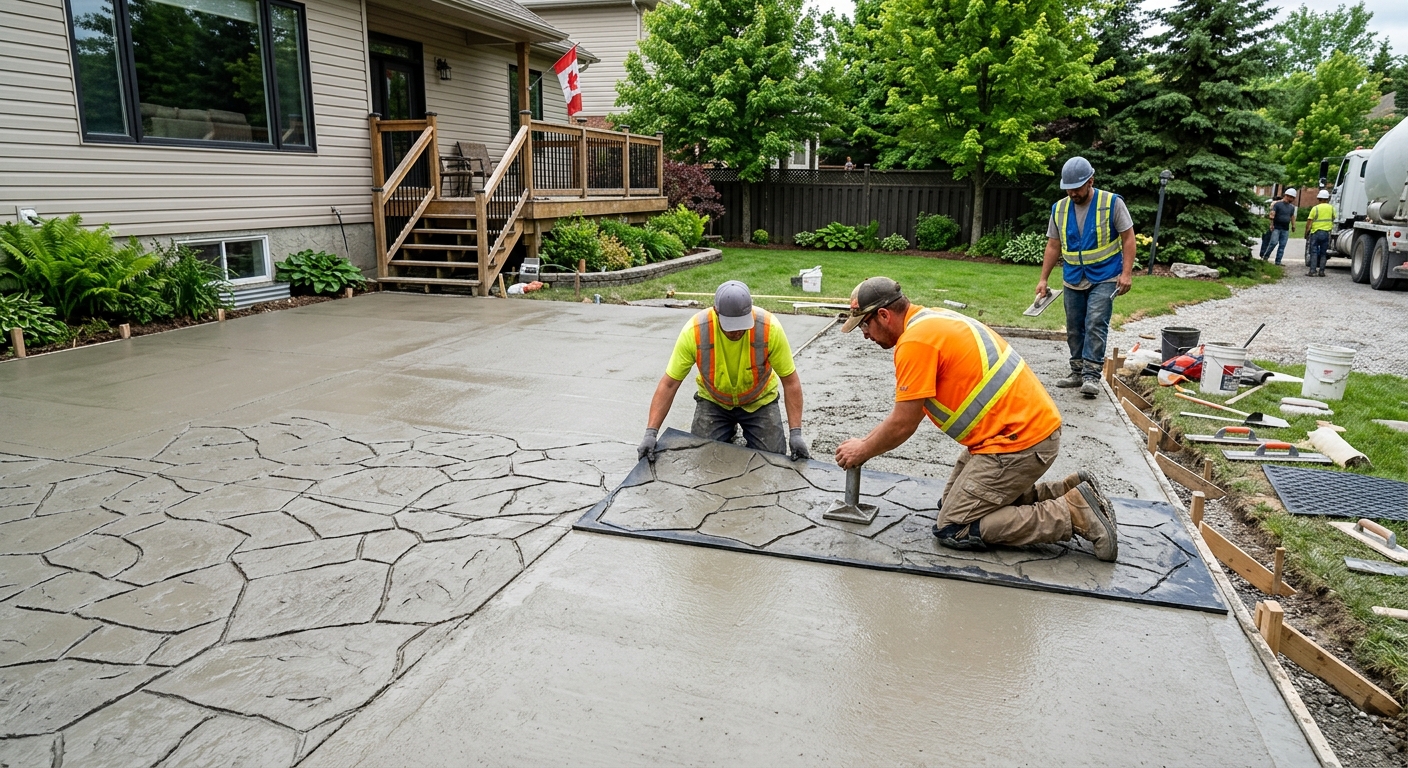
Concrete work options and costs in Kapuskasing
Kapuskasing is a northern Ontario community where concrete is expected to last through real winter swings—ice, snowmelt, and freeze–thaw all show up every year. With 62.1% of local dwellings being single-detached homes (Statistics Canada, 2021 Census), the most common requests are concrete driveways, patios, walkways, and garage floors for owner-occupied houses (66.6% of households own, Statistics Canada, 2021 Census). That homeowner base matters because contractors can specialize in flatwork crews and seasonal scheduling around your short window for outdoor work.
Pricing here isn’t just about concrete thickness. Northeast weather drives the specs: we plan for frost-protected excavation and proper granular base prep so slabs don’t heave, we use air-entrained mixes for durability, and we manage short “pour season” conditions that affect labour availability. In older housing stock—85.4% of homes built before 1981—many lots have mature backyards, tighter access, and existing landscaping or failing slabs that need extra removal and disposal. Areas like the downtown corridor and the older residential streets near the core tend to see consistent demand because homeowners often renovate driveways and front steps first for curb appeal and safety.
Below is a practical way to compare common options by scope and finish, then we’ll break down the biggest cost drivers (frost depth, base, reinforcement, mix design, and access) in the next section.
| Application |
Typical Size |
Key Spec |
Finish Option |
Price Range |
| Concrete driveway (standard broom finish) |
400–600 sq. ft. |
4 in. slab, compacted granular base, air-entrained concrete |
Broom finish with control joints |
$18,000–$28,000 |
| Exposed aggregate driveway |
400–600 sq. ft. |
4 in. slab, proper base drainage, air-entrained mix |
Exposed aggregate with sealer |
$22,000–$34,000 |
| Stamped concrete driveway or patio |
300–500 sq. ft. |
4 in. slab, colour hardener, air-entrained mix |
Stamped pattern with release + sealing |
$25,000–$40,000 |
| Plain concrete patio or walkway |
150–300 sq. ft. |
4 in. slab (patio) or 4 in. walkway, compacted base |
Light broom or smooth trowel |
$15,000–$25,000 |
| Garage floor (interior slab) |
480–720 sq. ft. |
4–5 in. slab, vapour barrier (as needed), fibres or mesh |
Float finish with jointing |
$16,000–$28,000 |
| Foundation footings (structural, below frost) |
Per linear ft. (typ. 80–160 ft. total) |
Excavation to below frost, rebar, waterproofing details |
Structural concrete only |
$55–$90 |
Prices are estimates only and vary by project scope, site access and material selection.
What affects the price of concrete work in Kapuskasing
In Kapuskasing, it’s common to see quotes for the “same” concrete project land 30–50% apart across Northeast Ontario because the cheapest bid often assumes easier site conditions or simpler specs. Two crews may price a driveway at the same square footage, but one includes deeper excavation to proper frost protection, full granular base build-up, drainage considerations, and reinforcement details—while the other treats it as a surface pour. That difference is exactly what drives real durability in freeze–thaw climates.
Every exterior spec is shaped by frost and moisture movement. Frost penetration and freeze–thaw cycles dictate that footings extend below the design frost depth (in Ontario, typically 1.5–2.4 m) to help prevent frost heave and slab cracking. Exterior slabs also need air-entrained concrete so the paste has room to accommodate freezing water. Northern work has a shorter pour season, and cold-weather precautions—insulating blankets, controlled set times, and longer protected curing—can add labour and materials. Plus, de-icing salt accelerates surface spalling when air content, curing, or sealing are inadequate; that’s why sealing is often recommended.
In Kapuskasing, two local examples that raise cost are: replacing an old driveway that has poor drainage and needs regrading, and dealing with older sites where trees and mature landscaping limit equipment access near the downtown streets and older residential blocks. On the other hand, costs can come down when excavation is minimal and truck access is straightforward—especially for smaller patios or walkway pours where mobilization is short and forms are simpler. If you’re choosing between broom-finish and a more decorative option, the spread can be meaningful: a standard driveway often aligns with the $18–$28 per-scope band, while stamped and decorative work typically sits higher (around $25–$40 depending on area and details).
| Price Factor |
Why It Matters |
Cost Impact |
| Frost line depth |
Determines footing depth and form height to prevent frost heave |
Higher excavation and concrete volume; can be a major driver |
| Site preparation |
Excavation, grading, and compacted granular base control water and support |
More base build-up and disposal increases labour and equipment time |
| Reinforcement |
Rebar or wire mesh manages movement and distributes loads |
Material cost plus additional placement labour |
| Mix design |
Air-entrainment and compressive strength spec protect against freeze–thaw damage |
Premium mix and tighter quality control; reduces failure risk |
| Finish type |
Broom vs. stamped vs. exposed aggregate changes labour, materials, and curing schedule |
Stamped/exposed typically costs more than plain finishes |
| Pour size and concrete truck access to site |
Short access drives pumping/extra handling; tight sites can slow production |
Mobilization and extra crew time can raise total cost |
| Cold-weather curing precautions |
Heating, insulating blankets, and protected curing protect strength gain and surface quality |
Adds material, labour, and scheduling flexibility needs |
| Control joint pattern and sealing cost |
Joints manage cracking; sealing helps repel de-icing salt and moisture |
Better long-term performance, but adds line-item cost |
Permits & regulations in Ontario
In Ontario, structural concrete work—footings, foundation walls, grade beams, and other load-bearing concrete elements—generally requires a building permit, and engineered drawings are often reviewed by the municipality as part of the approval process. For concrete flatwork (patios, walkways, driveways), a permit is usually not required unless the work affects lot grading, drainage, impervious surface coverage limits, or changes the municipal right-of-way. Because requirements can vary by situation, always confirm with the local authority before breaking ground in Kapuskasing.
On the contractor side, verify the company carries liability insurance and WSIB coverage (where applicable). Then request evidence such as: a current certificate of insurance, WSIB clearance documentation, and references from similar projects in similar site conditions (older lots, drainage challenges, and winter-access constraints). Step-by-step for homeowners in Kapuskasing:
- Check the contractor’s Ontario business information and licensing/registration status through the appropriate online registry sources.
- Ask for a certificate of insurance and confirm the coverage is active for the project period.
- Request WSIB clearance (or confirmation of coverage) before work starts.
- Ask for 2–3 references from projects with similar scope (driveways with base prep, or foundation work below frost).
- Ensure the written quote clearly states who pulls any permit if one is required.
Getting concrete right in Kapuskasing's freeze-thaw climate
Concrete fails in Kapuskasing when water gets in and expands, when the base can’t support the slab, or when the mix and curing aren’t suited to cold nights and freeze–thaw swings. The biggest “silent” failure is spalling from inadequate air-entrainment—on the surface it looks like rough pitting or scaling, but underneath it’s a durability problem that often shows up after the first couple of winters. The fix is specification, not just thicker concrete.
To spec the job correctly, start with base preparation: build a properly compacted granular sub-base to the right depth for local soil and frost considerations. Next, mix design: exterior flatwork should use air-entrained concrete (typically 5–7% air content) and a minimum 32 MPa compressive strength to support long-term performance. Third, use control joints at an appropriate spacing to encourage cracking where it’s intended—not randomly. Fourth, curing: plan for at least 7 days of proper curing conditions; in cold weather, curing blankets or heat protection can be necessary to prevent early freezing and strength loss. Fifth, sealing: apply a penetrating sealer after the concrete has cured (commonly 28 days post-pour) to repel de-icing salts and reduce moisture uptake.
When you’re comparing options, it helps to see where the money is justified. For example, spending on air-entrainment, base drainage, and sealing may add a few thousand dollars to a plain driveway, but it’s often cheaper than replacing a scaled, salt-damaged slab. By contrast, stamped patterns cost more (often aligning with the $25–$40 decorative band), but they can be worthwhile when you want the curb appeal—provided the durability specs are still met.
| Spec |
Why It Matters in Kapuskasing |
What to Ask For |
Impact if Skipped |
| Compacted granular base (depth?) |
Supports the slab and helps manage water before freeze–thaw |
“Confirm base thickness, compaction method, and disposal/backfill plan.” |
Settlement, cracking, and heaving from trapped moisture |
| Air-entrained concrete mix (target air %?) |
Resists freeze–thaw damage and surface scaling |
“What air content will you achieve for exterior flatwork?” |
Spalling and premature surface failure |
| Compressive strength (MPa rating) |
Ensures adequate strength gain for winter loads |
“Specify the minimum compressive strength (MPa) and test plan.” |
Weaker slab and faster deterioration |
| Control joints (spacing per ACI guidelines) |
Controls cracking locations in expanding/freezing conditions |
“Show the joint layout and spacing plan.” |
Random cracks that can allow water ingress |
| Minimum 7-day curing period |
Cold nights can slow strength development and increase vulnerability |
“How will you protect curing if temperatures drop?” |
Weak concrete, higher cracking and scaling risk |
| Penetrating sealer (when applied after cure) |
Reduces moisture and salt uptake on exposed surfaces |
“Confirm sealer type and application timing (after cure).” |
Faster spalling from de-icing chemicals |
How to choose a concrete work contractor in Kapuskasing
Choosing the right contractor matters in Kapuskasing because freeze–thaw durability depends on workmanship details that aren’t always visible at first look. Start by verifying Ontario compliance: ask for the company’s current Ontario business status (and applicable contractor registrations where required), a certificate of liability insurance, and proof of WSIB/WCB coverage. If anything is unclear, don’t start—get it in writing. A strong contractor will also provide references from comparable jobs (driveways with proper base prep, or structural concrete below frost).
Next, get 2–3 itemised written quotes rather than one lump sum. You want a breakdown that separates excavation and disposal, granular base, reinforcement, concrete supply and mix spec, forms, finishing labour, curing protection, and sealing (if included). Make sure the quote states whether permits are required and who pulls them, and what’s excluded (for example: existing slab removal limits, backfill type, landscaping reinstatement, or delays caused by weather). Ask about warranty coverage: confirm the workmanship warranty length, whether it’s tied to freeze–thaw defects, and what product/manufacturer warranty covers. Also ask whether warranties are transferable if you sell the home.
For payment, be cautious: never pay more than 10–15% upfront, and hold back until the final grade, joints, curing documentation, and any sealer touch-ups are done. Request a written timeline with an expected start date, pour date, and completion estimate—then plan around winter conditions that can disrupt cold-weather curing.
- Provide written itemized quote (labour vs materials) and include mix spec, not just “concrete”.
- List base thickness, compaction expectations, and drainage/grading steps.
- Confirm reinforcement plan (mesh vs rebar, and placement depth).
- Ask how they protect curing if temperatures drop (blankets/insulation/heating).
- Confirm air-entrainment target and compressive strength requirement (MPa).
- Request a joint layout drawing or description (spacing and pattern).
- Clarify sealing: product type and timing after cure.
- Ensure the quote includes site access plan, equipment staging, and concrete truck logistics.
- Check disposal included for removed concrete and old base materials.
- Verify liability insurance and WSIB/WCB coverage before work starts.
- Get permit responsibilities in writing (who pulls it, if needed).
- Review warranty terms and what “failure” means (cracking, spalling, scaling, settlement).
Concrete red flags in Kapuskasing: no clear mix spec or air-entrainment details; vague base prep (“we’ll level it”) without thickness/compaction; no plan for cold-weather curing; quotes that skip sealing for salt exposure; and a warranty that only covers “material defects” while excluding workmanship and durability issues.
Frequently asked questions — concrete work in Kapuskasing
Why does concrete crack in Kapuskasing and how is it prevented?
Concrete cracks in Kapuskasing mainly because it’s designed to move a bit with temperature changes, moisture, and seasonal freeze–thaw. Even well-built slabs will crack—what you want is controlled cracking at the right locations. Prevention starts with proper base preparation: a compacted granular sub-base and correct grading reduce movement and trapped water. Next, the mix needs air-entrainment for freeze–thaw durability, and the slab should hit at least the specified strength (often 32 MPa minimum for exterior work). Control joints (and their spacing) guide where shrinkage and movement happen. Finally, curing matters: in cool Ontario conditions, early freezing or poor curing can increase cracking risk. If you’re comparing finishes, remember that even a standard broom-finish driveway in the $18–$28 band should still include joints and sealing to limit water ingress.
Stamped vs broom-finish concrete — cost difference?
Stamped concrete costs more than broom-finish because it adds colour, release agents, labour-intensive stamping, and often a tighter finishing schedule. In Kapuskasing, your quote typically rises into the stamped/decorative band (commonly around $25–$40 depending on size and complexity). Broom-finish driveways are still finished with care—air-entrainment, proper base, reinforcement (when needed), and control joints—but the finishing tools and time are simpler. You should not choose stamped just for appearance; insist the contractor meets the durability specs that protect against spalling and scaling from winter salt exposure. A useful way to decide is whether you’re gaining curb appeal and surface texture benefits at the front—many homeowners in older neighbourhood streets near the core find stamped patterns justify the upgrade if the prep and curing are not compromised.
When is the best time to pour concrete in Kapuskasing?
The best time is when temperatures allow predictable placement and curing—typically when daytime conditions stay reliably above freezing and nights aren’t consistently harsh. In Northeast Ontario winters, cold nights can slow strength gain and raise the risk of surface damage if curing protection isn’t planned. That doesn’t mean you can’t pour later, but you’ll pay for cold-weather precautions such as insulated blankets and heating to keep the slab from freezing early. For summer pours, the work is usually smoother and faster because curing protection demands are lower. If you’re booking, aim for the main warm window so you’re not fighting weather delays that affect truck schedules and crew availability. When planning a driveway or patio, also consider your schedule for sealer timing after cure—sealer is commonly applied about 28 days post-pour.
How long does concrete take to cure?
Concrete cures in stages. You’ll see early “set” within hours, but strength gain continues for weeks. For most exterior work in Ontario, you should plan for at least 7 days of protected curing conditions so the slab develops enough early strength to resist damage, especially in cold snap conditions common around Kapuskasing. Full strength is typically achieved over a longer period (often around 28 days), which is why many durability steps are tied to that timeline. Sealing is commonly applied after the cure period (often around 28 days) so the surface isn’t trapping moisture. If you use de-icing salts soon after pouring, you’re more likely to get premature scaling. A reputable contractor will describe curing temperatures, protection methods, and when it’s safe to use the driveway or patio.
Do I need a permit for concrete work in Ontario?
In Ontario, structural concrete work such as footings, foundation walls, and grade beams typically requires a building permit and often engineered drawings reviewed by the municipality. Concrete flatwork—like patios, walkways, and driveways—often does not require a permit, but it can if the work affects lot grading, drainage, impervious surface coverage, or the municipal right-of-way. For Kapuskasing homeowners, the safest approach is to ask the contractor to confirm whether your project triggers a permit requirement before any excavation begins. Also confirm responsibilities: is the permit pulled by the contractor or homeowner? Don’t assume the scope is “just a driveway.” If your driveway ties into drainage or reshapes the surface near the property line, it can change the permitting conversation.
Concrete vs pavers for a patio in Kapuskasing?
Concrete and pavers both work in Kapuskasing, but they fail differently. Concrete patios can be durable when the base is compacted correctly, the mix is air-entrained, joints are planned, and curing is protected—costs for plain concrete patio/walkways commonly fall in the $15–$25 band depending on size and prep. Pavers can be more “repairable” because individual stones can be lifted and re-leveled, and they can sometimes tolerate minor base movement better if installed properly. However, pavers still need good drainage and a stable base; otherwise you’ll get rocking and uneven surfaces. If you want a smooth, monolithic look with fewer joints on the surface, concrete is a strong choice. If you expect utility access, prefer easy spot repairs, or want flexible design, pavers may suit better—just ensure both options include freeze–thaw-aware base construction and proper drainage.