Concrete work options and costs in LaSalle
LaSalle homeowners typically choose concrete flatwork because it holds up well through Windsor–Sarnia’s cold, lake-influenced freeze–thaw seasons—especially when contractors spec air-entrained concrete, correct base prep, and early control-joint work. This matters locally because LaSalle is a largely owner-occupied community (10,640 homeowner households, 91.4% of households own) with many single-detached homes (84.4% of dwellings), and that housing mix drives steady demand for driveways, patios and garage floors. In the same area, 31.6% of homes were built before 1981, so you’ll often see replacement work where older slabs have to be removed, ground out, or regraded before new pours.
Pricing in this region can feel “all over the map” because the climate changes the whole spec: exterior slabs need air-entrainment to resist scaling and surface spalling, and footings must extend below the design frost depth to limit frost heave. The effective pour season is shorter too; in spring or fall, crews may use heaters, insulated blankets, or admixtures to reach proper set and curing conditions. Add the reality of concrete trucking and labour availability around the Windsor–Sarnia corridor, and you’ll see why two similar-looking jobs can land in different bands.
In LaSalle—particularly around Downtown LaSalle and the older residential pockets near the St. Clair Parkway corridor—driveway and walkway replacements are especially common, as homeowners modernize entryways and manage water drainage problems that show up after freeze–thaw cycles. Below is a practical comparison of common options and what they typically cost installed, so you can benchmark quotes before you call for an on-site measurement.
| Application |
Typical Size |
Key Spec |
Finish Option |
Price Range |
| Concrete driveway (standard broom finish) |
24 ft x 10 ft (240 sq ft) |
Air-entrained mix, reinforced base & compacted granular |
Broom finish + joints |
$5,500–$9,500 |
| Exposed aggregate driveway |
24 ft x 10 ft (240 sq ft) |
Air-entrained mix, consistent wash timing, proper curing |
Exposed aggregate with controlled wash |
$9,500–$15,000 |
| Stamped concrete driveway or patio |
16 ft x 12 ft (192 sq ft) |
Air-entrained mix, integral colour (as specified), joint plan |
Stamped pattern with release & sealer |
$9,000–$18,500 |
| Plain concrete patio or walkway |
10 ft x 12 ft (120 sq ft) |
Air-entrained mix, compacted base, drainage-aware grading |
Broom or smooth trowel edge |
$3,500–$7,000 |
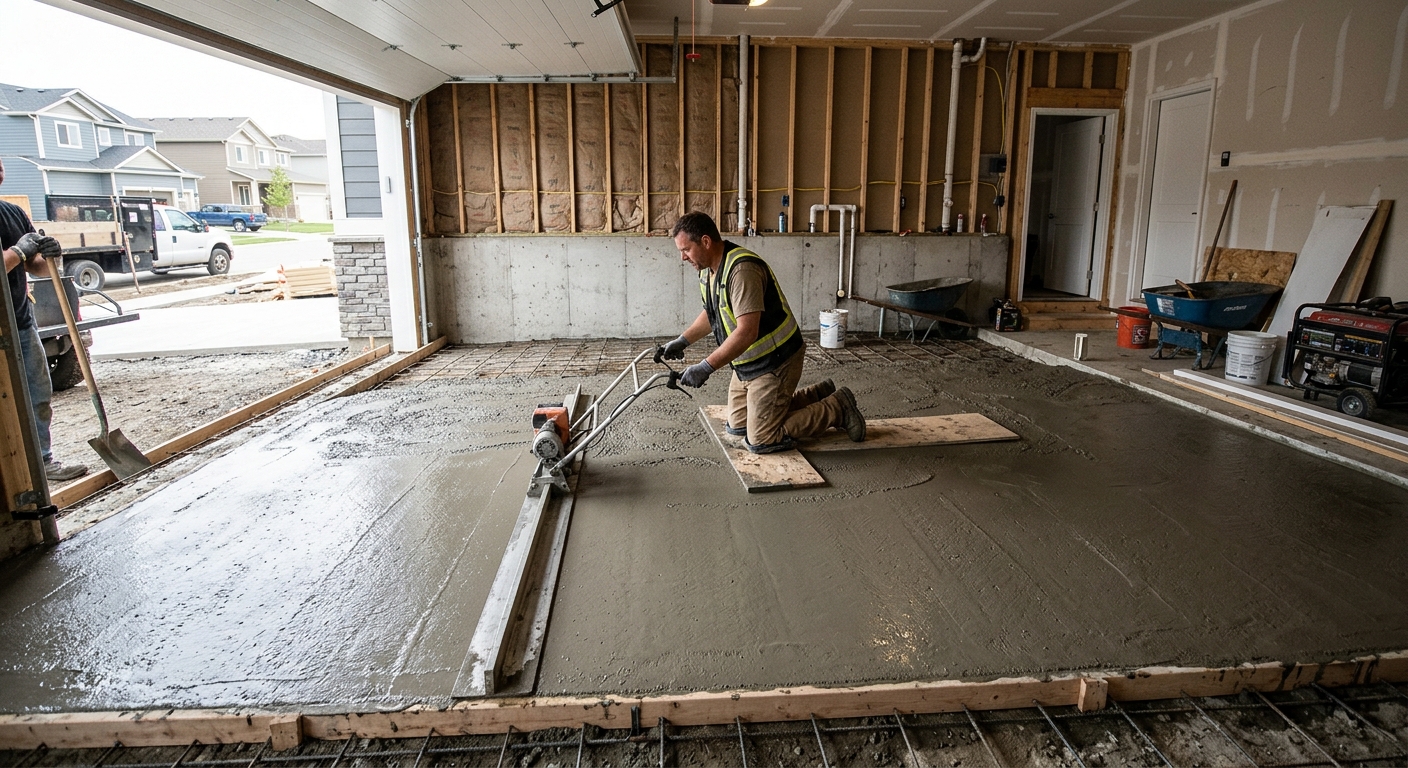
| Garage floor (interior slab) |
20 ft x 22 ft (440 sq ft) |
Reinforcement per design, vapour control considerations |
Broom finish + saw cuts |
$8,500–$14,500 |
| Foundation footings (structural, below frost) |
Typical single-detached footing package |
Excavation below frost line, rebar cage, engineered spec |
Structural concrete formwork |
$12,000–$35,000 |
Prices are estimates only and vary by project scope, site access and material selection.
What affects the price of concrete work in LaSalle
In LaSalle and across the Windsor–Sarnia region, the same “driveway replacement” can come back 30–50% apart on price because the quote isn’t just about concrete—it’s excavation depth, base design, reinforcement, and how the contractor protects the slab during cold or wet weather. In Ontario, crews also price risk differently: if the weather window is tight, they may need heaters/blankets, extra labour for saw-cut timing, and more careful curing to prevent early cracking and scaling. Those variables are amplified in this area because lake influence drives moisture and freeze–thaw cycles that stress exterior concrete.
Every exterior spec usually starts with frost considerations. Footings must extend below the design frost depth to prevent frost heave, which typically means deeper excavation and more concrete per linear foot than milder climates. For the above-grade part of your system, contractors commonly use air-entrained concrete mixes to help the surface resist freeze–thaw damage and de-icing salt exposure. When spring or fall placement happens (or if temperatures swing during curing), the need for cold-weather curing precautions can add meaningful cost. On a standard driveway job, those steps help explain why a basic broom-finished pour might sit in the mid-to-lower portion of the driveway band (for example, $5,500–$15,000 overall), while decorative work like stamped or exposed aggregate pushes you toward the higher end.
Two practical examples from LaSalle: (1) If your site needs regrading or drainage correction, excavation and granular base thickness increase, which can move a patio from the “simple” walkway range toward the higher end of patio pricing (often closer to $3,500–$9,000 than the minimum). (2) If an older slab removal reveals unstable soil or waterlogged subgrade, reinforcement and thicker base become necessary, and the job starts to resemble a foundation-prep exercise rather than a surface replacement.
| Price Factor |
Why It Matters |
Cost Impact |
| Frost line depth — determines footing depth and form height |
Deeper frost protection requires more excavation and more concrete/steel |
Higher when the footing depth is at the top of the Ontario range and access is limited |
| Site preparation — excavation, grading, compacted granular base |
Correct base compaction reduces settlement and long-term cracking |
Can add major cost if soil is wet, soft, or requires hauling/disposal |
| Reinforcement — rebar or wire mesh requirement |
Controls crack widths and improves slab durability |
More steel and labour when engineering/design calls for heavier reinforcement |
| Mix design — air-entrainment and compressive strength spec |
Air-entrainment improves freeze–thaw durability; strength affects long-term performance |
Higher for specialty mixes or tighter strength requirements (still essential outdoors) |
| Finish type — broom vs. stamped vs. exposed aggregate |
Decorative finishes require additional labour, timing, and materials |
Stamped/exposed typically increases cost versus plain broom finishing |
| Pour size and concrete truck access to site |
Limited access increases labour and may require pumping/extra staging |
Costs rise when trucks can’t get close to the forms |
| Cold-weather curing precautions — heating and blankets |
Helps concrete reach proper strength gain under colder conditions |
Adds expense during shoulder seasons or when the forecast is unstable |
| Control joint pattern and sealing cost |
Joints manage shrinkage cracking; sealing helps protect from moisture and de-icing salt |
Better performance requires correct joint layout and (often) later sealer application |
Permits & regulations in Ontario
In Ontario, the key question is whether your project is considered structural concrete or site flatwork. Structural concrete work—such as footings, foundation walls, and grade beams—typically requires a building permit and, in most cases, engineered drawings reviewed through the local municipal process. For homeowners in LaSalle, that means the contractor or builder often won’t proceed until the permit pathway is confirmed, because foundation work affects the building’s structural integrity and must match the design.
Concrete flatwork like driveways, patios, and walkways often does not require a building permit by default, especially when it’s replacing like-for-like. However, it can require municipal attention (or at least confirmation) when it changes lot grading, involves drainage modifications, or creates new hard surface coverage that may affect stormwater handling or lot rules near the right-of-way. In short: replacement usually doesn’t trigger a permit, but altering drainage/grade or doing foundation-related work often does.
Step-by-step, here’s how a LaSalle homeowner should verify your contractor before work starts: (1) Ask for their Ontario business registration details and the appropriate licence information they hold for the work they’re doing. (2) Request a certificate of liability insurance and confirm it covers the full job period. (3) Verify WSIB/WCB coverage (or their equivalent clearance/registration proof). (4) Confirm references for similar scope—especially exterior flatwork that’s been built with proper air-entrainment and jointing. If any of these are missing or vague, treat it as a red flag and move on.
Getting concrete right in LaSalle's freeze-thaw climate
Concrete failures in LaSalle usually trace back to moisture and temperature swings: wet subgrade, insufficient base compaction, inadequate air-entrainment, and poor curing timing. The result shows up as scaling, spalling (flaking at the surface), and sometimes early cracking from shrinkage or uneven support. To spec the job correctly in this Windsor–Sarnia climate, you want five fundamentals nailed down before the first truck shows up.
1) Base preparation: The base has to be compacted granular sub-base to the right depth for local soil conditions and frost protection. If the base is thin or not compacted to spec, the slab will settle and crack even with a good finish. 2) Mix design: For exterior flatwork, air-entrained concrete (commonly in the 5–7% air range, depending on design) helps the freeze–thaw cycle by creating microscopic space for ice expansion. Many residential projects also target at least 32 MPa compressive strength for durability. 3) Control joints: Control joints must be laid out and cut on time to prevent random cracking patterns from forming as the concrete shrinks. 4) Curing: Plan for a minimum of 7 days of proper curing conditions; in cold or shoulder-season weather, curing becomes a cost driver because you may need blankets or heaters to keep concrete progressing. 5) Sealing: Apply a penetrating sealer after the curing window (often around 28 days post-pour) to repel de-icing salt water and reduce freeze–thaw damage at the surface.
If you’re comparing options, the price difference should map to these specs. For example, a plain patio/walkway might land around $3,500–$7,000, but stamped concrete tends to be higher (often within $9,000–$18,500 for a typical residential footprint) because of extra labour, pattern/colour materials, and more careful finishing timing—not because the contractor “uses fancier concrete.”
| Spec |
Why It Matters in LaSalle |
What to Ask For |
Impact if Skipped |
| Compacted granular base (depth?) |
Supports slab through freeze–thaw and prevents settlement cracks |
Base depth for your subgrade + compaction method |
Cracking, unevenness, premature failure |
| Air-entrained concrete mix (target air %?) |
Improves freeze–thaw durability in an Ontario exterior environment |
Air content target (typically 5–7% for exterior flatwork) |
Surface scaling and spalling, especially with de-icing salts |
| Compressive strength (MPa rating) |
Ensures strength gain and long-term durability under seasonal stresses |
Minimum 32 MPa or the exact mix design strength |
Higher risk of abrasion damage and early deterioration |
| Control joints (spacing per ACI guidelines) |
Controls shrinkage cracking so cracks form where you planned |
Joint layout drawings and saw-cut timing |
Random cracking that’s harder to repair and seals poorly |
| Minimum 7-day curing period |
Cold/wet conditions can slow strength gain if curing is inadequate |
Curing plan for your pour date (including blankets/heaters if needed) |
Weak surface, increased cracking risk, poor finish performance |
| Penetrating sealer (when applied after cure) |
Reduces water and salt penetration at the surface layer |
Sealer type + application timing (often ~28 days post-pour) |
Faster surface degradation and more frequent maintenance |
How to choose a concrete work contractor in LaSalle
Choosing the right contractor in LaSalle is mostly about verification and clarity. Start with licensing and coverage. In Ontario, ask for their Ontario business licence details for the work they’re bidding (where applicable), a current certificate of liability insurance, and proof of WSIB/WCB coverage. You can verify these documents by checking the certificate directly (ensure it lists your job location and dates) and, if provided, reviewing the contractor’s clearance/registration information through the relevant Ontario channels. Don’t accept “we have it” without paperwork.
Next, get 2–3 itemised written quotes where labour and materials are broken out, not just a single lump sum. You want to see what’s included for excavation, granular base, reinforcement, formwork, saw-cut joints, concrete supply/placement, and disposal/hauling. Confirm whether permits are included (for foundation work they often are), whether site protection is part of the scope, and whether they’re accounting for truck access limitations—those details can swing cost.
Warranty matters too: ask for the length of the workmanship warranty, the product/manufacturer warranty for any admixtures or sealers, and whether warranties are transferable if you sell the home. For payment, keep it conservative: typically no more than 10–15% upfront, then use progress payments tied to milestones. Finally, insist on a written start date and completion timeline.
- Ask for proof of liability insurance and confirm coverage period dates match your schedule.
- Verify WSIB/WCB clearance/coverage before work starts.
- Get itemised quotes (labour, materials, excavation, base, rebar/mesh, finishing, disposal).
- Confirm whether the quote includes saw-cut control joints and when cutting will be done.
- Ask for the concrete mix spec: air-entrainment and minimum strength (MPa).
- Request the planned base thickness and compaction method.
- Confirm curing and cold-weather measures (blankets/heaters/admixtures if needed).
- Clarify whether sealer is included and when it will be applied (after cure).
- Check how truck access is handled; ask if pumping or extra equipment is needed.
- Ensure the scope states who supplies forms, protects landscaping, and handles clean-up.
- Ask about warranty length and what it actually covers (cracks, scaling, settlement).
- Make sure the schedule is written (pour date, cut timing, and curing window).
Concrete contractor red flags we see in LaSalle include: refusing to provide insurance/WSIB proof, quoting only a lump sum with no mix spec or base depth, skipping or delaying control joint cutting, pressuring you for large upfront payments, and not having a cold-weather curing plan when the forecast is risky.
Frequently asked questions — concrete work in LaSalle
How do I seal concrete to protect it in LaSalle?
In LaSalle and across Southwestern Ontario, sealing is mainly about keeping water and de-icing salt out of the surface so freeze–thaw cycles don’t keep breaking down the top layer. After a new pour, you generally shouldn’t seal immediately—you need the concrete to cure properly first. A common approach is applying a penetrating sealer after cure, often around 28 days post-pour, though the exact timing depends on weather and the product’s label directions. For exterior slabs, sealing works best when control joints are cut correctly and the surface was properly finished and cleaned before application. If you’re comparing options, remember sealer is one of the steps that helps keep an outdoor slab serviceable; for example, plain patios/walkways often start around $3,500–$7,000, but skipping sealing increases how often homeowners feel they need repairs or resurfacing.
What is the difference between concrete and cement?
Concrete is the finished construction material; cement is one ingredient inside concrete. Portland cement (often just called “cement”) is the binder that reacts with water. Concrete is made from cement plus water, aggregates (sand and gravel/crushed stone), and sometimes admixtures for performance. In LaSalle’s freeze–thaw climate, the important part of your specification is the whole mix design, not just cement. Exterior concrete typically uses air-entrainment to resist scaling and spalling when temperatures swing and moisture freezes. You’ll also hear about compressive strength (like a minimum 32 MPa target) and curing practices, which affect how the concrete performs over years—not just how quickly it hardens. When contractors quote driveways or patios, ask what the mix includes and whether it’s engineered for Ontario exterior exposure conditions.
How much does concrete work cost in LaSalle?
Concrete pricing in LaSalle depends on size, excavation and base prep, reinforcement, finish type, and—big one here—freeze–thaw protection requirements. As a homeowner benchmark, typical installed ranges for residential projects often fall into the following bands: concrete patios/walkways are commonly $3,500–$9,000, standard broom-finished driveways are in the broader $5,500–$15,000 range, and stamped or decorative concrete usually lands higher, commonly $7,500–$22,000 depending on size and complexity. Foundation footings (structural, below frost) are more substantial, often $12,000–$35,000 for typical residential packages. Because 31.6% of LaSalle homes were built before 1981, replacements are frequent—removal and site regrading can push costs up versus a simple “new pour” on undisturbed ground.
How deep must footings be for LaSalle's frost line?
Footing depth is determined by the local frost depth requirements used in Ontario structural design and the engineered foundation plan for your specific soil conditions. In Ontario, the design frost depth is commonly around 1.5–2.4 m depending on the location and design assumptions, and contractors must place footings below that frost line to prevent frost heave. For LaSalle homeowners, the practical point is that you should not guess. The correct depth comes from the foundation engineer’s drawings (and sometimes soil report recommendations), not from what a neighbour did. If you see a quote that doesn’t mention below-frost excavation and engineered requirements for footings, that’s a concern. When it’s done properly, it protects the building long-term—even when freeze–thaw cycles keep stressing the ground each winter.
Why does concrete crack in LaSalle and how is it prevented?
Concrete can crack in LaSalle mainly because of shrinkage (as concrete cures), uneven support or settlement, and temperature/moisture cycling—especially with exterior slabs. Freeze–thaw cycles add stress when water gets into the surface or joints and then freezes and expands. The two biggest prevention steps are: (1) correct base prep and support (compacted granular base designed for your soil), and (2) correct mix design with air-entrainment so the concrete can survive freeze–thaw exposure without surface scaling/spalling. Control joints are also critical: they need to be planned and cut on time so the slab cracks where you intend. Finally, proper curing matters in Ontario because cool shoulder-season conditions can slow strength gain. If your job is being done in spring/fall, ask what curing blankets/heaters or admixtures will be used, since that affects how the slab performs.
Stamped vs broom-finish concrete — cost difference?
Stamped concrete typically costs more than broom-finished concrete because it requires more labour and materials, plus tighter timing on finishing. A broom-finished driveway or patio is usually the “value” option: it’s durable and straightforward, and pricing commonly falls within the driveway band of $5,500–$15,000 depending on size and prep. Stamped concrete adds colour (often integral colour), release agent, texture/pattern tools, and more careful finishing and joint detailing, which is why it often lands in the higher range—commonly $7,500–$22,000 for stamped residential projects in Western Ontario. The important technical point in LaSalle is that stamped concrete still needs Ontario-grade exterior specs: air-entrainment, proper base compaction, and a control-joint plan. If a contractor can’t explain those details, the finish may look good at first but won’t last through our freeze–thaw cycles.