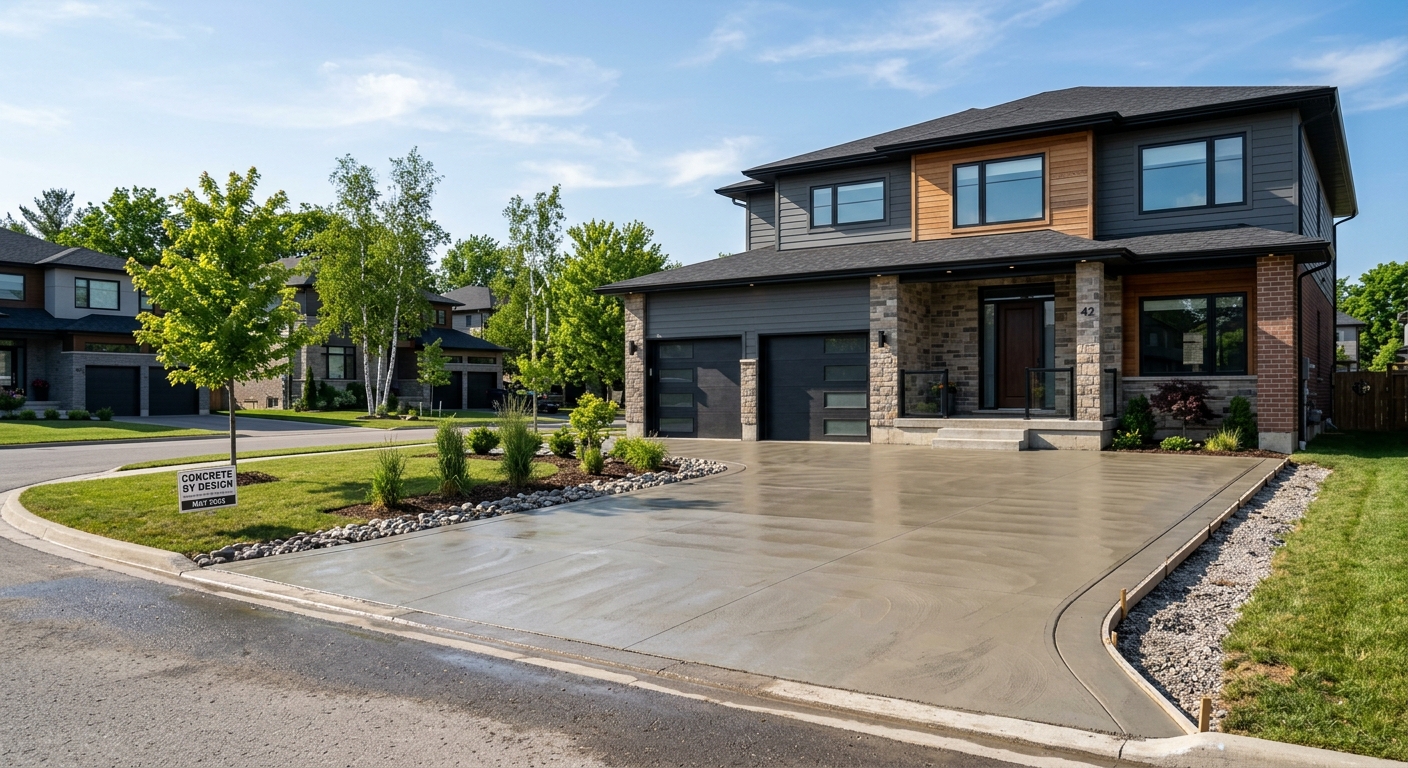
Concrete work options and costs in Sydenham
Sydenham, Ontario has a steady demand for concrete driveways, patios, walkways, and foundation work, especially as homes age and residents upgrade curb appeal and accessibility. With a 2021 population of 3,249 (Statistics Canada, 2021 Census), the market is smaller than the GTA core, but the Toronto economic region still drives pricing through material supply, skilled labour availability, and contractor scheduling. In neighbourhoods such as the Highway 41 corridor area, concrete flatwork is particularly busy because many properties are on larger lots where vehicle access and outdoor living spaces matter year-round.
In this region, concrete costs are strongly shaped by frost depth and freeze–thaw cycles. Most structural footings need to sit below the design frost depth (commonly around 1.2 m or more), and exterior slabs are typically specified with air-entrained concrete plus proper base drainage to reduce heaving and cracking. Contractors also concentrate pours in the warmer months to manage curing; once temperatures trend toward the low teens and below, the risk of surface damage and long cure times increases, so crews may build in protection measures. That combination—deep excavation, robust mixes, and weather-aware scheduling—is why two “similar” quotes can land far apart.
Below is a practical comparison of typical scopes and the contractor price bands that match Sydenham’s tier, using Ontario-typical specs and finishing choices. Use this table to sanity-check proposals before you book a site visit.
| Application |
Typical Size |
Key Spec |
Finish Option |
Price Range |
| Concrete driveway (standard broom finish) |
16 ft x 28 ft (448 sq ft) |
Air-entrained mix; compacted granular base; control joints |
Broom finished + basic edging |
$8,000 – $12,500 |
| Exposed aggregate driveway |
16 ft x 30 ft (480 sq ft) |
Air-entrained mix; properly timed wash for exposed stone |
Exposed aggregate with sealed surface |
$10,000 – $15,500 |
| Stamped concrete driveway or patio |
12 ft x 28 ft (336 sq ft) |
Air-entrained mix; hardened surface; control joints |
Stamped pattern + release agent + seal coat |
$9,500 – $14,000 |
| Plain concrete patio or walkway |
10 ft x 16 ft (160 sq ft) |
Compacted base; drainage slope; control joints as needed |
Float finish with broom edge or lightly trowelled surface |
$2,600 – $4,300 |
| Garage floor (interior slab) |
20 ft x 20 ft (400 sq ft) |
Vapour barrier + reinforcement where specified |
Steel trowelled or broom finish (dust control optional) |
$6,500 – $10,500 |
| Foundation footings (structural, below frost) |
Typical single home footing package |
Excavation + formwork; rebar; pour below frost line |
Structural concrete (not decorative) |
$9,000 – $18,000 |
Prices are estimates only and vary by project scope, site access and material selection.
What affects the price of concrete work in Sydenham
In Sydenham, you can see the same type of concrete job priced 30–50% differently between contractors, even when the finish looks similar. The main drivers are site conditions, how each company designs for frost and freeze–thaw durability, and how they schedule crews for Ontario’s variable spring and fall weather. In the Toronto economic region, labour availability and truck scheduling also tighten up quickly when multiple builders chase the same pour window.
Frost line depth and freeze–thaw cycles dictate nearly every spec: structural footings must extend below the design frost depth (often around 1.2 m or more in Ontario) to prevent frost heave and differential movement. For exterior flatwork, contractors typically require air-entrained mixes so the concrete can tolerate repeated expansion and contraction. When temps dip toward about 10 °C or below, cold-weather curing precautions become critical—using insulated blankets, protecting edges, and sometimes adding heated curing—because early freezing can harm strength gain and later durability. Finally, de-icing salts accelerate surface spalling if the mix and sealing plan aren’t right; that’s why sealing is commonly included or recommended.
Here are a few Sydenham-specific examples of why costs move up or down. If your driveway base needs significant excavation to reach firm subgrade, you’ll pay more than a “same-size” pour with an easier grade. If your soil is wetter in spring, contractors will increase drainage and granular base thickness—costly up front, but it reduces settlement and cracking. On the finish side, a plain broom-finish driveway usually falls in the $18–$28 per sq ft band, while stamped work commonly trends toward the $24–$40 per sq ft band due to labour-intensive forming, texturing, and sealing.
| Price Factor |
Why It Matters |
Cost Impact |
| Frost line depth — determines footing depth and form height |
Deeper excavation and more concrete keep footings stable through freeze–thaw |
Higher excavation + more rebar/formwork can raise structural costs notably |
| Site preparation — excavation, grading, compacted granular base |
Proper base prevents pumping, settlement, and cracking |
Wet soils, soft spots, and hauling/disposal can add substantial charges |
| Reinforcement — rebar or wire mesh requirement |
Improves crack control and load capacity for slabs |
Mesh/rebar plus ties/chairs and extra labour increases material and time |
| Mix design — air-entrainment and compressive strength spec |
Air entrainment helps resist freeze–thaw damage on exterior concrete |
Stronger specs and air-entrained materials cost more than basic mixes |
| Finish type — broom vs. stamped vs. exposed aggregate |
Texture and colour work increases labour and curing/sequencing demands |
Stamped/exposed options typically cost more than standard broom finishes |
| Pour size and concrete truck access to site |
Limited access can require pumping or smaller batching runs |
Pumping, longer carry distances, or extra trucks increases total cost |
| Cold-weather curing precautions — heating and blankets |
Protects strength gain and reduces surface scaling/spalling risk |
Blankets/heaters add labour and materials, especially near the shoulder season |
| Control joint pattern and sealing cost |
Controls cracking and helps repel moisture/de-icing salt intrusion |
More saw cuts and a quality sealer line item can add a meaningful but worthwhile premium |
Permits & regulations in Ontario
In Ontario, structural concrete work generally needs a building permit. That includes footings, foundation walls, and grade beams, because these elements are part of the building’s structural system and are typically reviewed through municipal plan-check processes and, when required, engineering documentation. For concrete flatwork—patios, walkways, and driveways—permits are often not required unless your project affects lot grading, changes stormwater flow, or triggers municipal rules around impervious surface coverage and drainage management. Even when a permit isn’t typically required, it’s still smart to confirm with the local authority before breaking ground.
Before you hire anyone, verify three practical items: (1) the contractor’s liability insurance, (2) WSIB/WCB coverage (as applicable), and (3) references on similar-scale projects in your region. A Toronto-area crew that regularly works in frost-depth applications will understand the documentation and inspection expectations that come with structural pours.
Step-by-step for Sydenham homeowners: First, ask the contractor for their insurance certificate and ensure it lists your project’s scope (driveway vs. foundation) and coverage amounts. Second, request proof of WSIB/WCB clearance (or exemption paperwork if they’re legitimately not required). Third, confirm the contractor’s business licensing/registration through the appropriate provincial/municipal listing available online. Finally, compare quotes to ensure the scope includes excavation, base prep, reinforcement (if required), curing protection, and joint sealing.
Getting concrete right in Sydenham's freeze-thaw climate
Concrete most commonly fails in Sydenham winters through spalling, scaling, and cracking—usually tied to moisture getting into the surface and then expanding during freeze–thaw cycles. If the base isn’t compacted properly or drainage is poor, water saturates the subgrade, which creates movement under the slab. If the mix isn’t properly air-entrained, water inside the concrete freezes and expands, popping off the surface over multiple winters. In the Toronto market, contractors also have to manage curing when temperatures fall; if concrete is poured near cooler overnight lows without protection, early strength development can lag and surface durability suffers.
To spec the job correctly, focus on five areas. (1) Base preparation: require a compacted granular sub-base at the right depth for your soil and frost conditions, plus proper slope. (2) Mix design: request air-entrainment for exterior flatwork (commonly 5–7% air) and a minimum 32 MPa compressive strength target. (3) Control joints: specify a joint plan that limits random cracking and guides where shrinkage occurs. (4) Curing: aim for at least 7 days of curing under suitable conditions; in cooler weather, blankets/heat matter. (5) Sealing: plan for a penetrating sealer applied 28 days after the pour to help repel de-icing salts and reduce moisture ingress.
As a price example, a standard broom-finish driveway is often priced within the $18–$28 per sq ft band. If you pay toward the upper end to add proper base thickness, air-entrained concrete, and a control joint/sealing plan, you’re usually buying fewer call-backs and longer service life—whereas taking shortcuts on air content or base prep can lead to early spalling that costs far more to fix.
| Spec |
Why It Matters in Sydenham |
What to Ask For |
Impact if Skipped |
| Compacted granular base (depth?) |
Reduces water saturation and movement during freeze–thaw |
Documented excavation depth, compacted granular type, and compaction targets |
Settlement, cracking, and pumping; faster deterioration of edges |
| Air-entrained concrete mix (target air %?) |
Protects against spalling from repeated freezing and thawing |
Air-entrainment specified (commonly 5–7% for exterior flatwork) |
Surface scaling and spalling within a few winters |
| Compressive strength (MPa rating) |
Supports strength gain for long-term durability |
Minimum 32 MPa compressive strength target |
Weak surface, higher risk of damage during early seasons |
| Control joints (spacing per ACI guidelines) |
Limits random shrinkage cracking that water can infiltrate |
Joint spacing and timing (saw cut plan) in writing |
Wider random cracks and moisture pathways for freeze–thaw damage |
| Minimum 7-day curing period |
Ensures strength development before weather stress |
Curing method and whether cold-weather blankets/heating are used if needed |
Reduced strength gain and higher early cracking/scaling risk |
| Penetrating sealer (when applied after cure) |
Helps repel de-icing salts and reduces water absorption |
Confirm sealer type and schedule (commonly after 28 days) |
More rapid surface deterioration and more maintenance over time |
How to choose a concrete work contractor in Sydenham
Choosing the right concrete contractor matters in Sydenham because freeze–thaw performance depends on details—base prep, mix design, jointing, curing, and sealing—not just the look. Start by verifying Ontario requirements and practical protections. Ask for a certificate of liability insurance and confirm it covers the actual work being quoted (driveway, patio, foundation). Next, verify WSIB/WCB coverage: request proof of clearance or documentation showing they’re registered and in good standing, or a valid exemption if applicable. Then, look for at least one local set of references from similar work and ask how they handled cold-weather protection when temperatures dropped.
For pricing, don’t accept a vague lump sum. Get 2–3 itemised written quotes with a breakdown of labour and materials, including excavation, granular base, reinforcement (if required), concrete supply, saw cutting/control joints, and sealing (if included). Read exclusions carefully: ask whether the contractor includes permit pulling (when needed for structural work), disposal/hauling, protection of landscaping, and any patching or regrading.
Warranty should be in writing, with a clear workmanship warranty length and what it covers (cracking control, spalling issues, joint performance). Product/manufacturer warranties—if they apply to sealing products or admixtures—should be specified and you should ask whether benefits are transferable. Keep the payment schedule conservative: never pay more than 10–15% upfront, and hold back until the final inspection/cleanup is complete. Also, get a start date and completion estimate in writing, since Ontario’s weather window can change quickly.
- Confirm liability insurance certificate is current and matches the scope (flatwork vs. foundation).
- Verify WSIB/WCB clearance (or valid exemption paperwork) before work starts.
- Ask for 2–3 recent reference photos from Sydenham or the broader Toronto area.
- Require itemised quotes: base prep, reinforcement, concrete supply, finishing, and sealing.
- Check that the quote specifies air-entrained concrete for exterior flatwork.
- Ensure control joints and saw-cut timing are included in the scope.
- Ask what happens if temps drop before the pour—blankets/heating plan should be explained.
- Clarify disposal/hauling of removed asphalt/soil (often a surprise line item).
- Confirm site access and equipment plan (hand-lay vs. wheelbarrow vs. pumping).
- Get the exact timeline: start date, pour day, curing/return dates, and sealing date.
- Review warranty wording for workmanship coverage and limitations.
- Verify payment terms: 10–15% max upfront, and a holdback until completion.
Concrete red flags I see in the Sydenham area include quotes that omit air-entrainment for exterior work, “we’ll figure out joints later” language, vague curing promises (no blankets/heating plan near cool nights), refusal to provide insurance/WSIB documentation, and no schedule for sealing or joint saw cuts.
Frequently asked questions — concrete work in Sydenham
What causes concrete to spall in Sydenham winters?
Spalling in Sydenham is usually a freeze–thaw problem: moisture gets into the concrete (often through surface pores or small cracks), then expands when temperatures drop, breaking the surface layer. The biggest preventable causes are inadequate air-entrainment, poor curing, and a slab that isn’t protected by proper base prep and drainage. When de-icing salts are used, the surface is exposed to additional chemical stress, which can make scaling and spalling show up sooner. Another contributor is early freezing—if a crew pours near cooler weather without cold-weather curing precautions, the concrete may not reach adequate early strength. If you’re comparing quotes, make sure the mix is specified for exterior durability, and ask whether sealing is included or scheduled about 28 days after the pour. A “too cheap” driveway can end up costing more than a $18–$28 per sq ft properly planned job.
What is rebar and when is it required in Ontario?
Rebar (reinforcing steel) is used to strengthen concrete and control cracking in structural elements, especially where loads and movement are expected. In Ontario, the need for rebar depends on the engineering design and the type of concrete work. Structural work like foundation footings, foundation walls, and grade beams typically includes reinforcement as part of the load-carrying system. For exterior slabs such as driveways and patios, reinforcement may be specified based on slab thickness, soil conditions, and expected vehicle loads, but it isn’t automatically “always required” for every small patio. That said, many contractors include wire mesh or rebar for driveways to improve crack control, particularly where the base prep is challenging. The key is that your quote should state reinforcement type, placement (on chairs/bars), and slab thickness, not just “reinforcement included.” Always ask for the engineered drawings or the spec basis when structural details are part of the scope.
How long does a concrete project take in Sydenham?
Timelines in Sydenham depend on weather, curing conditions, and the scope. For simple flatwork like a small patio or walkway, you might see excavation and base prep in one day, the pour on a second day, and finishing/joint cutting shortly after. However, the concrete still needs time to cure properly. Many homeowners can use the area lightly after a period, but for durability—especially in freeze–thaw conditions—concrete should cure for at least 7 days under suitable conditions, with full strength development over longer time. If you’re pouring in a cooler stretch, crews may need extra protection (blankets/heaters), which can extend the schedule. Also, if sealing is part of the plan, penetrating sealer is typically applied after the concrete has cured—commonly around 28 days post-pour. Compare quotes by schedule, not only by price: a driveway that’s rushed may look fine at first but fail earlier in Ontario winters. That’s also why stamped work often takes longer due to pattern sequencing.
What is a concrete overlay and is it suited to Sydenham?
A concrete overlay is an additional concrete layer placed over an existing slab after preparation, typically involving grinding, cleaning, crack repair, and sometimes applying a bonding system. It can be a cost-effective option when the existing concrete is mostly structurally sound but has surface deterioration, minor spalling, or uneven appearance. In Sydenham’s freeze–thaw climate, suitability depends on why the original slab is failing: if there are major base problems, recurring settlement, or widespread structural cracking, an overlay may not last and can trap moisture. The contractor should inspect the slab, assess drainage, and explain how they’ll prepare the surface so bonding is reliable. Overlays often come with specialized surface prep and may be less appropriate if the old slab is actively pumping or moving. If you’re looking for a fresh look, sometimes a full removal and new slab is a better long-term value than an overlay—especially when your quote is close to the standard driveway band of $18–$28 per sq ft. A good overlay contractor should be specific about prep steps and expected life in Ontario winters.
How do I seal concrete to protect it in Sydenham?
To protect concrete in Sydenham, sealing is mainly about reducing moisture and de-icing salt penetration. The most reliable approach is to use a penetrating sealer designed for concrete and apply it after the slab has fully cured—commonly around 28 days after the pour. If you seal too early, you can trap moisture and reduce performance. Before sealing, the surface should be clean and dry, and any curing residue or contaminants must be removed according to the sealer manufacturer’s directions. In winter, you’ll also want to follow a realistic de-icing plan: use de-icers properly and avoid over-salting, because salts can still contribute to scaling even with a good seal. When comparing quotes, check whether sealing is included, which product is used, and whether the contractor has a sealing schedule. A stamped or exposed aggregate driveway often looks best when sealed correctly, but even broom-finish work benefits from sealing—particularly when exterior slabs are exposed to Toronto-area humid winters and wet seasons.
What is the difference between concrete and cement?
Cement and concrete aren’t the same thing, even though people use the terms interchangeably. Cement is one ingredient—typically Portland cement—within the concrete mix. Concrete is the full mixture: cement plus water plus aggregates (sand and gravel or crushed stone), and often additives such as air-entrainment for exterior freeze–thaw durability. In Ontario, for exterior flatwork in Sydenham, contractors commonly specify an air-entrained mix so the concrete can withstand repeated freezing and thawing cycles without spalling. Mix design also includes strength targets (often around 32 MPa) and workability requirements for your specific site. This is why two driveways that “look the same” can cost different amounts: the cement content, air-entrainment, and admixtures affect material cost and durability, not just appearance. When you read a proposal, ask what mix is being used and whether air-entrainment and curing/protection are covered—especially if the price seems lower than the $18–$28 per sq ft typical band for standard exterior driveways.