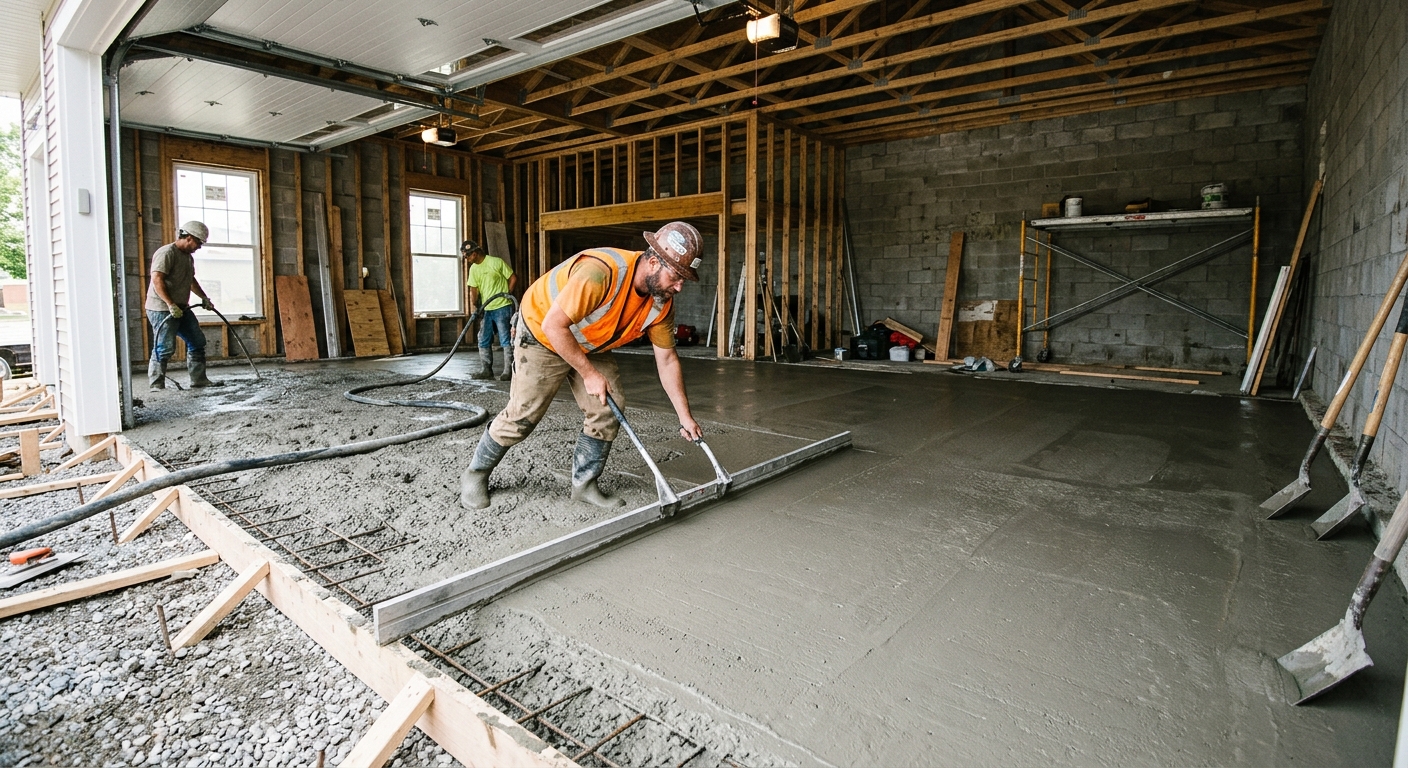
Concrete work options and costs in Etobicoke
Concrete work in Etobicoke is mostly driven by season and soil conditions—Toronto’s freeze–thaw cycle pushes contractors to build for longevity, not just curb appeal. With a city population of about 365,000 (Statistics Canada, 2021 Census), the demand for driveways, patios, and walkways is steady, especially in neighbourhood pockets where families invest in resurfacing rather than landscaping. The area around long-established residential strips—such as Islington–City Centre and the broader south Etobicoke corridor—often sees active upgrades because homeowners plan around school schedules, summer listings, and vehicle access.
In the Toronto economic region, local specs are shaped by frost depth and repeated freezing around the slab. For exterior work, contractors typically use air-entrained concrete, adequate thickness, and a properly planned joint layout to control random cracking. Exterior pours are usually concentrated in warmer months so the concrete can cure properly; when temperatures drop toward 10 °C or below, curing management (covers, blankets, sometimes heat) becomes a cost driver.
That’s why you’ll sometimes see quotes for the “same” driveway differ by more than you’d expect: base excavation and compaction, concrete mix design, reinforcement, and finishing all respond to site access and drainage. If you’re choosing between a standard broom finish and decorative options like stamped concrete, the premium is real—but so is the long-term performance when the base and mix are done right. Use the table below as a practical starting point for budgeting before you request itemised quotes.
| Application |
Typical Size |
Key Spec |
Finish Option |
Price Range |
| Concrete driveway (standard broom finish) |
10 ft x 20 ft (200 sq ft) |
4 in (100 mm) slab, air-entrained mix, compacted granular base |
Broom finish + control joints |
$3,600 – $5,600 |
| Exposed aggregate driveway |
10 ft x 20 ft (200 sq ft) |
4 in (100 mm) slab, proper retarder timing, air-entrained mix |
Exposed aggregate + sealed |
$4,400 – $7,000 |
| Stamped concrete driveway or patio |
12 ft x 18 ft (216 sq ft) |
4 in (100 mm) slab, air-entrained mix, release agent, accent colours |
Stamped pattern + colour hardener |
$5,200 – $8,700 |
| Plain concrete patio or walkway |
10 ft x 12 ft (120 sq ft) |
4 in (100 mm) slab, compacted base, drainage slope |
Float/smooth + light broom texture |
$2,000 – $3,600 |
| Garage floor (interior slab) |
20 ft x 22 ft (440 sq ft) |
4 in (100 mm) slab, vapour barrier (where required), reinforcement if specified |
Steel trowel or light broom for traction |
$7,500 – $13,200 |
| Foundation footings (structural, below frost) |
Typical single-family partial perimeter |
Engineered width/depth; below frost, rebar per drawings |
Not applicable (structural concrete) |
$180 – $300 |
Prices are estimates only and vary by project scope, site access and material selection.
What affects the price of concrete work in Etobicoke
In Etobicoke, you can see the same concrete project swing by 30–50% across the Toronto area because each quote reflects different assumptions about site conditions, base preparation, mix design, and finishing labour. Even when your finished dimensions match, one contractor may include proper granular excavation, reinforcement, and drainage, while another assumes “close enough” base conditions—those choices become cost differences once you account for frost protection and freeze–thaw durability requirements.
In the Toronto economic region, frost depth and freeze–thaw cycles dictate most specs. Structural footings generally need to extend at least about 1.2 m (roughly 4 ft) below grade to reduce frost heave and differential movement. That requirement drives formwork height, excavation labour, and rebar congestion. For exterior slabs—driveways, patios, and walkways—contractors typically specify air-entrained concrete so the mix can survive the repeated freeze–thaw cycle. When pours land near cooler shoulder-season temperatures, crews often need cold-weather curing precautions (insulating blankets, additional protection time, sometimes heat), which raises labour and material handling costs. Finally, Toronto-area de-icing habits can accelerate surface spalling if the surface isn’t sealed or if the mix isn’t properly air-entrained.
Two common Etobicoke examples: (1) a driveway over soft or waterlogged soils can add excavation and granular base thickness before you pour—pushing you toward the higher end of standard driveway pricing; (2) a stamped patio often costs more than plain, not because of aesthetics alone, but due to labour-intensive form liners, release agents, and colouring—usually putting decorative jobs in the $24–$40 per sq ft range (reflected in Etobicoke totals of the stamped driveway/patio band). Conversely, a simple interior garage slab may land closer to the mid-to-lower end when access is good and there’s minimal demolition. Housing stock age matters too: many older lots have older drainage patterns and saturated edges, meaning you pay to correct the base and grading before concrete is placed.
| Price Factor |
Why It Matters |
Cost Impact |
| Frost line depth — determines footing depth and form height |
Deeper footings reduce frost heave risk and differential settlement |
Higher excavation/formwork can increase foundation-related line items |
| Site preparation — excavation, grading, compacted granular base |
Concrete fails more from poor base than from the surface finish |
Can add substantial labour and material when soils are wet or unstable |
| Reinforcement — rebar or wire mesh requirement |
Controls cracking and improves load capacity, especially on larger slabs |
Adds material and tying/labour time, particularly on exterior slabs |
| Mix design — air-entrainment and compressive strength spec |
Air-entrainment is crucial for freeze–thaw durability |
More robust mix specs typically increase per-cubic-yard material cost |
| Finish type — broom vs. stamped vs. exposed aggregate |
Finishes require different tools, timing, and curing/protection steps |
Stamped and exposed aggregate materially increase labour and materials |
| Pour size and concrete truck access to site |
Short access routes can delay pours and increase labour handling |
More logistics costs if pumps/extra wheelbarrow time are needed |
| Cold-weather curing precautions — heating and blankets |
Stops early freezing and protects early strength gain |
Increases labour, protection materials, and scheduling flexibility |
| Control joint pattern and sealing cost |
Joints manage cracking; sealing helps repel de-icing salts |
Small adders per sq ft, but important for long-term appearance and durability |
Permits & regulations in Ontario
In Ontario, how you permit concrete depends on whether the work affects structural elements or lot conditions. Structural concrete work—such as foundation footings, foundation walls, and grade beams—typically requires a building permit and often engineered drawings that the municipality reviews. For concrete flatwork (driveways, patios, and walkways), permits are usually not required by default, unless the work affects lot grading, drainage, or impervious surface coverage limits, or you’re altering areas within municipal right-of-way. Because Etobicoke lots vary widely in drainage and in how they connect to municipal infrastructure, it’s smart to confirm with the local authority before breaking ground.
For contractor compliance in Ontario, verify three things before you sign: licensing (where applicable for the trade and scope), liability insurance, and WSIB/WCB coverage for workers. Step-by-step: (1) ask for the contractor’s certificate of insurance and confirm it covers the specific job location; (2) request proof of WSIB/WCB clearance or account verification and check it’s current; (3) look up the contractor using Ontario’s public-facing business/registry listings where available and confirm the business name matches the quote; (4) review their past projects in similar Etobicoke conditions (driveway thickness, drainage corrections, and exterior freeze–thaw specs). Finally, ask for references that match your scope—flatwork versus structural work—and ensure the quote notes whether permit/engineering steps are included where required.
Getting concrete right in Etobicoke's freeze-thaw climate
Concrete failure in Etobicoke is usually preventable when you control five things: base support, mix durability, crack control, curing, and surface protection. First, base preparation matters. Exterior slabs need a compacted granular sub-base to the right depth for the soil and drainage, so water doesn’t sit under the slab and expand during freeze–thaw. Second, mix design: for exterior flatwork, aim for air-entrainment (commonly 5–7% air for many exterior exposures) and a minimum 32 MPa compressive strength, so the paste has enough flexibility to handle freezing. Third, control joints: spacing and timing decide where cracks happen; the goal is predictable cracking at joints, not random cracking through the slab. Fourth, curing: concrete needs time to develop strength—typically at least 7 days in proper conditions. When temperatures drop, crews must protect and manage curing so the slab doesn’t freeze before it gains early strength. Fifth, sealing: applying a penetrating sealer after the recommended cure period helps repel de-icing salts and reduces surface deterioration.
Ask technical questions that target spalling risk from inadequate air-entrainment. For example, if a quote is noticeably cheaper than others for an exposed aggregate or broom-finished driveway, confirm the specified air content and minimum strength. A $200–$600 difference in materials is sometimes “hidden” by reducing air content, cutting base depth, or skipping reinforcement and joint work—those shortcuts can cost far more once you see scaling and patchwork. In Etobicoke’s climate, the contractor who builds in durability typically keeps you closer to the mid range of standard pricing (and helps explain why stamped options commonly sit higher, such as the stamped driveway/patio band).
| Spec |
Why It Matters in Etobicoke |
What to Ask For |
Impact if Skipped |
| Compacted granular base (depth?) |
Prevents water trapping and supports slab through freeze–thaw |
Confirm excavation depth and granular lift/compaction standard |
Settlement, voids, and early cracking or pumping |
| Air-entrained concrete mix (target air %?) |
Reduces risk of scaling/spalling from repeated freezing |
Ask for target air content (commonly 5–7% for exterior flatwork) |
Spalling and surface scaling, especially after de-icing salt |
| Compressive strength (MPa rating) |
Ensures durability and resistance to early damage |
Confirm minimum compressive strength (commonly 32 MPa) |
Lower long-term performance and increased cracking risk |
| Control joints (spacing per ACI guidelines) |
Controls where cracks form in Ontario’s freeze–thaw |
Confirm joint spacing and saw-cut timing |
Random cracks and uneven surface heave/repair cycles |
| Minimum 7-day curing period |
Strength gain supports resistance to cold and early wear |
Ask how they protect the slab and what curing conditions are required |
Weak surface, scaling, and premature deterioration |
| Penetrating sealer (when applied after cure) |
Helps repel de-icing salts and moisture-driven damage |
Confirm sealer type and application after full cure (often 28 days) |
Faster staining, scaling, and higher maintenance costs |
How to choose a concrete work contractor in Etobicoke
Choosing the right contractor in Etobicoke starts with verification and then with how clearly they price your scope. For Ontario compliance, confirm the contractor can perform your specific work and that they carry liability insurance and WSIB/WCB coverage. How to check: request a current certificate of insurance and ensure the jobsite address is covered; ask for a WSIB/WCB clearance letter (or proof of account status) and verify the dates are current; and confirm the business details on the certificate match the company name on the quote and contract. If they hesitate to provide documents up front, that’s a major red flag.
Next, get 2–3 itemised written quotes rather than one lump sum. You want a breakdown of labour, concrete supply, base prep, reinforcement, formwork, finishing, saw-cutting/joints, and sealing (if included). Read the scope line-by-line: what’s excluded (demo, hauling/disposal, tree/root remediation, drainage corrections, permit handling if required)? Is the disposal of old concrete included, and where does the material go? Confirm warranty details: workmanship warranty length, whether the product/manufacturer warranty applies to the sealer or mix, and if it’s transferable if you sell your home. Payment matters too—don’t pay more than 10–15% upfront, and hold back until key items are complete and inspected. Finally, insist on a written schedule: a start date and an estimated completion window, with weather-related contingencies noted for curing protection during cold snaps.
- Ask for WSIB/WCB proof and confirm it’s current
- Request a certificate of liability insurance before signing
- Get an itemised quote (labour + materials), not only a total
- Confirm base prep scope: excavation depth, granular type, and compaction
- Verify reinforcement plans for exterior slabs where applicable
- Ask the contractor to specify air-entrained mix and minimum strength
- Confirm control joint spacing and saw-cut timing
- Ask how they protect curing in cooler weather and what happens if temperatures fall
- Confirm whether sealing is included and when it’s applied after cure
- Make sure demo and disposal are clearly included or excluded
- Clarify how they manage site access for the concrete truck
- Review warranty terms for workmanship and finish products
Concrete red flags in Etobicoke include: quotes that don’t mention air-entrainment or minimum strength, skipping granular base depth details, no plan for drainage slope, unusually low pricing compared with the local $18–$28 driveway band, and vague warranties (or refusing to provide insurance/WSIB documents).
Frequently asked questions — concrete work in Etobicoke
How long does a concrete driveway last?
In Etobicoke and across Ontario, a properly built concrete driveway commonly lasts 20–30 years (sometimes longer) when the contractor nails the basics: adequate granular base, correct slope and drainage, air-entrained mix for freeze–thaw, and control joints. The Toronto region’s winter cycle is hard on poorly drained slabs—water under the concrete expands as it freezes, leading to cracking and surface scaling. If you choose decorative options, you can still get long life, but only if the base prep and mix design are equivalent to standard work. For budgeting, many homeowners compare standard driveway totals that land roughly in the $18–$28 per sq ft range, with larger or decorative projects moving higher due to labour and finishing complexity. Regular maintenance (prompt crack filling where needed and sealing when recommended) helps protect against de-icing salt wear.
What is air-entrained concrete and why does it matter here?
Air-entrained concrete is a mix designed with tiny air bubbles that give freezing water space to expand. In Etobicoke, that matters because the slab repeatedly freezes and thaws; without proper air-entrainment, the concrete paste can break down and you’ll see scaling or spalling over time. That’s why GTA contractors typically specify air-entrained concrete for exterior flatwork—driveways, patios, and walkways—especially where de-icing salt accelerates surface damage. When comparing quotes, don’t accept “we use good concrete” as a substitute for technical specs. Ask whether the mix is air-entrained and what target air content is being used. If one quote is far below the local price band (for example, well under the common driveway range of $18–$28), ask why—sometimes the cheaper number comes from weaker mix or reduced base depth.
How do I prepare the base for a concrete slab?
Base preparation determines whether a slab performs. For Etobicoke, the general approach is: excavate to the required depth for the slab thickness and the local soil conditions, then place and compact a granular sub-base in lifts. You want a firm, uniform surface with correct drainage slope so water doesn’t pool under the concrete. A contractor should also confirm whether reinforcement is needed for your slab type and size. For exterior flatwork, proper compaction and moisture control during base work are critical because freeze–thaw cycles punish even small voids or soft spots. When you’re interviewing contractors, ask for details like granular type, compaction method, thickness/lift plan, and how they handle wet or unstable subgrade. A well-prepped base helps keep you in the expected pricing band for the project—while poor prep is one reason you’ll see major quote differences across Toronto.
How do I compare concrete quotes?
Start by comparing apples to apples: get itemised quotes with line items for demolition, excavation, granular base, reinforcement (if any), concrete supply, formwork, finishing, saw cutting/control joints, and sealing. A quote that looks lower might have exclusions like disposal, reduced base depth, or no sealing—those omissions can show up months later as spalling or early cracking. Ask each contractor to state the mix design (air-entrainment for exterior), minimum strength, slab thickness, and whether they include cold-weather curing protection if the pour approaches cooler temperatures. In Etobicoke’s climate, you should also ask about scheduling: curing quality matters and pours are often best in the warmer months. If one contractor is quoting stamped work, compare the finishing scope (pattern, colour system, and sealer timing) since decorative work tends to align with the local $24–$40 per sq ft stamped band. For standard driveways, compare against the $18–$28 driveway band and ensure the technical specs match.
Can concrete be poured in cold weather in Etobicoke?
Yes, concrete can be poured in cold weather in Etobicoke, but it must be done correctly. When temperatures fall toward about 10 °C and below, contractors need cold-weather precautions so the concrete doesn’t freeze before it reaches sufficient early strength. That often includes insulated blankets, covers, and sometimes temporary heating, plus careful scheduling to protect curing. The key is that protection isn’t optional—freezing early can reduce strength and increase the risk of surface scaling and long-term cracking. Ask the contractor what minimum temperature triggers additional protection, what method they use to maintain curing temperature, and how long they expect the protection to stay on. Make sure the quote includes curing protection labour and materials rather than assuming “concrete will be fine.” If the job is seasonal and they can’t support proper curing, it’s usually better to adjust the schedule to maintain durability.
How do I maintain concrete in Etobicoke's freeze-thaw climate?
Concrete maintenance in Etobicoke is mainly about moisture and de-icing salt management. Keep the surface reasonably clear and avoid letting salt and grit sit on low spots—proper drainage at the edges reduces water trapping. For appearance and long-term durability, sealing is important: a penetrating sealer is typically applied after the concrete has fully cured (often around 28 days) to help repel moisture and de-icing chemicals. If you see small cracks, fill them promptly so water doesn’t get under the slab and expand during freeze–thaw. For control-joint areas, crack maintenance is usually part of normal upkeep. Also, watch for spalling patches and uneven settling, which may indicate base or drainage issues rather than just surface wear. If you had decorative finishes, maintenance requirements can differ slightly based on colour and sealer type, but the freeze–thaw principles stay the same. Following these steps helps protect what you paid for—especially if you invested in options near the higher-end driveway or decorative bands.