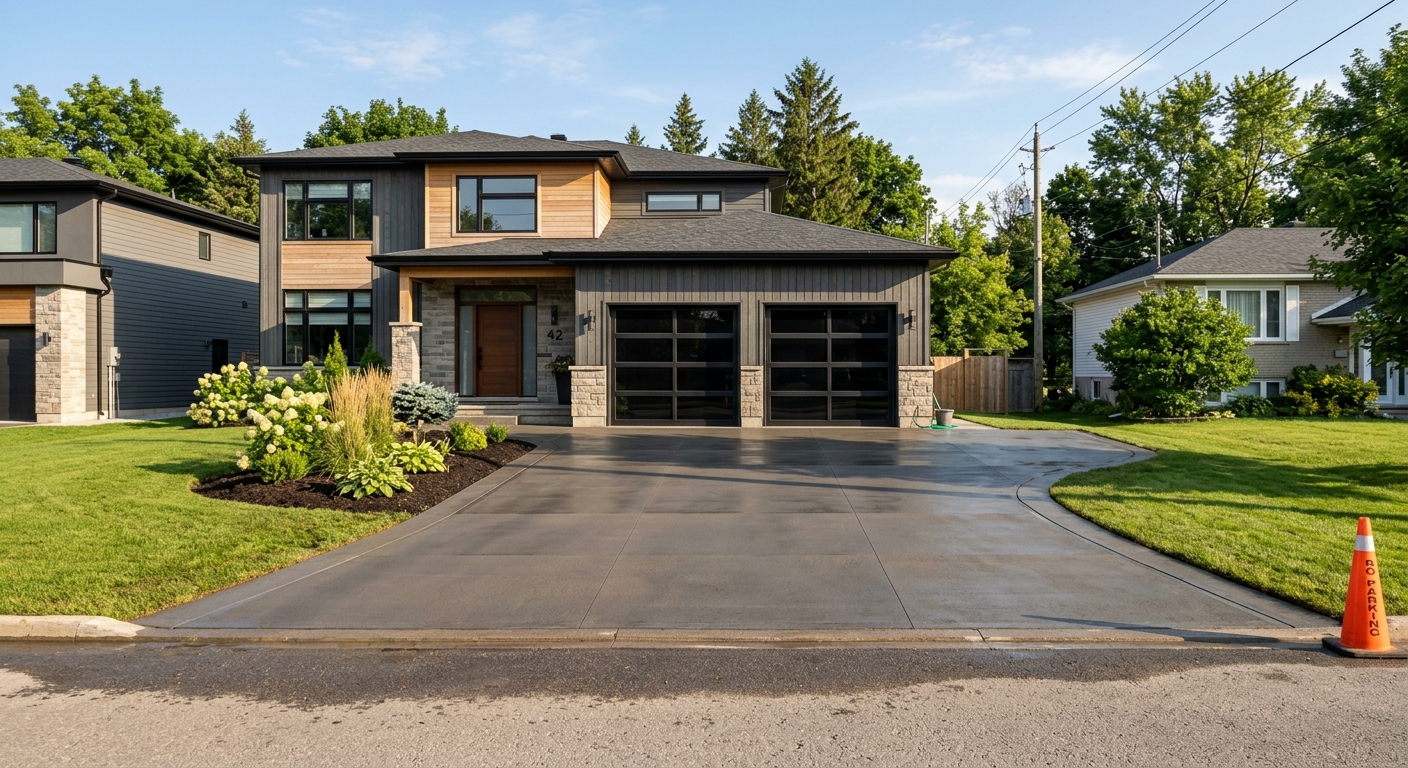
Concrete work options and costs in Grimsby
Concrete work is a common homeowner upgrade in Grimsby, especially for properties that need durable flatwork through our cold, wet Great Lakes seasons. In a community of 28,883 people (Statistics Canada, 2021 Census), most homeowners are owners—9,415 homeowner households, about 82.6% of households (Statistics Canada, 2021 Census). That mix, along with the fact that single-detached homes make up 64.4% of dwellings, is why you’ll typically see driveways, patios, and walkways demand the most attention. (In Grimsby’s established neighbourhoods, curb appeal projects often pair well with landscaping and drainage fixes.)
The Hamilton–Niagara Peninsula market shapes pricing in practical ways. Because we’re in a cold, wet corridor, local frost depth and repeated freeze-thaw cycles force contractors to design deeper excavations and require air-entrained mixes for exterior slabs. That means “same size” pours can still come in higher than expected when the site needs extra granular base, reinforcing steel, or colder-season precautions like curing blankets and heated protection. Contractors also schedule exterior work roughly May–October when temperatures and curing conditions are more reliable, which can tighten availability earlier in the season.
Demand is especially strong in areas like the West Lincoln / Casablanca Road corridor and along commuting routes near the QEW, where many homes were built before 1981 (42.2% of the housing stock, Statistics Canada, 2021 Census) and often need foundation and exterior slab repairs. With those realities in mind, here’s a realistic cost range comparison for the most requested projects in Grimsby.
| Application |
Typical Size |
Key Spec |
Finish Option |
Price Range |
| Concrete driveway (standard broom finish) |
400–600 sq. ft. |
Air-entrained concrete, compacted granular base, control joints |
Broom finish, saw-cut joints |
$6,500–$13,000 |
| Exposed aggregate driveway |
400–600 sq. ft. |
Air-entrained mix, appropriate base and curing, controlled finishing |
Exposed aggregate with surface retarder |
$8,000–$15,500 |
| Stamped concrete driveway or patio |
300–500 sq. ft. |
Reinforced slab detailing, consistent air content, proper jointing |
Stamped patterns (stone/brick look) + release agent |
$9,000–$17,500 |
| Plain concrete patio or walkway |
200–400 sq. ft. |
Air-entrained concrete, compacted base, drainage allowance |
Float + broom finish, simple saw joints |
$2,400–$7,600 |
| Garage floor (interior slab) |
300–600 sq. ft. |
Proper sub-base, fibre/wire reinforcement as specified |
Light trowel + densifier (optional) |
$4,800–$13,000 |
| Foundation footings (structural, below frost) |
Varies by plan |
Excavation to below frost, engineered rebar cage, forms |
Structural concrete with specified reinforcement |
$6,000–$18,000 |
Prices are estimates only and vary by project scope, site access and material selection.
What affects the price of concrete work in Grimsby
In Grimsby and across the Hamilton–Niagara Peninsula, the same general concrete job can swing 30–50% from one quote to the next. The reason isn’t “contractor prices being arbitrary”—it’s the way frost protection, drainage, reinforcement, and curing requirements get built into the scope. On top of that, Hamilton/Niagara contractor availability can tighten during the May–October window, pushing seasonal labour premiums and affecting scheduling.
For exterior concrete, frost line depth and freeze-thaw cycles dictate the spec. Footings and pier bases must extend below the design frost depth to prevent frost heave and cracking. That typically means deeper excavations than many homeowners expect, and it directly drives excavation/formwork costs. Likewise, flatwork (driveways, patios, walks) needs air-entrained concrete to survive repeated freeze-thaw cycles. When winter work happens or when concrete placement runs late into the season, cold-weather curing precautions—heating, insulating blankets, and longer protection—add cost. De-icing salt in our coastal-wet conditions can also accelerate surface spalling, so sealing is often recommended and sometimes included.
Two practical examples from Grimsby: (1) a driveway replacement where the existing base is soft or waterlogged often requires extra granular base and regrading before any concrete is poured, pushing the project toward the higher end of the $14–$22 per sq. ft. driveway band; (2) if you’re choosing stamped or decorative concrete (often $22–$35 per sq. ft. for stamped), the additional labour for stamping tools and careful curing consistency usually justifies the upgrade—whereas simply changing broom finish rarely does.
Finally, housing age plays a role. With 42.2% of homes built before 1981 (Statistics Canada, 2021 Census), you’ll see more original drainage patterns and older soil conditions that require more site prep. Median household income is $104,000 (Statistics Canada, 2021 Census), and many homeowners balance upgrades by choosing higher-performance base/air content first, then selecting finish style based on budget.
| Price Factor |
Why It Matters |
Cost Impact |
| Frost line depth — determines footing depth and form height |
Deeper excavation is required to prevent frost heave and structural movement |
Can add substantial formwork, trucking and labour; commonly drives footing jobs toward the higher band |
| Site preparation — excavation, grading, compacted granular base |
Proper base reduces settlement and pumping during wet freeze-thaw cycles |
Soft subgrade or limited access can raise costs by forcing additional granular and compaction time |
| Reinforcement — rebar or wire mesh requirement |
Reinforcement controls cracking in thicker slabs and supports heavier loads |
Material + install labour increases for driveways, steps, and garage slabs |
| Mix design — air-entrainment and compressive strength spec |
Air-entrained concrete improves freeze-thaw durability in exterior exposure |
Higher-performance mix is a measurable material cost, but it reduces early spalling failures |
| Finish type — broom vs. stamped vs. exposed aggregate |
Decorative finishes require additional labour, setup and careful curing |
Stamped/exposed typically adds to the $22–$35 per sq. ft. decorative range |
| Pour size and concrete truck access to site |
Smaller pours, tight driveways, or long wheelbarrow runs increase labour time |
Access constraints can increase total labour and placement time by a meaningful margin |
| Cold-weather curing precautions — heating and blankets |
Maintains strength development when temperatures drop |
Common in late-season placements; adds rental/heating/blanket costs |
| Control joint pattern and sealing cost |
Joints manage shrinkage; sealer helps repel de-icing salt-driven damage |
Improves long-term performance; adds cost but can prevent costly early surface failures |
Permits & regulations in Ontario
In Ontario, most homeowners in Grimsby don’t need to become experts in permitting—but you do need to know what work triggers municipal oversight. Structural concrete work typically requires a building permit. That includes footings, foundation walls, grade beams, and other parts of the structural foundation system. In many cases, engineered drawings are required and then reviewed as part of the permit process.
Concrete flatwork—like driveways, patios, walkways and garage slabs—usually does not require a permit if it’s simply replacement or minor addition on the yard side and doesn’t materially alter grading or drainage. However, a permit (or at least municipal approvals) can come into play if the work affects lot grading, intersects municipal right-of-way requirements, or changes impervious surface coverage/drainage direction.
Before breaking ground, homeowners should confirm the contractor is properly insured and compliant. Here’s a practical step-by-step verification you can do:
- Ask the contractor for their certificate of liability insurance (ensure it matches your project address and includes concrete work).
- Request proof of WSIB/WCB coverage for the individuals doing the work.
- Verify the contractor’s licensing/registration through the appropriate Ontario business/public registry entry (the contractor should provide the reference number).
- Confirm whether the contractor will pull any required permits and whether that cost is included or excluded in the quote.
- Get references for similar-scale work in the Hamilton–Niagara area and ask about frost-proofing and curing practices.
Getting concrete right in Grimsby's freeze-thaw climate
Concrete fails most often in Grimsby when the job is treated like “just pouring a slab.” In our cold, wet Great Lakes corridor, the main causes of early problems are inadequate base support, poor air-entrainment, and curing that’s rushed or exposed to temperature swings. The fix is to specify the system, not just the thickness.
First, base preparation matters: use a properly compacted granular sub-base to the correct depth for the local soil and frost considerations. If the base isn’t built and compacted correctly, freeze-thaw can lift and shift the slab even when the concrete “looks fine” at first.
Second, mix design: for exterior flatwork, require air-entrained concrete (commonly 5–7% air content for freeze-thaw durability) and minimum 32 MPa compressive strength. Third, control joints: the spacing and timing of joints manage shrinkage cracking so cracks don’t turn into water pathways that worsen freeze-thaw damage.
Fourth, curing: plan for a minimum 7-day curing period under proper conditions. In shoulder seasons, curing blankets and protection from rapid temperature changes help avoid surface scaling and strength losses. Fifth, sealing: apply a penetrating sealer after the cure (often around 28 days post-pour) to repel de-icing salt-driven deterioration.
When homeowners ask about value, I often compare broom-finished driveway work versus decorative options. For example, a straightforward driveway may land in the $14–$22 per sq. ft. range, while stamped decorative work can be $22–$35 per sq. ft. The dollar difference is justified when you want the look—but performance depends more on base, air content, and jointing than on whether it’s broom, stamped, or exposed aggregate. Ask contractors how they’ll prevent spalling caused by inadequate air-entrainment; that’s the technical question that protects your budget long-term.
| Spec |
Why It Matters in Grimsby |
What to Ask For |
Impact if Skipped |
| Compacted granular base (depth?) |
Reduces settlement and helps manage water during freeze-thaw cycles |
Granular base depth and compaction method (and whether any soft spots are removed) |
Premature cracking, rocking slab, and water pumping that accelerates deterioration |
| Air-entrained concrete mix (target air %?) |
Improves freeze-thaw durability for exterior exposure |
Air content target (commonly 5–7% for exterior flatwork) |
Higher risk of spalling and scaling during repeated winter cycles |
| Compressive strength (MPa rating) |
Ensures strength development and better surface durability |
Minimum 32 MPa (and whether fibres/reinforcement are added as specified) |
Weaker concrete can wear faster and crack sooner under loads |
| Control joints (spacing per ACI guidelines) |
Controls shrinkage cracking so cracks don’t become water channels |
Planned joint pattern and spacing for the slab dimensions |
Random cracking, increased water entry, and faster freeze-thaw damage |
| Minimum 7-day curing period |
Strength gain and surface stability are time- and temperature-dependent |
How curing will be managed (blankets/heating if temperatures drop) |
Surface scaling, reduced strength, and inconsistent performance |
| Penetrating sealer (when applied after cure) |
Helps protect against de-icing salt and moisture exposure |
Sealer type and timing (often after ~28 days of cure) |
More porous surface, faster wear, and greater salt-related scaling |
How to choose a concrete work contractor in Grimsby
Choosing a concrete contractor in Grimsby comes down to proof: proof they understand frost and freeze-thaw, proof they’re insured for the work, and proof their quote matches your scope. Start with licensing/coverage verification. Ask for their certificate of liability insurance (confirm the policy covers your work type and address). Then request proof of WSIB/WCB coverage for the crews on site. If they can’t provide these promptly—or they only share vague statements—walk away.
Next, get 2–3 itemised written quotes, not one-page estimates. A good quote breaks labour and materials separately (excavation, base material, reinforcement, forms, concrete supply, finishing, saw-cutting, sealing if included, and disposal). Be careful with exclusions: is demolition included, is hauling/disposal included, and does the price include any permit or engineering draw if your project touches structural work? The best contractors will clarify the scope line by line so there are no surprises.
Warranty matters too. Ask for the workmanship warranty length and what it covers (cracking from shrinkage under proper jointing, spalling, settlement issues, etc.). Also ask about product/manufacturer warranties for specific sealers or admixtures. Make sure the warranty is transferable to future owners if that’s a concern.
On payment schedule, avoid large up-front cheques. I recommend no more than 10–15% upfront, with a holdback kept until the job is fully complete and cleaned. Finally, insist on timeline details in writing: start date, estimated completion date, and what happens if weather pushes the pour window.
- Provide insurance certificate and WSIB/WCB proof before signing.
- Show similar project photos from the Hamilton–Niagara Peninsula (not just across Canada).
- Use written, itemised quotes with labour and materials separated.
- Confirm demolition, disposal, and site protection are included (or excluded).
- Ask the exact air-entrainment and strength specs for exterior slabs.
- Ask who supplies the mix and whether it’s batched for freeze-thaw durability.
- Confirm reinforcement details (wire mesh vs rebar, spacing, and coverage).
- Ask about joint pattern and timing (saw-cut vs formed joints).
- Confirm curing protection (blankets/heating in cooler months).
- Confirm sealing plan and whether it’s included or an add-on (timing after cure).
- Agree on payment schedule: small deposit, progress payments, holdback.
- Get a start date and completion estimate in writing, tied to weather contingencies.
Concrete red flags in Grimsby: (1) a contractor who can’t explain how they address frost and freeze-thaw (air content, base depth, jointing); (2) quotes that ignore reinforcement or base preparation; (3) too-low pricing that doesn’t include proper excavation/compaction; (4) no mention of curing protection or sealing in cold/wet conditions; and (5) vague warranties or no documentation of insurance/WSIB/WCB.
Frequently asked questions — concrete work in Grimsby
How long does a concrete project take in Grimsby?
In Grimsby, typical timelines depend on weather and the scope, but most homeowner pours follow a predictable rhythm. A driveway replacement or patio often takes 1–3 days of site work (demo/removal, base prep, forms) and 1 day for placing and finishing. The curing period matters more than the “pour day”: even though the surface may look solid within hours, you should plan for a minimum 7-day curing period before normal use, and longer for heavy vehicle traffic. If work runs near cooler shoulder months, crews may add curing blankets or heating, which can extend the schedule. Decorative projects like stamped concrete require careful finishing timing, so the day-of placement can be more sensitive.
What is a concrete overlay and is it suited to Grimsby?
A concrete overlay is a thin bonded layer placed over an existing concrete slab to improve appearance and reduce surface deterioration—commonly used for driveways when the base is still sound. In Grimsby’s freeze-thaw climate, overlays can work well only when the original slab is stable (no significant rocking or structural failure), and when proper surface prep is completed (grinding, cleaning, and bonding methods). If the underlying concrete is already heaving or badly cracked, an overlay may simply “cover” the problem and cracks can reappear. Because de-icing salts and moisture exposure are tough here, overlays need good sealing practices. Pricing varies widely, so if you’re deciding between replacement and overlay, ask for a breakdown and confirm whether the contractor has a plan to address drainage. If you’re targeting a plain patio or walkway, typical work can fall in the $12–$20 per sq. ft. band, but overlays can still be cost-effective when the existing base is truly in good shape.
How do I seal concrete to protect it in Grimsby?
Sealing is especially relevant in Ontario and for Grimsby driveways where winter traction compounds and de-icing salt accelerate surface scaling. The key is timing: most penetrating sealers are applied after the concrete has cured adequately—commonly around 28 days post-pour—so the surface moisture is low enough for the sealer to bond. Before sealing, the slab should be clean and dry; follow the manufacturer’s prep steps (some require light cleaning or acid wash alternatives). Choose a penetrating sealer designed for exterior freeze-thaw exposure rather than just a surface film. Also, don’t rely on sealing alone—specifying air-entrained concrete, correct joint spacing, and a well-compacted granular base are what prevent the deeper freeze-thaw damage that leads to spalling. If you’re getting a quote, ask whether sealing is included and what product is being used, and whether the contractor will come back after cure to apply it.
What is the difference between concrete and cement?
In everyday talk people say “cement,” but for a concrete driveway in Grimsby the material is typically concrete—a blend of cement, water, sand, and gravel (plus air-entraining admixtures when needed). Cement is only one ingredient; it’s the binder that reacts with water and hardens. Concrete is the full composite. For freeze-thaw durability on exterior slabs, contractors specify a mix design that includes air-entrainment (to reduce damage during repeated freezing and thawing), plus a target compressive strength (often minimum 32 MPa for typical exterior specs). That’s why you should ask your contractor for the mix properties rather than focusing only on “cement brand.” Decorative and decorative stamped work (commonly in the $22–$35 per sq. ft. range) also depends on the concrete being right for finishing and curing—not just on the stamp pattern.
How much does concrete work cost in Grimsby?
Concrete pricing in Grimsby varies based on finish, site prep, reinforcement, and whether cold-weather protections are needed. As a rule of thumb for flatwork, driveway and slab costs commonly reference the $14–$22 per sq. ft. range, while stamped/decorative work often lands in the $22–$35 per sq. ft. band. For patios and walkways, plain concrete typically trends around $12–$20 per sq. ft. Total project pricing also changes with how much excavation and granular base is required; older homes and sites with drainage issues often need more prep. As an example, a standard broom-finished driveway might be estimated in the lower-to-mid range of the driveway band if access is straightforward and the base is good, while stamped concrete on a similar footprint usually moves toward the higher decorative range because of extra labour and finishing time. Always request an itemised quote so you can see what’s driving the difference—materials, labour, reinforcement, sealing, and disposal.
How deep must footings be for Grimsby's frost line?
In Ontario, footing depth is driven by frost protection requirements, and the goal is to place footings below the design frost depth so the foundation isn’t pushed by freeze-thaw heave. In practice, that typically means footings are commonly designed around 4 ft or deeper (depending on the engineering design and soil conditions), especially for exterior structural supports. Because local soil drainage and moisture exposure matter, your footing depth can vary by lot conditions and the engineered foundation plan. If you’re building or doing structural foundation work in Grimsby, don’t guess—ask for the engineered drawing or permit documents that show the required footing embedment and reinforcement details. Flatwork like patios and driveways doesn’t use the same “below frost” design logic as structural foundations, but it still requires air-entrained concrete and proper granular base compaction to handle freeze-thaw cycles and water movement.