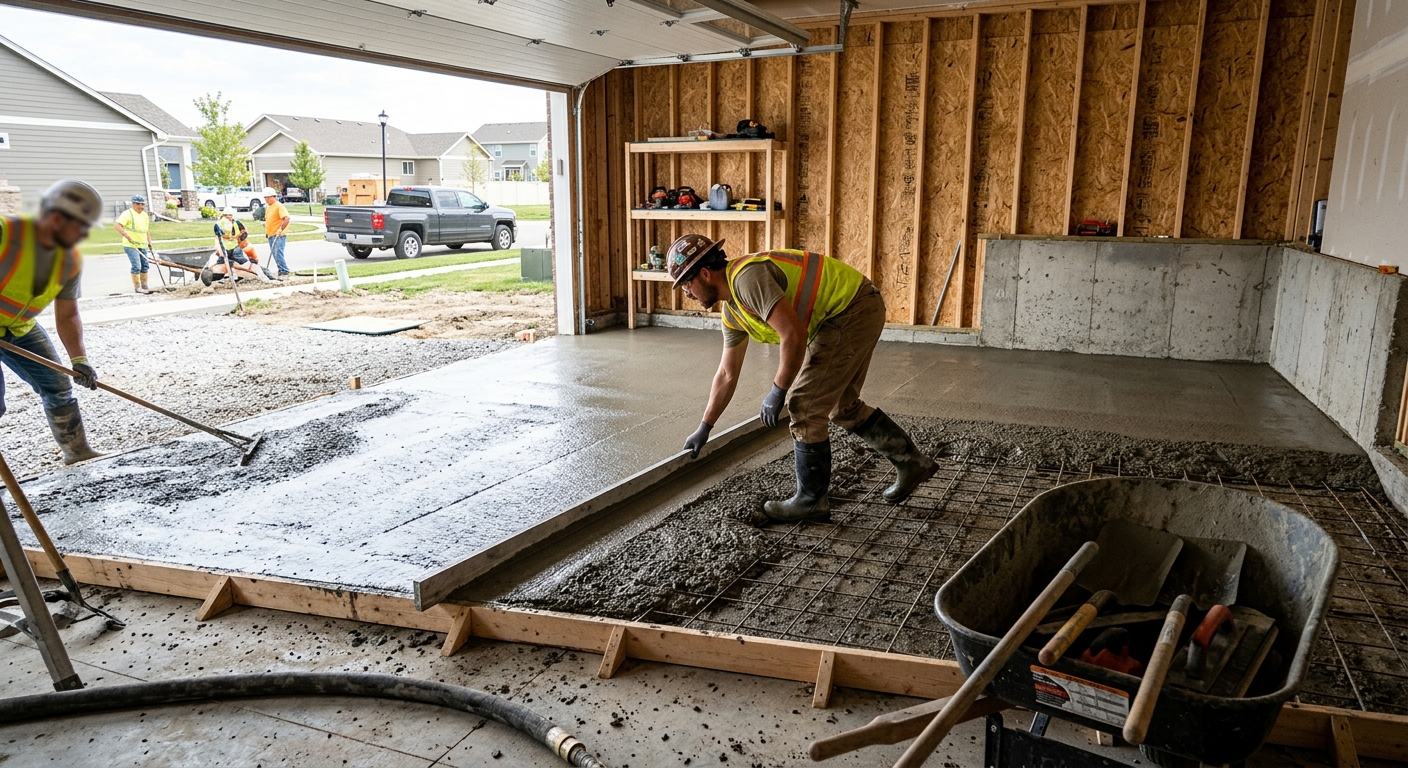
Concrete work options and costs in Pickering
Pickering homeowners typically start shopping for concrete when they want a durable driveway, a clean patio, or tidy walkways that handle Toronto-area freeze–thaw every winter. In Pickering, with 59.6% of dwellings being single-detached homes (Statistics Canada, 2021 Census), it’s a steady market for exterior concrete flatwork—especially around long driveways, side-yard access, and backyard patios. And with 31.2% of homes built before 1981 (Statistics Canada, 2021 Census), many projects are upgrades where drainage, base thickness, and slab detailing need a second look, not just a surface “overlay” mindset.
In the Toronto economic region, costs are shaped by frost depth and repeated freeze–thaw cycles. Local requirements for structural footings generally need to extend about 1.2 m (roughly 4 ft) below grade to reduce frost heave and differential movement, and contractors plan exterior slabs with air-entrained concrete, proper base prep, and control joints. The pour season is also shorter than in milder areas: contractors concentrate exterior placements in warmer months and use curing protection when temperatures fall near 10 °C or below. That means scheduling and labour availability can affect price as much as material selection—particularly for decorative work and larger truck-access sites.
You’ll often see the highest demand in growing pockets such as West Shore–like residential areas and the older established neighbourhoods around the Pickering Village corridor, where homeowners are both replacing aging flatwork and adding curb appeal. Use the comparison below to ballpark your options, then we’ll break down exactly which site details swing quotes up or down.
| Application |
Typical Size |
Key Spec |
Finish Option |
Price Range |
| Concrete driveway (standard broom finish) |
400–600 sq. ft. |
Air-entrained mix; compacted granular base; control joints |
Broom finish |
$18,000–$28,000 |
| Exposed aggregate driveway |
400–600 sq. ft. |
Air-entrained mix; proper retarder timing; good base and drainage |
Exposed aggregate |
$22,000–$34,000 |
| Stamped concrete driveway or patio |
300–500 sq. ft. |
Air-entrained mix; reinforced base as required; joint pattern planning |
Stamp + colour hardener (or integral colour) |
$24,000–$40,000 |
| Plain concrete patio or walkway |
150–300 sq. ft. |
Compacted granular base; air-entrained mix; sealed edges |
Broom or light trowel |
$16,000–$26,000 |
| Garage floor (interior slab) |
400–600 sq. ft. |
Vapour barrier as needed; perimeter insulation optional; joints/finishing |
Float + burnish/light broom |
$7,000–$12,000 |
| Foundation footings (structural, below frost) |
Per typical footing wall run |
Engineered footing size/steel; placed below frost depth |
Structural concrete (no decorative finish) |
$180–$300 |
Prices are estimates only and vary by project scope, site access and material selection.
What affects the price of concrete work in Pickering
In Pickering and across the Toronto economic region, it’s common to see quotes for the “same” concrete project swing by 30–50%. The difference usually isn’t the concrete itself—it’s the engineering-level details contractors include (or skip): base thickness and compaction, drainage design, air-entrainment and strength specs, reinforcement, and the joint/seal plan that protects your slab through freeze–thaw.
Frost depth and freeze–thaw cycles dictate nearly every structural and exterior detail. For Ontario, most structural footings need to extend below design frost depth—often around 1.2 m in typical practice—to prevent frost heave and differential movement. Exterior flatwork in the GTA is also specified with air-entrained concrete to survive repeated freezing and thawing. When temps drop toward 10 °C or below, contractors must manage curing with protection (insulating blankets, wind breaks, and sometimes added heat for larger pours), which adds labour and rental costs. De-icing salts then accelerate surface spalling if the mix and curing weren’t done correctly—so sealing becomes a cost-effective safeguard.
Two concrete examples show why local conditions matter. First, a driveway replacement on a sloped or poorly drained lot may require deeper excavation and regrading, pushing you toward the upper end of the $18,000–$28,000 driveway range because granular base and drainage components take time. Second, a backyard walkway built over heavy clay often needs better base prep; that can reduce settlement-related cracking, even if it modestly increases the upfront cost compared with a “thin” install.
Finally, housing stock affects scope: with 31.2% of Pickering homes built before 1981 (Statistics Canada, 2021 Census), it’s common to find older drainage patterns and settled slabs, meaning demolition, disposal, and sometimes curb/edge work are bundled into the price. Those site realities are exactly why itemised estimates matter.
| Price Factor |
Why It Matters |
Cost Impact |
| Frost line depth — determines footing depth and form height |
Footings must extend below design frost to reduce heave and movement |
Major cost driver; more excavation and concrete volume |
| Site preparation — excavation, grading, compacted granular base |
Proper base reduces settlement and voids that lead to cracking |
Moderate to major; varies with soil and required regrading |
| Reinforcement — rebar or wire mesh requirement |
Supports loads and helps manage cracking over time |
Moderate; material and labour add up on larger slabs |
| Mix design — air-entrainment and compressive strength spec |
Air entrainment improves freeze–thaw durability in GTA winters |
Small to moderate; prevents early spalling and failures |
| Finish type — broom vs. stamped vs. exposed aggregate |
Decorative systems require extra steps, timing, and materials |
Moderate; typically shifts you into the higher price band |
| Pour size and concrete truck access to site |
Access limits may require pumping or smaller batches |
Moderate; affects labour efficiency and schedule |
| Cold-weather curing precautions — heating and blankets |
Protects strength gain when temperatures drop |
Moderate; can add rental and labour hours |
| Control joint pattern and sealing cost |
Joints guide cracking and sealing helps repel de-icing salt attack |
Small to moderate; often worthwhile for exterior durability |
Permits & regulations in Ontario
In Ontario, how permits work depends on what you’re building. Structural concrete work—such as foundation footings, foundation walls, and grade beams—generally requires a building permit, and municipalities often expect engineered drawings reviewed before the work proceeds. If you’re doing a basement underpinning, adding a new foundation element, or making changes that affect load paths, you should assume a permit and engineering package will be required.
Concrete flatwork like driveways, patios, and walkways usually does not require a permit on its own in Pickering. However, it can become permit-relevant if your project affects lot grading, stormwater drainage, or impervious surface coverage, or if the work touches municipal property/right-of-way requirements. When in doubt, confirm with the local authority before breaking ground.
Step-by-step for homeowners in Pickering: (1) ask the contractor for their Ontario business licence details and confirm their trade/contractor status through available online registry sources; (2) request a certificate of liability insurance showing adequate coverage for concrete operations and name your property/owner as required; (3) verify they have WSIB coverage (or the correct coverage documentation under Ontario’s framework) before work starts; (4) ask for recent photos and references for similar slab/driveway projects with comparable access conditions; and (5) get everything in writing, including whether demolition, disposal, and any permit support are included.
Getting concrete right in Pickering's freeze-thaw climate
Concrete failures in Pickering almost always connect back to freeze–thaw stress, moisture movement, and inadequate base or curing. To spec the job correctly, start from the ground up: base preparation must include a properly compacted granular sub-base to the right depth for local soil conditions and frost considerations. If water collects under a slab, it can expand and contract against the concrete each winter, leading to rocking, settlement, and cracking.
Next is mix design. For exterior flatwork in the GTA, contractors should use air-entrained concrete (typically around 5–7% air content) and a minimum 32 MPa compressive strength spec appropriate for the intended use. Air entrainment is what helps the concrete tolerate repeated freezing; it’s one of the biggest defences against spalling when de-icing salts are present.
Then handle control joints so cracking happens where it’s planned. On patios, walkways, and driveways, joint spacing should limit random cracking and reduce the chance of water intrusion. Curing is also critical: plan for at least 7 days of proper curing conditions, and for late-season work, protection becomes a cost add-on that prevents weak early-age concrete. Finally, sealing with a penetrating sealer after the slab has fully cured—commonly around 28 days—helps repel moisture and de-icing salt impact.
For a budget reality check: choosing standard broom-finish instead of stamped can keep many projects closer to the $16,000–$26,000 patio/walkway band, while decorative options typically push higher—often into the $24,000–$40,000 range—yet the durability still depends on the base, air content, and joint/seal plan. In Pickering, paying a bit more for correct prep usually beats paying later for repairs.
| Spec |
Why It Matters in Pickering |
What to Ask For |
Impact if Skipped |
| Compacted granular base (depth?) |
Stable base reduces settlement and helps manage freeze–thaw moisture movement |
Base depth and compaction method (and whether drainage is improved) |
Rocking, uneven cracking, premature failure |
| Air-entrained concrete mix (target air %?) |
Air voids protect against freeze–thaw damage and spalling from salts |
Air-entrainment target (commonly 5–7% for exterior flatwork) |
Surface scaling/spalling within a few seasons |
| Compressive strength (MPa rating) |
Strength gain supports durability through winter loads and thermal cycling |
Minimum 32 MPa spec for the slab application |
Lower long-term performance and cracking risk |
| Control joints (spacing per ACI guidelines) |
Joints control where cracks form as the slab shrinks/expands |
Joint layout drawings or spacing plan before pour |
Random cracking and water getting into slab edges |
| Minimum 7-day curing period |
Proper curing is essential for strength development in GTA temperature swings |
Curing plan and protection for cooler days |
Weak concrete that chips and spalls faster |
| Penetrating sealer (when applied after cure) |
Repels moisture and reduces salt-related surface degradation |
Penetrating sealer timing (commonly ~28 days post-pour) |
Higher risk of deterioration from de-icing salts |
How to choose a concrete work contractor in Pickering
For concrete work in Pickering, start by verifying the right credentials—not just the price. Ask for proof of Ontario licensing/registration applicable to their trade, plus a current certificate of liability insurance that covers on-site work (including property protection). Confirm WSIB coverage (or the required Ontario coverage documentation) before any work begins. Don’t accept “we’ll cover it” verbally; request documentation and check dates.
Next, request 2–3 itemised written quotes with a labour and materials breakdown, not only a lump sum. You want lines for excavation/demolition, granular base, reinforcement, concrete supply, finishing, joints, curing protection (if needed), and sealing (for exterior). Carefully read what’s excluded: disposal, traffic control, protection of landscaping, cutting/demolition limits, and whether a permit application or grading adjustments are included.
For warranty, separate workmanship from product/manufacturer where applicable. Ask: how many years for workmanship, is the concrete sealer covered, and is any warranty transferable to future owners? Payment schedule matters too: never pay more than 10–15% upfront; hold back until you see the base prep, finishing, jointing, and cleanup are complete.
Finally, timelines should be written. Ask for a start date and a concrete-completion estimate, and discuss weather contingencies—Toronto-area crews often plan pours in warmer months and use curing protection when temperatures fall.
- Ask for a written scope that includes demolition limits and disposal charges
- Confirm the slab thickness and granular base depth (not just “good base”)
- Require the mix spec: air-entrainment and target compressive strength
- Get joint spacing and layout documented before the pour
- Verify whether reinforcement (rebar or mesh) is included for your use
- Confirm curing protection for cool nights and wind during finishing
- Ask if sealing is included and when it will be applied (typically after cure)
- Look for experience with your site constraints (side gates, slope, tree roots)
- Request references for projects of similar size and finish (broom vs stamped)
- Check insurance coverage limits and coverage dates on the certificate
- Confirm WSIB coverage documentation is current before work starts
- Ensure contract includes a clear warranty and what actions are covered if defects appear
Red flags in Pickering: a contractor who won’t discuss air-entrained mix or curing; quotes that are substantially lower because they omit base depth/compaction; refusing to provide insurance/WSIB documentation; vague scope language like “concrete as needed” without thickness or reinforcement; and asking for large upfront payments (well above 10–15%) before forms are set and prep work is verified.
Frequently asked questions — concrete work in Pickering
When is the best time to pour concrete in Pickering?
In Pickering, the best time for most exterior flatwork (driveways, patios, walkways) is late spring through early fall when daytime temperatures stay consistent and curing temperatures are easier to maintain. Toronto-area contractors typically schedule pours to avoid prolonged periods near 10 °C or lower, because cold weather can slow strength gain. That said, good contractors can still pour later in the season if they plan curing protection (insulating blankets, wind breaks, and monitored curing) and document it in the schedule. If your project involves footings or foundation-related concrete, timing matters too, but the permit/engineering steps generally drive the calendar more than decorative finish does. For planning, ask for a written weather contingency and curing plan before you sign.
How long does concrete take to cure?
Concrete curing has two parts: strength gain and surface readiness. For most typical homeowner timelines in Ontario, contractors target at least a 7-day curing period under proper conditions before treating the slab as serviceable for light use, while full strength development continues much longer. Exterior work in Pickering—especially where de-icing salts are used—benefits from waiting until the concrete is fully cured before applying protective coatings. For example, penetrating sealer is commonly applied around 28 days after the pour so moisture and salts are less likely to drive into the surface. If you’re hearing “it’s hard tomorrow,” that’s a red flag. Ask how they protect the slab during curing and what your recommended waiting period is for vehicle traffic.
Do I need a permit for concrete work in Ontario?
In Ontario, it depends on what you’re building. Structural concrete work such as foundation footings, foundation walls, and grade beams generally requires a building permit, and engineered drawings are often reviewed by the municipality. Concrete flatwork like driveways, patios, and walkways usually does not require a permit by itself, but you should confirm if your project affects lot grading, stormwater drainage, or municipal/right-of-way rules around your property. In Pickering, older homes (31.2% built before 1981, Statistics Canada, 2021 Census) sometimes have drainage issues that trigger additional scrutiny. Always ask your contractor whether they’re pulling any permits and, if applicable, provide proof of insurance and WSIB coverage before work begins.
Concrete vs pavers for a patio in Pickering?
For many Pickering patios, concrete and pavers can both work well, but they fail differently in freeze–thaw climates. Concrete patios depend heavily on base preparation, proper air-entrainment, and control joints; when done right, a plain patio near the $16,000–$26,000 band can look sharp and stay solid for years. Pavers are more forgiving for minor ground movement because individual units can shift, but the long-term performance depends on strict base compaction and joint sand maintenance. Decorative stamped concrete can jump toward the $24,000–$40,000 range and offers a uniform look without separating stones, but you still need proper joints and sealing. Choose based on your priorities: uniform finish and monolithic durability vs. flexibility and easier localized repairs.
How long does a concrete driveway last?
In Pickering’s freeze–thaw environment, a well-installed concrete driveway often lasts decades, but “how long” hinges on what’s underneath it. The big determinants are base compaction, drainage so water doesn’t sit under the slab, air-entrained concrete mix, and a joint/seal plan that reduces salt-driven surface damage. If a driveway was poured on weak base or without proper air content, you can see spalling and cracking much sooner than expected. On the other hand, when contractors follow GTA best practice, many homeowners plan replacements only after significant wear—often long after the initial pour. If you’re budgeting, compare like-for-like quotes. Even within the local driveway pricing band of $18,000–$28,000, a higher spec (better base, reinforcement where needed, sealing) can be the difference between 10 years and 25+ years.
What is air-entrained concrete and why does it matter here?
Air-entrained concrete is mixed with tiny, evenly distributed air bubbles designed to give freezing water room to expand without breaking the concrete. In Pickering and the wider Toronto area, that matters because exterior slabs face repeated freeze–thaw cycles and often encounter moisture plus de-icing salt in winter. Without air entrainment, concrete can develop surface scaling and spalling—especially around edges and areas exposed to salt spray. That’s why GTA concrete contractors commonly specify air-entrained mixes for driveways, patios, and walkways, and why a “cheap” quote sometimes fails to include the correct mix design. For your project, ask for the target air content (often about 5–7% for exterior flatwork) and confirm that curing protection and control joints are included as well.