Concrete work options and costs in Hintonburg
In Hintonburg, concrete work is a year-round conversation for homeowners because our driveways, patios, and walkways have to survive Toronto’s freeze–thaw swings. With a 2021 population of 7,844 (Statistics Canada, 2021 Census), the neighbourhood’s steady housing demand supports a busy—though schedule-constrained—concrete trade, especially around the heavier residential pockets near Wellington Street West and the Hintonburg community area. Most concrete flatwork goes on homes that are typically long-lived and weather-exposed, and that’s why contractors prioritize the details that prevent frost-related movement and winter damage.
In the Toronto economic region, costs are strongly influenced by frost depth requirements and contractor availability during the short, practical pour season. Structural footings and foundations generally need to extend at least 1.2 m below grade to reduce frost heave and differential settlement, and exterior slabs usually require air-entrained mixes for durability through repeated cycles. You’ll also see premiums in colder months when contractors need cold-weather curing protection (insulating blankets or temporary heat) to keep concrete on track to gain strength.
To help you compare options, the table below lists common Hintonburg applications with typical sizing and the specs that drive pricing—so you can line up apples-to-apples when you request quotes.
| Application |
Typical Size |
Key Spec |
Finish Option |
Price Range |
| Concrete driveway (standard broom finish) |
400–500 sq. ft. |
Air-entrained mix; compacted granular base; control joints |
Broom finish; sealant recommended |
$18,000–$28,000 |
| Exposed aggregate driveway |
400–500 sq. ft. |
Air-entrained mix; proper mix design for clean stone exposure |
Exposed aggregate; often more time for finishing |
$22,000–$34,000 |
| Stamped concrete driveway or patio |
300–450 sq. ft. |
Air-entrained mix; thicker slab profile to support stamping |
Stamped pattern; release agent and colour system |
$24,000–$40,000 |
| Plain concrete patio or walkway |
150–250 sq. ft. |
Air-entrained mix; drainage slope; control joints |
Float/ broom finish; simple edge forms |
$16,000–$26,000 |
| Garage floor (interior slab) |
450–650 sq. ft. |
Vapour barrier; reinforcement as required; thicker slab if heavy use |
Steel-trowel or broom; basic curing |
$14,000–$26,000 |
| Foundation footings (structural, below frost) |
Varies by house footprint |
Structural concrete and reinforcing; forms and excavation to design depth |
Engineered spec; interior finish is typically not included |
$180–$300 |
Prices are estimates only and vary by project scope, site access and material selection.
What affects the price of concrete work in Hintonburg
In Hintonburg and across the Toronto economic region, it’s common to see quotes for the “same” concrete job vary by 30–50%. That difference usually comes down to how each contractor handles the non-negotiables: base prep, reinforcement, mix design for freeze–thaw, and the finishing/control-joint details that determine whether concrete performs for years or starts to spall and crack early. Labour rates and scheduling also affect pricing—concrete crews can be fully booked during the best pour windows, and rush work often costs more.
Frost depth and freeze–thaw cycles dictate every structural decision in Ontario: footings must extend below the design frost depth to prevent frost heave and differential movement, and exterior slabs need air-entrained concrete mixes to survive winter expansion/contraction. In colder seasons, contractors may need cold-weather curing precautions—heating, insulating blankets, and longer protection periods—which increases labour time and materials. Finally, de-icing salt accelerates surface wear; sealing isn’t a “nice-to-have” in Hintonburg if you want to slow down spalling and water intrusion.
In practical Hintonburg terms, costs rise when excavation is deeper or access is tight (narrow driveways, mature trees, or limited truck staging), because excavation and formwork take longer. Costs can also drop when your soil is stable and drainage is straightforward, letting the contractor achieve a properly compacted granular base without extra undercutting. As a simple guide, a basic plain patio often lands closer to the $16,000–$26,000 band, while stamped systems—materials plus careful placement—usually sit higher in the $24,000–$40,000 range for similar sq. ft.
Home age matters too. Many Hintonburg properties have older grading patterns or mature landscaping, which can require additional drainage corrections; even a few extra feet of regrading and sub-drain work can shift a project by thousands.
| Price Factor |
Why It Matters |
Cost Impact |
| Frost line depth — determines footing depth and form height |
Lower footings reduce frost heave risk under exterior and foundation elements |
Higher excavation and forming; can raise structural cost substantially |
| Site preparation — excavation, grading, compacted granular base |
Concrete is only as stable as the compacted base beneath it |
Extra trucking, hauling, and time increase labour and material costs |
| Reinforcement — rebar or wire mesh requirement |
Controls cracking and supports load, especially for thicker exterior slabs and garage floors |
Adds materials and labour for proper placement and cover |
| Mix design — air-entrainment and compressive strength spec |
Air-entrainment is key for freeze–thaw durability in Ontario winters |
May cost more than basic mixes, but reduces early failure and repairs |
| Finish type — broom vs. stamped vs. exposed aggregate |
Finishes add steps, equipment, and labour time |
Stamped and exposed finishes typically cost more than broom-finished concrete |
| Pour size and concrete truck access to site |
Long pours and awkward access increase pump time or require more staging |
Access issues can add pump labour, waiting time, and rework risk |
| Cold-weather curing precautions — heating and blankets |
Proper early strength gain protects concrete as temperatures drop |
Cold-season protection can add several hundred to over a thousand dollars depending on scope |
| Control joint pattern and sealing cost |
Joints manage shrinkage cracking; sealing helps repel salt and water |
More joints and proper sealing add cost, but reduce maintenance |
Permits & regulations in Ontario
In Ontario, structural concrete work—things that form part of a building’s structural system—normally requires a building permit. That includes concrete footings, foundation walls, and grade beams, and it’s commonly supported by engineered drawings that the municipality reviews through the permit process. If your scope involves underpinning, altering foundation elements, or any work that could change loads or support conditions, treat it as permit-required and plan for inspection steps.
Concrete flatwork (patios, walkways, and driveways) usually does not require a permit by itself, but it can if it affects lot grading, drainage, or impervious surface coverage limits, or if it changes municipal right-of-way conditions (for example, where a new driveway apron or curb cut is involved). When in doubt, confirm with the local authority before excavation.
For contractor compliance in Hintonburg, verify three things before signing: (1) Ontario licensing/authorization where applicable to the trade, (2) liability insurance, and (3) WSIB/WCB clearance for workers. Step-by-step: first, ask the contractor for their certificate of insurance and have the coverage expiry date match the project schedule; second, confirm WSIB/WCB status by requesting a clearance letter or reference number they can validate; third, check their standing through the appropriate online registries and ensure the company name matches your quote and contract.
Finally, request references from similar concrete scopes—especially exterior flatwork in freeze–thaw conditions—so you know they’ve handled base prep, air-entrainment, and finishing properly the first time.
Getting concrete right in Hintonburg's freeze-thaw climate
Concrete failures in Hintonburg are usually preventable, and most come from the same chain: weak or poorly compacted base, inadequate air-entrainment, and joints/sealing that don’t manage winter water and de-icing salt exposure. In the Toronto market, the goal is to spec a system that stays stable under freeze–thaw cycles: build a proper compacted granular base to the right depth for local soil and design frost considerations, then place the right mix and finishing details so the slab can tolerate expansion and contraction.
Start with base preparation. The contractor should excavate to achieve a solid sub-base and compact it in lifts, ensuring drainage falls away from the slab so saturated soils don’t expand and push against concrete. Next is mix design: for exterior flatwork in Ontario, an air-entrained mix with 5–7% air content and a minimum 32 MPa compressive strength is the common performance target for freeze–thaw durability. Then control joints: you want a planned joint layout to limit random cracking, followed by proper curing. Plan for at least 7 days of curing under favourable conditions; when temperatures dip toward about 10 °C or below, curing protection (blankets/heat) becomes part of the spec and the cost.
Sealing is the final layer of defence—apply a penetrating sealer after the concrete has cured (commonly around 28 days) to repel meltwater and reduce salt-driven surface breakdown.
A quick pricing reality check: if one quote offers only the “lowest” broom-finish price but cuts corners on base depth, air-entrainment, or joints, you may save a few thousand upfront and then lose it to early repair. For example, moving from a basic patio approach closer to the $16,000–$26,000 band to a more robust exterior spec (still plain, but correctly detailed) can be worth it when the difference is smaller than the cost of resurfacing later.
| Spec |
Why It Matters in Hintonburg |
What to Ask For |
Impact if Skipped |
| Compacted granular base (depth?) |
Provides stability and drainage so soils don’t pump against the slab during freeze–thaw |
Base thickness and compaction method; confirmation it’s built to subgrade conditions |
Settlement, cracking, and early failure; higher likelihood of uneven slabs |
| Air-entrained concrete mix (target air %?) |
Air voids help concrete resist freezing water expansion |
Target air content typically 5–7% for exterior flatwork |
Spalling and scaling, especially after winters with de-icing salts |
| Compressive strength (MPa rating) |
Strength gain supports durability and surface wear |
Minimum 32 MPa compressive strength spec (and curing plan) |
Higher risk of cracking, surface breakdown, and reduced service life |
| Control joints (spacing per ACI guidelines) |
Controls where cracks happen instead of allowing random cracking |
Joint spacing and layout plan for your slab dimensions |
Random cracking and difficult-to-seal joints that admit water |
| Minimum 7-day curing period |
Early strength is essential before exposure to moisture and freeze–thaw cycles |
Confirm curing method and protection if temps drop |
Surface weakness leading to premature spalling and deterioration |
| Penetrating sealer (when applied after cure) |
Repels water and reduces salt penetration into the concrete matrix |
Penetrating sealer after cure (commonly around 28 days) |
Faster salt damage, higher maintenance, and reduced long-term durability |
How to choose a concrete work contractor in Hintonburg
Choosing a concrete contractor in Hintonburg is mostly about verification and clarity. In Ontario, first confirm licensing/authorization where required for the work type, then check liability insurance and WSIB/WCB coverage so you’re not exposed if something goes wrong. How to check: request a certificate of insurance showing active general liability coverage for the contractor and the applicable project period; ask for a WSIB/WCB clearance letter or a verification number the company can validate. Ensure the certificate lists the correct business name that will appear on the contract.
Next, get 2–3 itemised written quotes. You want a breakdown that separates excavation/site prep, granular base and compacting, reinforcement, concrete supply and mix spec, forming, finishing, joints, and sealing. Avoid “lump sum only” quotes unless they clearly reference drawings and specs. Also read exclusions: is debris removal included? Is disposal/haul-away included? Is the permit pull included where required for structural concrete? If not, find out what you must do and the expected timeline.
Warranty matters too. Ask for a workmanship warranty length, and separate that from any manufacturer product warranty. Confirm whether the warranty is transferable if you sell the home.
Payment schedule: never pay more than 10–15% upfront. Keep a holdback until the final walk-through and completion items (sealing where included, joint cut confirmation, site cleanup) are done. Finally, ask for a written start date and completion estimate—concrete timelines depend on curing conditions, deliveries, and weather protection planning.
- Confirm insurance certificate is current and matches the contractor’s legal name.
- Request WSIB/WCB clearance letter (or verification number) before any work starts.
- Ask whether the quote includes permits for structural concrete work.
- Require an itemised breakdown (base, reinforcement, concrete mix, labour, finishing, sealing).
- Confirm exterior air-entrainment and minimum strength are included for freeze–thaw durability.
- Check that control joints and sealing are specified—not “optional” after the fact.
- Ask how they handle cold-weather curing if temperatures drop mid-project.
- Verify disposal/haul-away and protection of landscaping are included.
- Look for clear scope drawings or measurements (sq. ft., thickness assumptions, joint layout).
- Ensure the quote includes site access/pumping details if your driveway is tight.
- Confirm warranty terms are in writing and specify workmanship vs product.
- Agree on payment milestones with a holdback until final acceptance.
In Hintonburg, red flags include: quotes that omit base thickness/compaction details, promises to “pour in any weather” without curing protection, no mention of air-entrained concrete for exterior slabs, vague scope language with no joint layout, and schedules that don’t align with concrete curing needs (minimum 7 days) for freeze–thaw exposure.
Frequently asked questions — concrete work in Hintonburg
Stamped vs broom-finish concrete — cost difference?
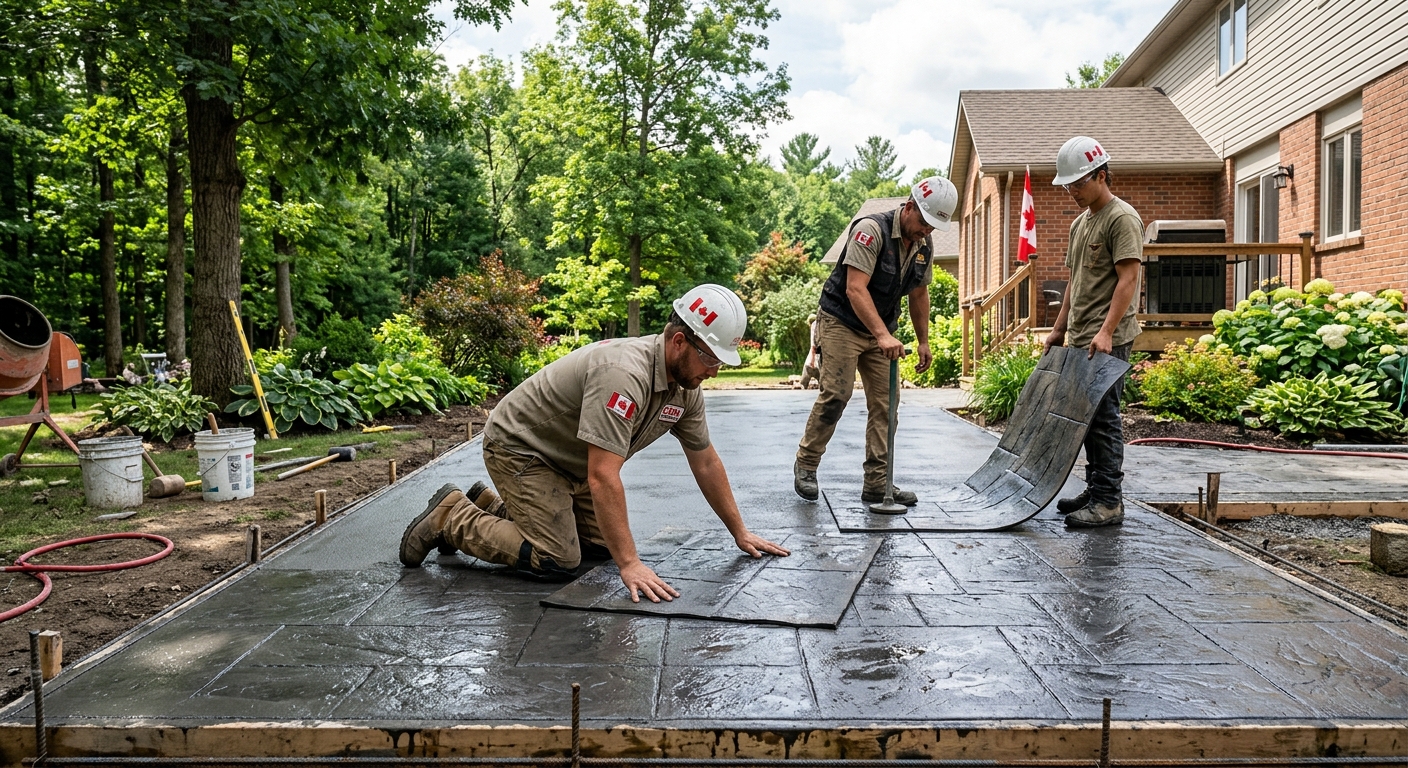
In Hintonburg (and throughout the Toronto region), stamped concrete typically costs more than broom-finish because it adds extra steps: specialty forms/tools, release agents, colouring, and careful timing to ensure the pattern matches your joints and slab edges. For a driveway or patio, broom-finished work often aligns with the lower end of the flatwork bands, while stamped options commonly land in the stamped range of $24,000–$40,000 depending on size, thickness, and how complex the pattern is. If the underlying slab design is the same—proper air-entrained mix and base prep—your biggest cost driver is the finish system and labour time, not “just the look.” When you compare quotes, insist that both options include air-entrainment and control joints, otherwise the cheaper broom quote may not be apples-to-apples in freeze–thaw durability.
When is the best time to pour concrete in Hintonburg?
For Hintonburg, the best window is late spring through early fall when temperatures stay consistently high enough for proper curing. In the Toronto economic region, contractors prefer exterior pours during warmer months because concrete needs time to gain strength and develop surface durability before freeze–thaw cycles arrive. If you’re pouring near the shoulder seasons, the contractor should plan cold-weather protection if temperatures drop toward about 10 °C or below—blankets, insulation, and sometimes heat—so curing isn’t compromised. That protection is usually a cost add, but it’s cheaper than early failure. If you’re aiming for a plain patio or walkway, you may see better availability in warmer weeks. For stamped concrete, crews often prefer stable conditions because timing affects pattern quality and colour release.
How long does concrete take to cure?
Concrete curing happens in stages. For exterior flatwork in Ontario, a practical target is at least 7 days of curing before you treat the slab as “ready” for regular exposure, but full performance develops over longer time. You’ll often hear that 28 days is when concrete reaches a more complete level of strength and when it’s safe to apply a penetrating sealer. That seal timing matters in Hintonburg because de-icing salts and meltwater accelerate surface wear during freeze–thaw cycles. If the contractor plans a cold-weather pour, curing may need extended protection to ensure the concrete gains strength reliably. When comparing quotes, look for explicit curing steps—not just a pouring date—especially if your project is scheduled for early spring or late fall.
Do I need a permit for concrete work in Ontario?
In Ontario, structural concrete typically requires a permit. That includes items like footings, foundation walls, and grade beams—work that affects the building’s structural system. Concrete flatwork such as patios, walkways, and driveways usually doesn’t need a permit by itself, but it can if it impacts lot grading, drainage, impervious surface limits, or if municipal right-of-way conditions are affected. For homeowners in Hintonburg, the safe approach is to confirm with the local authority before breaking ground, especially if you’re changing elevations, adding drains, or modifying where water flows from your home. Also verify your contractor’s compliance: ask for liability insurance documentation and WSIB/WCB clearance, because those aren’t optional extras when structural work or heavier excavation is involved.
Concrete vs pavers for a patio in Hintonburg?
Concrete and pavers both work well in Hintonburg, but they’re suited to different priorities. Concrete is often more cost-effective for larger continuous areas when properly built with air-entrainment, good drainage, and a joint plan; your budget typically falls within the patio/walkway flatwork bands, commonly around $16,000–$26,000 for a typical project size depending on thickness and site conditions. Pavers can be easier to repair locally—individual stones can be replaced—but the base prep and compaction must still be engineered well to avoid settlement during freeze–thaw. If you expect future landscaping changes or want more design flexibility, pavers can be attractive. If you want a seamless surface and lower maintenance, plain concrete is often the better choice, as long as it’s sealed properly after curing to reduce salt-driven surface wear.
How long does a concrete driveway last?
A well-built concrete driveway in Ontario commonly lasts decades, but it depends on the details that address freeze–thaw and salt exposure. The biggest factors are compacted granular base and drainage, air-entrained concrete for exterior durability, proper thickness, reinforcement where needed, a planned control-joint pattern, and sealing after curing. In Hintonburg winters, de-icing salt and repeated freeze–thaw cycles can lead to spalling and surface scaling if the mix design or sealing is insufficient. That’s why a driveway built to the performance spec may be priced higher than a “minimum” approach, even if both are broom-finished. If you’re budgeting, the driveway range you’ll typically see in this market is often anchored around $18,000–$28,000 for standard broom-finish projects. The right installation is what extends lifespan—cutting corners usually shows up as cracking, scaling, and unevenness sooner.