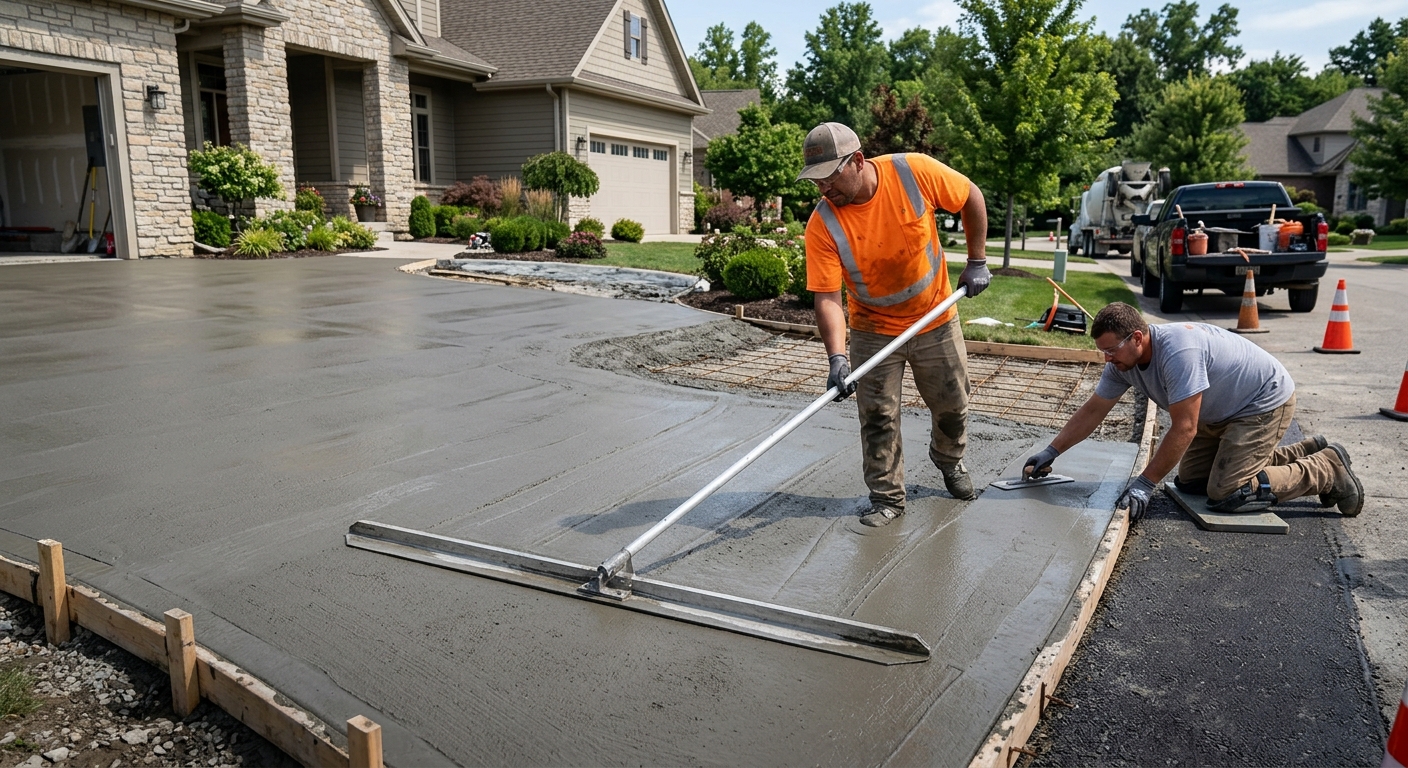
Concrete work options and costs in Plantagenet
Concrete contractors in Plantagenet see steady demand year-round, and driveway, patio and walkway projects are usually the first things homeowners notice after a new landscaping plan. With a 2021 population of 9,680 (Statistics Canada, 2021 Census), Plantagenet is smaller than the Toronto core, but it still sits in Ontario’s broader housing market—so pricing and scheduling often track the same frost-depth and freeze–thaw realities that shape concrete costs across the Toronto economic region. In practice, many projects are driven by residential flatwork improvements: as older properties refresh entrances, or as families upgrade outdoor living spaces for the patio season.
In the Toronto region, concrete work is strongly shaped by repeated freeze–thaw cycles. That means structural footings typically need to extend at least 1.2 m below grade to limit frost heave and differential movement, and exterior flatwork needs air-entrained concrete, adequate thickness, proper drainage, and well-planned control joints to manage cracking. Contractors also try to concentrate exterior pours in the warmer months to ensure curing doesn’t get interrupted when temperatures trend toward 10 °C or below. Because Plantagenet is a smaller local market, you can sometimes see fewer crews available during peak weeks, which affects scheduling—especially in spring when everyone wants similar access to trucks and finish crews.
For homeowners in the area around Plantagenet’s downtown and the surrounding rural lots, driveways and walkways are especially in demand because many homes rely on straightforward access routes that benefit from durable drainage and joint control. Below are typical cost ranges for the most common concrete options, so you can compare quotes apples-to-apples before you ask for an itemised breakdown.
| Application |
Typical Size |
Key Spec |
Finish Option |
Price Range |
| Concrete driveway (standard broom finish) |
400 sq ft (approx. 12 ft × 34 ft) |
Air-entrained mix, compacted base, joints |
Broom finish |
$7,200 – $11,200 |
| Exposed aggregate driveway |
400 sq ft (approx. 12 ft × 34 ft) |
Air-entrained mix, careful curing and wash timing |
Exposed aggregate finish |
$9,000 – $14,000 |
| Stamped concrete driveway or patio |
300 sq ft (approx. 15 ft × 20 ft) |
Air-entrained mix, release agent and proper sealer system |
Stamped pattern |
$10,000 – $15,000 |
| Plain concrete patio or walkway |
200 sq ft (approx. 10 ft × 20 ft) |
Air-entrained mix, slope for drainage, joints |
Float or broom finish |
$3,200 – $5,200 |
| Garage floor (interior slab) |
480 sq ft (approx. 12 ft × 40 ft) |
Vapour barrier and base, optional reinforcement |
Broom/smooth trowel (as specified) |
$9,000 – $14,000 |
| Foundation footings (structural, below frost) |
Typical: 1,000–1,600 linear ft for a small build footprint |
Below frost depth placement, reinforcement as engineered |
Structural concrete (not decorative) |
$180 – $300 |
Prices are estimates only and vary by project scope, site access and material selection.
What affects the price of concrete work in Plantagenet
In Plantagenet, two quotes for the “same” concrete job can differ by 30–50% because the hard costs aren’t just the concrete. They also include excavation, haul/disposal, compacted granular base, reinforcement, labour productivity, truck access, finishing complexity, and how the contractor plans curing around cold snaps. In the Toronto economic region, that planning is especially important because frost depth and freeze–thaw cycles dictate every spec. Structural footings must extend below design frost depth (typically achieved by extending at least 1.2 m below grade for many Ontario builds) to prevent frost heave and differential movement. For exterior slabs, contractors typically use air-entrained mixes so the concrete can survive repeated freezing and thawing without spalling. That air-entrainment, plus control joints, adds cost—but it’s cheaper than repairs.
Cold-weather curing precautions also drive price. When temperatures drop toward 10 °C or below, contractors may need insulating blankets, temporary heat, and tighter scheduling to keep curing conditions consistent. De-icing salts in winter further increase the need for good surface sealing once curing is complete. In practice, the “weather window” affects availability: more crews chase pours at the same time, which can raise labour rates.
Local examples in Plantagenet: (1) If your soil is soft or poorly drained, base prep may add depth and truckloads—pushing a driveway toward the higher end of $18–$28 per sq ft. (2) If you want exposed aggregate or stamped details, plan on working at the $24–$40 per sq ft range because finishing time and materials are higher. (3) Older properties with narrow approaches often require smaller equipment and careful formwork, which can move a patio from the lower band to the upper band even when square footage looks similar. With Ontario’s mix of humid wet fall/spring conditions, drainage and curing management can be the difference between a finish that stays crisp and one that needs patching sooner—often costing homeowners more than the initial savings.
| Price Factor |
Why It Matters |
Cost Impact |
| Frost line depth — determines footing depth and form height |
Footings must be below frost to prevent heave and movement. |
Higher excavation and concrete volume can add significant cost. |
| Site preparation — excavation, grading, compacted granular base |
Even concrete cracks if the base is unstable or saturated. |
More hauling and compaction time can move pricing toward the upper band. |
| Reinforcement — rebar or wire mesh requirement |
Controls cracking and improves load performance. |
Material + labour placement cost; omission increases early failure risk. |
| Mix design — air-entrainment and compressive strength spec |
Freeze–thaw resistance and durability depend on the mix. |
Air-entrained mix often increases material cost slightly, preventing expensive repairs. |
| Finish type — broom vs. stamped vs. exposed aggregate |
Labour time and finishing materials differ a lot. |
Stamped/exposed finishes typically cost more per sq ft than broom or plain. |
| Pour size and concrete truck access to site |
Smaller pours with limited access require more handling and staging. |
Delivery constraints can add labour and affect sequencing. |
| Cold-weather curing precautions — heating and blankets |
Curing slows sharply when temperatures drop. |
Heat/insulation adds cost but supports strength and surface integrity. |
| Control joint pattern and sealing cost |
Joints reduce random cracking; sealing helps repel de-icing salts. |
Proper jointing and sealing can cost more upfront but extend service life. |
Permits & regulations in Ontario
In Ontario, structural concrete work typically requires a building permit. That includes concrete that forms part of the structure—such as footings, foundation walls, grade beams, and other load-bearing elements shown on engineered drawings. Municipal review is common because the foundation is designed to support loads and resist local conditions. For that reason, homeowners should expect engineered foundation details for anything below grade and plan for permit lead times.
Concrete flatwork (driveways, patios, sidewalks, and walkways) usually does not require a permit by default, especially when it’s simply replacing like-for-like surfaces. However, permits may be required if the work affects lot grading, changes drainage patterns, increases impervious surface coverage beyond local limits, or involves work near municipal right-of-way or within setbacks. In Plantagenet, always confirm with the local authority before breaking ground—especially if you’re changing elevations, adding a new driveway approach, or regrading to fix drainage.
Contractor verification should be step-by-step. First, ask for their Ontario liability insurance certificate and confirm it matches the legal business name. Second, confirm workers’ coverage under WSIB/WCB and request proof of clear coverage (or appropriate exemption documents, if applicable). Third, verify their licensing/registrations through Ontario’s applicable online resources and ensure they can provide references for similar-sized residential pours in your area.
Getting concrete right in Plantagenet's freeze-thaw climate
Concrete failures in Plantagenet are usually a freeze–thaw story. When water gets trapped under a slab or within the surface, it expands during freezing, which can lead to cracking and spalling—especially if the concrete isn’t air-entrained or if the base isn’t properly compacted and drained. The fix isn’t guesswork; it’s specification. Start with base preparation: excavate to the required depth for the local soil conditions and frost performance, then place compacted granular sub-base in lifts and ensure correct slopes for drainage. Next, use the right mix design. For exterior flatwork, contractors typically target 5–7% air content and at least 32 MPa compressive strength. That’s what gives the paste room to handle freeze–thaw stresses.
Control joints are your best defence against random cracking. Plan joint spacing so cracks are directed where you can manage them. Curing is equally critical: allow a minimum 7-day curing period under proper conditions, and protect the pour in cold snaps with insulated blankets and/or heating if temperatures threaten to stall strength gain. Finally, apply a penetrating sealer after the concrete has cured—commonly around 28 days post-pour—to help repel de-icing salts.
Ask technical questions that target these failure points. If a contractor proposes “plain” mix for an exterior slab or skips joint planning, that’s a red flag. As a dollar example, upgrading from a standard broom-finished driveway to stamped concrete may move you into the $24–$40 per sq ft range, but it can be justified when the contractor also improves base prep, specifies air-entrainment, and includes a correct joint layout. Paying less for decorative looks is rarely worth it if the freeze–thaw durability details are missing.
| Spec |
Why It Matters in Plantagenet |
What to Ask For |
Impact if Skipped |
| Compacted granular base (depth?) |
Stable, drained base reduces movement and pumping during freeze–thaw. |
Granular depth and compaction method for your soil and frost conditions |
Premature cracking, settlement, and uneven surface |
| Air-entrained concrete mix (target air %?) |
Air pockets control internal freeze–thaw expansion in Ontario winters. |
Target air content (commonly 5–7% for exterior flatwork) |
Spalling and surface deterioration after first few winters |
| Compressive strength (MPa rating) |
Strength gain supports durability and load resistance. |
Minimum 32 MPa mix specification |
Weaker concrete, raveling, and faster wear under traffic |
| Control joints (spacing per ACI guidelines) |
Directs cracking and helps manage shrinkage and temperature movement. |
Joint spacing plan and saw-cut timing |
Random cracking that spreads and is harder to repair |
| Minimum 7-day curing period |
Curing affects strength and reduces permeability. |
Protection plan if temperatures approach cold-weather conditions |
Reduced strength, increased permeability, and durability issues |
| Penetrating sealer (when applied after cure) |
Repels moisture and de-icing salt intrusion in freeze–thaw cycles. |
Sealer application timing (often after full cure, commonly around 28 days) |
Higher risk of scaling, staining, and salt-related surface damage |
How to choose a concrete work contractor in Plantagenet
Start by verifying the contractor is set up to protect you. In Ontario, confirm they carry current liability insurance and provide a certificate of insurance that matches the company name on the quote. Next, verify WSIB/WCB coverage (and request proof/clearance as applicable), because concrete work involves real jobsite risks—excavation, truck movement, and cutting. Then check references: ask for photos and warranty claims history on similar projects in your region so you know their finishing and jointing match local expectations for freeze–thaw.
Get 2–3 quotes that are itemised, not just a lump sum. A good quote breaks out labour, excavation/base prep, reinforcement (if any), concrete supply, forming, finishing, sealing, and disposal. Check what’s excluded: is lifting/hauling of old concrete included? Is reinforcement included for a driveway or walkway? Is permit support included for structural work, and who pulls the permit?
Warranty matters too. Ask for the workmanship warranty length and what it covers—cracks, spalling, settlement—and whether there are conditions (like improper de-icing or removal of sealer). Payment schedule should be controlled: never pay more than 10–15% upfront, and hold back a portion until the job is complete and cleaned.
Finally, timeline should be written: request a start date range, expected pour date, cure/protection approach, and completion estimate. In a market where cold snaps can shorten the pour window, clarity prevents delays and rushed finishing.
- Confirm liability insurance and WSIB/WCB coverage before signing
- Ask for at least two local references from similar residential scopes
- Use itemised quotes (labour, materials, base prep, reinforcement, disposal)
- Verify thickness and base depth are stated, not just “concrete included”
- Confirm air-entrainment for all exterior flatwork
- Ask about control joint pattern, saw-cut timing, and edge finishing
- Check curing and cold-weather protection plan
- Clarify sealing: product type, application timing (after cure), and coverage
- Confirm drainage/slope and how it will tie into existing grades
- Review truck access and how they’ll manage formwork and concrete placement
- Confirm permit scope for structural work and who is responsible for it
- Set a payment schedule: 10–15% max upfront and holdback until completion
Concrete contractor red flags I see in Plantagenet: skipping air-entrainment for exterior pours, vague quotes that don’t list base depth or jointing, no written curing/protection plan for cold nights, pressuring you for large upfront payments, and refusing to put warranty details (and exclusions) in writing.
Frequently asked questions — concrete work in Plantagenet
When is the best time to pour concrete in Plantagenet?
The best time in Ontario for most exterior flatwork in Plantagenet is late spring through summer, when daytime temperatures are reliably warm and the curing window isn’t constantly interrupted by cool nights. In the Toronto economic region, many contractors try to schedule exterior pours before temperatures start trending close to 10 °C or below, because slow curing increases the risk of surface issues and reduces overall strength gain. If you’re planning a driveway or walkway, aim for a stretch of stable weather and ask your contractor about cold-weather protection if a cold snap shows up. For reference, stamped and decorative work can sit in the $24–$40 per sq ft band, and finishing demands are easiest when the weather cooperates. (Statistics Canada, 2021 Census)
How long does concrete take to cure?
Concrete curing isn’t just a single number. For typical exterior flatwork in Ontario, you’ll often hear “7 days” as a practical minimum for curing/protection before normal light use, but full performance develops over longer time as hydration continues. In freeze–thaw climates like Plantagenet, the big point is curing conditions: if temperatures drop and protection isn’t used, strength gain can stall and the surface can become more vulnerable to scaling or spalling. Most reputable contractors protect the slab during the first week and then manage sealer timing separately. For example, penetrating sealing is commonly planned after cure—often around 28 days post-pour—so it can better repel moisture and de-icing salt intrusion. Always ask how they’ll protect the pour overnight and whether they’ll use blankets/heating if needed.
Do I need a permit for concrete work in Ontario?
Often, concrete flatwork like patios, walkways, and driveways does not require a permit in Ontario if it’s like-for-like and doesn’t alter grading or drainage in a way that affects lot conditions or municipal requirements. But structural concrete—footings, foundation walls, grade beams and other load-bearing elements—typically requires a building permit and may involve engineered drawings reviewed by the municipality. In Plantagenet, the safe approach is to confirm with the local authority before you break ground, especially if you’re changing elevations, adding a new driveway approach, or correcting drainage so surface water doesn’t run toward a foundation. Also verify your contractor handles the proper permitting scope. A good contractor should be able to clearly state what’s included in the price and what requires homeowner or permit involvement.
Concrete vs pavers for a patio in Plantagenet?
Concrete and pavers both work well in Ontario, but freeze–thaw performance depends heavily on base prep and drainage. A properly built concrete patio uses air-entrained mix, correct slope, and control joints to manage cracking—then a penetrating sealer helps with de-icing salts. Pavers can be more forgiving visually after minor heaving, because individual units can be lifted and reset, but pavers still require proper compacted granular base to avoid settling and weed growth. If you want a lower upfront cost, plain concrete patios often land in the $16–$26 range per sq ft. If aesthetics are the priority and you’re comparing price bands, stamped concrete can move toward the $24–$40 per sq ft band, but still gives a monolithic look. In Plantagenet, I usually recommend concrete when you want durability and a clean finish, and pavers when you expect ongoing landscape changes—provided the base is done correctly.
How long does a concrete driveway last?
A concrete driveway can last 20–30 years when it’s built for Ontario’s freeze–thaw cycles: adequate base preparation, air-entrained concrete, correct thickness, proper jointing, and sealing. The weak points tend to be water management and surface protection. If water sits under the driveway or the slab edges trap moisture, freeze–thaw pressures can cause settlement and cracking. If de-icing salt is used aggressively without sealing, the surface can scale and spall sooner. The contractor’s attention to curing and joint pattern makes a real difference—especially in climates like the Toronto region where spring melt/refreeze happens frequently. Price-wise, many standard broom-finished driveways fall into the $18–$28 per sq ft band, while decorative upgrades push higher. You should ask your contractor whether sealing is included and when they plan to apply it (commonly after full cure).
What is air-entrained concrete and why does it matter here?
Air-entrained concrete is a mix designed with microscopic air bubbles that give freeze–thaw water a place to expand. That matters in Plantagenet and across Ontario because repeated freezing and thawing can break down normal concrete paste if there’s no engineered room for expansion. The result of inadequate air content is often spalling (surface flaking) and faster deterioration, especially on exterior flatwork like driveways, patios, and walkways. Contractors typically specify air-entrainment for exterior slabs and manage thickness, base prep, control joints, and curing to reduce cracking and moisture intrusion. If a quote doesn’t mention air-entrainment for an exterior pour, ask directly—don’t assume. Even though air-entrained mix is a small cost increase, it’s one of the most cost-effective choices in the $18–$28 per sq ft concrete band for standard work and in the higher band for decorative finishes.