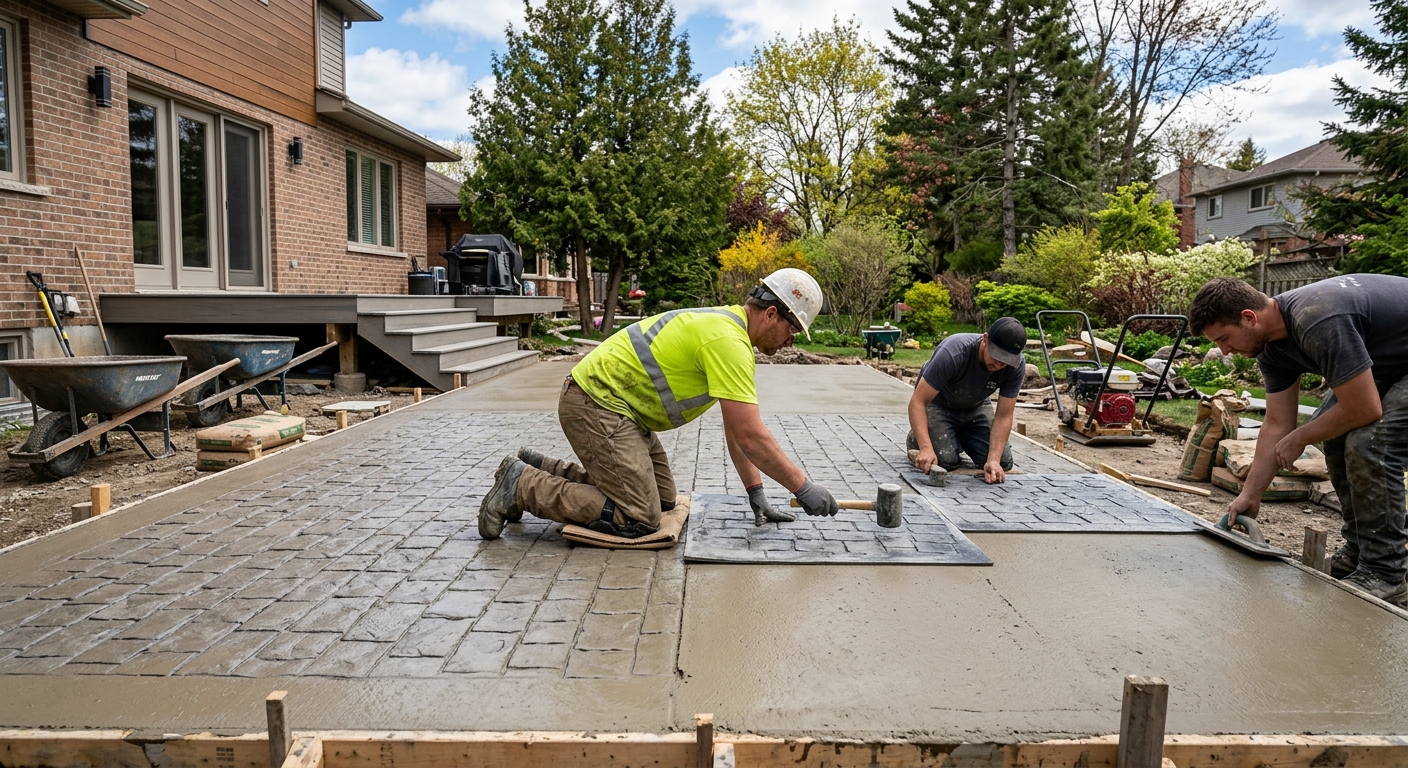
Concrete work options and costs in Tillsonburg
Tillsonburg homeowners typically price concrete by the application, but the local climate and soil conditions make the “same” job come out differently from lot to lot. In a town where 67.7% of dwellings are single-detached homes (Statistics Canada, 2021 Census), the most common concrete projects are driveways, patios, walkways and garage floors—often tied to renovations of older housing stock (49.3% built before 1981, Statistics Canada, 2021 Census). In the London economic region, frost depth and freeze–thaw cycling are the main concrete cost drivers. That means exterior footings and heavy slabs generally require deeper excavation and more forming to reach below the local frost line, plus air-entrained mixes and proper drainage so the slab doesn’t heave or scale. Contractors also plan around a shorter, cooler pour season, so winter protection and curing care can add labour and materials. If you’re in or near the north end (for example, around Tillsonburg’s downtown and residential streets nearby), demand is steady because many homes are on older services with limited access—tight truck staging affects placement and can shift labour costs.
Below are typical pricing ranges you’ll see from reputable crews in Tillsonburg, including the real-world tendency for frost-related prep and air-entrainment to push exterior work toward the mid-to-high end of Ontario average pricing.
| Application |
Typical Size |
Key Spec |
Finish Option |
Price Range |
| Concrete driveway (standard broom finish) |
12’ x 20’ (240 sq ft) |
Reinforced slab with compacted granular base; air-entrained mix |
Broom finish, control joints and edge finishing |
$3,600 – $6,000 |
| Exposed aggregate driveway |
12’ x 20’ (240 sq ft) |
Reinforced slab; air-entrained mix |
Exposed aggregate with sealer-ready surface prep |
$4,500 – $7,200 |
| Stamped concrete driveway or patio |
10’ x 20’ (200 sq ft) |
Reinforced slab; air-entrained mix; colour integral |
Stamp pattern, release agent, and protective sealer |
$4,400 – $8,000 |
| Plain concrete patio or walkway |
10’ x 12’ (120 sq ft) |
Compacted base, reinforcement where required |
Smooth or lightly broomed finish; clean edges |
$1,450 – $2,650 |
| Garage floor (interior slab) |
20’ x 22’ (440 sq ft) |
Vapour barrier (as needed), reinforcement and proper base |
Plain finish; option for densifier/coat |
$7,000 – $12,000 |
| Foundation footings (structural, below frost) |
Typical single home footing lineal ft |
Excavation to frost depth; forms; rebar and inspection hold points |
Structural concrete, not a decorative finish |
$80 – $140 |
Prices are estimates only and vary by project scope, site access and material selection.
What affects the price of concrete work in Tillsonburg
In Tillsonburg and the wider London economic region, it’s common to see quotes for the “same” driveway or patio differ by 30–50%. The biggest reason isn’t brand preference—it’s how each contractor sizes the job to handle frost depth, drainage, and freeze–thaw exposure on your specific lot. Exterior concrete has to be built for Ontario’s repeated thawing and freezing. That means footings for additions, garages and heavier supports generally extend below the design frost depth, which drives more excavation, deeper forms and more concrete. It also means air-entrained concrete mixes are standard for exterior flatwork so the surface resists scaling and cracking. In cooler seasons, crews may need blankets, heaters or accelerators to protect early curing, increasing labour and material costs.
Local examples that move the price up or down in Tillsonburg include: (1) compacted granular base quality—if the granular isn’t brought to the right depth and compaction, you may see settlement and increased remedial work later; (2) reinforcement changes—tight spans, thicker sections, or certain load requirements can shift the rebar/wire mesh amount; and (3) finish selection—plain broom work is usually near the lower end of the local band, while stamped or exposed aggregate typically lands mid-to-high. For instance, stamped concrete often sits around the $22 – $40 per sq ft decorative range, while plain exterior flatwork may be closer to $12 – $22 per sq ft depending on thickness and base prep. Housing age also matters: when older homes (49.3% built before 1981, Statistics Canada, 2021 Census) have mature landscaping, removal and haul-off can be a surprise cost compared with newer yards.
| Price Factor |
Why It Matters |
Cost Impact |
| Frost line depth — determines footing depth and form height |
Deeper frost protection requires more excavation and concrete volume. |
Can add 10–25% on foundation/footing-heavy scopes. |
| Site preparation — excavation, grading, compacted granular base |
Poor base = settlement and early cracking; proper base stabilizes the slab. |
Often the difference between budget and durable outcomes (5–20%). |
| Reinforcement — rebar or wire mesh requirement |
Controls cracking under loading and helps structural performance. |
Material and labour can swing total by 5–15%. |
| Mix design — air-entrainment and compressive strength spec |
Air-entrainment improves freeze–thaw durability in Southwestern Ontario. |
Small per-cubic-cost increase, but meaningful for long-term durability (2–8%). |
| Finish type — broom vs. stamped vs. exposed aggregate |
Complex finishes require labour, tools, colour system, and extra curing care. |
Stamped/exposed typically adds 20–60% over broom/plain. |
| Pour size and concrete truck access to site |
Tight access may require more crew time and extra handling. |
Can add 5–20% depending on staging and distance. |
| Cold-weather curing precautions — heating and blankets |
Protects early strength gain in cool, damp conditions. |
Often adds 3–12% when protection is required. |
| Control joint pattern and sealing cost |
Joints manage cracking; sealing helps with de-icing salt exposure. |
Usually a modest add (1–5%), but can reduce costly failures. |
Permits & regulations in Ontario
In Ontario, structural concrete work usually requires a building permit and, in many cases, engineered drawings reviewed by the municipality. That includes foundation components like footings, foundation walls, grade beams, and any structural elements tied to the building’s load path. Concrete flatwork—patios, walkways, and driveways—typically does not require a permit unless it affects lot grading, drainage, impervious surface coverage limits, or works near the municipal right-of-way/sidewalk where approval may be needed. Because Tillsonburg relies on drainage and frost-safe grading for neighborhood performance, it’s smart to confirm with the local authority before breaking ground.
Here’s a practical homeowner checklist to verify a contractor in Ontario, step by step. First, ask the contractor for their liability insurance certificate: it should list the policyholder and coverage limits relevant to concrete placement and site work. Second, confirm workers are covered by WSIB/WCB (documentation should be provided on request, and an active account/status matters). Third, verify contractor licensing/registration through Ontario’s online registry resources (your contractor’s business name and trades information should match the proposal and invoice). Finally, request clearance letters or proof of coverage directly from the insurer/regulator where applicable.
If the quote involves structural concrete, ask whether permits and inspections are included, and who is responsible for scheduling. For exterior work, confirm how drainage is handled (slope, weeping, and tie-in to existing surfaces) and whether sealer and curing protection are specified.
Getting concrete right in Tillsonburg's freeze-thaw climate
Concrete failures in Tillsonburg usually trace back to one of five weak points: inadequate base preparation, the wrong mix for freeze–thaw, poor joint layout, insufficient curing protection, or skipping sealing in a road-salt environment. To spec the job correctly, start with base preparation: use a compacted granular sub-base to the required depth for your soil and frost conditions, with proper grading and drainage so water can’t sit under the slab. Next, insist on the right mix design. For exterior flatwork, request air-entrainment (often 5–7% air content target for freeze–thaw durability) and a minimum compressive strength spec of 32 MPa. Air-entrainment is the big one—if the crew adds “water to make it easier,” or uses a non-air-entrained mix, the surface can scale and spall faster under Ontario winter cycles.
Then manage cracking with control joints. Ask for a joint spacing plan tailored to slab dimensions so cracks form where they’re least visible and most serviceable. Curing matters just as much: plan for at least 7 days of proper curing under conditions that protect the slab from cold nights and rain. Finally, for exterior concrete exposed to de-icing salts, schedule penetrating sealer after the cure (commonly after 28 days) so it resists chloride ingress and helps preserve the finish.
To make the pricing practical: if a stamped patio quote is about $6,000, but the contractor also offers the correct base depth, air-entrainment, proper curing blankets (when needed), and a sealer plan, the extra cost is usually justified. Cutting corners on base or air content is where cheap quotes quietly fail—especially in Southwestern Ontario’s freeze–thaw.
| Spec |
Why It Matters in Tillsonburg |
What to Ask For |
Impact if Skipped |
| Compacted granular base (depth?) |
Prevents settlement and frost-related movement under repeated cycling. |
Confirm base depth, compaction method, and drainage slope. |
Cracking, unevenness, and premature failure. |
| Air-entrained concrete mix (target air %?) |
Reduces freeze–thaw scaling and improves durability in Ontario winters. |
Request air-entrainment and specify target air content (commonly 5–7%). |
Spalling and surface pop-outs. |
| Compressive strength (MPa rating) |
Ensures the slab reaches design performance despite cool curing conditions. |
Confirm 32 MPa minimum (or project-specific spec) and test approach. |
Lower strength and higher risk of early damage. |
| Control joints (spacing per ACI guidelines) |
Controls where cracks occur as the slab expands and contracts. |
Ask for joint spacing plan and sealing details. |
Random cracking and difficult-to-repair surface breaks. |
| Minimum 7-day curing period |
Cool, damp weather can slow strength gain without protection. |
Confirm curing protection plan (blankets/heating if nights are cold). |
Weaker surface and reduced long-term durability. |
| Penetrating sealer (when applied after cure) |
Helps limit chloride/de-icer penetration during winters. |
Confirm sealer type and timing (commonly after 28 days cure). |
Faster scaling, staining, and moisture ingress. |
How to choose a concrete work contractor in Tillsonburg
Choosing a contractor in Tillsonburg comes down to verification and clarity. First, confirm Ontario trade licensing/registration for the business (ask for their current business details and match them to the proposal). Next, verify liability insurance: request the certificate of insurance before work starts and ensure the coverage aligns with the scope (sitework, excavation, concrete placement). For worker coverage, ask for WSIB/WCB proof—legitimate paperwork should show active coverage and the correct employer name. Don’t accept “we’ll take care of it” wording; ask for documents.
Then get 2–3 itemised written quotes that break out labour, concrete supply, reinforcement, excavation/grading, forming, and finish. Avoid lump sums that don’t explain what’s included. Confirm whether permits (when required for structural concrete) and municipal inspections are included, and what’s excluded (disposal/haul-away, sawcutting existing slabs, excavation depth, regrading, and any drainage tie-in). A reputable contractor will also provide workmanship warranty details and product/manufacturer warranty where applicable, including whether it’s transferable if you sell your house.
For payment, keep deposits modest—never more than 10–15% upfront—and use a holdback until the job is complete and cleaned up. Ask for a written start date and completion estimate. Since Tillsonburg winters can slow work, a schedule should also state how they manage curing and protection if temperatures drop.
- Ask for a detailed scope with base depth, reinforcement type, and slab thickness.
- Confirm air-entrainment and compressive strength (e.g., 32 MPa) in writing.
- Request joint layout details (where and how often joints are cut).
- Get line-item pricing for excavation, disposal, and compacted granular base.
- Confirm who provides and places the rebar/wire mesh and how it’s supported.
- Ask how they handle drainage and water away from house foundations.
- Clarify finishing responsibilities (broom vs stamped vs exposed aggregate).
- Request their curing plan (blankets/heaters if cold nights are expected).
- Confirm whether sealer is included and when it’s applied (after cure).
- Ask for a warranty length and what it covers for cracking/spalling.
- Verify liability insurance and WSIB/WCB proof before scheduling.
- Ensure payment schedule includes a holdback until final acceptance.
Concrete red flags in Tillsonburg include: skipping mention of air-entrainment, offering a “low price” without base preparation details, no written curing plan for cool/damp periods, unclear joint spacing (or none at all), and refusing to provide insurance/WSIB/WCB documentation up front.
Frequently asked questions — concrete work in Tillsonburg
How long does concrete take to cure?
In Tillsonburg, curing time depends on temperature and exposure, but a solid rule is to plan for minimum 7 days before heavy use, and longer before full durability. Concrete gains strength rapidly in warm conditions; however, Southwestern Ontario often has cool nights and damp weather that can slow early strength. That’s why reputable contractors build in curing protection when temperatures drop—blankets or controlled heating for the first days can matter. Even after the slab is “walkable,” don’t rush loads, vehicle traffic or cutting corners on curing. For exterior protection, sealer is commonly scheduled after the slab has fully cured (often around 28 days), which helps repel moisture and de-icing salt. Always ask your contractor to state curing steps in writing as part of the schedule.
Do I need a permit for concrete work in Ontario?
In Ontario, structural concrete work such as footings, foundation walls, and grade beams typically requires a building permit and often engineered drawings reviewed by the municipality. Concrete flatwork like patios, walkways and driveways usually does not require a permit unless it impacts lot grading, drainage, impervious surface limits, or the municipal right-of-way (for example, tie-ins near sidewalks/curbs). For a homeowner in Tillsonburg, the safe approach is to confirm with the local authority before excavation—especially if you’re changing drainage patterns or slope. Also verify the contractor’s responsibilities: ask who pulls permits (when required), who schedules inspections, and what documentation you’ll receive. This helps avoid delays that can be costly because cold weather can affect curing timelines.
Concrete vs pavers for a patio in Tillsonburg?
Concrete and pavers can both look great, but the decision is about maintenance, freeze–thaw tolerance, and how your base is prepared. In Tillsonburg’s freeze–thaw climate, both systems rely on drainage and a properly compacted base. Pavers can be easier to replace in small sections, but they require ongoing maintenance like re-leveling or resetting if the base shifts. A plain concrete patio is usually simpler and can be very durable when built with air-entrained concrete (for exterior durability) and correctly spaced control joints. Pricing often reflects that: plain concrete patio/walkway work typically falls around the $12 – $22 per sq ft band for many projects depending on thickness and access. If you want a decorative look, stamped concrete generally costs more, often aligning with the $22 – $40 per sq ft decorative range.
How long does a concrete driveway last?
A well-built concrete driveway in Tillsonburg can last decades, but “how long” depends heavily on prep and durability specs. The biggest factors are whether the base is properly compacted, whether the mix is air-entrained for Ontario freeze–thaw cycles, and whether control joints and sealing were done. De-icing salts and winter moisture exposure can accelerate surface scaling if sealing and curing aren’t handled correctly. Cracks are common in any concrete over time; the goal is to have them controlled through joint placement and good detailing so they don’t turn into large spalls or trip hazards. If your driveway is in the $15–$25 per sq ft typical band for standard installs, that’s usually achievable for broom-finished work—assuming base prep and durability requirements are included. If you want to reduce long-term maintenance risk, ask specifically about air-entrainment, joint spacing, and whether sealer is applied.
What is air-entrained concrete and why does it matter here?
Air-entrained concrete is designed to survive freeze–thaw cycles by creating tiny, evenly distributed air bubbles in the mix. In Tillsonburg and other parts of Ontario’s London region, those bubbles give water a place to expand when it freezes, reducing internal pressure that can lead to surface scaling and spalling. This is critical for exterior flatwork—driveways, patios and walkways—because they’re repeatedly exposed to moisture and temperature swings. A contractor should specify air-entrainment as part of the mix design for exterior pours. You’ll often hear target air content around 5–7% for freeze–thaw durability, though the exact spec can vary by project. If someone tries to “fix” workability with extra water or skips the air-entrainment requirement, durability drops noticeably over time. That’s one of the most common reasons early concrete failures happen in Southwestern Ontario.
How do I prepare the base for a concrete slab?
Concrete slab performance starts with the base. For a slab or exterior flatwork in Tillsonburg, you want a compacted granular sub-base placed to the correct depth for your frost and soil conditions, with proper grading so water drains away. Preparation typically involves removing topsoil, excavating to a stable depth, installing and compacting granular material in lifts, and ensuring the sub-grade isn’t over-wet. You also need to plan reinforcement correctly (rebar or wire mesh where required) so it sits at the right elevation, not directly on the soil. After base prep, the pour can’t be “improvised”—the contractor should confirm air-entrained mix, correct joint layout, and curing. If the contractor doesn’t clearly describe excavation depth, base thickness, and compaction methods, treat that as a warning sign before you approve a quote.