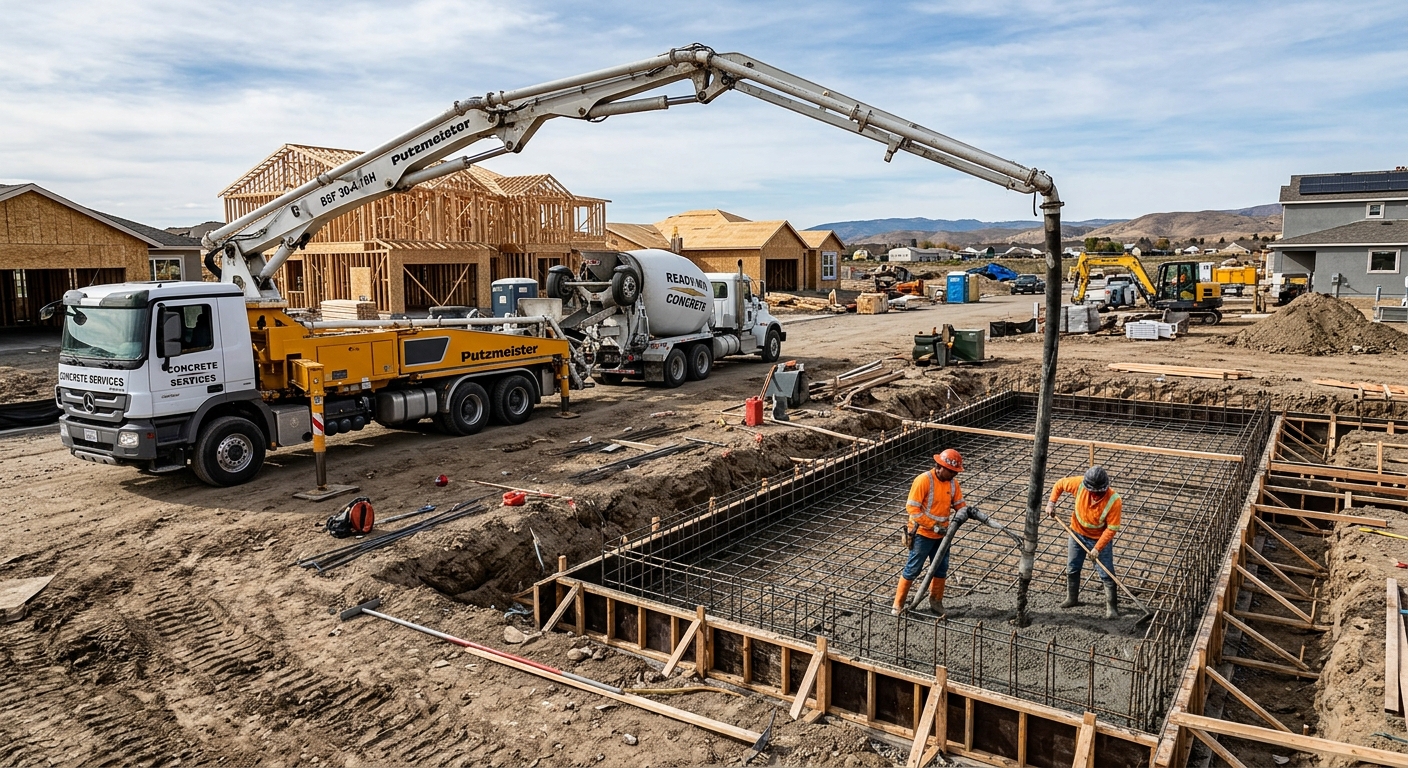
Concrete work options and costs in Columbia Hills
In Columbia Hills, concrete projects tend to fall into three buckets: exterior flatwork (driveways, patios, walkways), interior slabs (like garage floors), and structural concrete (footings and foundation elements). With a population of 7,125 (Statistics Canada, 2021 Census), the market is smaller than the larger GTA centres, so you’ll often see scheduling pressure when weather windows open—especially for busy crews serving nearby neighbourhoods such as Aurora Road and the surrounding residential corridors.
Home type matters too. Columbia Hills is dominated by established residential lots where homeowners regularly update aging surfaces—particularly front-drive areas and backyard access points. That mix of older housing stock and recurring upgrades is a big reason driveway and walkway work stays in demand locally. In the Toronto economic region, pricing is strongly influenced by frost depth and the long freeze–thaw cycle. Ontario Building Code requirements typically push structural footings to extend at least 1.2 m below grade to help prevent frost heave, and exterior flatwork needs air-entrained concrete plus proper drainage so saturated soils don’t expand and contract against the slab.
Because late fall and spring in the GTA can be wet, crews often have fewer truly “dry” working days, and contractors may add curing protection for pours that approach cooler conditions. The end result is that similar scopes can land in different price tiers, depending on base preparation, mix design, finish complexity, and access for concrete trucks.
Below is a practical comparison of common options and what you can realistically expect to pay.
| Application |
Typical Size |
Key Spec |
Finish Option |
Price Range |
| Concrete driveway (standard broom finish) |
400 sq. ft. |
Air-entrained mix, compacted granular base, control joints |
Broom finish + light sealer |
$18,000–$28,000 |
| Exposed aggregate driveway |
400 sq. ft. |
Air-entrained mix, retarder or wash process, sealed surface |
Exposed aggregate with broom/stone texture |
$22,000–$34,000 |
| Stamped concrete driveway or patio |
300 sq. ft. |
Air-entrained mix, integral colour (where selected), control joints |
Stamp + release + texture |
$8,500–$15,000 |
| Plain concrete patio or walkway |
250 sq. ft. |
Air-entrained mix, compacted base, drainage slope |
Float + broom finish |
$4,000–$6,500 |
| Garage floor (interior slab) |
500 sq. ft. |
Vapour barrier/insulation (if needed), fibre or mesh, proper thickness |
Steel-trowel or broom finish |
$9,000–$16,000 |
| Foundation footings (structural, below frost) |
~120 linear ft. |
Engineered rebar, continuous footings, below frost excavation |
Formed concrete footings (no decorative finish) |
$21,500–$36,000 |
Prices are estimates only and vary by project scope, site access and material selection.
What affects the price of concrete work in Columbia Hills
In Columbia Hills and across the Toronto economic region, you can see the same general concrete job come in 30–50% apart between quotes. The gap usually isn’t “mystery mark-ups”—it’s differences in sub-base preparation, reinforcement, mix design, finishing complexity, and how crews manage curing when temperatures wobble. When crews are booked around a few short pour windows, labour pricing can also move quickly, especially for homeowners trying to complete work before rain or cold settles in.
Toronto-area frost and freeze–thaw cycles dictate most of the technical requirements. Structural footings must extend below the design frost depth (often 1.5–2.4 m in Ontario scenarios) so frost heave can’t lift the building or create differential movement. For exterior slabs—driveways, patios, and walkways—air-entrained concrete is essential to survive repeated freezing and thawing. Cold weather also changes the economics: when conditions drop toward 10 °C or below, contractors may need insulating blankets or temporary heating to protect curing. And because Ontario winters include de-icing salt, sealing becomes more than “nice to have”—it helps reduce surface deterioration and spalling risk.
Two concrete examples from typical Columbia Hills sites: (1) a driveway over poorly drained fill often needs extra granular base and drainage adjustments, which can push a standard broom driveway from the lower end toward the higher end of local driveway pricing (around $18,000–$28,000 for a typical-sized job); (2) a smaller front walkway with good access might stay closer to the patio/walkway band (roughly $4,000–$6,500 for a typical project), while adding stamped patterns can materially increase finish labour and material handling.
| Price Factor |
Why It Matters |
Cost Impact |
| Frost line depth — determines footing depth and form height |
Deeper excavation and more concrete per linear foot |
Higher excavation/disposal and forming labour |
| Site preparation — excavation, grading, compacted granular base |
Controls settlement and helps drainage prevent pumping |
More base depth and compaction passes increase cost |
| Reinforcement — rebar or wire mesh requirement |
Improves crack control and load resistance |
Steel, chairs, tying labour, and higher material cost |
| Mix design — air-entrainment and compressive strength spec |
Air void system manages freeze–thaw durability |
Premium materials and higher spec may require scheduling |
| Finish type — broom vs. stamped vs. exposed aggregate |
Finish complexity drives labour time and materials |
Stamped and exposed aggregate usually add significant labour |
| Pour size and concrete truck access to site |
Placement speed and equipment planning affect labour |
Limited access can trigger pumping or additional crew time |
| Cold-weather curing precautions — heating and blankets |
Protects strength gain and surface integrity |
Adds equipment, fuel, and staging time |
| Control joint pattern and sealing cost |
Joints manage shrinkage cracking; sealing reduces salt damage |
More layout time and materials for long-term performance |
Permits & regulations in Ontario
In Ontario, structural concrete work generally needs a building permit because it’s part of the load-bearing system. That includes: concrete footings, foundation walls, grade beams, and other engineered structural elements. Municipal review often involves engineered drawings and inspections at key stages (e.g., footing inspection before walls are poured). For concrete flatwork—driveways, patios, sidewalks, and walkways—permits are often not required unless the work affects lot grading, impervious surface coverage limits, or involves municipal right-of-way / sidewalk connections. Even when a permit isn’t typically required, it’s still smart to confirm with the local authority before breaking ground.
Before you sign a contract in Columbia Hills, verify the contractor carries proper liability insurance and WSIB/WCB coverage (for workers). Also ask for references on projects of similar scale (e.g., a driveway replacement with similar soil conditions or a small foundation repair).
Step-by-step, homeowners can verify credentials like this: (1) confirm the contractor’s business licence and any relevant Ontario registration using the appropriate online registry used for contractor verification; (2) ask for a certificate of insurance (COI) and check that it names you (or the project owner) appropriately and shows active coverage; (3) request proof of WSIB/WCB account status or clearance documentation; (4) look for a clear permit plan in the written scope—who pulls permits (if required), and when.
Getting concrete right in Columbia Hills's freeze-thaw climate
Concrete fails in Columbia Hills mainly when freeze–thaw exposure meets water-saturated soil, weak base support, or inadequate durability specs. When water gets into voids under or within the slab, expansion during freezing pushes on the surface, leading to cracking, loss of surface, and in winter climates—often spalling, especially when de-icing salt is used. To spec the job correctly, you start from the ground up.
First is base preparation: ensure a compacted granular sub-base to the required depth for the local soil and frost conditions, with proper grading so water sheds away from the slab. Second is mix design: for exterior flatwork, air-entrainment is a non-negotiable—target about 5–7% air content—and meet at least a 32 MPa compressive strength spec. Third are control joints: spacing should be planned so cracking happens where it’s expected, not randomly. Fourth is curing: minimum 7 days of proper curing matters; in cold snaps, the contractor should protect the slab with insulating blankets or heating where needed so strength gain isn’t interrupted. Finally, apply penetrating sealer after cure (often around 28 days post-pour) to repel moisture and reduce salt-driven deterioration.
Ask questions using real outcomes: “How will you prevent water pooling at the edge?” “What’s your air-entrainment target and strength spec?” and “What’s the joint spacing plan?” For cost justification, consider this: spending a bit more on base depth and air-entrainment may raise your driveway total within the local driveway band (for example, moving from the mid-range toward the higher $18,000–$28,000 end), but it typically prevents early breakdown that would otherwise push you toward a costly re-do in a few winters.
| Spec |
Why It Matters in Columbia Hills |
What to Ask For |
Impact if Skipped |
| Compacted granular base (depth?) |
Prevents settlement and reduces water saturation under slabs in freeze–thaw cycles |
Minimum granular depth for your soil and proof of compaction (passes/test method) |
Uneven settling, cracking, and faster deterioration |
| Air-entrained concrete mix (target air %?) |
Durable freeze–thaw resistance in Ontario winters |
Confirm target air content around 5–7% for exterior flatwork |
Higher risk of spalling and surface scaling |
| Compressive strength (MPa rating) |
Affects long-term load capacity and resistance to early weather damage |
Minimum 32 MPa (or project-specific engineered value) |
Weaker slab; increased cracking and durability loss |
| Control joints (spacing per ACI guidelines) |
Controls shrinkage cracking in exterior flatwork |
Joint layout plan with spacing and sealing approach |
Random cracking and moisture pathways into the slab system |
| Minimum 7-day curing period |
Strength gain and surface integrity, especially when temperatures fall |
Protection plan if nights cool; confirm curing timeline in writing |
Surface weakness, scaling, and reduced freeze–thaw durability |
| Penetrating sealer (when applied after cure) |
Reduces water and salt penetration before the next winter |
Apply after cure (commonly around 28 days post-pour) |
More salt-driven wear and faster surface breakdown |
How to choose a concrete work contractor in Columbia Hills
Start with credentials. In Ontario, a legit concrete contractor should be able to show proof of liability insurance and active WSIB/WCB coverage for their workers. Ask for a certificate of insurance (COI) and check expiry dates, coverage limits, and whether they’ve listed you or the project as appropriate. For WSIB/WCB, request documentation showing account status or clearance, and don’t rely on verbal confirmation. If the job involves permit-required structural concrete (like footings), the contractor should also understand the inspection sequence and provide a clear plan.
Next, get 2–3 itemised written quotes. You want a breakdown that separates labour from materials (and includes what’s included in hauling/disposal if excavation is needed). Avoid “lump sum only” quotes that don’t specify thickness, base build-up, reinforcement, mix type, finish, joints, sealing, and curing protection.
Read the scope carefully: what’s excluded (e.g., removal of existing slab, landscaping restoration, permit costs, de-icing salt restrictions during early curing)? Is permit pull included where required? What about disposal and concrete forms? A solid warranty should state workmanship coverage length, and whether product/manufacturer warranties apply to admixtures, sealers, or concrete materials. Ask if the warranty is transferable to future homeowners.
Finally, payment schedule and timeline matter. Never pay more than 10–15% upfront; hold back a portion until completion and final inspection are done. Get the start date and completion estimate in writing, including contingency for weather—important in Columbia Hills where freeze–thaw cycles can shorten the practical pour window.
- Valid liability insurance COI with current expiry dates
- WSIB/WCB proof or clearance documentation provided before work starts
- Itemised quote (labour, materials, base prep, reinforcement, finishing)
- Specified slab/footing thickness and granular base depth
- Concrete mix details: air-entrainment and compressive strength requirement
- Control joint plan (layout and spacing) and sealing approach
- Cold-weather curing plan (blankets/heating if temperatures drop)
- Clear scope on demolition removal, hauling, and disposal
- Project access plan for concrete trucks and any pumping/laying method
- Product/spec sheets for sealers and admixtures where applicable
- Workmanship warranty stated in writing with coverage length
- Payment schedule capped at 10–15% upfront, with holdback until completion
Concrete red flags in Columbia Hills: (1) a quote that avoids specifying air-entrainment or curing steps; (2) “we’ll pour anytime” promises without a cold-weather protection plan; (3) vague joint spacing or no mention of sealing; (4) asking for large deposits upfront; and (5) no proof of WSIB/WCB or liability insurance when requested.
Frequently asked questions — concrete work in Columbia Hills
How long does a concrete driveway last?
In Columbia Hills and the wider Toronto region, a well-built concrete driveway commonly lasts 25 to 35 years, sometimes longer. Longevity depends most on base preparation (proper compacted granular support), air-entrainment for freeze–thaw durability, and how joints and edges are handled. If water is allowed to pool at the edges or under the slab, the freeze–thaw cycle accelerates cracking and scaling. Also, de-icing salts used during winter can speed surface wear if the driveway isn’t sealed after curing. With the right specs, homeowners typically justify paying within local driveway pricing—often around $18,000–$28,000 for a standard broom-finish replacement—because the “cheaper” version usually means thinner/less protected build-up that fails sooner.
What is air-entrained concrete and why does it matter here?
Air-entrained concrete is mixed with microscopic air bubbles that provide pressure relief when water inside the concrete freezes. In Ontario’s freeze–thaw climate, that’s critical because repeated freezing and thawing can otherwise crack the paste and break down the surface. For exterior flatwork in the Toronto region, contractors typically aim for about 5–7% air content and ensure the mix meets a minimum strength requirement (commonly at least 32 MPa). Without air entrainment, spalling and surface scaling become much more likely—especially once de-icing salt hits the surface each winter. That durability spec is one reason you may see quote differences of 30–50% across Ontario for “similar” driveways: the cheaper quote may simply not be building for freeze–thaw performance.
How do I prepare the base for a concrete slab?
Base prep is the hidden driver of performance in Columbia Hills. Contractors remove topsoil and any unsuitable material, then grade and compact a granular sub-base to the correct depth for your soil and expected frost conditions. The goal is uniform support with good drainage so water doesn’t sit beneath the slab. You should ask whether they’re using a compacted granular base (and how deep), what compaction method they use, and how they confirm sub-grade readiness. For exterior slabs like patios and walkways, the build-up also includes slope so runoff moves away from the home. If base prep is rushed, even a good finish won’t stop cracking over the freeze–thaw cycle—because movement starts under the concrete.
How do I compare concrete quotes?
To compare quotes fairly in Columbia Hills, focus on what’s specified, not just the total price. Ask for an itemised breakdown that covers excavation/demolition, granular base depth, reinforcement (rebar/mesh and chairs), concrete thickness, air-entrainment and strength spec, finishing method, control joint spacing, curing protection (especially near colder periods), and sealing. A stamped driveway quote may land in a different band because it includes higher labour and materials; for example, stamped concrete typically runs higher than plain broom-finish work. Compare like-for-like sizes and accessibility too—truck access or pumping can change costs. If one quote doesn’t mention air-entrainment or curing, it’s not the same product. Where you see big swings, that’s often the difference between a durable build and a minimum-spec build.
Can concrete be poured in cold weather in Columbia Hills?
Concrete can be poured in cold weather, but it should be done with precautions—and not every “cold day” is suitable. In the Toronto economic region, crews often concentrate exterior pours in warmer months for proper curing. If temperatures trend toward 10 °C or below, you should expect cold-weather curing measures like insulating blankets, temporary heating, and more careful monitoring of strength gain. The key is protecting the slab long enough to reach early strength without damaging freeze risk during the curing period. If a contractor promises to pour without a curing protection plan or doesn’t adjust materials and methods, that’s a major risk for freeze–thaw durability. Your best protection is a written plan for curing duration and temperature protection in the scope, not just a verbal assurance.
How do I maintain concrete in Columbia Hills's freeze-thaw climate?
Maintenance is mainly about controlling water and reducing salt impact. For new exterior flatwork, wait until it’s fully cured (often about 28 days) before applying penetrating sealer, then follow the sealer manufacturer’s instructions. Keep drainage pathways clear so runoff doesn’t pond at the driveway edge or patio perimeter. During winter, use de-icing methods carefully: avoid overloading salt and consider sand or low-chloride alternatives when appropriate. Inspect joints and sealed edges annually—if sealant fails, water can enter and speed deterioration through freeze–thaw expansion. If you see early surface scaling or small spalls, addressing them sooner is cheaper than waiting for full cracking. With proper sealing and joint care, you protect the investment you paid within local bands such as $16,000–$26,000 for typical patio/walkway scopes depending on size and finish.