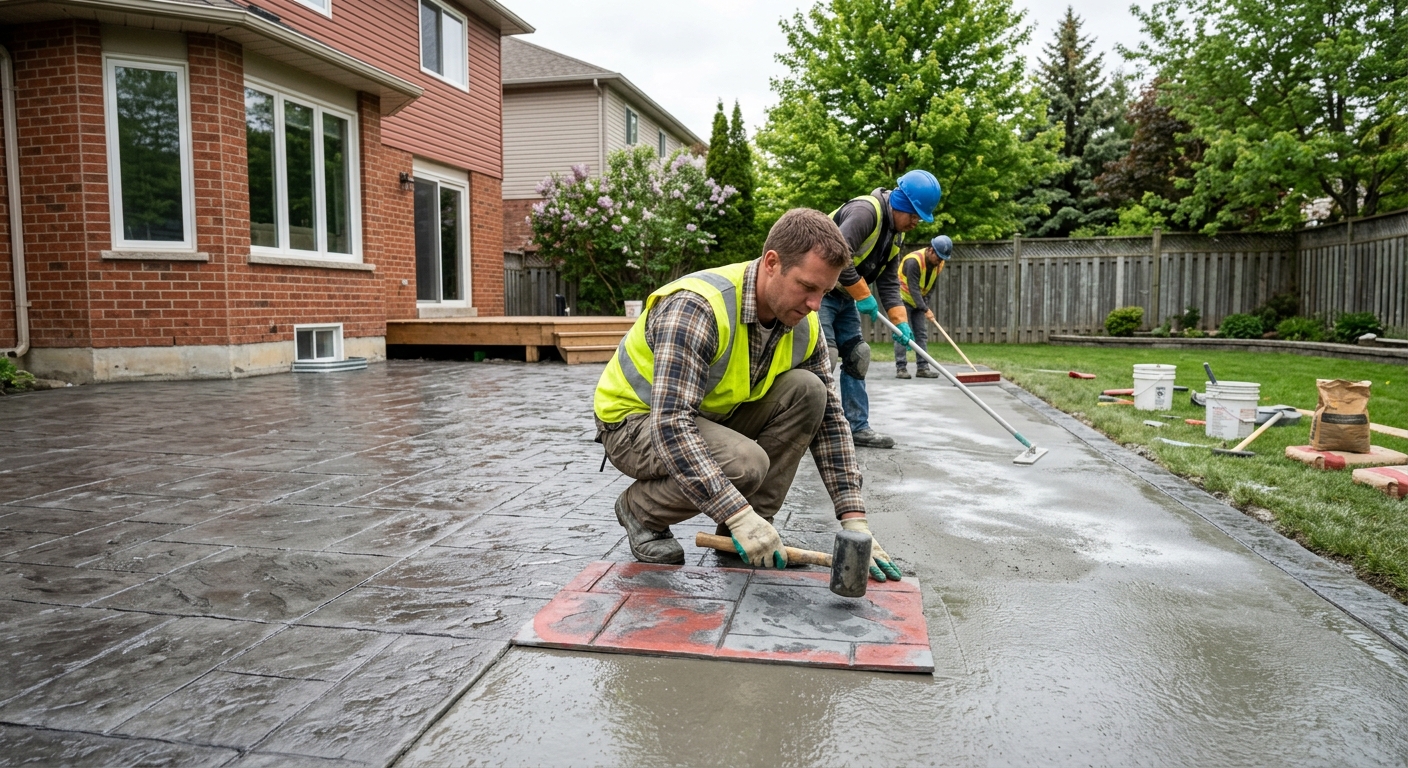
Concrete work options and costs in Dorset Park
Dorset Park, Ontario is a steady market for concrete flatwork—driveways, patios, walkways, and interior slabs—because many homes here are built on lots that need durable, easy-to-maintain surfaces. In the broader Toronto region, single-detached homes make up a big share of the housing stock (Statistics Canada, 2021 Census), and that lines up with the most common requests I see: new or widened driveways, backyard patios, and repairs to cracked walkways. Dorset Park’s population is also sizable for a neighbourhood, at 25,003 residents (Statistics Canada, 2021 Census), which supports year-round contractor availability, though scheduling still tightens when spring “ground thaw” hits.
Toronto-area concrete pricing moves with frost depth requirements, freeze–thaw cycles, and how well a job is prepared and protected during curing. Exterior pours need air-entrained concrete and enough thickness so the slab doesn’t spall or heave after winter. In practice, that means longer prep time, better drainage/granular base, and sometimes cold-weather protection if temperatures drop near 10 °C or below. That’s why two homes with the “same” driveway size can land 30–50% apart in Toronto—one contractor may price a higher-spec mix and proper jointing, while another may not.
In Dorset Park—especially around established lanes close to the newer arterial routes—driveway replacements are especially in demand when homeowners refurbish entrances and garages at the same time. Use the table below as a realistic starting point before you compare itemized quotes.
| Application |
Typical Size |
Key Spec |
Finish Option |
Price Range |
| Concrete driveway (standard broom finish) |
12 ft x 22 ft (264 sq. ft.) |
Air-entrained, compacted granular base, control joints |
Broomed |
$4,800–$7,200 |
| Exposed aggregate driveway |
12 ft x 22 ft (264 sq. ft.) |
Air-entrained, proper curing, reveal finish |
Exposed aggregate |
$6,200–$9,400 |
| Stamped concrete driveway or patio |
12 ft x 20 ft (240 sq. ft.) |
Air-entrained, stamped surface, sealer-ready |
Stamped pattern + release + borders |
$6,400–$10,200 |
| Plain concrete patio or walkway |
10 ft x 16 ft (160 sq. ft.) |
Well-drained base, air-entrained, jointing |
Float + light broom |
$2,600–$4,200 |
| Garage floor (interior slab) |
22 ft x 20 ft (440 sq. ft.) |
Vapour barrier (as needed), fibre or mesh reinforcement, flatness |
Light trowel / power float |
$6,000–$10,900 |
| Foundation footings (structural, below frost) |
Per linear foot (common homes: 30–70 lin. ft.) |
Below frost depth, engineered rebar placement |
Formed structural concrete |
$180–$300 |
Prices are estimates only and vary by project scope, site access and material selection.
What affects the price of concrete work in Dorset Park
In Toronto and across Ontario, it’s common to see bids for “the same” concrete work come in 30–50% apart. The big reason isn’t just brand names—it’s the real scope hidden inside prep, specs, and protections: the depth of excavation, the quality of granular base and compaction, the amount of reinforcement, the air content of the mix for freeze–thaw durability, and whether the crew plans curing and protection when temperatures swing. Contractors who price for winter-minded curing and proper jointing typically look higher, but those choices reduce long-term callbacks.
For frost and freeze–thaw, the job spec is dictated by Ontario practice: structural footings generally extend below the design frost depth (often 1.5–2.4 m in Ontario) so the ground can’t heave and shove the foundation. Exterior slabs and flatwork also need air-entrained concrete to survive repeated freeze–thaw cycling, especially when saturated soils freeze and expand in winter. When a pour happens during shoulder season, curing management becomes critical. If temperatures near 10 °C or below are expected, crews may need insulated blankets and/or temporary heating, which adds labour and equipment cost.
In Dorset Park, I often see two cost drivers that move numbers quickly. First, wet soil and poor drainage around entrances can force deeper drainage work and more base—pushing a driveway project toward the higher end of the $18–$28 per sq. ft. band. Second, de-icing salt spalls surfaces over time if the mix/air and sealing plan aren’t right—so a broom-finish slab may look cheaper at first, but skipping sealing can lead to early surface wear. As a practical example, stamped concrete typically costs more (often $24–$40 per sq. ft.), but the extra cost is justified when you’re replacing a worn entrance and want a long-lasting, cohesive look instead of adding pavers that can shift over winter.
| Price Factor |
Why It Matters |
Cost Impact |
| Frost line depth |
Determines how deep footings/forms must be to resist frost heave |
Can raise foundation/footing costs toward the upper $180–$300 per lin. ft. band |
| Site preparation |
Excavation, grading, and compacted granular base prevent saturation and pumping |
Low prep can cut price short-term, but proper prep adds labour and material |
| Reinforcement |
Controls slab movement/cracking; affects durability under loads |
Using mesh/rebar correctly increases material and placement time |
| Mix design |
Air-entrainment and strength requirements for freeze–thaw resistance |
Higher-spec air content and certified strength can increase material cost |
| Finish type |
Broom finish is simpler; stamped/exposed require additional steps and labour |
Stamped/exposed commonly pushes flatwork toward the $24–$40 band |
| Pour size and concrete truck access to site |
Shorter pumping/placing distance reduces labour and delay |
Restricted access can add pump/extra crew time |
| Cold-weather curing precautions |
Protects hydration when temperatures drop and slows early freezing risk |
Heating/blankets can add meaningful day-rate and material costs |
| Control joint pattern and sealing cost |
Joints reduce random cracking; sealing helps repel de-icing salt intrusion |
Skipping either can lead to early repairs or patchwork expenses |
Permits & regulations in Ontario
In Ontario, structural concrete work typically requires a building permit and, in many cases, engineered drawings reviewed through the municipal process. This includes foundation footings, foundation walls, grade beams, and any structural elements that support the building. Concrete flatwork (patios, walkways, and most driveways) often does not need a permit by itself, but it can trigger approvals if it affects lot grading, drainage, or impervious surface rules, or if it impacts municipal right-of-way areas.
For Dorset Park homeowners, the safest approach is to confirm with your local building department before any excavation. Also verify that the contractor carries: (1) liability insurance and (2) proper WSIB/WCB coverage for their workers (this is what Ontario expects for worker protection). Ask for references on similar-scale projects—especially exterior flatwork on soils that see freeze–thaw moisture movement.
Step-by-step verification you can do before hiring:
- Ask the contractor for their certificate of insurance (COI) and confirm it matches the job address details.
- Ask for their WSIB clearance letter (or WCB equivalent documentation), then verify the documentation is current.
- For structural work, request the engineered drawings/permit package they used on similar jobs and confirm a permit will be pulled if required.
- If the scope includes work that could touch right-of-way or drainage, confirm whether a municipal approval is required.
- Review references: look for photos of completed projects through at least one winter season.
Getting concrete right in Dorset Park's freeze-thaw climate
Concrete fails in Dorset Park primarily because freeze–thaw stresses the slab when water is present and the concrete isn’t protected by the right mix and detailing. The most common homeowner-visible issues are surface scaling/spalling and random cracking—often traced back to inadequate air-entrainment, weak base preparation, poor jointing, or shortcuts on curing and sealing. In a Toronto-area climate with humid fall/spring and repeated winter cycles, you should think in terms of water control first, then durability.
To spec the job correctly, start with base preparation: a compacted granular sub-base to the right depth for local soil conditions, with grading that drains away from the house. Next, require an air-entrained mix. For exterior flatwork, a common target is 5–7% air content, paired with minimum 32 MPa compressive strength (as commonly specified for durable residential exterior slabs). Control joints matter too—place them to limit random cracking to predictable locations. Then plan curing: even with good materials, concrete needs proper protection so it achieves strength. In Dorset Park, I recommend minimum 7-day curing under proper conditions, and if you pour into cooler weather, the crew should use insulating blankets and/or temporary heat to keep conditions consistent. Finally, sealing: apply a penetrating sealer after cure (commonly at about 28 days post-pour) to repel de-icing salt intrusion.
Here’s a quick pricing reality check. A broom-finish driveway might fall around the $18–$28 band, while stamped can move toward $24–$40 due to labour and finishing steps. That extra spend is justified when you’re already replacing the entire slab and want a durable, sealed decorative finish. What you should not “save” on is air content and base compaction—those are the exact things that prevent spalling.
| Spec |
Why It Matters in Dorset Park |
What to Ask For |
Impact if Skipped |
| Compacted granular base (depth?) |
Prevents water saturation and reduces freeze–thaw pumping under the slab |
Confirm base depth, compaction method, and drainage slope away from the structure |
More settlement, cracking, and premature surface failure |
| Air-entrained concrete mix (target air %?) |
Air voids give freeze–thaw protection to reduce scaling/spalling |
Ask for mix design with target 5–7% air content for exterior flatwork |
Higher risk of spalling and flaky scaling after winters |
| Compressive strength (MPa rating) |
Ensures the slab reaches sufficient strength for wear and durability |
Ask for minimum 32 MPa for the exterior slab mix |
Surface wear, increased cracking, and reduced long-term performance |
| Control joints (spacing per ACI guidelines) |
Creates planned crack locations and manages shrinkage/temperature movement |
Request the joint pattern and spacing plan for your slab dimensions |
Random cracking across visible areas |
| Minimum 7-day curing period |
Supports proper hydration and strength gain despite Toronto temperature swings |
Ask how they’ll maintain curing conditions, especially near cooler pour dates |
Weaker surface, increased permeability, and early deterioration |
| Penetrating sealer (when applied after cure) |
Repels de-icing salts and moisture from entering the concrete |
Confirm product type and timing (commonly after ~28 days post-pour) |
Salt-driven scaling and faster surface breakdown |
How to choose a concrete work contractor in Dorset Park
Choosing a concrete contractor in Dorset Park is less about flashy photos and more about proving they can build to spec in freeze–thaw conditions. Start with Ontario coverage checks: request a certificate of insurance (liability COI), then verify current coverage for the work. Next, ask for WSIB/WCB clearance documentation for their workers—your goal is to confirm they’re properly registered and insured before excavation begins. For structural work, insist they clarify whether permits and engineered drawings are part of the process.
When you request quotes, get 2–3 itemised written estimates—not a single lump sum. A good quote breaks out labour, concrete supply, excavation/grading, granular base, reinforcement (mesh/rebar), forming, finishing, and any curing/sealing steps. Ask what’s excluded: disposal of old concrete? Permit pull? Temporary protection/blankets? If a quote is cheaper but omits base depth, reinforcement placement, or sealing, it’s usually a “discount” on durability.
Warranty should be in writing. Confirm the workmanship warranty length, whether the manufacturer backs any concrete product/material warranties, and whether warranties are transferable to a new homeowner (important for resale). Payment scheduling matters too: never pay more than 10–15% upfront, and hold back until the job is complete and surfaces are protected. Also ask for a start date and completion estimate in writing so you can plan around Ontario weather windows.
- Ask for proof of liability insurance with your project address listed or clearly referenced.
- Request WSIB/WCB clearance letter before any work starts.
- Get at least three itemized quotes with labour and materials clearly separated.
- Confirm base preparation scope: excavation depth, granular type, and compaction method.
- Verify reinforcement plan: mesh vs. rebar, placement depth, and tying/wire support.
- Ask for the concrete mix spec including air-entrainment for exterior flatwork.
- Confirm finish scope: broom vs. stamped vs. exposed aggregate.
- Ensure control joints are included (spacing plan matched to slab size).
- Ask how they’ll protect curing in cool or wet shoulder-season conditions.
- Confirm sealing is included or priced as an add-on (timing after cure).
- Request disposal/crushing/removal details for old concrete and packaging.
- Ask for a written warranty and identify what triggers service calls.
Concrete red flags I see around Dorset Park: quotes that won’t specify base depth or joint spacing, vague answers on air-entrainment and mix design, crews that pour and rush finishing in cold weather without blankets, no written warranty/payment schedule, and contractors who want large deposits before any site preparation starts.
Frequently asked questions — concrete work in Dorset Park
Why does concrete crack in Dorset Park and how is it prevented?
In Dorset Park, cracks usually come from a combination of shrinkage, temperature movement, and freeze–thaw stress—especially where water can sit under or on the surface. Even a well-finished slab will crack naturally as it shrinks, so the prevention strategy is to control where it cracks: planned control joints, correct joint spacing for the slab dimensions, and proper curing. Base preparation matters too; a poorly compacted or water-prone granular base can allow movement, which turns small shrinkage into wider cracking after winters. For exterior work, ensure the mix is air-entrained (commonly 5–7% air) and that the contractor seals after cure. If you’re budgeting, a standard broom driveway typically lands in the $18–$28 per sq. ft. range, and “too cheap” bids often skip the details that prevent random cracking.
Stamped vs broom-finish concrete — cost difference?
Stamped concrete costs more because it requires additional steps: release agents, precise finishing, pattern mats, and more careful curing/protection to hold the surface detail. In the Toronto region, that cost jump is reflected in pricing bands—stamped/decorative concrete often falls in the $24–$40 per sq. ft. range, while standard broom-finish exterior slabs are usually lower (around the $18–$28 band). The best comparison in Dorset Park is to price both as full replacements: if you’re already removing and rebuilding the slab, the extra cost for stamping can be worth it for curb appeal and a cohesive look. If the contractor offers stamped work at an unusually low number, ask what’s included—especially air-entrainment, jointing plan, and whether sealing is included at the right time.
When is the best time to pour concrete in Dorset Park?
For Dorset Park (Ontario’s Toronto economic region), the best time is late spring through summer when daytime temperatures are stable and curing conditions are easier to manage. Exterior pours are commonly scheduled in the warmer months because freeze–thaw risk and temperature drops toward 10 °C or below can slow strength gain or require more protection. That doesn’t mean shoulder-season work is impossible—just that good contractors plan ahead: they use curing blankets/insulation and adjust placement timing based on forecasted temperatures. If you’re aiming for a driveway or walkway, try to avoid heavy rain weeks and cold snap alerts right after finishing. Budget-wise, the difference shows up in labour/equipment time; the base cost may look similar, but cold-weather precautions can push the job toward the upper end of the $18–$28 (driveway/slab) or $16–$26 (patio/walkway) style bands.
How long does concrete take to cure?
Concrete curing has two layers of timing: gaining sufficient strength and reaching full long-term durability. For typical residential exterior flatwork in Ontario, plan for a minimum 7-day curing period under proper conditions, with protection from freezing and excessive drying. Then, for sealing—important in Dorset Park because de-icing salt and moisture drive surface deterioration—most penetrating sealers are applied after the concrete has cured enough (commonly around 28 days post-pour). During the early days, avoid heavy loads and limit foot traffic. If you poured in cooler weather, the contractor should outline how they’ll manage temperature and moisture so hydration proceeds correctly. A common mistake homeowners make is expecting “dry to the touch” to equal “ready”; it usually isn’t. Proper curing is one of the reasons quality contractors price reliably within the local bands.
Do I need a permit for concrete work in Ontario?
In Ontario, structural concrete work like foundation footings, foundation walls, and grade beams generally requires a building permit, and engineered drawings may be reviewed as part of the municipal process. For concrete flatwork—patios, walkways, and most driveways—permits are often not required unless the work affects lot grading, drainage, impervious surface limits, or municipal right-of-way conditions. In Dorset Park, the practical step is to confirm with the local authority before excavation, especially if you’re changing slopes, tying into existing drainage, or replacing sidewalks near the frontage. Also confirm the contractor will carry appropriate liability insurance and worker coverage. Before you sign, ask for documentation like a WSIB/WCB clearance letter and their proof of insurance, and clarify whether permit pull/discussions are included in the scope.
Concrete vs pavers for a patio in Dorset Park?
Concrete and pavers can both work well for patios in Dorset Park, but they handle Ontario’s freeze–thaw differently. Concrete is typically a monolithic slab that, when built with proper base prep, air-entrained mix, and control joints, can perform well and simplify maintenance. Pavers can look great and allow partial replacement, but they depend heavily on granular bedding and edge restraints; if water can migrate or base compaction isn’t consistent, pavers can shift or settle over winters. Pricing comparisons in the Toronto region often put plain concrete patios/walkways around the $16–$26 band, while decorative stamped options run higher (commonly $24–$40). If you want a low-maintenance surface that can handle de-icing salt and heavy use, concrete is often the more straightforward choice—provided the contractor includes sealing and correct jointing.