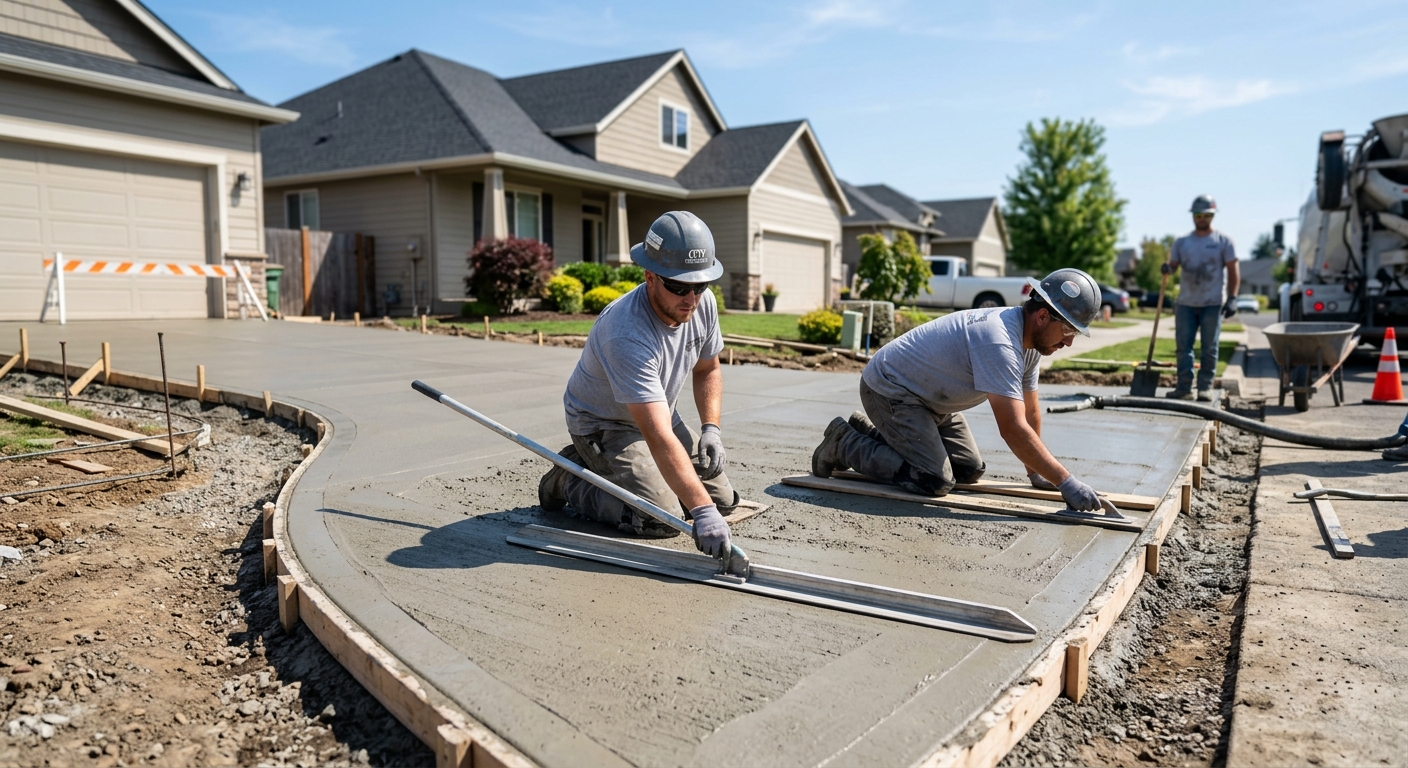
Concrete work options and costs in Stirling
Concrete work in Stirling is most often needed for driveways, patios and walkways that connect today’s homes to the street year-round. Stirling has a population of 2,030 (Statistics Canada, 2021 Census), and most homeowners are dealing with established neighbourhoods where stone, clay or mixed fill can sit under the surface. In this part of Ontario, the Toronto economic region’s freeze–thaw cycles directly affect how contractors price and spec concrete—especially because exterior slabs and pavements must handle repeated expansion and contraction. That’s why local crews typically plan for deeper, well-compacted support and use air-entrained mixes to resist surface damage and cracking.
Contractor availability and scheduling also matter. In the Toronto corridor, exterior pours are commonly concentrated in the warmer months to support proper curing. When temperatures drop toward 10 °C or below, curing slows and the risk of early surface scaling rises, so you may see add-on costs for cold-weather protection (insulating blankets and/or temporary heating). If your property is in an area with limited access—such as tighter residential lanes off the main roads—labour time increases because the crew may need additional prep for grade, forms, and concrete truck access.
In Stirling, driveways and flatwork are especially in demand around the built-up residential areas near the town core, where homeowners often upgrade older surfaces to improve traction, drainage and curb appeal. The next step is to compare common concrete options side-by-side, then match the spec to your soil, frost depth requirements, and desired appearance.
| Application |
Typical Size |
Key Spec |
Finish Option |
Price Range |
| Concrete driveway (standard broom finish) |
400–600 sq. ft. |
Air-entrained exterior mix; compacted granular base |
Broom finish |
$9,000 – $16,500 |
| Exposed aggregate driveway |
400–600 sq. ft. |
Air-entrained mix; proper curing window for exposure |
Exposed aggregate |
$11,500 – $20,500 |
| Stamped concrete driveway or patio |
300–600 sq. ft. |
Colour hardener or integral colour; control joints |
Stamped pattern |
$10,000 – $24,000 |
| Plain concrete patio or walkway |
150–300 sq. ft. |
Air-entrained mix; slope to drain |
Float + broom/brush texture |
$2,400 – $6,800 |
| Garage floor (interior slab) |
300–500 sq. ft. |
Reinforcement as required; vapour considerations |
Smooth steel trowel or light texture |
$6,000 – $11,500 |
| Foundation footings (structural, below frost) |
Per linear foot |
Engineered thickness; below-grade frost depth |
Structural concrete |
$180 – $300 |
Prices are estimates only and vary by project scope, site access and material selection.
What affects the price of concrete work in Stirling
In the Toronto economic region, quotes for the “same” concrete job can vary by roughly 30–50% because the hidden work is different: sub-base depth and compaction, reinforcement type and spacing, concrete mix design, and how well the crew can protect curing in cooler conditions. Two driveways that both measure 500 sq. ft. can land in very different price ranges if one contractor over-excavates for frost and drainage while the other relies on a thinner base and fewer drains.
Frost line depth and freeze–thaw cycles dictate every structural choice here. In Ontario, structural footings must extend below design frost depth (often in the 1.5–2.4 m range) to prevent frost heave and differential movement. Exterior flatwork also needs air-entrained concrete mixes to handle repeated freeze–thaw damage. When temperatures drop toward 10 °C or below during the pour period, contractors may add cold-weather curing precautions such as insulating blankets or temporary heating—extra labour and materials that increase total cost. Finally, de-icing salt accelerates surface spalling when the concrete mix and surface protection aren’t right, so sealing can be a smart value step rather than an afterthought.
In Stirling specifically, local soils and the slope of your yard often swing the price. If saturated clay is present, contractors may need additional granular drainage, which increases excavation and granular supply costs. Conversely, if your site has good grade, firm soil, and easy truck access, a standard broom-finished driveway can stay closer to the concrete driveway/slab range of $18–$28 per sq. ft. For upgrades, stamped concrete or exposed aggregate can cost more—often justified when you want better curb appeal and a finish that hides small surface variations, but you should verify the base and joints are still engineered correctly.
| Price Factor |
Why It Matters |
Cost Impact |
| Frost line depth — determines footing depth and form height |
Controls how far below grade concrete must be to prevent frost movement |
Deeper frost requirement typically raises excavation and formwork labour |
| Site preparation — excavation, grading, compacted granular base |
Strong drainage and support prevent settlement and early cracking |
Heavier excavation or poor subgrade increases material haul and time |
| Reinforcement — rebar or wire mesh requirement |
Helps control cracking and supports loads |
Additional steel and tie/walk time adds cost |
| Mix design — air-entrainment and compressive strength spec |
Improves freeze–thaw durability and strength reliability |
Higher-spec mix costs more per yard, but reduces failures |
| Finish type — broom vs. stamped vs. exposed aggregate |
Surface complexity affects crew time and materials |
Stamped/exposed often increases cost due to colouring, tools and labour |
| Pour size and concrete truck access to site |
Shorter pours and easier access reduce waiting and labour hours |
Tight access can require pump/alternate logistics or more manual handling |
| Cold-weather curing precautions — heating and blankets |
Maintains curing conditions when air temps fall |
Adds setup time, power/heat and protective materials |
| Control joint pattern and sealing cost |
Limits random cracking and improves resistance to salt scaling |
More joints and sealing line items increase the total but extend lifespan |
Permits & regulations in Ontario
In Ontario, structural concrete work almost always needs municipal involvement. Footings, foundation walls, and grade beams typically require a building permit, and many projects also rely on engineered drawings reviewed by the municipality. Concrete flatwork—patios, walkways and driveways—usually does not require a permit by itself unless it affects lot grading, drainage, impervious surface coverage limits, or ties into municipal right-of-way conditions. Even when a permit isn’t triggered directly, your project may still be subject to inspections tied to drainage and structural interfaces, so confirm before breaking ground.
For a homeowner in Stirling, the practical verification steps are straightforward. First, ask the contractor for their business details and proof of liability insurance (certificate of insurance showing coverage and limits). Second, confirm they carry WSIB coverage (or the applicable provincial coverage structure for the situation) and provide proof. Third, request references on similar projects in the same frost-and-flatwork category—driveways and exterior slabs, not just interior work. Finally, verify whether your municipal application is required for your specific scope (especially if you’re changing slopes, adding drains, or modifying access/sidewalk relationships).
To avoid gaps, request copies of: certificate of insurance, WSIB/WCB clearance (where applicable), and their written scope of work that states what they include (permit pulls if required, disposal, base prep depth, reinforcement, and concrete mix spec).
Getting concrete right in Stirling's freeze-thaw climate
Concrete problems in Stirling are usually about water and early durability failures. Freeze–thaw cycles can push moisture that sits in or under the slab, leading to settlement, cracking, and—most commonly on exterior flatwork—spalling when air-entrainment and finishing aren’t done correctly. The fix is to spec the job like it will be exposed to winter salt, not like a sheltered interior pour.
Start with base preparation: the slab needs a compacted granular sub-base to the right depth for local soil and the required support condition. If saturated soils are present, drainage and granular selection matter as much as the concrete itself. Next, use a proper mix: for exterior flatwork, contractors typically target about 5–7% air content and a minimum 32 MPa compressive strength so the concrete can tolerate freeze–thaw damage. Control joints are also essential—spacing and layout reduce random cracking and guide where shrinkage cracks can occur. Curing is another critical spec point: plan for at least 7 days under suitable conditions. In cold snaps, this is where Toronto-area contractors add protection so the concrete develops strength instead of surface scaling. After cure, sealing—often a penetrating sealer applied after full curing (commonly around 28 days)—helps repel de-icing salts.
If you’re comparing options, remember that saving on the wrong line item can cost more later. For example, a broom-finished patio might price closer to $16–$26 per sq. ft., while stamped concrete typically prices higher (often $24–$40 per sq. ft.). The extra cost is justified only if the base prep, joints, and air-entrained mix are fully addressed—otherwise the finish won’t prevent spalling or cracking.
When you interview contractors in Stirling, ask specifically how they prevent inadequate air-entrainment, because that’s a direct driver of winter spalling in exterior concrete.
| Spec |
Why It Matters in Stirling |
What to Ask For |
Impact if Skipped |
| Compacted granular base (depth?) |
Supports slab loads and limits moisture movement under freeze–thaw |
“What base depth will you excavate to, and what granular material will you use?” |
Settlement, cracking, and premature edge failure |
| Air-entrained concrete mix (target air %?) |
Creates freeze–thaw resistance by giving excess water room to expand |
“What air content will the mix target (about 5–7% for exterior flatwork)?” |
Higher risk of spalling and surface scaling after winters |
| Compressive strength (MPa rating) |
Ensures strength gain for durability and load performance |
“Will it meet at least 32 MPa?” |
Weaker surface and faster deterioration under salt and traffic |
| Control joints (spacing per ACI guidelines) |
Controls where shrinkage cracks form instead of random cracking |
“What joint spacing and layout will you use, and how will you saw-cut?” |
Uncontrolled cracking and water intrusion |
| Minimum 7-day curing period |
Cold mornings and cool evenings can slow strength development |
“How will you cure the concrete for at least 7 days, especially if temps drop?” |
Surface damage and reduced long-term durability |
| Penetrating sealer (when applied after cure) |
Salt exposure makes water and chloride penetration a major failure path |
“Will you apply a penetrating sealer after cure, commonly around 28 days?” |
More staining, scaling and spalling over multiple winters |
How to choose a concrete work contractor in Stirling
Choosing a concrete contractor in Stirling is mostly about verifying the basics and then insisting on a detailed scope. In Ontario, confirm they’re properly licensed for the work they’re doing (where applicable), and request proof of liability insurance—so you’re not exposed if something goes wrong with equipment or materials. Next, ask for WSIB/WCB coverage documentation. A legitimate contractor should provide clear certificates without hesitation.
For pricing, don’t accept a vague lump sum. Get 2–3 itemised written quotes that break out labour, materials (including concrete mix spec and reinforcement), excavation/grading, base prep and disposal. The scope should state whether they include: permit pull (if your project needs it), saw-cutting and joint sealing, cold-weather protection, and how they handle drainage. Also ask about warranty terms: workmanship warranty length, whether product/manufacturer warranties apply, and whether warranties transfer if you sell the home.
Payment scheduling should stay conservative. Never pay more than about 10–15% upfront for materials and mobilisation, and use a holdback until the job is complete and any curing/sealing steps are finished. Finally, request a written timeline with a proposed start date and completion estimate, along with weather contingency—freeze–thaw conditions and short pour windows in cooler stretches are real in the Toronto region, and your contractor should plan around them.
- Ask for a written scope with base depth, excavation limits and disposal details.
- Confirm air-entrained mix and target air content for exterior work.
- Require reinforcement details (where rebar or mesh is used and why).
- Ensure the quote includes control joint layout and whether sealing is included.
- Verify cold-weather protection plan if temps drop during pour or cure.
- Check liability insurance certificate limits and coverage dates.
- Provide WSIB/WCB coverage proof (ask for the clearance documentation).
- Confirm permit responsibility in writing (who pulls it if required).
- Get a concrete truck access plan for your lot (distance, staging, pumping if needed).
- Ask for examples of similar projects in the area (Stirling/close by) with photos.
- Use an itemised price sheet—no “one number” quotes.
- Hold back payment until joints, clean-up, and any sealer step are complete.
Concrete contractor red flags in Stirling: vague specs with no mention of air-entrainment or base depth; quotes that don’t address curing and cold-weather protection; “standard” joint spacing that ignores exterior cracking risk; reluctance to provide insurance/WSIB documentation; and payment terms that ask for large upfront deposits or no holdback.
Frequently asked questions — concrete work in Stirling
What is air-entrained concrete and why does it matter here?
Air-entrained concrete includes tiny, evenly distributed air bubbles in the mix. Those bubbles give freezing water space to expand, reducing internal pressure that would otherwise lead to spalling and surface scaling. In Stirling and across Ontario, freeze–thaw cycles are a major durability concern—especially for exterior flatwork like driveways, patios and walkways that see moisture and de-icing salt. That’s why contractors in the Toronto economic region usually specify an exterior mix designed for winter exposure, often targeting about 5–7% air content for flatwork. If a quote only mentions “concrete” without air-entrainment, you should treat it as incomplete. Even if the initial cost seems in line with the concrete driveway/slab range of $18–$28 per sq. ft., skipping the right mix can shorten service life and increase repair costs sooner than expected. (Statistics Canada, 2021 Census)
How do I prepare the base for a concrete slab?
Base preparation is where most long-term performance is decided. For a slab in Stirling, the contractor should excavate to the required sub-base depth for your soil conditions, then grade and compact granular material in lifts to achieve the support the concrete needs. This matters because exterior slabs are affected by frost and moisture movement; a thin or poorly compacted base can let the slab settle or heave over repeated winters. Ask your contractor what granular material they’re using (and why), how deep they’re excavating, and what compaction testing or checks they perform. Also confirm drainage: the slab should have an engineered slope so water doesn’t pond near foundations or garage doors. If you’re comparing quotes that land at very different totals for the same square footage, it’s often because one contractor is budgeting more excavation/compaction and doing it properly. A properly prepped base is part of why exterior slab pricing in this area commonly ranges around $16–$26 per sq. ft. for patios/walkways, even before finishes are added.
How do I compare concrete quotes?
To compare concrete quotes fairly in Stirling, focus on the line items behind the number. You want an itemised breakdown for base prep, excavation, reinforcement, concrete mix spec (including air-entrainment for exterior), finishing method, curing protection, joints and sealing (if included). A quote that only lists “labour + concrete” typically hides the real cost drivers—like whether the contractor is providing enough granular depth, using the correct mix for freeze–thaw, or planning for a cold evening cure. Also compare scope exclusions: is disposal included? Are protection and cleaning included? Who is responsible for permits if your driveway or flatwork affects drainage or grading rules? A useful comparison is to ask each contractor the same technical questions: target air content, compressive strength requirement (often at least 32 MPa for exterior work), and control joint spacing. If one option is near the $18–$28 per sq. ft. driveway/slab band and another is higher, the difference should be explained in specs—not just “brand name” materials.
Can concrete be poured in cold weather in Stirling?
Yes, concrete can be poured in cold weather in Stirling, but it must be managed correctly. The risk isn’t just that it’s cold; it’s that curing slows and the surface can scale if temperatures drop too far too soon. In the Toronto economic region, many crews plan pours for warmer months to ensure reliable curing, and when temperatures approach the low teens or fall toward around 10 °C or below, you should expect cold-weather precautions. Ask how the contractor will protect the pour: insulating blankets, heated enclosures (where practical), wind protection, and curing time adjustments. Your contract should specify minimum curing duration and what happens if weather changes mid-pour. A contractor who’s prepared will budget for protection rather than rushing the schedule. If a low quote ignores curing protection, it may “work” initially but can lead to higher maintenance needs after winter freeze–thaw cycles—exactly the failure path air-entrainment and curing are meant to prevent.
How do I maintain concrete in Stirling's freeze-thaw climate?
Maintenance in Stirling is mainly about water control and salt exposure. Keep an eye on drainage: ensure downspouts and grading direct water away from the edges of your slab and away from foundation contact points. During winter, use de-icing products carefully—rock salt and repeated applications can speed up surface scaling when the concrete is porous or unsealed. If your contractor applied a penetrating sealer (commonly after full cure, about 28 days), recoat timing depends on exposure and wear, but staying consistent with a maintenance plan helps. Visually inspect for early signs like hairline cracking that allows water to sit under the slab, spalling at edges, or lifting near joints. Address small issues early; spot repairs cost less than replacing a wide section. Also, avoid de-icing that’s too abrasive and don’t apply heavy loads immediately after a new pour—cure time matters for long-term durability in freeze–thaw climates.
What causes concrete to spall in Stirling winters?
Spalling typically happens when water gets into the concrete and freezes, expanding and breaking the surface. In Stirling’s Ontario climate, the most common causes include inadequate air-entrainment, poor curing, and water pathways from insufficient base drainage or joints that let moisture in. If the mix doesn’t have the correct air content for freeze–thaw resistance, the internal pressure from freezing water can crack and pop the surface over time. Another contributor is rushing the curing period, especially when temperatures drop and the concrete hasn’t developed the strength it needs. Salt aggravates the problem by increasing damage to the surface during repeated freeze–thaw cycles. That’s why local contractors stress both the mix design and protection steps. When you’re evaluating quotes—especially for exterior patios and driveways—don’t just compare finish prices. A driveway finishing upgrade (broom vs exposed aggregate vs stamped) won’t stop spalling if air-entrainment and curing weren’t handled correctly.