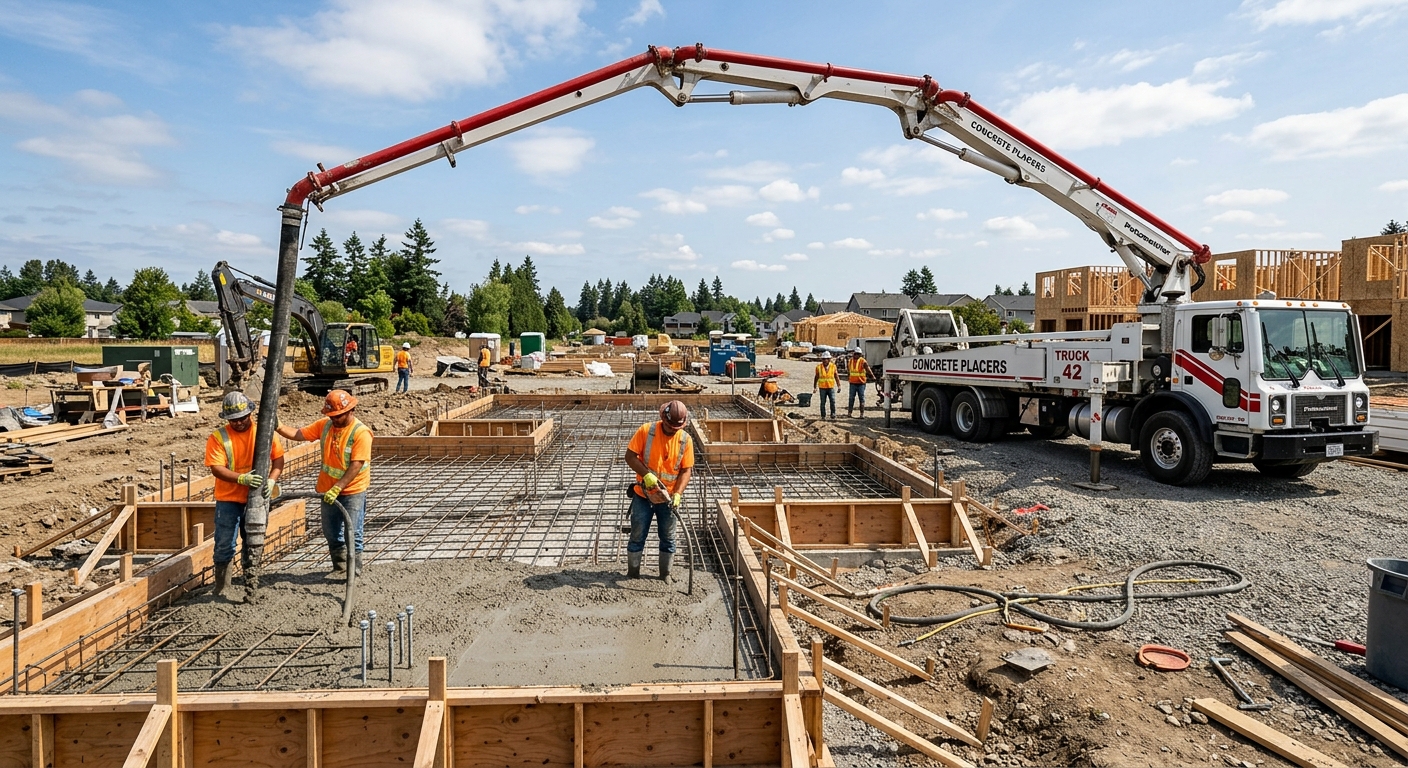
Concrete work options and costs in Rouge
Concrete projects in Rouge, Ontario are as much about managing winter performance as they are about appearance. With a population of 46,496 (Statistics Canada, 2021 Census), the area has an active homeowner market focused on curb appeal and long-life exterior surfaces—especially in established pockets of the community where driveways, patios, and walkways get replaced as homes age. Rouge is predominantly residential, and concrete flatwork is one of the most common upgrades you’ll see for single-detached properties that want durable, low-maintenance results.
In the Toronto economic region, contractors price concrete with frost depth and freeze–thaw in mind. Exterior work typically needs footings that extend at least 1.2 m below grade (often deeper depending on site and design), plus air-entrained concrete to resist spalling from repeated wetting and freezing. Because curing is temperature-sensitive, most driveway and patio pours are scheduled for the warmer months, and cold-weather protection can add labour and equipment costs when crews have to pour near 10 °C or below.
Labour availability also shifts through the season: in Rouge, you’ll usually see more scheduling capacity in late spring through early fall, while summer weather and short windows can tighten demand. One neighbourhood area where this trade tends to be especially in demand is around the more established residential streets near community hubs and older subdivision edges—where homeowners often replace failing surfaces rather than patch them.
Below is a practical comparison of common options so you can benchmark your quote before you call for an on-site measurement.
| Application |
Typical Size |
Key Spec |
Finish Option |
Price Range |
| Concrete driveway (standard broom finish) |
300–500 sq. ft. |
Air-entrained exterior mix, compacted granular base |
Broom finish, basic control joints |
$18,000 – $28,000 |
| Exposed aggregate driveway |
300–500 sq. ft. |
Air-entrained mix; proper retarder/wash timing |
Exposed aggregate (medium/small stone) |
$22,000 – $34,000 |
| Stamped concrete driveway or patio |
250–450 sq. ft. |
Reinforcement as required by design; air-entrainment |
Stamped pattern + integral or overlay colour |
$24,000 – $40,000 |
| Plain concrete patio or walkway |
120–300 sq. ft. |
Well-drained base, joints to control cracking |
Broom or smooth trowel (exterior) |
$2,000 – $7,800 |
| Garage floor (interior slab) |
400–650 sq. ft. |
Vapour barrier where needed; reinforcement if required |
Plain finish; optional power-trowel |
$10,000 – $18,000 |
| Foundation footings (structural, below frost) |
Per linear foot; typical house footprint |
Minimum frost-depth bearing; engineered rebar |
Structural concrete only |
$18,000 – $30,000 |
Prices are estimates only and vary by project scope, site access and material selection.
What affects the price of concrete work in Rouge
In Rouge and across the Toronto economic region, you can see the same “type” of concrete job priced 30–50% differently between quotes. The spread usually comes down to depth (frost and base), site prep effort, and how carefully the contractor designs for freeze–thaw. Even when finishes look similar, the underlying specs—air-entrainment, reinforcement, and joint layout—can change labour, materials, and how many passes a crew has to make.
Concrete pricing is strongly influenced by frost depth and freeze–thaw cycles. For structural footings and foundations, Ontario practice generally targets footings extending below the design frost depth—often around 1.2 m below grade in many Ontario conditions—to limit frost heave and differential movement. For exterior slabs like driveways and patios, contractors typically specify air-entrained concrete and adequate thickness so the surface survives repeated wetting, freezing, and thawing. When temperatures drop toward 10 °C or below, crews may need cold-weather curing precautions—heating or insulating blankets—which can add cost even if the pour itself is scheduled late.
Local conditions also change the amount of excavation and base repair you need. For example: a driveway replacement that requires removing saturated topsoil and hauling it away costs more than a straightforward overlay of sound sub-base; steep grades or poor drainage can require additional granular base and regrading; and older properties sometimes have buried services that slow excavation and add potholing. In many Rouge projects, you’ll also see a meaningful jump when switching from standard broom finish toward decorative work—moving from a typical concrete driveway band around $18–$28 into stamped pricing around $24–$40 is justified when the contractor includes proper reinforcement, formwork, and colour system for exterior durability.
| Price Factor |
Why It Matters |
Cost Impact |
| Frost line depth |
Determines footing depth and form height |
More excavation and concrete; higher labour |
| Site preparation |
Excavation, grading, compacted granular base |
Haul-off, rebase thickness changes price |
| Reinforcement |
Rebar or wire mesh requirement |
Material + labour for tying/placement |
| Mix design |
Air-entrainment and compressive strength spec |
Premium mix and higher QC handling |
| Finish type |
Broom vs. stamped vs. exposed aggregate |
More labour time and consumables |
| Pour size and concrete truck access to site |
Access affects pumping/placing time |
Truck/pump fees; crew efficiency |
| Cold-weather curing precautions |
Heating and blankets for late-season pours |
Equipment rental and extra supervision |
| Control joint pattern and sealing cost |
Crack control and moisture resistance |
Additional sawing labour and sealer materials |
Permits & regulations in Ontario
In Ontario, structural concrete work—such as footings, foundation walls, and grade beams—almost always requires a building permit, and the municipality may review engineered drawings or structural details before work starts. Concrete flatwork (like driveways, patios, and walkways) often does not require a permit, unless it affects lot grading, changes drainage patterns, or triggers municipal impervious surface/lot coverage rules, or it impacts the municipal right-of-way. Because Rouge projects can involve regrading or drainage adjustments, always confirm with the local authority before demolition or forms go down.
For contractor compliance, start by verifying three things: (1) Ontario contractor licensing/eligibility where applicable for the scope, (2) liability insurance, and (3) WSIB/WCB coverage for workers. Here’s a homeowner-friendly step-by-step checklist:
- Ask for the contractor’s licence details and the exact scope they are quoting (structural vs flatwork).
- Request a current certificate of insurance; verify it includes general liability and matches the project address.
- Ask for proof of WSIB/WCB clearance or equivalent coverage documents.
- Confirm whether they will pull any required permits for the structural portions, and who is responsible for inspections.
- Check references from similar-scale work (same frost-season exterior exposure and slab thickness).
Then, don’t skip the paperwork—proper insurance and coverage protect you when timing, excavation, and concrete placements don’t go perfectly as planned.
Getting concrete right in Rouge's freeze-thaw climate
Concrete failures in Rouge typically show up as surface scaling, spalling, and random cracking—most often caused by water getting into the slab or edges, then freezing and expanding. In the Toronto region’s humid fall/spring swings and repeated freeze–thaw cycles, the biggest preventable issue is inadequate air-entrainment in the mix. If the concrete can’t tolerate freeze–thaw internally, the surface deteriorates faster—sometimes within a few winters—especially where de-icing salt is used on driveways and steps.
To spec the job correctly, focus on five areas. First, base preparation: the concrete needs a properly graded and compacted granular sub-base sized to support frost conditions; a soft or saturated base leads to settlement and cracked edges. Second, mix design: for exterior flatwork, ask for air-entrainment (commonly about 5–7% air for exterior concrete) and a minimum 32 MPa compressive strength. Third, control joints: plan joint spacing so shrinkage and thermal stresses go where you want the cracks. Fourth, curing: plan for a minimum 7-day curing period under proper conditions; late-season pours may require insulating protection. Fifth, sealing: use a penetrating sealer after the cure (commonly at 28 days) to reduce the impact of meltwater and salts.
For example, if a standard broom driveway quote lands at the typical $18–$28 band but the cheaper option skips adequate base compaction or uses a lower spec mix, it can cost you twice later. Spending closer to the middle-to-upper end is often justified when it includes the right air content, correct thickness, and proper joint/surface protection for Rouge’s winters.
| Spec |
Why It Matters in Rouge |
What to Ask For |
Impact if Skipped |
| Compacted granular base (depth?) |
Prevents pumping/settlement during wet-freeze cycles |
Base thickness and compaction method stated in writing |
Cracking at edges, uneven surface, spalling acceleration |
| Air-entrained concrete mix (target air %?) |
Protects against freeze–thaw scaling and spalling |
Air content target (commonly 5–7% for exterior flatwork) |
Surface scaling and premature deterioration in 2–5 winters |
| Compressive strength (MPa rating) |
Supports durability and structural performance under loading |
Minimum 32 MPa stated on the mix/placement document |
Reduced durability and higher risk of surface damage |
| Control joints (spacing per ACI guidelines) |
Directs shrinkage/thermal cracking in a controlled pattern |
Joint layout and sawcut timing plan |
Random cracking, wider cracks, water ingress |
| Minimum 7-day curing period |
Strength gain depends on proper curing through temperature swings |
Curing plan and cold-weather protection if near season end |
Weak surfaces, early wear, higher failure risk |
| Penetrating sealer (when applied after cure) |
Reduces salt/water penetration on exterior slabs |
Apply after cure (commonly 28 days post-pour) |
More salt damage, faster scaling and joint deterioration |
How to choose a concrete work contractor in Rouge
Choosing a contractor in Rouge is less about who has the prettiest photos and more about who can document the details that protect concrete from freeze–thaw. Start with Ontario compliance checks. Ask for a current certificate of insurance (general liability) and verify the project location is listed or the coverage terms match your job. Next, request proof of WSIB/WCB coverage or a clearance letter—this confirms the workers are covered if an incident happens on your property. Then confirm they’re properly licensed/eligible for the scope they’re performing (structural vs flatwork can change expectations).
When you request quotes, ask for 2–3 written, itemised estimates—not just one lump sum. A solid quote separates labour and materials and spells out what’s included: excavation and haul-off, granular base type and depth, reinforcement, concrete mix specs, sawcut timing, and whether disposal is covered. Also clarify if permits are required for any structural portion and whether the contractor will manage the process.
Warranty matters, too. Look for a workmanship warranty length stated in writing, and ask whether any product/manufacturer warranty applies to the concrete systems (like sealers or decorative colouring) and whether it’s transferable to future owners.
Payment schedule should be conservative. In most homeowner projects, you should never pay more than about 10–15% upfront. Hold back the final portion until the work is complete and you’ve verified cleanup, edges, and curing/protection steps.
- Get a start date and completion estimate in writing.
- Confirm crew count and who finishes/boards/controls joints.
- Ask what mix design they use and whether it’s air-entrained for exterior.
- Request base thickness and compaction method in the scope.
- Verify reinforcement placement plan (ties/mesh position and coverage).
- Confirm sawcut timing and joint layout spacing.
- Ask how they handle drainage at the tie-in to existing grades.
- Clarify equipment access (truck, chute/pump) and site protection.
- Check whether cold-weather curing gear is included if timing is tight.
- Ask who supplies and applies sealer (and when) after the cure.
- Review exclusions: permit fees, sump/pump impacts, and unknown utilities.
- Ensure the contract lists cleanup and disposal of concrete/soil.
Red flags I’ve seen too often in the Rouge area: “too cheap to be true” pricing that omits air-entrainment or reinforcement language, quotes that don’t mention base depth/compaction, no proof of WSIB/WCB or insurance, no written joint/sealing plan, and contractors who ask for large upfront payments before any site work begins.
Frequently asked questions — concrete work in Rouge
What causes concrete to spall in Rouge winters?
Spalling in Rouge winters is usually driven by freeze–thaw stress plus water ingress. When water gets into tiny pores, cracks, or along edges, it expands as it freezes, breaking surface paste and exposing aggregate. De-icing salt makes this worse by increasing the number of freeze events at the surface. The most common root cause we see on exterior flatwork is inadequate air-entrainment (or the wrong mix spec), which means the concrete can’t handle freeze–thaw internally. Secondary contributors include poor drainage, insufficient base support (so the slab flexes), and control joints that are missing or cut too late. If you’re comparing quotes, a standard broom driveway often sits around $18–$28 depending on scope—if the cheaper option leaves out air-entrainment and proper joint/sealing steps, it tends to cost more in repairs later.
What is rebar and when is it required in Ontario?
Rebar (reinforcing steel) is used to strengthen concrete against cracking and to control crack widths under loads and movement. In Ontario, whether rebar is required depends on engineering/design requirements, slab thickness, soil conditions, and the purpose of the concrete element. For structural work—like foundation walls and footings—reinforcement is determined by the structural drawings and the engineered design. For exterior slabs such as driveways, some projects use mesh or rebar based on thickness, sub-base condition, and load expectations (for example, heavier vehicles). Even when rebar isn’t mandated for every patio, the contractor should still explain the reinforcement approach and why it’s adequate for freeze–thaw movement and loading. Ask your contractor to state whether mesh/rebar is included, the placement method, and the concrete cover, because correct placement is as important as the steel itself.
How long does a concrete project take in Rouge?
Timing in Rouge depends on size, site access, and weather windows for curing. A typical driveway replacement can take about 1–3 days of active work, but the concrete needs a minimum curing period before you can treat the surface as fully protected. For most mixes, plan on at least 7 days for initial curing before heavier use, with sealing commonly scheduled around 28 days post-pour. Patios and walkways are often faster—sometimes 1–2 days of work plus curing. If you’re pouring during cooler shoulder-season weather, crews may extend the schedule due to cold-weather curing precautions (like insulated blankets/heating) to prevent early strength loss. Also remember that excavation, forms, and disposal can add time if there are obstacles or saturated soils.
What is a concrete overlay and is it suited to Rouge?
A concrete overlay is placing new concrete (or sometimes a thin resurfacing system) over an existing slab, usually after surface preparation like cleaning, profiling, and repair of spalls/cracks. Overlays can work in Rouge when the original slab is structurally sound and properly prepped—because freeze–thaw resistance depends on preventing moisture pathways beneath the new surface. If the old slab has widespread scaling, failed base support, or recurring settlement, an overlay may only postpone failure. That’s why contractors should evaluate base condition and crack patterns, not just the surface. From a cost perspective, overlays can be tempting versus full replacement, but if the existing drainage issues are still present, you’ll likely pay again. For homeowners, compare the overlay scope against a full replacement budget—driveways typically fall in the $18–$28 band, while decorative upgrades like stamped concrete usually land higher (often $24–$40 depending on size and finish).
How do I seal concrete to protect it in Rouge?
Sealing protects by reducing how easily water and de-icing salts penetrate the concrete surface, which matters in Rouge due to repeated freeze–thaw. The key is timing and product choice. Most penetrating sealers are applied after the concrete has fully cured—commonly around 28 days post-pour—so you don’t trap moisture inside. Before sealing, the surface must be clean, dry, and free of curing compounds or contaminants; otherwise, the sealer may not bond. Apply according to the sealer manufacturer’s coverage rates and weather requirements. If your contractor suggested sealing as part of a driveway or patio plan, ask which sealer they use, when it will be applied, and how they’ll prep the surface. Sealing isn’t a substitute for correct air-entrained mix, base compaction, and joint design, but it’s a strong added layer of protection for Toronto-area winters.
What is the difference between concrete and cement?
Cement and concrete are related, but they’re not the same. Cement is one ingredient—the binder—made from materials like limestone and clay. Concrete is the final building material created by mixing cement with water, sand, gravel (or other aggregate), and often admixtures such as air-entrainment for exterior freeze–thaw durability. That’s why the “spec” matters: two concretes can have the same cement but perform very differently if the air content, water-cement ratio, curing approach, or strength target changes. For Rouge homeowners, the performance concern is freeze–thaw resistance and durability under de-icing salt. That’s why reputable contractors specify air-entrained concrete and adequate curing for exterior slabs, regardless of whether the job is a standard broom driveway or a decorative stamped finish. When you see pricing differences, ask what concrete mix design is included—not just what the finish looks like.