Concrete work options and costs in Rockcliffe-Smythe
Rockcliffe-Smythe has a lot of curb appeal riding on concrete, from driveways to patios and walkways. With a population of 22,246 (Statistics Canada, 2021 Census), the area is busy enough that crews can usually schedule exterior work in the spring and summer—but it’s still competitive for mid-season dates. Most homeowners here are in traditional single-detached neighbourhoods, and that housing pattern drives steady demand for slab work: driveways for vehicles, sidewalks for daily access, and patio pads that match how families live outdoors. It’s also why even “simple” jobs tend to be priced carefully, because base prep and drainage details are scrutinized the first time the snow melts and the freeze–thaw cycle starts again.
In the Toronto economic region, costs are strongly shaped by frost depth requirements and repeated freeze–thaw cycles. Ontario typically requires structural footings to extend at least about 1.2 m below grade to help control frost heave and differential movement, and exterior flatwork needs air-entrained mixes plus proper control joints to manage cracking. Pour timing matters too: when temperatures drop toward 10 °C or below, crews may need added protection for curing to ensure the slab reaches strength reliably.
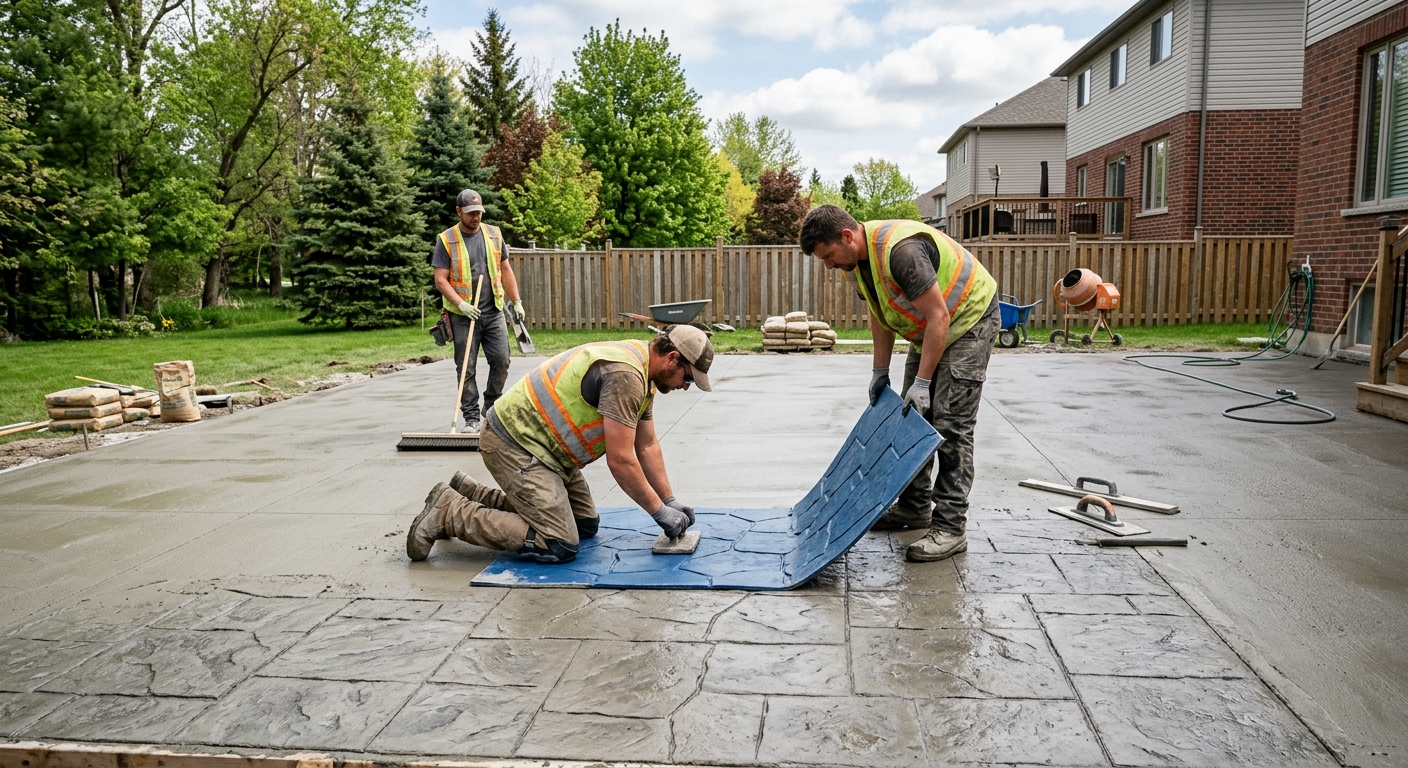
If you’re comparing options, you’ll notice standard broom-finished concrete is usually the lowest-cost path, while stamped and exposed aggregate come with higher material and labour time. Stacked demand is especially common around established pockets near major arterial roads and schools—homeowners there often upgrade driveways and entry walkways to keep up with both appearance and wear.
The table below summarizes typical options and what you can expect to pay in Rockcliffe-Smythe.
| Application |
Typical Size |
Key Spec |
Finish Option |
Price Range |
| Concrete driveway (standard broom finish) |
400–600 sq. ft. |
Air-entrained mix, compacted granular base, control joints |
Broomed |
$18,000–$28,000 |
| Exposed aggregate driveway |
400–600 sq. ft. |
Air-entrained mix, correct cure timing for wash/expose |
Exposed aggregate texture |
$24,000–$36,000 |
| Stamped concrete driveway or patio |
300–500 sq. ft. |
Air-entrained mix, integral colour (where specified) |
Stamped pattern + colour |
$24,000–$40,000 |
| Plain concrete patio or walkway |
200–400 sq. ft. |
Air-entrained mix, drainage slope, control joints |
Broomed/steel trowel (finish varies) |
$16,000–$26,000 |
| Garage floor (interior slab) |
320–480 sq. ft. |
Vapour control where needed, proper sub-base and rebar as required |
Steel-trowel or light broom |
$14,000–$24,000 |
| Foundation footings (structural, below frost) |
Varies by foundation layout |
Engineered footing dimensions, rebar, concrete below frost line |
Formed structural concrete |
$180,000–$300,000 |
Prices are estimates only and vary by project scope, site access and material selection.
What affects the price of concrete work in Rockcliffe-Smythe
In Rockcliffe-Smythe and the wider Toronto region, the same “looking” concrete job can land 30–50% apart in price because the real drivers aren’t the finish alone—they’re the specs required to survive freeze–thaw, plus how hard the site is to prepare. Contractors who price low often get there by trimming base prep, reducing reinforcement scope, or assuming easier curing conditions than you’ll actually have. In contrast, bids that include the right base depth, air-entrainment, and proper jointing reflect the reality of Ontario winters and spring thaw.
Frost depth and freeze–thaw cycles dictate almost every structural and exterior specification. Footings must extend below the local design frost depth (in Ontario commonly around 1.5–2.4 m depending on design and conditions) so soils don’t heave and crack foundations. Exterior slabs and flatwork need air-entrained concrete mixes to survive repeated expansion and contraction. When the pour season is short or when late fall/early spring weather pushes temperatures toward 10 °C or below, cold-weather curing precautions—insulating blankets, heated enclosures for the forms, and longer protection—add cost. Add de-icing salt to that, and surface spalling becomes a bigger risk if the slab isn’t sealed and maintained properly.
Two common Rockcliffe-Smythe examples: (1) a driveway replacement where excavation hits soft, saturated subgrade often costs more because we remove/replace and rebuild a compacted granular base; (2) a walkway poured close to a landscaped area can be priced higher due to restricted truck access and more labour for careful forming and finishing. That’s also why a basic plain patio near the lower end of the $16,000–$26,000 band can jump toward the top when you need extra drainage detailing and heavier base, while stamped work near $24,000–$40,000 is justified when you’re paying for labour-intensive pattern setting and finishing time—not just “colour and stamps.”
Older housing stock in the GTA typically means more tie-ins: existing slopes may be off, drainage may be compromised, and tie-in saw cuts can add labour. Those small site realities show up in the dollars.
| Price Factor |
Why It Matters |
Cost Impact |
| Frost line depth |
Determines how deep footings/forms must go to prevent heave |
Higher footing excavation and concrete volume when deeper |
| Site preparation |
Controls settlement and prevents saturated subgrade pumping |
Costs rise with hauling, grading, and granular base rebuild |
| Reinforcement |
Reduces shrinkage cracking and improves slab performance |
Rebar and wire mesh add material and placement labour |
| Mix design |
Air-entrainment and strength targets improve freeze–thaw durability |
Air-entrained spec can add marginal cost but reduces failures |
| Finish type |
Finish drives labour time and finishing control needs |
Stamped/exposed aggregate typically increases unit labour |
| Pour size and concrete truck access to site |
Access affects line-up time, pump needs, and labour coordination |
Limited access can mean extra crew time or pumping charges |
| Cold-weather curing precautions |
Protects early-age concrete when temperatures are near/under thresholds |
Blankets/heaters can add significant line-item cost |
| Control joint pattern and sealing cost |
Joints manage cracking and sealing helps resist salt scaling |
Proper jointing and sealer add cost but extend service life |
Permits & regulations in Ontario
In Ontario, structural concrete work—think foundation walls, grade beams, and structural footing systems—generally falls under municipal building permitting. In many cases, engineered drawings are required or reviewed by the municipality to confirm footing sizes, reinforcement, and load paths. For example, if you’re doing new footings, underpinning, or changes that affect the foundation system, expect a permit workflow and often engineering involvement.
Concrete flatwork like patios, walkways, and driveways typically does not require a separate building permit as a stand-alone project—provided you’re not changing lot grading in a way that conflicts with stormwater management, impervious surface limits, or drainage/Right-of-Way requirements. However, even when a permit isn’t required for the concrete itself, homeowners still need to confirm municipal rules related to drainage, eavestrough discharge, and surface water management.
Here’s a simple step-by-step homeowner check in Rockcliffe-Smythe:
- Ask the contractor for a copy of their liability insurance certificate and confirm the project address is covered.
- Verify they carry WSIB coverage (or WCB) for their workers—request the clearance letter or proof of account status.
- Confirm the contractor’s licensing/registration requirements through Ontario’s applicable online resources (use the contractor’s legal business name, not a brand name).
- Request references from similar foundation or flatwork jobs, ideally within the last 2–3 seasons.
- For structural work, confirm the permit is pulled before excavation begins, and ask who is responsible for inspections.
When in doubt, call the local building department before demolition—stopping the job for a permitting issue late in the schedule is one of the easiest ways to add cost.
Getting concrete right in Rockcliffe-Smythe's freeze-thaw climate
Concrete can struggle in Rockcliffe-Smythe when water gets in and expands during freeze–thaw. The two biggest culprits we see are inadequate base preparation and poor mix design—especially inadequate air-entrainment, which leads to freeze–thaw damage and eventually spalling. The fix starts before the truck arrives: you need a compacted granular base to the correct depth for your soil and local frost considerations, proper drainage so water doesn’t sit under the slab, and a mix spec that can handle Ontario winters.
For an exterior flatwork job, the mix should be air-entrained (typically about 5–7% air content for exterior slabs) and meet a minimum compressive strength target such as 32 MPa (project-specific specs can vary with exposure). Next comes control joints: spacing should limit random cracking into manageable areas. Then curing: don’t treat curing like “set and done.” In this Toronto-area climate, we plan for at least 7 days of proper curing conditions, and when temperatures drop, we protect the slab with insulation and windbreaks. After cure, sealing matters because de-icing salts can accelerate surface scaling—apply a penetrating sealer after the concrete has fully cured, commonly around 28 days post-pour.
If you’re choosing between options, here’s where dollars are justified: it’s common to see a plain patio priced near the $16,000–$26,000 band, and stamped work near $24,000–$40,000. Stamping costs more because it requires extra finishing time, careful curing/colour steps, and more labour for pattern alignment—so you’re paying for both aesthetics and process control. But if a low bid cuts base depth or uses the wrong air content, you can “save” money upfront and pay for replacement later, often within a few winters.
Ask your contractor the technical questions—air content, base depth, joint plan, curing protection—and you’ll avoid most failures tied to spalling and premature surface deterioration.
| Spec |
Why It Matters in Rockcliffe-Smythe |
What to Ask For |
Impact if Skipped |
| Compacted granular base (depth?) |
Prevents settlement and keeps water from saturating the soil beneath |
Base depth and compaction method based on your soil and slab thickness |
Uneven settlement, premature cracking, and water-driven failure |
| Air-entrained concrete mix (target air %?) |
Reduces freeze–thaw damage and helps prevent spalling |
Documented target air content and exposure/mix design for exterior use |
Freeze–thaw scaling, pop-outs, and surface deterioration |
| Compressive strength (MPa rating) |
Ensures the slab reaches the strength needed for durability and load |
Minimum 32 MPa (or project-specific rating) and mix design confirmation |
Soft early-age concrete and higher risk of surface damage |
| Control joints (spacing per ACI guidelines) |
Manages shrinkage cracking to predictable locations |
Planned joint spacing, saw-cut timing, and joint sealing details |
Random cracks and moisture paths for freeze–thaw to worsen |
| Minimum 7-day curing period |
Protects early-age concrete during the critical strength-gain phase |
Curing plan, including temperature/wind protection if it’s cool |
Weaker concrete and higher risk of surface scaling |
| Penetrating sealer (when applied after cure) |
Repels water and helps resist de-icing salt effects on the surface |
Sealer type and timing—commonly after full cure (around 28 days) |
Faster salt damage and reduced service life |
How to choose a concrete work contractor in Rockcliffe-Smythe
Choosing the right contractor is the difference between a driveway that looks good for years and one that starts cracking or spalling after a couple of winters. Start with Ontario coverage checks. Ask for their liability insurance certificate and make sure it’s current and lists your project as covered. Next, verify WSIB/WCB coverage—request the clearance letter or proof of account status so you’re not left dealing with issues related to uninsured workers. Then confirm their licensing/registration credentials through Ontario’s appropriate online registry using the legal business name.
After that, get 2–3 itemised written quotes rather than a single lump sum. A proper quote breaks down labour and materials (excavation, granular base, rebar/wire mesh, concrete supply, forms, finishing, saw-cut joints, sealing) and explains what’s included for disposal and any pump/truck access challenges. Pay attention to exclusions: Is permit pulling included for structural work? Is the cost of subgrade replacement or drainage corrections included if conditions are worse than expected? A responsible contractor will describe allowances and how they’ll price changes if they uncover additional excavation needs.
Warranty matters too. Ask for a workmanship warranty length and whether product/manufacturer warranties apply to sealers or specialty materials. Confirm whether warranties are transferable if you sell the home.
On payment schedule, don’t fund the job heavily up front—generally keep deposits around 10–15% and hold back a portion until completion and final clean-up are done. Finally, insist on a written start date and completion estimate. In Rockcliffe-Smythe, weather can compress schedules—protect yourself with dates and protection plans.
- Provide liability insurance certificate (confirm project address coverage).
- Provide WSIB/WCB clearance/proof and confirm it covers all workers.
- Use a legal business name for registry/licensing checks.
- Get itemised quotes: labour, concrete, base material, rebar/mesh, finishing, sealing.
- Confirm disposal/haul-away is included or priced separately.
- Ask who determines footing depth and base depth based on site conditions.
- Request a mix spec with air-entrainment and minimum strength (e.g., 32 MPa for exterior).
- Ask about control joint pattern and saw-cut timing.
- Confirm curing protection plan if daytime temps are cool.
- Verify sealing plan (type and when it’s applied—often after cure around 28 days).
- Get timeline in writing: start date, curing window, and completion estimate.
- Limit upfront payment to about 10–15% and hold back until final acceptance.
Concrete contractor red flags we see in Rockcliffe-Smythe: (1) they won’t discuss air-entrainment or joint spacing; (2) “cheap” quotes that assume stable soil without contingency for subgrade replacement; (3) no curing/protection plan when temperatures are cool; (4) skipping sealing where de-icing salts are in play; and (5) vague warranties or no written scope (especially around base depth and drainage).
Frequently asked questions — concrete work in Rockcliffe-Smythe
How do I maintain concrete in Rockcliffe-Smythe's freeze-thaw climate?
In Rockcliffe-Smythe, maintenance is mostly about keeping water and salt from attacking the surface. First, clear snow promptly and avoid letting piles sit in the same spot for days; trapped moisture accelerates freeze–thaw wear. Use de-icing products as directed—salt is effective but harsh on surfaces over time. If you had new exterior concrete poured, a penetrating sealer applied after proper cure (often around 28 days post-pour) can help repel water and reduce salt scaling. For existing slabs, re-seal when the surface starts to look less water-repellent. Inspect seasonally for early signs like surface scaling, small pop-outs, or widening joints, and address drainage issues around eavestrough discharge or low spots before cracks grow.
What causes concrete to spall in Rockcliffe-Smythe winters?
Spalling—flaking or scaling of the surface—usually comes from water getting into the concrete and then freezing repeatedly. In Ontario’s freeze–thaw cycle, this is made worse when the concrete mix isn’t properly air-entrained or when the slab is too thin for the site and load. Salt (de-icing) compounds the problem by increasing damage at the surface during cold periods. Another common contributor is base and drainage issues: if water pools under or near the slab, the freeze–thaw process becomes more severe. When spalling appears, it’s often not something you “seal over” forever. The durable fix is typically addressing mix spec, ensuring the right thickness and base prep, and using proper curing during the first week.
What is rebar and when is it required in Ontario?
Rebar is steel reinforcement placed in concrete to improve tensile capacity and help control cracking under load and shrinkage. In Ontario, whether rebar is required depends on the structural design and the slab’s purpose—driveways and exterior flatwork typically include reinforcement or welded wire mesh when engineered for the expected loads and when the design calls for it. For structural elements like foundation footings and grade beams, rebar is commonly specified by engineers as part of the load-bearing system. For non-structural patios, reinforcement may be reduced or omitted if the design and thickness are appropriate, but it still can be important in freeze–thaw climates to limit cracking. Your best move is to ask your contractor to identify where reinforcement is included in the quote and to provide the mix and thickness spec that matches the reinforcement plan.
How long does a concrete project take in Rockcliffe-Smythe?
Timeline depends on the scope and, in Rockcliffe-Smythe, the season. For small exterior work like a walkway or patio, the crew may pour and finish in one day, but the project isn’t “complete” right away because curing protection matters. In typical conditions, you’ll plan for a minimum of 7 days of curing before you fully load or treat it as complete for long-term durability. For driveways, it can take longer due to forms, base preparation, joint layout, and finish work—especially if you’re doing stamped concrete. If the weather cools toward 10 °C or below, contractors often add insulating blankets or heat protection, which can extend the calendar. If your quote is, for example, in the $16,000–$26,000 patio/walkway band, the schedule can still shift if base correction or drainage work is needed.
What is a concrete overlay and is it suited to Rockcliffe-Smythe?
A concrete overlay is an additional concrete layer placed on top of an existing slab—often to restore appearance or create a new surface without full removal. In Rockcliffe-Smythe, overlays can be a fit when the existing concrete is still structurally sound (no major settlement, heaving, or deep delamination) and when joints and drainage are properly managed. Overlays are less suitable when there are ongoing problems like widespread cracking from soil movement or serious spalling with water intrusion; placing new concrete over failing conditions usually leads to a repeat failure. Whether an overlay works comes down to existing slab condition, moisture problems, and how well the base preparation is done. A proper assessment should be part of your contractor’s quote process—don’t accept an overlay recommendation without inspecting the slab, checking thickness, and confirming how they’ll prep the surface for bond.
How do I seal concrete to protect it in Rockcliffe-Smythe?
Sealing helps protect concrete from water and salt effects, which is important in Ontario winters. The key is timing: sealers generally should be applied after the concrete has cured fully—commonly around 28 days post-pour for new exterior work—so you’re not trapping moisture in the slab. Use a penetrating sealer intended for concrete (not just a decorative coating) and follow the label for surface prep requirements, temperature, and application method. Before sealing, the surface should be clean and dry; pressure washing and letting it dry completely is often needed for best results. For ongoing protection, keep de-icing use reasonable and avoid heavy salt accumulation in one spot. If you’re comparing options, sealing is one of the reasons a properly detailed project within the $18,000–$28,000 driveway band can outperform a cheaper “no-protection” approach in the first few winters—because the slab is built and protected for freeze–thaw durability from day one.