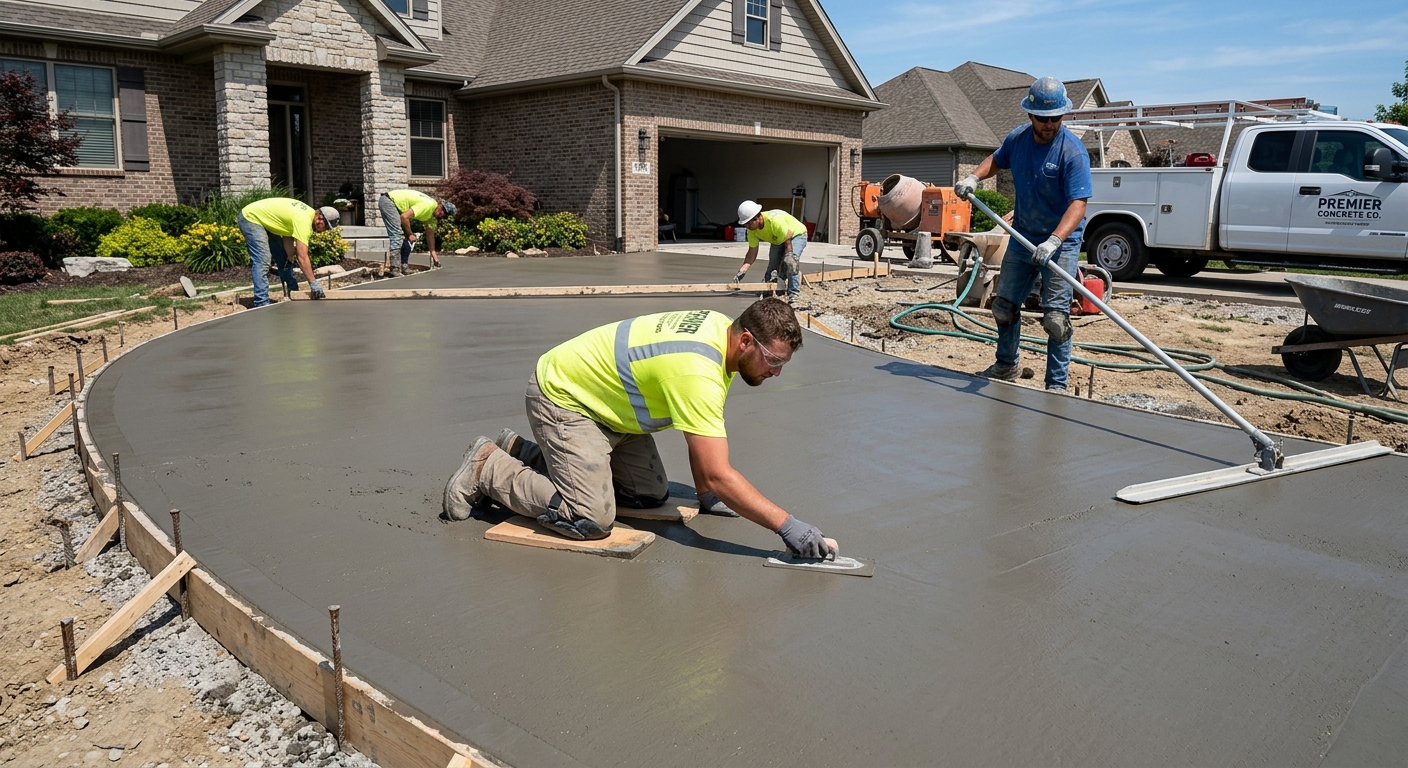
Concrete work options and costs in Lindsay
Lindsay is a great place to invest in durable concrete flatwork, from driveways to patios and walkways, especially with the town’s older housing stock and regular freeze-thaw cycles. As of the 2021 Census, about 88.9% of occupied private dwellings in Lindsay are single-detached homes (Statistics Canada, 2021 Census), and that matters because most residential concrete projects—driveways, garage slabs, and rear patios—are tied to these lots and their grading. With a population of 20,354 (Statistics Canada, 2021 Census), local trades stay busy when the weather window opens, which can affect scheduling and labour availability.
In the Kingston–Pembroke region, pricing is shaped less by “the slab” and more by what’s around it: frost depth, repeated freeze-thaw, site drainage, and how quickly a contractor can protect the pour in cooler shoulder-season temperatures. Exterior work typically needs air-entrained concrete, well-compacted granular base, and properly planned control joints to reduce cracking and surface spalling. If you’re in a neighbourhood with older soil conditions or tighter access—often seen around areas like West Street and the Downtown/Core edge—excavation and delivery logistics can push costs toward the top of the range.
Below is a practical comparison of common options so you can translate a quote into like-for-like scope.
| Application |
Typical Size |
Key Spec |
Finish Option |
Price Range |
| Concrete driveway (standard broom finish) |
16 m x 4 m (64 m²) |
Air-entrained mix for exterior, compacted granular base, control joints |
Broom finish + seal (optional) |
$120–$180 |
| Exposed aggregate driveway |
16 m x 4 m (64 m²) |
Air-entrained mix, careful set/wash timing, proper base and drainage |
Exposed aggregate finish |
$145–$210 |
| Stamped concrete driveway or patio |
10 m x 3.5 m (35 m²) |
Air-entrained mix, integral colouring, tighter finishing tolerances |
Stamped with colour + sealer |
$160–$280 |
| Plain concrete patio or walkway |
6 m x 3 m (18 m²) |
Air-entrained exterior mix, compacted base, control joints |
Smooth trowel or broom (match existing style) |
$90–$150 |
| Garage floor (interior slab) |
6 m x 6 m (36 m²) |
Engineered base prep, vapour considerations, fibre or mesh as specified |
Broom or light float finish |
$115–$175 |
| Foundation footings (structural, below frost) |
Typical house perimeter (variable) |
Structural concrete, excavation to below frost, rebar per engineering |
Structural formwork + properly cured concrete |
$180–$320 |
Prices are estimates only and vary by project scope, site access and material selection.
What affects the price of concrete work in Lindsay
In Lindsay, it’s common to see quotes for a “similar-looking” concrete job swing by 30–50% across the Kingston–Pembroke region and Southern Ontario. The slab thickness and square footage are only part of the equation. Two contractors can quote the same driveway size but price very differently once you account for excavation complexity, how much granular base is needed (and how well it’s compacted), reinforcement quantity, formwork, concrete delivery distance, and the cost of protecting the pour during cooler weather.
Climate drives a lot of the spec. Frost line depth and freeze-thaw cycles mean footings must extend below the design frost depth to prevent frost heave, and exterior slabs should be air-entrained to survive repeated wetting and thawing. Ontario practice commonly targets deeper footing depths (around 1.2 m below grade as a baseline, with colder pockets sometimes requiring more). A shorter warm-weather pour season can also increase labour scheduling costs. When surface conditions are damp or cool, concrete strength gain slows, so contractors must be disciplined with curing and traffic control—otherwise you risk early surface damage. De-icing salt in winter then accelerates scaling if the finish and sealing plan aren’t right.
In practical terms for Lindsay: (1) a driveway over clay that needs extra base and improved drainage usually costs closer to the $120–$180 band for standard work and higher if you add reinforcement or tricky grading; (2) stamped concrete costs more—often $160–$280—because colouring, stamping, and sealing require tighter finishing tolerances; and (3) garage floors can be less expensive than exterior work because they avoid the same level of exposure and salt risk, but they still need correct sub-base and crack control.
| Price Factor |
Why It Matters |
Cost Impact |
| Frost line depth — determines footing depth and form height |
Controls excavation quantity and how deep the structure must be built to prevent heaving. |
High swing potential where frost or soil conditions require deeper work |
| Site preparation — excavation, grading, compacted granular base |
Bad base leads to settlement and cracking; proper compaction is non-negotiable in freeze-thaw. |
Often the biggest driver for driveway/sidewalk pricing |
| Reinforcement — rebar or wire mesh requirement |
Helps control shrinkage and structural cracking, especially for driveways and garage floors. |
Can add meaningful cost if required or if thickness increases |
| Mix design — air-entrainment and compressive strength spec |
Air-entrainment improves durability against freeze-thaw and helps reduce spalling. |
Moderate increase, but it protects the finish long-term |
| Finish type — broom vs. stamped vs. exposed aggregate |
More complex finishes require skilled labour, additional materials and careful timing. |
Stamped/exposed typically jump toward the top end of the band |
| Pour size and concrete truck access to site |
Tight access increases labour and may require additional pumping/hoses or smaller loads. |
Can raise cost quickly in older neighbourhoods with narrow approaches |
| Cold-weather curing precautions — heating and blankets |
Warm-enough curing protects strength gain; cold delays risk surface damage. |
More common in shoulder-season schedules; adds labour/material costs |
| Control joint pattern and sealing cost |
Proper joints reduce random cracking; sealing helps repel de-icing salt and moisture. |
Small per-metre cost, but significant for durability |
Permits & regulations in Ontario
In Ontario, many structural concrete tasks require a building permit—especially work that affects a home’s structural system. For typical residential builds and major structural repairs, footings, foundation walls, grade beams, and structural slabs are the kind of concrete work that usually requires a permit and often engineered drawings that get reviewed by the municipality. Concrete flatwork—patios, walkways, and standard driveways—typically does not require a permit, unless it changes lot grading, impacts stormwater drainage, affects impervious surface coverage limits, or encroaches into areas governed by municipal approvals. Because rules can hinge on lot conditions, always confirm with the City/municipal authority before excavation.
Step-by-step, here’s how a homeowner in Lindsay can verify the contractor they’re hiring:
- Ask for their certificate of insurance showing general liability limits (request the actual document, not just a summary).
- Confirm WSIB/WCB coverage documentation for the workers involved.
- Look for a contractor registration/licence (where applicable for their work category) through the appropriate provincial registry and/or the contractor’s own licence number on invoices/quotes.
- Request proof of workmanship warranty and references from jobs similar in size to yours.
- Verify they include key items in writing: reinforcement, drainage details, protection for cool weather pours, and disposal of excavated materials.
If a contractor can’t clearly show insurance and coverage paperwork, or refuses to put scope details in writing, that’s a major red flag—especially with frost-sensitive work that needs to be done correctly the first time.
Getting concrete right in Lindsay's freeze-thaw climate
Concrete in Lindsay has a simple enemy: water, then freezing. When water gets into the surface or near the base, freeze-thaw cycles expand it, and you can see issues like scaling, pop-outs, and spalling—especially on exterior flatwork exposed to rain, snowmelt, and de-icing salts. The way to spec the job correctly is to treat it like a system: base, mix, joints, curing and (often) sealing. In the Kingston–Pembroke market, I see failures most often when contractors cut corners on base prep or skip the air-entrainment/curing discipline needed for Ontario winters.
(1) Base preparation: use compacted granular sub-base to the correct depth for local soil and frost considerations. If the base is too thin or poorly compacted, the slab can settle and crack, letting water in. (2) Mix design: exterior concrete should use air-entrained mix (commonly 5–7% air) and a minimum 32 MPa compressive strength for typical residential flatwork specs. (3) Control joints: plan joint spacing so cracking is directed and predictable instead of random. (4) Curing: plan for minimum 7 days of curing under proper conditions; cold weather often requires blankets or temporary heat to keep the surface safe while strength develops. (5) Sealing: apply a penetrating sealer after the concrete has cured—typically around 28 days post-pour—to help repel de-icing salts.
How this shows up in your wallet: choosing a standard broom-finished driveway at roughly $120–$180 per m² might be lower upfront, but if you then want longevity, you’ll often spend a bit more on correct air-entrainment, base depth and sealing. Stamped concrete can run around $160–$280 per m²; that extra cost is justified when the contractor is experienced with timing, curing control and proper sealing—otherwise the decorative surface can still fail like any other exterior slab.
| Spec |
Why It Matters in Lindsay |
What to Ask For |
Impact if Skipped |
| Compacted granular base (depth?) |
Stable support prevents settlement and reduces water entry under the slab in freeze-thaw. |
Ask for base thickness, compaction method (e.g., plate compactor), and drainage strategy |
Premature cracking, uneven slab, and accelerated deterioration |
| Air-entrained concrete mix (target air %?) |
Freeze-thaw durability depends on controlled microscopic air voids. |
Ask for target air content (commonly 5–7% for exterior flatwork) |
Higher risk of spalling and scaling within a few winters |
| Compressive strength (MPa rating) |
Sufficient strength gain supports surface durability and resists early damage. |
Ask for minimum 32 MPa and the curing plan for your pour date |
Surface wear, dusting, and weaker bond to finishing |
| Control joints (spacing per ACI guidelines) |
Directs shrinkage cracking where it’s designed to be repaired/managed. |
Ask for joint spacing and whether joints will be saw-cut at the right time |
Random cracking and water infiltration through uncontrolled cracks |
| Minimum 7-day curing period |
Cold or damp conditions can slow strength gain without protection. |
Ask how they will protect the slab from cold nights and traffic early |
Reduced durability and higher risk of surface damage |
| Penetrating sealer (when applied after cure) |
Helps repel moisture and de-icing salts that drive spalling over time. |
Ask for sealer type and application timing (typically around 28 days post-pour) |
Faster surface deterioration and more frequent patching |
How to choose a concrete work contractor in Lindsay
When you’re choosing a concrete contractor in Lindsay, start with verification and then move to clarity. First, confirm Ontario compliance and protection: ask for their general liability insurance certificate and verify WSIB/WCB coverage for workers on your site. Check that their quote includes the concrete delivery plan (distance and access), reinforcement details, and how they handle protection during cool shoulder-season weather. A strong contractor will provide documentation quickly and explain what’s included without steering you to vague “allowances.”
Next, get 2–3 itemised written quotes—not just one lump-sum number. You want line items that show labour and materials and that match apples-to-apples: excavation/grading, granular base depth and compaction, formwork, reinforcement, concrete mix specification (air-entrainment and strength), finishing method, control joints, and sealer (if included). Also ask whether permits (if applicable) and disposal of excavated material are included, and whether site protection (tarps, curing blankets, or heaters) is part of the plan.
Finally, look at warranty and payment terms. A workmanship warranty should be in writing, and you should know whether it’s tied to the property/owner and whether it’s transferable. For payment, avoid paying more than 10–15% upfront; hold back a portion until the job is complete and the final surfaces are accepted. Get a start date and completion estimate in writing, including weather contingency language—this matters in Ontario’s variable late-fall and spring conditions.
- Request insurance certificate (liability limits) before work begins.
- Confirm WSIB/WCB coverage in writing.
- Ask whether they’re doing structural vs flatwork and whether engineering is involved.
- Get an itemised breakdown (base prep, reinforcement, mix spec, finishing, joints, sealer).
- Confirm air-entrainment is specified for exterior work.
- Ask for the control joint plan (spacing and whether saw cuts are scheduled).
- Confirm curing plan (minimum 7 days, and cold-weather protection if needed).
- Verify drainage details around the slab/driveway tie-in.
- Check concrete truck access assumptions and whether pumping/hoses are included.
- Confirm disposal of excavated material and waste handling is included.
- Ask about finish timing (especially for exposed aggregate or stamping).
- Review warranty terms and what voids coverage.
Concrete work red flags I see in Lindsay include: no written curing plan for cool nights, vague “we’ll use air” statements without a spec, refusal to explain joint spacing, and quotes that don’t show base thickness/compaction details. Also watch for contractors who push full payment upfront or won’t provide proof of insurance/coverage.
Frequently asked questions — concrete work in Lindsay
What is air-entrained concrete and why does it matter here?
Air-entrained concrete is mixed with tiny microscopic air bubbles that give water a place to expand when it freezes. In Lindsay and across Ontario, exterior slabs are repeatedly exposed to snowmelt, rain, and de-icing salt, so the freeze-thaw action can damage concrete if the air content isn’t right. That’s why exterior flatwork—driveways, patios, and walkways—should specify air-entrainment (commonly 5–7% air for typical exterior residential work) rather than relying on “standard” mix. The protection is especially important when pours happen near cooler shoulder-season weather, since slow strength gain combined with water exposure increases risk. In practical pricing terms, air-entrainment is part of why a typical driveway ends up in the $120–$180 per m² band instead of being unrealistically low; it’s a small cost compared with the expense of premature spalling repairs.
How do I prepare the base for a concrete slab?
For a slab or driveway in Lindsay, base prep is where most long-term performance is decided. A good contractor excavates to the required depth, removes topsoil/soft spots, then installs a compacted granular sub-base designed for local soil and frost considerations. The key is not just having gravel—it’s compacting it in lifts to the right density and keeping it level so the slab doesn’t settle. Good base prep also includes drainage: slopes and edges should move water away rather than letting it pool under the concrete. Ask what the base thickness is, how they compact (and whether they’ll proofroll), and how they handle rebar/wire placement relative to the compacted base. If base prep is skimpy, you can crack and get water infiltration, which then accelerates deterioration during freeze-thaw seasons.
How do I compare concrete quotes?
Compare quotes like a checklist, not like a single number. First, ensure the scope is identical: same square footage, same thickness assumptions, and same access conditions. Then match key technical items—air-entrainment for exterior work, minimum compressive strength (often 32 MPa for typical residential flatwork specs), reinforcement type/amount, base thickness and compaction requirements, and the control joint plan. Make sure finishing method is specified (broom vs exposed aggregate vs stamped) because stamped work can push you into the $160–$280 per m² band for labour and materials (integral colour, stamping, sealing). Finally, confirm what’s included: excavation limits, disposal, whether sealing is included, and whether curing blankets/heating is part of the schedule. A properly itemised quote should let you see where the difference comes from.
Can concrete be poured in cold weather in Lindsay?
Yes, concrete can be poured in cold weather in Lindsay, but it should be done with a plan. The risk isn’t just “cold air”—it’s how long the concrete takes to reach safe strength before the temperature drops again. A responsible contractor will protect the pour with curing blankets or temporary heating, manage wind exposure, and monitor temperatures so curing continues long enough for proper strength gain. They should also delay opening the surface to traffic until it’s ready, which is why cool weather pours can be more expensive even if the concrete price itself doesn’t change much. Ask specifically: what temperature range will they pour at, what protection is included, and what’s the minimum curing time on your dates. If those details aren’t clearly stated in writing, you’re taking a durability risk in Ontario’s freeze-thaw climate.
How do I maintain concrete in Lindsay's freeze-thaw climate?
Maintenance in Lindsay is mostly about keeping water and salts off the surface and keeping small issues from growing. Start with sealing: for exterior flatwork, many homeowners plan a penetrating sealer applied about 28 days after the pour to help repel de-icing salts and moisture. For day-to-day care, use de-icing products appropriately (avoid overloading salt), and clear snow promptly so meltwater doesn’t sit in low spots. Inspect seasonally for hairline cracks, spalling corners, or joint gaps—small repairs are much cheaper than replacing sections. If you have stamped or exposed aggregate, avoid harsh pressure washing that can damage the surface texture. The goal is to protect the finish and keep water from getting into joints or cracks, because that’s what drives freeze-thaw deterioration over Ontario winters.
What causes concrete to spall in Lindsay winters?
Spalling in Lindsay winters is usually a combination of water entry and insufficient freeze-thaw durability. The most common causes are inadequate air-entrainment (so freeze-thaw pressure isn’t managed), poor base drainage or settlement that creates water pooling, and cracks/joints that allow water to move under the surface. If the finishing and curing were rushed—especially when pours were done in cool, damp conditions—surface strength can lag, making the top layer more vulnerable to salt scaling. De-icing salts then accelerate the damage by increasing moisture movement and chemical exposure at the surface. The fix is to spec the right mix (air-entrainment), build a stable and compacted granular base with proper drainage, and include control joints plus sealing. Choosing the lowest bid without these specs can cost you more later, because repairs tend to be localized but repeated over multiple winters.