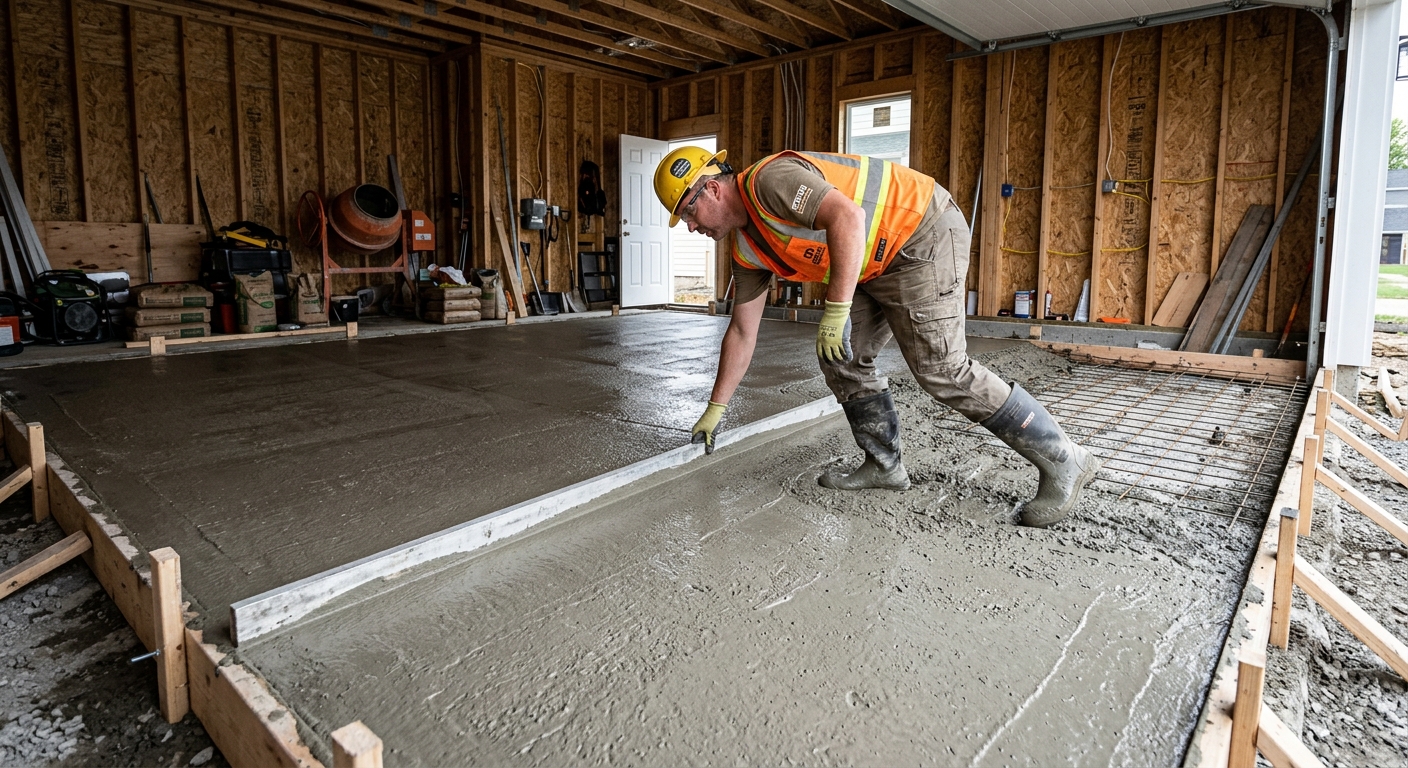
Concrete work options and costs in Mississauga
Mississauga homeowners rely on concrete every year—from driveways and patios to the flatwork that keeps garages and entrances functional in winter. In a city of 717,961 people (Statistics Canada, 2021 Census), concrete demand is especially strong because a large share of homes are single-detached—37.1% of dwellings—so many properties need repeat resurfacing, expansions, or drainage fixes for exterior slab work. The homeowner base is also substantial: 172,225 homeowner households (70.4% of households own), which typically translates into steady replacement cycles as asphalt ages and as older foundations settle or show wear.
Toronto-area concrete pricing is shaped by the freeze–thaw cycle and local frost-depth expectations. Structural work must be built below design frost so the ground movement doesn’t heave or crack foundations; for exterior flatwork, crews typically specify air-entrained mixes, proper thickness, and well-planned control joints to manage cracking. In Mississauga, humid wet periods in spring and fall can slow scheduling and change site prep requirements, while cold snaps near 10 °C demand curing protection. That’s why the same driveway can land 10s of percent apart depending on base thickness, reinforcement, and whether the contractor can secure the right mix and finishing crew during the pour window.
In terms of where it’s most in demand, areas like Meadowvale commonly see long runs of driveways and aging exterior slabs in established neighbourhoods, creating a steady flow of slab replacement and drainage reworks. Below is a practical comparison of common options and realistic Mississauga price ranges to help you budget before comparing quotes.
| Application |
Typical Size |
Key Spec |
Finish Option |
Price Range |
| Concrete driveway (standard broom finish) |
400 sq. ft. (approx. 20’ x 20’) |
Air-entrained mix, compacted base, control joints |
Broom finish |
$7,200 – $11,200 |
| Exposed aggregate driveway |
400 sq. ft. (approx. 20’ x 20’) |
Air-entrained mix, proper curing, aggregate exposure |
Exposed aggregate |
$9,600 – $14,800 |
| Stamped concrete driveway or patio |
300 sq. ft. (approx. 15’ x 20’) |
Air-entrained mix, integral colour, release + sealer system |
Stamped |
$8,400 – $14,800 |
| Plain concrete patio or walkway |
200 sq. ft. (approx. 10’ x 20’) |
Compacted base, air-entrained mix, joints where needed |
Steel trowel light float or broom |
$3,200 – $5,200 |
| Garage floor (interior slab) |
300 sq. ft. (approx. 20’ x 15’) |
Vapour barrier (if required), reinforcement optional, sealed finish |
Broom-finish or light trowel |
$5,400 – $9,200 |
| Foundation footings (structural, below frost) |
Per lineal foot equivalent |
Engineered excavation + rebar, below frost depth, structural concrete |
Structural finish (not decorative) |
$180 – $300 |
Prices are estimates only and vary by project scope, site access and material selection.
What affects the price of concrete work in Mississauga
Even when homeowners request the “same” concrete job in Mississauga, quotes can vary by 30–50% across the Toronto economic region because the cheapest bid often underestimates what freeze–thaw protection and base prep actually require. In practice, the differences show up in footing depth assumptions, granular base depth/compaction, whether the contractor provides air-entrained concrete, the mix design strength, and how many crew-hours are allocated for proper finishing and curing protection.
For the Toronto region, frost depth and freeze–thaw cycles dictate nearly every spec. Exterior concrete slabs and driveways are exposed to repeated expansion and contraction—so crews typically use air-entrained concrete mixes to survive freeze–thaw cycling, plus thickness and control joints to manage cracking. Ontario’s typical design approach for structural footings is to extend below design frost depth (often on the order of 1.5–2.4 m in Ontario) to prevent frost heave and differential movement. When temperatures trend toward 10 °C or below, contractors also plan cold-weather curing precautions—like insulated blankets or heated enclosures—so concrete gains strength instead of just “looking set.” And once de-icing salt hits a driveway or patio every winter, surface protection becomes more important; sealing is often the difference between a driveway that stays looking good and one that begins to spall or scale.
Concrete in Mississauga also isn’t priced in a vacuum. A new build on a clean, accessible lot might fall near the $18–$28 driveway backbone range, while a retrofit on an older lot with soft subgrade, tree roots, or poor drainage can push costs toward the upper end because excavation and rebuild thickness increase. Likewise, a simple broom-finished patio is usually closer to $16–$26 per sq. ft., but stamped work adds labour and materials, often justifying the premium when you want a decorative look without paver maintenance. Older homes—37.9% built before 1981 (Statistics Canada, 2021 Census)—can mean more site surprises, and that’s where real dollars tend to move.
| Price Factor |
Why It Matters |
Cost Impact |
| Frost line depth — determines footing depth and form height |
Footings must sit below design frost to prevent heave and settlement-driven cracking. |
Higher excavation and formwork can increase the foundation cost substantially. |
| Site preparation — excavation, grading, compacted granular base |
Base thickness and compaction control voids and prevent pumping under freeze–thaw. |
Poor soil or restricted access can raise labour and hauling/disposal costs. |
| Reinforcement — rebar or wire mesh requirement |
Rebar/wire supports load distribution and reduces cracking from movement. |
Material and placement time add cost, especially on wider slabs. |
| Mix design — air-entrainment and compressive strength spec |
Air-entrainment helps manage freeze–thaw scaling and durability. |
Higher-spec mix costs more but improves longevity on exterior work. |
| Finish type — broom vs. stamped vs. exposed aggregate |
Complex finishes require more steps, timing, and skilled labour. |
Decorative finishes typically move pricing toward the upper end. |
| Pour size and concrete truck access to site |
Access affects pump use, hose length, and pour speed. |
Limited access may increase labour and equipment fees. |
| Cold-weather curing precautions — heating and blankets |
Concrete needs controlled curing to reach strength when temperatures drop. |
Insulation/heating can add noticeable labour and rental costs. |
| Control joint pattern and sealing cost |
Joints limit random cracking; sealing reduces moisture and de-icer damage. |
Sealers and additional finishing time add cost, but can prevent early failure. |
Permits & regulations in Ontario
In Ontario, structural concrete work typically requires a building permit, and municipalities often require engineered drawings for review before construction. That includes foundation footings, foundation walls, and grade beams—basically any concrete portion that supports the building structure. Concrete flatwork like driveways, patios, and walkways usually does not require a permit by default, unless it affects lot grading, drainage, or impervious surface coverage limits, or involves work near a municipal right-of-way. Because Mississauga policies can vary by exact site conditions, it’s smart to confirm with the municipality before you break ground or remove existing surfaces.
For contractor verification in Ontario, start with three basics: licence (where applicable), liability insurance, and WSIB/WCB coverage. Step-by-step: (1) Ask the contractor for their current proof of general liability insurance—you should see the certificate holder and coverage limits; (2) Request proof of coverage under WSIB or equivalent WCB for their workers—this is particularly important when excavation and concrete delivery increase jobsite risk; (3) If a permit is involved, confirm the permit is pulled under the correct party and that drawings, inspections, and hold points match the scope. Finally, ask for references on similar-scale projects in the GTA so you can match the contractor’s track record to your site conditions.
For homeowners, the goal is simple: don’t let “we’ll handle it” replace documentation. Concrete delays and rework are expensive—so verify up front.
Getting concrete right in Mississauga's freeze-thaw climate
Concrete failures in Mississauga usually aren’t random—they’re predictable outcomes of poor base prep, weak or wrong mix design, inadequate jointing, and rushed curing during Ontario’s spring/fall temperature swings. Start with the base: a compacted granular sub-base to the right depth for your soil and local frost exposure is what keeps the slab from flexing and opening micro-cracks. Next, specify the mix: exterior flatwork should use air-entrainment—commonly targeted at about 5–7% air content—and a minimum 32 MPa compressive strength so freeze–thaw stress doesn’t turn into scaling and spalling.
Then manage cracking with joints. Control joints should be planned and installed early enough that shrinkage cracking happens where you want it—not randomly through decorative areas or along driveway edges. Curing matters just as much: concrete needs at least 7 days of proper curing conditions to develop strength. In colder weeks, contractors may use insulated blankets or temporary heating so the slab isn’t exposed before strength gain is adequate.
Finally, sealing helps protect against moisture and de-icing salt. A penetrating sealer applied after the cure window (often around 28 days post-pour) can reduce salt-driven surface damage and help the finish stay tighter.
Ask technical questions that point to these details. For example, if one quote is priced near the lower end of a driveway range, ask whether they’re using air-entrained concrete and what base thickness they’re compacting to. Spending more on base and mix can be justified: a stamped option might run closer to $24–$40 per sq. ft. equivalent, but if the contractor shortcuts air content or curing, you pay later in patching and premature resurfacing—usually at a cost far higher than the original difference.
| Spec | Why It Matters in Mississauga |
What to Ask For |
Impact if Skipped |
| Compacted granular base (depth?) |
In Mississauga, base compaction reduces voids that collect water and expand/contract during freeze–thaw. |
Slab movement, pumping, and early cracking or settlement. |
| Air-entrained concrete mix (target air %?) |
Air pockets help manage freeze–thaw pressure that causes scaling and spalling. |
Surface scaling, spalling around edges and high-traffic zones. |
| Compressive strength (MPa rating) |
Strength ensures the slab reaches durability targets before it’s exposed to winter loads. |
Reduced performance, increased cracking, and poor long-term wear. |
| Control joints (spacing per ACI guidelines) |
Joints tell the slab where to crack from shrinkage, protecting aesthetics and reducing random failures. |
Random cracking, wider fractures, and more water intrusion. |
| Minimum 7-day curing period |
Proper curing in Ontario conditions supports strength development even when temps fluctuate. |
Weak surface, delamination risk, and poor durability. |
| Penetrating sealer (when applied after cure) |
Sealer helps repel moisture and reduces de-icer salt damage in humid/wet cycles. |
Faster deterioration and more frequent resurfacing or spot repairs. |
How to choose a concrete work contractor in Mississauga
Choosing the right contractor in Mississauga comes down to proof and process, not just price. First, verify Ontario coverage and worker protection: ask for their certificate of general liability insurance (and confirm the certificate is current), then request proof of WSIB/WCB coverage for their workers. You should be able to read the documents and see coverage dates, and the contractor should be comfortable sending them without delay. For permit-related structural work, confirm who pulls the permit and who is named for inspections—misaligned paperwork can slow your project or create rework costs.
Next, get 2–3 itemised written quotes rather than lump sums. The best quotes separate labour and materials, and they clearly state items like excavation/haul-away, granular base thickness and compaction, reinforcement placement, concrete mix spec (including air entrainment), finishing method, joint cutting, curing/blanket provisions, and sealing (if included). Carefully review what’s excluded: is disposal included? Is pump rental included if access requires it? Is the contractor responsible for protecting adjacent landscaping during finishing?
For warranty, ask for two parts: a workmanship warranty (how long they stand behind joints, finishing, and installation) and any product/manufacturer warranty on coatings or sealers. Make sure it’s in writing and ask whether it’s transferable if you sell the home.
On payments, never pay more than about 10–15% upfront. Hold back a portion until the final walkthrough is complete and documentation is provided. Finally, demand a written timeline: start date, weather contingency plan, and estimated completion date—very important in Mississauga when temperature drops can affect curing.
- Ask for proof of current general liability insurance (certificate provided before work starts).
- Confirm WSIB/WCB coverage for their workers (copy of clearance or proof letter).
- Get itemised pricing: excavation, base prep, reinforcement, concrete supply, finishing, and cleanup.
- Require the mix spec to be written (air-entrainment and minimum strength).
- Clarify base thickness and compaction method (don’t accept “standard base”).
- Confirm reinforcement approach (mesh vs rebar, and when it’s used).
- Ask about joint placement plan and saw-cut timing.
- Ask how they handle cold weather curing (blankets/heaters and minimum cure protection).
- Confirm sealing scope: whether included, and when it’s applied (e.g., after cure window).
- Check pour-day logistics: truck access, pump use, and staging plan.
- Review warranty terms in writing, including what counts as “within normal cracking tolerance.”
- Use a payment schedule with holdback until completion and final inspection.
Concrete red flags in the Mississauga market: contractors who won’t provide their WSIB/WCB proof, quotes that omit air-entrainment or curing protection details, driveways priced unrealistically low without explaining base thickness and reinforcement, refusal to put control joint locations and sealing in writing, and crews that start pours without a clear weather plan for Ontario’s temperature swings.
Frequently asked questions — concrete work in Mississauga
Stamped vs broom-finish concrete — cost difference?
Stamped concrete costs more than a standard broom finish because it requires extra steps: colour (integral or surface), release agents, stamp setting, careful curing timing, and usually a more involved sealing system. In Mississauga, the GTA freeze–thaw cycle also makes the finishing sequence and curing protection important—so reputable contractors won’t treat it like “just a different texture.” As a ballpark, broom-finished driveway work often aligns with the local driveway backbone of about $18–$28, while stamped decorative concrete commonly moves into the $24–$40 range (typical for stamped/decorative jobs). If a quote is only slightly higher than broom finish, ask what’s actually included—especially air-entrainment, base depth, and whether sealing is included after the proper cure.
When is the best time to pour concrete in Mississauga?
The best time in Mississauga is typically late spring through early fall, when daytime temperatures are stable and overnight lows are less likely to drop enough to slow curing. You’ll often see scheduling prioritize weeks that allow crews to maintain proper cure conditions because Ontario weather can swing quickly. That matters because concrete needs time to develop strength; if temperatures fall toward 10 °C or below, a contractor may need heating or insulated blankets, which adds cost and can shift your timeline. For best results, ask your contractor about their cold-weather contingency plan even if the pour is in warm months—this also affects how they protect the slab edges and joints. A good contractor will plan the pour around weather windows, not just “when the truck can arrive.”
How long does concrete take to cure?
Concrete curing has two layers: initial set and strength development. Typically, concrete surfaces become walkable in about 24–48 hours depending on mix and conditions, but that isn’t the same as being fully cured. For durability in Ontario freeze–thaw conditions, you should expect a minimum curing period of about 7 days under proper conditions before subjecting the slab to significant loads. Full strength development continues over time, and sealing is usually best applied after the cure window—often around 28 days for many penetrating sealers. In Mississauga’s humid and variable shoulder seasons, contractors may increase protection time if temperatures drop. Ask your quote whether curing blankets/heating are included and what protection they provide for the first week.
Do I need a permit for concrete work in Ontario?
In Ontario, it depends on what you’re building. Structural concrete work like foundation footings, foundation walls, and grade beams generally requires a building permit and may involve engineered drawings reviewed by the municipality. Concrete flatwork—such as most driveways, patios, and walkways—often does not require a permit, unless it changes lot grading, drainage, impervious surface coverage rules, or touches municipal right-of-way areas. For Mississauga, the safest approach is to confirm with the municipality before removing existing surfaces. Also verify your contractor carries the right liability coverage and WSIB/WCB coverage—those documents are essential whether or not a permit is required.
Concrete vs pavers for a patio in Mississauga?
Concrete and pavers both perform well in Mississauga when installed correctly, but they’re different systems. Concrete patios are often more cost-effective for larger continuous areas and can be finished in broom or stamped styles. In local pricing terms, plain patio/walkway work commonly falls around $16–$26, while stamped decorative concrete tends to climb higher due to labour and materials. Pavers can be great if you want easy section-by-section replacement or a more intricate pattern; however, they require perfect base grading and joint sand maintenance, and weed control becomes a long-term task. Concrete’s biggest advantage is that, with air-entrainment, proper base prep, joint spacing, and curing, it can resist freeze–thaw movement without the ongoing shifting you sometimes see with poorly compacted paver bases.
How long does a concrete driveway last?
In Mississauga’s freeze–thaw climate, a well-built concrete driveway often lasts decades, but lifespan depends on base prep, air-entrainment, thickness, joints, curing, and how it’s maintained with de-icing salts. Driveways that were poured with the right mix and proper base compaction—and have control joints cut and sealed at the right time—tend to hold up much better through winter loading. If the slab is thin, air-entrainment is inadequate, or curing/finishing was rushed, you can see scaling or spalling earlier. As a practical budgeting reference, homeowners comparing options within the local driveway backbone of $18–$28 should still ask for the technical specs—because a “cheap” driveway that skips base depth or uses the wrong mix can fail sooner than a mid-range properly built job.