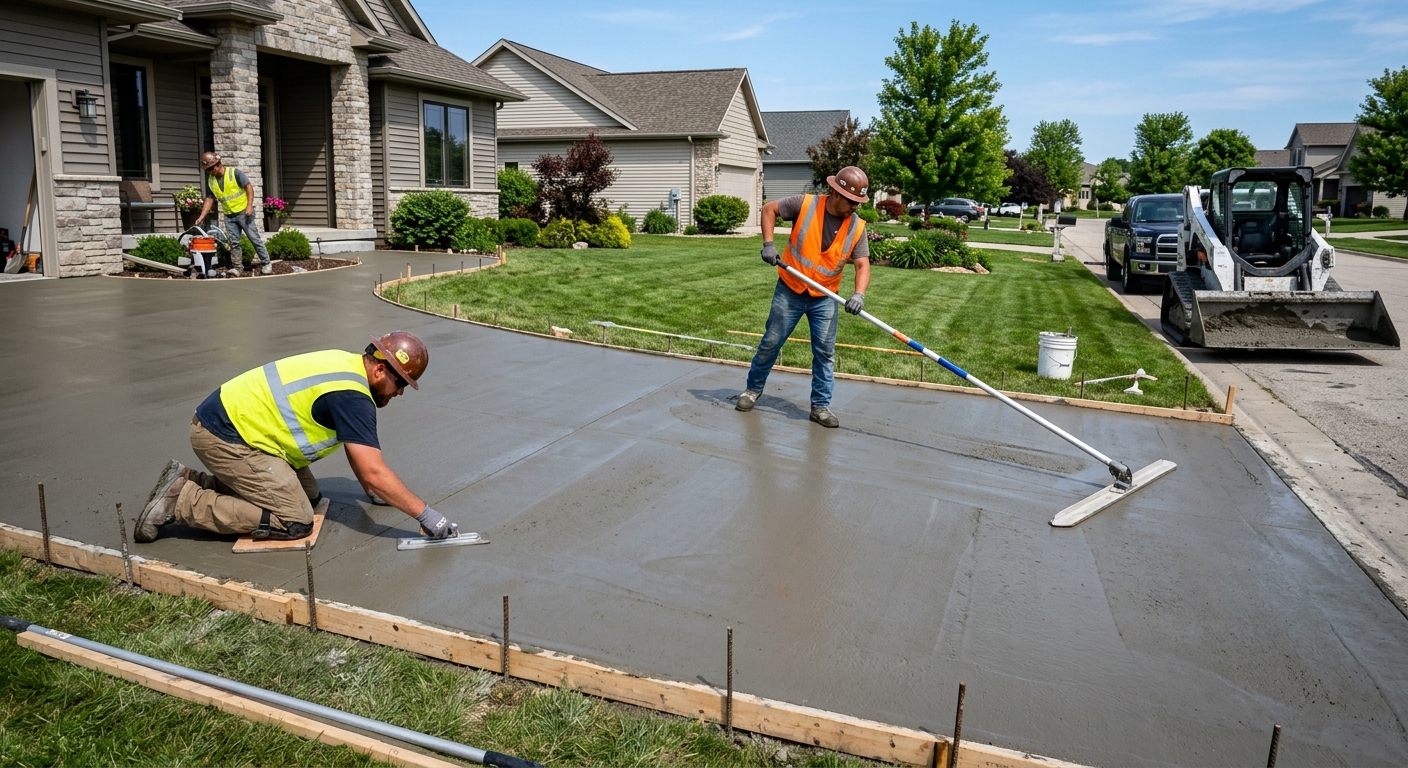
Concrete work options and costs in Agincourt South-Malvern West
In Agincourt South-Malvern West, concrete choices usually boil down to how you want it to look, how much traffic it will handle, and how the Toronto-area climate will treat it over repeated freeze–thaw cycles. With a population of 23,757 (Statistics Canada, 2021 Census), the neighbourhood sees steady demand for driveways, patios and walkways—especially around established residential pockets where many homes were built decades ago and regularly need patching or resurfacing. Many homeowners are dealing with aging flatwork that has started to heave at the edges or develop hairline cracking, and that’s where the “right concrete, right base, right schedule” approach really matters.
Toronto concrete pricing can swing meaningfully for the same basic scope because exterior slabs must perform through winter. Most structural footings need to extend below Ontario’s required design frost depth, and exterior flatwork typically uses air-entrained concrete plus adequate thickness, drainage, and control joints to manage cracking. Contractors also concentrate exterior pours in the warmer months because curing quality drops when air temperatures trend toward 10 °C or below—so you often see higher labour demand during the reliable pour season.
In Agincourt South-Malvern West, demand is especially strong in areas like Malvern Village and the surrounding streets where drive replacements and walkway upgrades are common. Use the ranges below as a baseline, then match the finish and specs to your site conditions before you compare quotes.
| Application |
Typical Size |
Key Spec |
Finish Option |
Price Range |
| Concrete driveway (standard broom finish) |
300–450 sq. ft. |
Air-entrained mix; compacted granular base; control joints |
Broom finish |
$18,000 – $28,000 |
| Exposed aggregate driveway |
300–450 sq. ft. |
Air-entrained mix; proper curing protection; drainage matters |
Exposed aggregate |
$22,000 – $34,000 |
| Stamped concrete driveway or patio |
200–450 sq. ft. |
Air-entrained mix; thicker slab than plain flatwork; release agent system |
Stamp + color hardener |
$24,000 – $40,000 |
| Plain concrete patio or walkway |
150–300 sq. ft. |
Air-entrained mix; compacted base; edge forms; saw cuts |
Float/trowel with light broom |
$3,000 – $7,800 |
| Garage floor (interior slab) |
400–600 sq. ft. |
Vapour barrier (when required); proper base; perimeter insulation if needed |
Plain trowel finish; optional seal |
$4,200 – $9,500 |
| Foundation footings (structural, below frost) |
Varies (linear footage) |
Structural concrete; excavation; rebar; formwork below grade |
Engineered footing construction |
$180 – $300 |
Prices are estimates only and vary by project scope, site access and material selection.
What affects the price of concrete work in Agincourt South-Malvern West
In Toronto and across Ontario, it’s common to see quotes for the “same-looking” concrete job vary by 30–50%. The difference usually isn’t the concrete itself—it’s the supporting work that makes the slab last: excavation depth, granular base quality, reinforcement decisions, truck access, and how crews protect curing during humid fall/spring swings. In Agincourt South-Malvern West specifically, the freeze–thaw cycle forces contractors to build durability into the design: structural footings generally must sit below the design frost depth to prevent frost heave, and exterior slabs must use air-entrained mixes plus proper thickness and control joints to manage random cracking.
Cold-weather considerations also move price. When pours happen as temperatures edge toward 10 °C or below, you typically need cold-weather curing precautions like insulated blankets, wind protection, and sometimes heating—these steps add labour and materials. De-icing salt is another GTA reality: it can accelerate surface spalling, which is why sealing and good finishing practices matter for longevity.
Two quick examples of how local conditions change cost in Agincourt South-Malvern West: first, a driveway that requires thicker slab and deeper base prep due to unstable topsoil usually climbs toward the higher end of driveway pricing (for flatwork, that’s often in the $18–$28 per sq. ft.-style band locally). Second, adding stamped decorative work pushes costs higher (Toronto homeowners often see stamped concrete land in the $24–$40 range) because it requires thicker slab, extra material steps, and a more skilled finishing crew. If your site is tight—like narrow access off a residential street—there’s also a real labour cost increase for pumping/forming and careful staging.
| Price Factor |
Why It Matters |
Cost Impact |
| Frost line depth — determines footing depth and form height |
Below-grade movement control to prevent heave and differential settlement |
Higher excavation and formwork can push footing scope toward the upper band |
| Site preparation — excavation, grading, compacted granular base |
Saturated or poorly compacted soil can expand/contract against the slab |
Extra hauling/compaction work is a common driver behind 30–50% swings |
| Reinforcement — rebar or wire mesh requirement |
Controls cracking and improves structural behaviour under loads |
Material cost + placement labour; typically higher for larger or heavier-use slabs |
| Mix design — air-entrainment and compressive strength spec |
Air-entrainment improves freeze–thaw durability for exterior concrete |
Upgraded specs can add cost but prevent early spalling and patching |
| Finish type — broom vs. stamped vs. exposed aggregate |
Durability and appearance depend on finishing system and thickness |
Stamped/exposed processes add crew time and materials |
| Pour size and concrete truck access to site |
Smaller access can require pumping or extra staging |
Tight sites may increase labour and equipment rental costs |
| Cold-weather curing precautions — heating and blankets |
Maintains temperature and curing performance below ideal conditions |
Can add measurable costs during late-season pours |
| Control joint pattern and sealing cost |
Joints guide shrinkage cracks; sealing helps manage salt exposure |
Often small compared to replacement, but frequently skipped unless specified |
Permits & regulations in Ontario
In Ontario, structural concrete work—like foundation footings, foundation walls, grade beams, and other load-bearing elements—typically requires a building permit, and municipal review often includes engineered drawings. Concrete flatwork (patios, walkways and most driveways) usually does not require a permit by default, but it can trigger permit requirements if the work affects lot grading, creates new impervious surface coverage beyond municipal limits, or involves changes within the municipal right-of-way. Because rules can vary depending on what’s being modified, confirm with the local authority before breaking ground.
For homeowner due diligence in Agincourt South-Malvern West, verification should be methodical. First, ask for the contractor’s Ontario business details and confirm the trade coverage you’re hiring for. Next, request a current certificate of liability insurance and ensure it matches the project address and covers the active period of the work. Then ask for proof of coverage through WSIB for workers (or WCB-equivalent coverage where applicable) before the crew starts. Finally, request clearance/verification documents where the contractor can provide them.
To verify step-by-step: (1) check the contractor’s online registry listing associated with their legal name; (2) review the certificate of insurance and look for policy dates and limits; (3) ask for WSIB/WCB clearance documentation for the specific job timeframe; and (4) confirm references on similar-scale projects in the GTA.
Getting concrete right in Agincourt South-Malvern West's freeze-thaw climate
Concrete fails in Agincourt South-Malvern West mainly when water gets into the wrong places, then expands and contracts through freeze–thaw cycles. In practice, the most common causes are inadequate base preparation, missing or incorrect air-entrainment, poor drainage that leaves the slab saturated, and insufficient curing/finishing. If you’re replacing or building exterior concrete, the spec should be written to withstand GTA winter: a properly compacted granular sub-base, an air-entrained mix, and a control joint layout that limits random cracking.
Start with base preparation: excavate to the required depth for your local soil, then build the granular layer in lifts and compact it properly. Next, mix design: exterior flatwork should use air-entrainment (often targeted around 5–7% air content for durable freeze–thaw performance) and a minimum 32 MPa compressive strength. Then control joints: they should be spaced to limit shrinkage and temperature cracking. Curing is critical—plan on a minimum 7-day curing period under conditions that support strength gain. If you pour toward colder weather, crews typically protect with insulated blankets or heating to avoid surface and early-age freeze damage. Finally, sealing: apply a penetrating sealer after cure (commonly around 28 days post-pour) to help repel de-icing salts and reduce surface deterioration.
To justify the cost difference, consider this example: a plain broom-finish walkway might land near the lower band, while stamped concrete generally costs more because it needs an upgraded finishing system and thicker slab. In Toronto, that extra upfront spend can be worth it when homeowners avoid recurring patch jobs caused by premature spalling from an under-spec mix or shortcuts on base and curing.
| Spec |
Why It Matters in Agincourt South-Malvern West |
What to Ask For |
Impact if Skipped |
| Compacted granular base (depth?) |
Controls water movement and limits frost-related movement under the slab |
Confirm excavation depth, granular type, lift thickness, and compaction testing |
Edge heaving, settlement, and cracking that shows up within a few winters |
| Air-entrained concrete mix (target air %?) |
Air bubbles reduce internal freezing stress during freeze–thaw cycles |
Ask for air content target (typically 5–7% for exterior flatwork) |
Spalling and surface scaling, especially with de-icing salt exposure |
| Compressive strength (MPa rating) |
Higher strength improves long-term performance under loads |
Verify minimum 32 MPa rating and test/manufacturing compliance |
Premature wear, potholing, and early deterioration |
| Control joints (spacing per ACI guidelines) |
Guides cracking to predictable lines instead of random fractures |
Ask for joint spacing and saw-cut timing plan |
Random cracks through the field that don’t seal well |
| Minimum 7-day curing period |
Ensures early-age strength gain in Toronto’s variable temperatures |
Confirm curing method and protection plan; what happens if weather drops |
Weakened surface, increased cracking, reduced durability |
| Penetrating sealer (when applied after cure) |
Helps repel salts and moisture during the winter season |
Ask for penetrating sealer and timing (commonly around 28 days post-pour) |
Faster surface breakdown and more frequent re-sealing or patching |
How to choose a concrete work contractor in Agincourt South-Malvern West
Choosing the right concrete contractor in Agincourt South-Malvern West is mostly about verification and clarity. Start with Ontario licensing/trade authorization for the scope you’re hiring, then confirm liability insurance and WSIB/WCB coverage before work begins. Ask for a certificate of insurance with the correct policy dates and project address listed. For WSIB, get clearance/documentation that shows their workers are covered for the job period. Don’t accept “we’re insured” without proof—reputable contractors provide paperwork without hesitation.
Next, get 2–3 written, itemised quotes rather than a single lump-sum. You want labour + materials breakdowns for excavation, base prep, reinforcement, concrete supply, finishing, joints and sealing. Confirm whether permits are included (if required), and whether debris disposal is included. Scope gaps are where change orders come from. Also ask about warranties: workmanship warranty length, whether product/manufacturer warranties apply to any admixtures/sealers, and whether warranties are transferable to you as the homeowner.
For payment structure, never pay more than 10–15% upfront. Use holdback until the job is complete and surfaces have been properly finished and cleaned. Lock in a timeline in writing: start date, expected pour day(s), curing/protection steps, and completion estimate. If a contractor can’t explain curing protection for colder nights, or can’t describe joint spacing and air-entrainment targets, that’s a red flag.
- Request proof of liability insurance (policy dates, limits, and job address).
- Confirm WSIB/WCB coverage for workers for your project timeframe.
- Verify trade authorization appropriate to structural or excavation-related scope.
- Ask for 2–3 itemised quotes (labour, materials, base, reinforcement, finishing).
- Require a written scope: thickness, base depth, reinforcement type, and joint plan.
- Confirm concrete mix spec: air-entrainment and minimum compressive strength (e.g., 32 MPa).
- Clarify whether saw-cut control joints are included and joint spacing criteria.
- Ask how the crew protects curing in weather dipping toward 10 °C.
- Include drainage/grade details so water doesn’t pond against the slab.
- Confirm sealing scope and timing (penetrating sealer after cure, commonly around 28 days).
- Check disposal and site restoration: haul-away, clean-up, and any asphalt/landscaping reinstatement.
- Review warranty terms in writing and ask who provides service if repairs are needed.
Concrete red flags in Agincourt South-Malvern West: contractors who refuse to show insurance/WSIB proof, quotes that don’t mention air-entrainment or joint layout, vague statements like “we’ll put in mesh” without clarifying type and coverage, rushing cold-weather pours without blankets/heating plan, and skipping base compaction details or drainage grading.
Frequently asked questions — concrete work in Agincourt South-Malvern West
How much does concrete work cost in Agincourt South-Malvern West?
Costs in Agincourt South-Malvern West depend on size, thickness, base preparation and whether you’re choosing broom-finished versus decorative concrete. As a baseline for Toronto-area exterior flatwork, driveway and slab projects often start around the $18–$28 range for standard driveway work and can increase when the job needs deeper prep, more reinforcement, or decorative steps. Patios and walkways commonly fall in the $16–$26 range, with higher pricing for options like stamped concrete, which typically lands in the $24–$40 band. If you’re comparing quotes, watch for differences in what’s included—haul-away, compacted granular base depth, reinforcement coverage, joint cutting, and sealing scope. For structural foundation footings, you’ll usually see pricing discussed as a $180–$300 range (often by linear/structural measurement) depending on engineered requirements and excavation conditions.
How deep must footings be for Agincourt South-Malvern West's frost line?
In Ontario, footing depth is tied to the design frost depth used in the local building/development context to reduce the risk of frost heave. For most structural concrete work in the province, footings extend to at least about 1.2 m below grade (and often deeper depending on conditions and engineering). In practical GTA terms, many projects require footings below the design frost depth so the concrete isn’t forced to move with winter freezing. The exact depth for your home should be set by your engineered foundation drawings and matched to your site’s soil conditions. Because even small changes in excavation depth can affect formwork height and concrete volume, quotes can differ—so ask your contractor how they’re handling frost-protected design and whether the excavation and bearing conditions match the drawings for your address in Agincourt South-Malvern West.
Why does concrete crack in Agincourt South-Malvern West and how is it prevented?
Concrete cracking in Agincourt South-Malvern West is usually the result of shrinkage, temperature movement, and—most importantly—how the slab interacts with the ground through freeze–thaw cycles. When the base isn’t properly compacted or drainage is poor, water can saturate the subgrade and contribute to heave and settlement, which then stresses the slab. Cracks are also managed by installing control joints on a deliberate pattern rather than letting cracking happen randomly. Prevention comes from four layers of quality: compacted granular base to the correct depth, air-entrained exterior concrete mix (to reduce freeze–thaw distress), correct slab thickness, and appropriately spaced control joints with proper saw-cut timing. If de-icing salts are used during winter, a properly timed penetrating sealer after curing also helps reduce surface deterioration that can otherwise worsen cracking.
Stamped vs broom-finish concrete — cost difference?
Stamped concrete costs more than broom-finished concrete because you’re paying for additional finishing steps and higher labour skill, plus often a thicker slab and more careful preparation for appearance and durability. In the Toronto market, a basic broom-finished driveway typically sits in the $18–$28 range, while stamped concrete for driveways or patios is commonly in the $24–$40 band due to colour hardeners, stamping tools, release agents, and more intensive curing/finishing control. It’s also not just aesthetics—stamped work is usually installed with durability-minded specs, because decorative surfaces can show deterioration sooner if the base prep or mix design is compromised. If you’re on the fence, ask your contractor for side-by-side scope: base depth, reinforcement, joint plan, and sealing. That’s where you confirm the price difference is real, not just marketing.
When is the best time to pour concrete in Agincourt South-Malvern West?
The best time to pour concrete in Agincourt South-Malvern West is during the warmer, more reliable part of the season when daytime temperatures stay comfortably above freezing and overnight conditions are manageable for curing. In the Toronto economic region, contractor scheduling is strongly influenced by the freeze–thaw cycle and the ability to cure properly; when temperatures trend toward 10 °C or below, curing quality becomes harder to maintain. That doesn’t mean you can’t pour later in the year—many contractors use curing blankets, wind protection, and heating measures—but those precautions add cost and require careful planning. If you want the simplest path to durability, aim for a pour when the forecast supports steady curing for the early 7-day period. Your contractor should also describe protection steps in writing, not just “we’ll pour and hope.”
How long does concrete take to cure?
Concrete needs both time and proper conditions to cure successfully in Ontario’s climate. For most residential concrete flatwork, contractors plan around a minimum 7-day curing period to achieve early strength and reduce the risk of surface problems. Even after that, concrete continues to gain strength over longer periods—so protection and weather management still matter in the weeks that follow. Sealing timing is also important: for many penetrating sealers, homeowners typically apply or schedule sealing around 28 days post-pour so the concrete has developed sufficient dryness and strength to accept the sealer. In Agincourt South-Malvern West, curing matters even more because humid wet fall/spring conditions and winter freeze–thaw cycles can amplify any early-age weaknesses. Ask your contractor what curing protection they’ll use if temperatures drop and how they plan to manage joints and finishing timing.