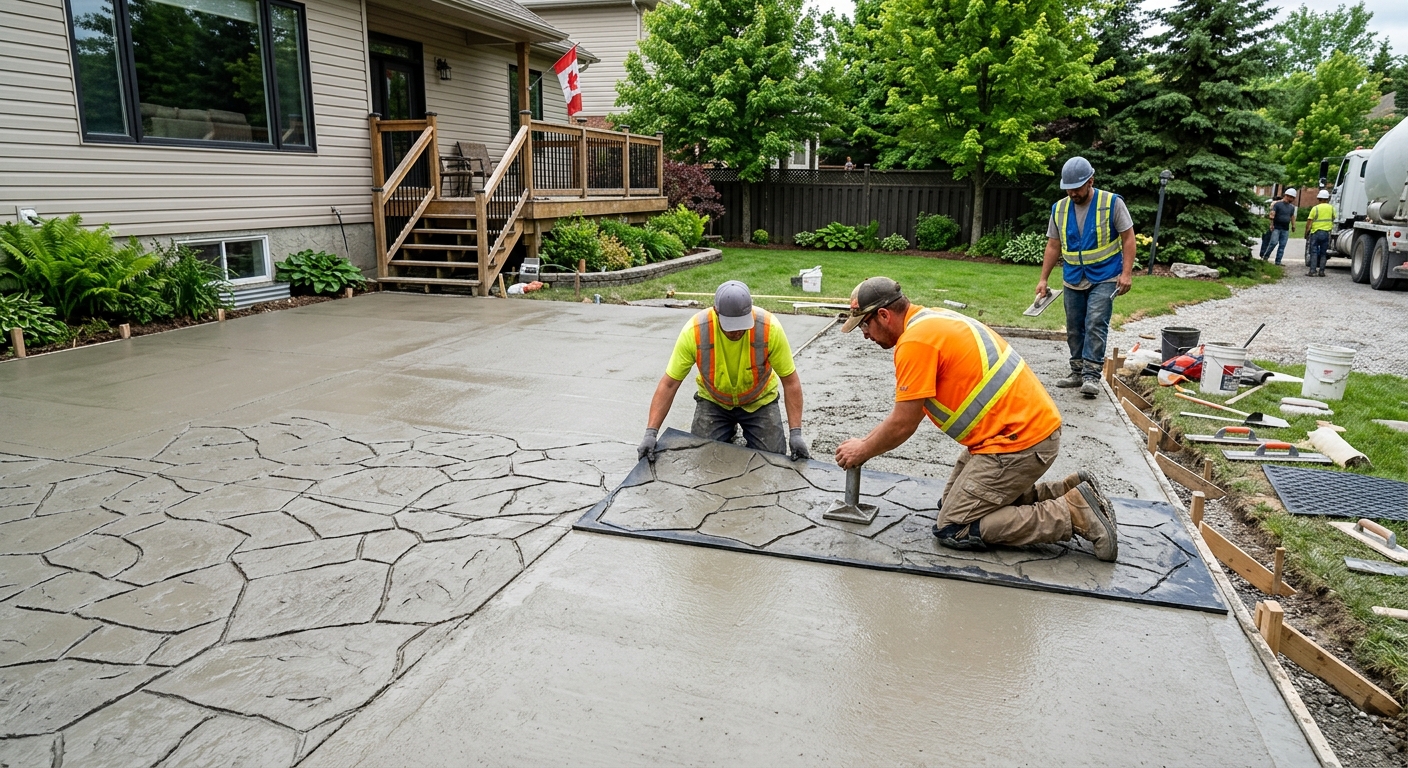
Concrete work options and costs in Petawawa
Petawawa homeowners typically choose concrete for driveways, patios, walkways and foundations because local soil and winters demand the right base, drainage and mix design—not just “pour and finish.” With 70.4% of local dwellings being single-detached houses (Statistics Canada, 2021 Census), demand for exterior flatwork is steady, especially around family neighbourhoods where people renovate, add parking pads, and rebuild front steps after years of freeze-thaw movement. In Petawawa, an additional pressure point is that 46.4% of homes were built before 1981 (Statistics Canada, 2021 Census), so you’ll often see retrofit work: thicker edges, re-graded slopes, replacement of failing base material, and utility relocations before any concrete can be poured.
In the Kingston–Pembroke region, concrete costs are shaped more by site conditions and weather windows than by the slab itself. Frost line depth and repeated freeze-thaw cycles mean footings must be set below frost, and exterior flatwork should be air-entrained with control joints to reduce cracking and spalling. The pour season is shorter, so labour and scheduling can be tighter when contractors are available. If you’re in areas like Westfort or along the faster-changing streets toward the west end, you’ll notice contractors are especially busy with driveway replacements and step repairs as spring thaw reveals base voids and settlement.
Below are realistic cost bands for common concrete jobs in Petawawa. Use them as a starting point, then ask for a written, itemised quote based on your site access, excavation depth and finish level.
| Application |
Typical Size |
Key Spec |
Finish Option |
Price Range |
| Concrete driveway (standard broom finish) |
400 sq. ft. (e.g., 20 ft × 20 ft) |
Air-entrained mix, proper base compaction, control joints |
Broom finish, saw-cut joints |
$120–$180 |
| Exposed aggregate driveway |
400 sq. ft. (e.g., 20 ft × 20 ft) |
Air-entrained mix, reinforcement as required |
Exposed aggregate (surface retarder), sealed finish |
$140–$220 |
| Stamped concrete driveway or patio |
300 sq. ft. (e.g., 15 ft × 20 ft) |
Air-entrained mix, integral colour, control joints |
Stamped pattern + colour hardener, sealed |
$160–$280 |
| Plain concrete patio or walkway |
200 sq. ft. (e.g., 10 ft × 20 ft) |
Air-entrained mix for exterior, compacted base |
Float/trowel base, broom or lightly textured finish |
$90–$150 |
| Garage floor (interior slab) |
450 sq. ft. (e.g., 20 ft × 22.5 ft) |
Vapour barrier (if required), reinforcement based on load, proper thickness |
Steel-trowel/finish, optional broom at perimeter |
$120–$190 |
| Foundation footings (structural, below frost) |
Varies (commonly 2–3 rows of forms per footing run) |
Below frost depth, rebar cage, engineered dims |
Structural concrete formwork + finish at grade only |
$180–$320 |
Prices are estimates only and vary by project scope, site access and material selection.
What affects the price of concrete work in Petawawa
If you request quotes for “the same” driveway in Petawawa and end up with numbers that differ by 30–50%, it’s usually because the contractors priced the fundamentals differently: excavation depth, base prep, drainage and reinforcement—not just the concrete volume. In the Kingston–Pembroke region, pricing also reflects that contractors have to protect pours during cool shoulder-season weather. That means additional labour time, scheduling constraints and sometimes extra curing materials when temperatures drop.
Frost line depth and freeze-thaw cycles dictate every spec in this region. To prevent frost heave, footings typically must extend below the design frost depth (Ontario practice commonly targets around 1.2 m below grade for many locations, and colder situations can require deeper), and all exterior slabs should use air-entrained concrete mixes to survive repeated cycles. When the weather window is shorter, cold-weather curing precautions (insulating blankets, heating, and strict protection of fresh concrete) can add real cost. Also, de-icing salt accelerates surface damage if the slab isn’t properly air-entrained and if curing/sealing isn’t handled correctly—so sealing is not an “upgrade” I’d skip on exterior work.
Two examples you’ll see in Petawawa: (1) older lots with soft fill often require deeper excavation and more granular base, which pushes the cost from the lower driveway band toward the mid range; (2) a stamped patio that needs tight excavation lines and colour consistency can justify the higher stamped band because it takes more finishing time and adds sealing. With many homes built before 1981, expect more frequent base replacement, which is one reason foundation or footing work typically lands closer to $180–$320 per footing scope line item instead of the low end.
| Price Factor |
Why It Matters |
Cost Impact |
| Frost line depth — determines footing depth and form height |
Deeper frost requirements increase excavation and formwork time |
Higher excavation/form costs; can move footing pricing toward the upper band |
| Site preparation — excavation, grading, compacted granular base |
Weak or wet subgrade causes settlement and early cracking |
Most variable line item; can add significant labour and material |
| Reinforcement — rebar or wire mesh requirement |
Controls cracking in slabs and provides structural capacity |
Extra steel, chairs/ties, and labour increases cost |
| Mix design — air-entrainment and compressive strength spec |
Air content and strength drive freeze-thaw and surface durability |
Higher-quality mix typically shifts exterior work toward mid/high range |
| Finish type — broom vs. stamped vs. exposed aggregate |
Decorative work requires more labour and tighter tolerance control |
Stamped/exposed finishes commonly land in the higher finish bands |
| Pour size and concrete truck access to site |
Long carries or restricted access can require pumping/extra labour |
Can add pump fees, staging time, and increased labour hours |
| Cold-weather curing precautions — heating and blankets |
Protects strength gain when nights get cold after the pour |
Adds rental materials and labour; important for shoulder-season pours |
| Control joint pattern and sealing cost |
Joints manage cracking; sealing reduces salt-related surface deterioration |
Minor per square foot but can be a meaningful add-on for exterior durability |
Permits & regulations in Ontario
In Ontario, structural concrete work—think footings, foundation walls, and grade beams—requires a building permit, and engineered drawings are often reviewed by the municipality. Concrete flatwork (driveways, patios, and walkways) usually does not need a permit by itself, unless it changes lot grading, affects impervious surface coverage limits, or involves work close to a municipal right-of-way or site drainage requirements. Because rules can vary by situation, confirm with the local authority before breaking ground.
For a homeowner in Petawawa, your practical checklist starts with paperwork and coverage. First, verify the contractor carries liability insurance (and that it’s active for the project dates). Next, confirm workers’ coverage: in Ontario this is WSIB coverage, and a clearance letter is often provided when requested. Then, ask for references on similar-scale concrete jobs—especially exterior flatwork in freeze-thaw climates—so you can see how they handle base prep, reinforcement, and finishing.
Step-by-step verification is straightforward:
- Look up the contractor’s Ontario business information through the appropriate online registry tools and ensure the company name matches the quote.
- Ask for a Certificate of Insurance (COI) showing liability coverage; confirm the address/job site is included.
- Request WSIB clearance (or evidence of active coverage) and keep it with your contract.
- Confirm who pulls permits (if required) and that the permit number is tied to the project scope.
- Use references: request photos and approximate dates, then compare finishes and joint patterns.
That diligence reduces the risk of underbuilt footings, rushed curing, and workmanship issues that show up after the first winter.
Getting concrete right in Petawawa's freeze-thaw climate
Concrete failures in Petawawa typically trace back to two problems: inadequate base/drainage and concrete that wasn’t engineered for freeze-thaw. When water gets under a slab or behind a curb/edge, freeze-thaw cycles expand and contract the system. That leads to settlement, cracking, and—worst case—spalling (flaking and surface pop-outs), especially where de-icing salts concentrate near garage doors and walkways.
To spec the job correctly in the Kingston–Pembroke market, insist on five fundamentals. (1) Base preparation: compacted granular sub-base to the correct depth for local soil conditions and frost considerations, with drainage addressed so meltwater has a path. (2) Mix design: air-entrainment is essential for exterior flatwork (commonly targeting 5–7% air content depending on exposure and supplier spec) and a minimum compressive strength spec (often 32 MPa for many exterior residential pours when required by design). (3) Control joints: proper spacing to limit random cracking and protect the surface. (4) Curing: a minimum 7-day curing period under suitable conditions—cold-weather pours need blankets/heating to protect strength gain. (5) Sealing: apply a penetrating sealer after full cure (commonly 28 days) to repel water and de-icing salts.
Ask about spalling prevention directly. If a contractor can’t explain air-entrainment and curing protection, that’s a red flag—on exterior work, it’s not a theoretical risk; it’s what you’ll see in Petawawa winters. As a dollar example, shifting from plain exterior concrete to a sealed, air-entrained, properly jointed design is often a relatively small difference compared with the cost of redoing a driveway. On decorative options, the added cost of stamped concrete can be justified when joints, colour integrity, and sealing are done to the same durability standard—rather than treating aesthetics as the only goal.
| Spec |
Why It Matters in Petawawa |
What to Ask For |
Impact if Skipped |
| Compacted granular base (depth?) |
Prevents settlement and reduces water movement under the slab during freeze-thaw |
Confirm excavation depth, granular type, compaction test approach, and final grade |
Cracking, edge break-up, voids and trip hazards after a couple winters |
| Air-entrained concrete mix (target air %?) |
Gives concrete microscopic room to expand during freezing, reducing spalling risk |
Request air content target (commonly 5–7% for exterior) and supplier batch ticket approach |
Surface flaking/spalling when salts and moisture combine with winter freeze-thaw |
| Compressive strength (MPa rating) |
Ensures strength gain so the slab tolerates early weather and loads |
Confirm minimum MPa (often 32 MPa for many exterior specs) and test/cylinder plan if applicable |
Premature wear, scaling and early cracking under driveway traffic |
| Control joints (spacing per ACI guidelines) |
Limits random cracking and keeps crack widths manageable |
Ask for joint spacing plan and sealing detail at joints if specified |
Wider cracks, water ingress, and faster deterioration at edges |
| Minimum 7-day curing period |
Protects strength development in Petawawa’s cold snaps after a pour |
Confirm curing method and when traffic is permitted |
Surface damage if opened too early; reduced durability in the first winter |
| Penetrating sealer (when applied after cure) |
Repels meltwater and de-icing salt so freeze-thaw is less destructive |
Apply after cure (commonly 28 days) and confirm product type and coverage rate |
Salt scaling and faster loss of surface finish |
How to choose a concrete work contractor in Petawawa
Choosing the right concrete contractor in Petawawa is mostly about verifying coverage, then matching the quote to the real specs needed for freeze-thaw durability. Start with Ontario licensing and insurance. In Ontario, you should verify the contractor’s business registration (and that the company name on the quote matches the insured entity). Ask for a current Certificate of Insurance for liability and ensure it’s valid for the project dates. For workers’ protection, confirm WSIB/WCB coverage—request a WSIB clearance letter if available. If a contractor won’t provide documentation, don’t “trade” safety for price.
Next, get 2–3 itemised written quotes, not lump sums. You want a breakdown that shows labour and materials for excavation, granular base prep, reinforcement, formwork, concrete supply, finishing, curing protection, and sealing (if exterior). Carefully read what’s excluded: haul-away/disposal, pumping, road/sidewalk cut permissions if relevant, and any permit pulling responsibilities for structural work. Clarify whether the quote includes engineered drawings/permit support for foundations/footings when required.
Warranty matters too. Ask how long the workmanship warranty is, what product/manufacturer warranty covers (if any), and whether it’s transferable if you sell your home. Payment schedule: never pay more than 10–15% upfront; hold back a portion until the final cure and cleanup are complete. Finally, insist on a written timeline with a start date and a realistic completion estimate, including curing time—especially important in shoulder-season weather.
- Confirm air-entrained mix and joint plan for exterior flatwork.
- Ask for the concrete thickness and base build-up (not just “it’ll be poured”).
- Get a written scope for excavation depth and disposal/haul-away.
- Confirm reinforcement approach (wire mesh vs rebar) for your specific use.
- Request details on truck access, pumping needs, and concrete placement logistics.
- Verify curing protection for cold nights (blankets/heating plan).
- Ask whether control joints are saw-cut or tooled and how spacing is determined.
- Confirm sealing type and timing (commonly 28 days post-pour for penetrating sealer).
- Read inclusions/exclusions for drainage (swales, downdrains, edge grading).
- Require itemised quote line items so you can compare apples-to-apples.
- Confirm liability insurance and WSIB coverage with documentation.
- Set payment milestones tied to inspection points (base, rebar, pour, cure/seal).
Concrete red flags we commonly see in Petawawa include: vague “we’ll handle it” answers about air-entrainment, no clear curing plan for cool nights, missing joint spacing details, quotes that skip reinforcement for driveways/steps without justification, and contractors asking for a large deposit before base work begins.
Frequently asked questions — concrete work in Petawawa
How do I maintain concrete in Petawawa's freeze-thaw climate?
In Petawawa, maintenance is about keeping water and salt from attacking the surface and edges. Start with everyday practices: remove snow and melt carefully, and avoid scraping aggressively—surface damage gives freeze-thaw an opening. For exterior slabs (driveways, walkways, patios), keep drainage working so meltwater can’t pool against the concrete. If your contractor used a proper air-entrained exterior mix and control joints, the slab should be more forgiving, but you still need protection. After full cure, plan on a penetrating sealer (often applied around 28 days post-pour) and recoat based on wear. In winter, use de-icers recommended for concrete and reduce overuse near garage doors where salt can concentrate. If you’re budgeting, exterior work like a plain patio or walkway often falls in the $90–$150 band, but adding sealing and correct jointing helps you avoid early resurfacing or costly redo work.
What causes concrete to spall in Petawawa winters?
Spalling in Petawawa winters is usually a combination of moisture, de-icing salts, and concrete that isn’t properly protected for freeze-thaw. The most common technical cause is inadequate air-entrainment—without the right microscopic air void system, water inside concrete expands during freezing and breaks the surface layer. Another driver is poor base prep or drainage: when water migrates under or into the edges, freeze-thaw cycles worsen the damage. If concrete is opened to traffic too early during cool shoulder-season weather, strength gain may be incomplete, making scaling and surface pop-outs more likely. Poor curing protection and missing control joints also allow uncontrolled cracking that lets water in. Finally, sealing that’s skipped or delayed can leave the surface vulnerable to salt attack. If your contractor can’t clearly discuss air %, curing time, joints and sealing, it’s a sign the job may drift toward failure—regardless of whether you chose standard broom concrete or a decorative finish.
What is rebar and when is it required in Ontario?
Rebar is reinforcing steel embedded in concrete to control cracking and increase load capacity, especially where the slab will carry heavier loads or where structural integrity matters. In Ontario, when rebar is required depends on the engineered design for the specific element (and the loading conditions). For structural work like foundation footings, foundation walls or grade beams, reinforcement is typically required and is part of the permit and engineered drawings. For exterior flatwork like driveways, many residential projects use reinforcement (either rebar or welded wire mesh) depending on thickness, soil conditions, and expected vehicle loads. In Petawawa, older lots and heavier-use driveways can make the reinforcement decision more critical because settlement or cracking becomes more apparent in freeze-thaw cycles. The key is to ask your contractor what the design spec is for your slab thickness and use, and to ensure the quote includes reinforcement where appropriate—not just “optional” steel. A structural footing scope commonly lands in the $180–$320 range because of reinforcement, excavation depth, and formwork below frost.
How long does a concrete project take in Petawawa?
The total calendar time in Petawawa depends on weather windows, excavation/base prep, and—most importantly—curing and protection. A typical exterior flatwork project (like a patio or walkway) often takes about 1–3 days of work on site (excavate, form, place steel if needed, pour, finish), but curing means you can’t fully treat it like a “same-week” job. Even though initial set happens quickly, contractors usually plan for at least 7 days before normal use, and curing protection if temperatures drop after the pour. If you’re doing stamped or decorative concrete, the finishing process takes longer due to colour, stamping and sealing workflow—so labour time increases even when the pour is the same. For driveways and heavier slabs, you also need time for saw-cut timing and setup. If cold nights are expected, cold-weather curing precautions can extend the practical timeline because concrete must be protected to achieve strength gain. In practice, planning for about 2–4 weeks from start to final sealing/settlement of the schedule is a safer homeowner expectation for exterior work.
What is a concrete overlay and is it suited to Petawawa?
A concrete overlay is an additional layer of concrete placed over an existing slab to restore appearance and extend service life without full demolition. It can be a good option when the existing base is still solid, the slab isn’t undermined, and cracks are stable. In Petawawa, overlays can be suited for some driveways or patios, but they’re not automatically the right fix—freeze-thaw issues like water penetration, unsupported edges, and ongoing settlement can cause the overlay to crack or delaminate. Before considering an overlay, you need an on-site assessment of bond conditions, surface condition, drainage, and whether the original slab has structural problems. If the existing slab is heaving or the base is failing, full replacement is usually the durable long-term choice. Cost-wise, overlays can look attractive versus replacement, but if water pathways and base prep are ignored, you end up paying twice. If you’re comparing options, a new plain patio or walkway commonly sits in the $90–$150 band, while replacement driveway work depends on thickness and finish—standard broom finishes often track the driveway pricing band. Ask for a concrete bond and base evaluation before choosing.
How do I seal concrete to protect it in Petawawa?
Sealing helps in Petawawa because it reduces how easily water and de-icing salt penetrate the concrete surface. For best results, wait until the slab has fully cured—commonly around 28 days post-pour—so moisture levels are appropriate for the sealer to bond properly. Use a penetrating sealer designed for exterior concrete; it’s different from film-forming coatings and is generally better at repelling water without trapping moisture in the slab. Before sealing, the surface must be clean and dry: remove dirt, laitance and any residue so the sealer can soak in evenly. Timing matters: avoid sealing right before heavy freeze events or if the forecast suggests prolonged damp weather. Also, sealing works together with other specs—air-entrained concrete, control joints and proper base drainage. If those fundamentals were skipped, sealing won’t fully prevent spalling. As a budgeting point, if you’re choosing between a basic broom-finish exterior pour and a decorative option, sealing is typically still a recommended durability step; and homeowners often see stamped and decorative work land in the higher $160–$280 range because finishing tolerances are tighter and sealing is expected for appearance longevity.