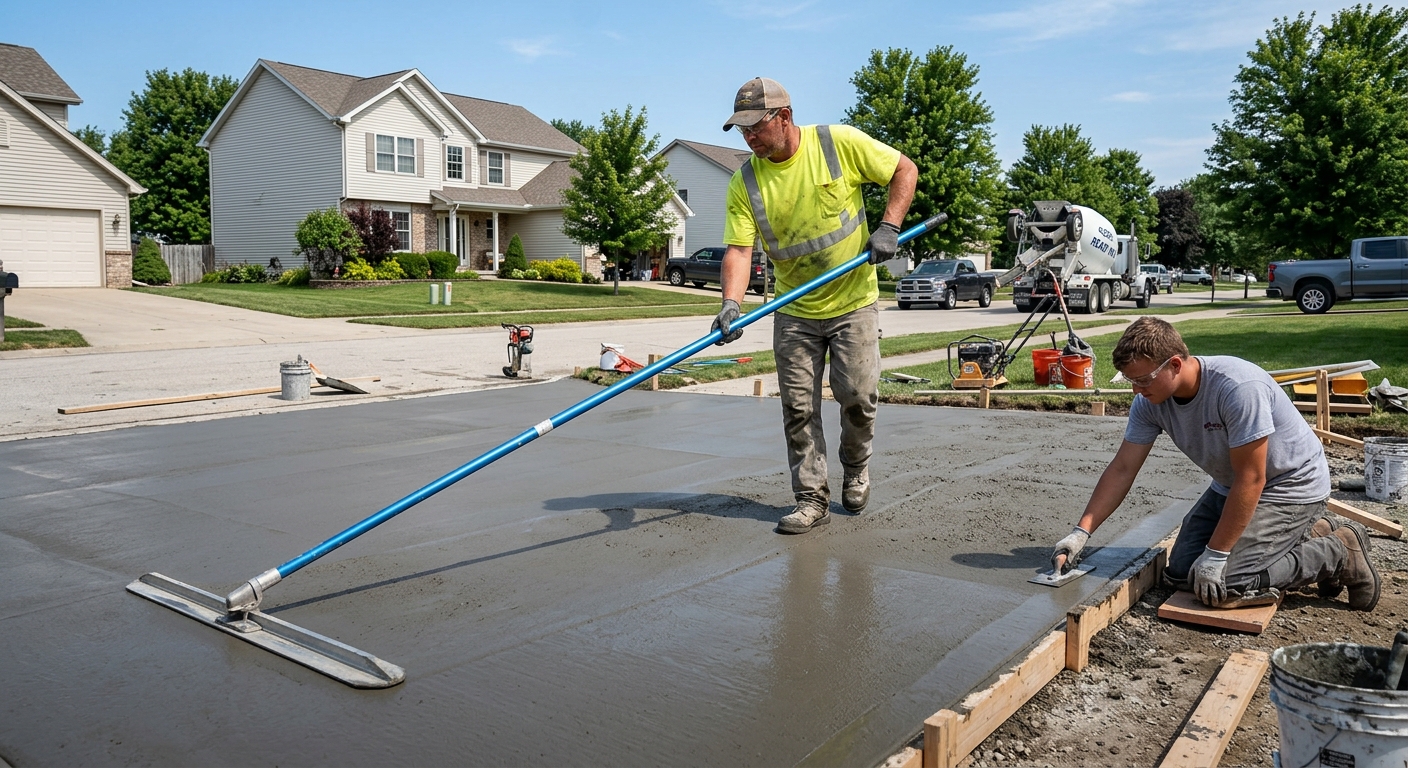
Concrete work options and costs in Mount Dennis
In Mount Dennis, concrete work is a common upgrade for homeowners because it’s durable, weather-ready, and well-suited to the city’s freeze–thaw winters. With a neighbourhood population of 13,593 people (Statistics Canada, 2021 Census), there’s steady demand for driveways, patios, walkways and basement-related concrete like footings. Most concrete flatwork in the area is tied to the type of housing people live in nearby—many homes are detached or semi-detached, which typically means wider drive approaches and longer runs of exterior walk surfaces. That scale matters for cost because the bigger the surface, the more time goes into base excavation, forming, finishing and jointing.
Toronto-area pricing is shaped by frost depth requirements and repeated freeze–thaw cycles. In practice, that means structural footings are built deep enough to limit frost heave, while exterior flatwork uses air-entrained concrete, proper drainage, and a control-joint plan to keep cracking predictable. It also affects scheduling: exterior pours are commonly concentrated in warmer months to protect early-age curing. Even though Mount Dennis isn’t coastal, humid shoulder seasons and wet site conditions still require careful base prep and curing protection so the surface doesn’t turn out weak or uneven.
Trade demand is especially noticeable around Wilson Avenue and the surrounding Mount Dennis corridors, where homeowners frequently refresh driveways and add patios to manage mud tracking and winter de-icing. Below is a side-by-side comparison of common options and realistic budget ranges, so you can compare contractor quotes more confidently.
| Application |
Typical Size |
Key Spec |
Finish Option |
Price Range |
| Concrete driveway (standard broom finish) |
12 ft x 20 ft (240 sq ft) |
Air-entrained mix, compacted granular base, control joints |
Broomed + sealer-ready |
$4,300 – $6,700 |
| Exposed aggregate driveway |
12 ft x 20 ft (240 sq ft) |
Staged aggregate exposure, air-entrained mix, proper base |
Exposed aggregate finish |
$5,900 – $8,700 |
| Stamped concrete driveway or patio |
10 ft x 18 ft (180 sq ft) |
Air-entrained mix, thicker top wear layer, joints |
Stamp pattern + colour |
$4,300 – $7,200 |
| Plain concrete patio or walkway |
10 ft x 12 ft (120 sq ft) |
Compacted granular base, drainage slope, joints |
Broom finish |
$2,000 – $3,100 |
| Garage floor (interior slab) |
20 ft x 22 ft (440 sq ft) |
Vapour barrier, compacted base, mesh where needed |
Float + broom edge finish |
$6,600 – $10,800 |
| Foundation footings (structural, below frost) |
Approx. 40 linear ft (varies by plan) |
Structural concrete + rebar, excavate below frost depth |
Structural concrete |
$7,200 – $12,000 |
Prices are estimates only and vary by project scope, site access and material selection.
What affects the price of concrete work in Mount Dennis
In the Toronto economic region—including Mount Dennis—two contractors can quote the “same” concrete job and land 30–50% apart because frost-protection requirements, base preparation, mix specifications, and finishing labour aren’t interchangeable. A driveway that looks flat on day one can still perform poorly if the contractor skips proper base thickness, uses the wrong mix, or doesn’t plan joints for freeze–thaw movement. That’s why the details in a quote matter more here than in mild climates.
Local frost depth and freeze–thaw cycles drive many of the costs. Footings for structural foundations must extend below the design frost depth (often around 1.2 m (about 4 ft) in Ontario), which increases excavation, forming height, and concrete volume. For exterior slabs, contractors typically specify air-entrained concrete so the material can survive repeated freeze–thaw cycles. When temperatures drop toward about 10 °C or below, cold-weather curing precautions—like insulation blankets or temporary heating—can add cost and reduce scheduling flexibility.
Mount Dennis soil and drainage also change labour time. For example: (1) a saturated or poorly drained lot can require extra base grading and drainage improvements before a driveway or walkway is poured; (2) poor truck access near Wilson Avenue-area properties can increase labour and equipment time for hauling and pumping; (3) older homes with uneven grades often need more demo and subgrade repair. Finish selection swings the budget too—standard broom-finished driveway work often fits the $18–$28 per sq ft band, while stamped or decorative options typically fall closer to the $24–$40 range because of added labour for stamping, colouring and additional finishing time.
| Price Factor |
Why It Matters |
Cost Impact |
| Frost line depth — determines footing depth and form height |
Footings must be set below design frost to prevent heave and differential movement |
Higher excavation depth can add substantial concrete and labour time |
| Site preparation — excavation, grading, compacted granular base |
Weak subgrade leads to settlement, cracking, and drainage failure |
Extra removal/haul and compaction steps can noticeably raise costs |
| Reinforcement — rebar or wire mesh requirement |
Rebar/wire mesh helps control cracking and improves load performance |
Material + labour for tying/positioning changes pricing |
| Mix design — air-entrainment and compressive strength spec |
Air entrainment improves freeze–thaw durability for exterior concrete |
Higher-spec mixes and testing add direct material cost |
| Finish type — broom vs. stamped vs. exposed aggregate |
Decorative work requires more labour and careful timing |
Stamped/exposed finishes typically cost more than broom finishes |
| Pour size and concrete truck access to site |
Narrow driveways or awkward access slow crews and may require pumping |
More logistics can increase labour and equipment charges |
| Cold-weather curing precautions — heating and blankets |
Cold slows strength gain and can harm early-age durability |
Heating/blankets can add line-item cost and restrict pour dates |
| Control joint pattern and sealing cost |
Joints manage cracking and sealing helps resist de-icing salt damage |
Correct jointing and sealer add small-to-moderate cost with big durability payoff |
Permits & regulations in Ontario
In Ontario, structural concrete work usually requires a building permit and may involve engineered drawings reviewed by the municipality. This includes foundation footings, foundation walls, and grade beams. Concrete flatwork—such as driveways, patios, and walkways—often does not require a permit by default, but it can if the work affects lot grading, drainage, impervious surface coverage limits, or the municipal right-of-way. In Mount Dennis, where many lots border established sidewalks and curbs, it’s wise to confirm whether any forms, excavation near municipal property, or changes to drainage need approval before concrete is poured.
Before breaking ground, you should also verify your contractor is legally set up to do the work. Concrete contractors should carry liability insurance and WSIB/WCB coverage (even when they’re using sub-trades). Ask for references on similar-scale jobs—driveways, patios, or foundation work—so you can see how they handle base preparation and freeze–thaw durability.
Step-by-step for homeowners in Mount Dennis: (1) get the contractor’s name and business number; (2) check Ontario licensing/registration online through the appropriate provincial registry used for contractor status; (3) request a current certificate of insurance and confirm the coverage is active for your project dates; (4) ask for proof of WSIB/WCB clearance (or equivalent verification documents); (5) keep copies of all documentation with your signed quote and drawings so there’s a clear record if questions come up later.
Getting concrete right in Mount Dennis's freeze-thaw climate
Concrete failures in Mount Dennis usually trace back to three things: poor base preparation, an inadequate freeze–thaw-resistant mix, and early-age curing problems. In a Toronto climate with frequent winter temperature swings, the biggest visible symptom is spalling—flaking or scaling at the surface—often caused by insufficient air-entrainment combined with de-icing salt exposure and moisture. The fix isn’t just “patch and go”; it’s about specifying the right system: compacted base, correct mix, planned joints, proper cure time, and sealing.
To spec your project correctly, start with base preparation: contractors should build a compacted granular sub-base to a depth that matches the soil condition and planned slab thickness (and they should address drainage so water doesn’t sit under your driveway or patio). Next, require an air-entrained concrete mix (typically 5–7% air for exterior flatwork) and a minimum performance target such as 32 MPa compressive strength. Then insist on control joints placed to limit random cracking, and curing protection so concrete reaches adequate early strength. If you’re pouring near colder conditions, curing needs to be protected—blankets and heated enclosures are common add-ons in the GTA when temps drop and strength gain slows.
Finally, sealing matters here because salt is used on driveways and walkways. A penetrating sealer applied after cure (commonly around 28 days) helps repel moisture and reduces surface degradation.
Budget example: a stamped patio might come in around $24–$40 per sq ft, versus $16–$26 for a plain broom-finished patio. If your plain patio is already properly built (good base, air-entrained mix, joints, sealing), you may not “need” stamped. But if you’re upgrading for aesthetics and longevity on a visible walkway to a main entrance in Mount Dennis, the added cost can be justified—just ensure the contractor doesn’t cut technical corners to fund the decorative finish.
| Spec |
Why It Matters in Mount Dennis |
What to Ask For |
Impact if Skipped |
| Compacted granular base (depth?) |
Stabilizes the slab and prevents settlement and pumping during freeze–thaw |
“What base depth and compaction method will you use, and how will you handle drainage?” |
Cracks, uneven surfaces, and accelerated deterioration |
| Air-entrained concrete mix (target air %?) |
Improves freeze–thaw durability and reduces moisture damage to the paste |
“Provide air content target of 5–7% for exterior flatwork and confirm mix design.” |
Higher risk of spalling and surface scaling |
| Compressive strength (MPa rating) |
Ensures strength development for durability and load performance |
“Minimum 32 MPa compressive strength at specified days; confirm mix class and documentation.” |
Weaker concrete that wears quickly and cracks sooner |
| Control joints (spacing per ACI guidelines) |
Controls where shrinkage and thermal movement will crack |
“Show joint layout and spacing, and confirm joint saw-cut timing.” |
Random cracking and moisture pathways |
| Minimum 7-day curing period |
Cold snaps and wet weather slow strength gain and can reduce long-term performance |
“How will you protect curing if temperatures drop—blankets, wind protection, curing schedule?” |
Surface weakness, reduced durability, and more early defects |
| Penetrating sealer (when applied after cure) |
Repels water and helps defend against de-icing salt exposure |
“Apply penetrating sealer after full cure (commonly at 28 days); confirm product type and coverage.” |
More moisture ingress, spalling risk, and faster surface breakdown |
How to choose a concrete work contractor in Mount Dennis
Choosing the right concrete contractor in Mount Dennis is mostly about verifying coverage, checking that the quote matches the technical requirements, and making sure the company has a track record with similar freeze–thaw conditions. Start by verifying Ontario licensing status where applicable, then confirm liability insurance and WSIB/WCB clearance. How to check each: (1) request the contractor’s certificate of insurance and verify it’s active for your project start and end dates; (2) ask for WSIB/WCB proof and confirm it’s for the contractor and any named workers (or their clearance documents); (3) keep a copy of the insurance and clearance documents in your records.
Next, request 2–3 itemised written quotes. You want a labour + materials breakdown (not one lump sum). Compare line items like demo/removal, excavation, granular base supply/compaction, reinforcement, concrete supply, formwork, finishing, curing protection, and sealing. Also ask what’s excluded: disposal of concrete, permit fees (if applicable), hauling distance, and any work needed to regrade for drainage.
Warranty is a big differentiator. Ask for the length of the workmanship warranty, whether it covers cracking/spalling, and if the warranty is tied to proper maintenance (like sealing). Confirm whether any product/manufacturer warranties apply and if they’re transferable if you sell the home.
For payment schedule, avoid heavy deposits—never pay more than about 10–15% upfront. Use a holdback until completion and final walkthrough. Finally, demand a start date and an estimated completion window in writing, because weather and curing protection can affect the schedule.
- Insurance certificate matches your project address and dates
- WSIB/WCB clearance is provided before work starts
- Quote includes excavation, granular base, and compaction—not just “concrete supply”
- Air-entrained mix and exterior durability specs are clearly stated
- Joint layout and sealing plan are included for driveways/patios/walkways
- Clear wording on disposal/haul-off of removed concrete
- Permit responsibility is identified for foundation/structural work
- Reinforcement (mesh/rebar) is specified based on slab use and design
- Curing method and cold-weather protection are included if temps are borderline
- Schedule includes curing time and not just “pour day”
- Warranty terms are in writing (workmanship and any limitations)
- Payment plan avoids large upfront payments; holdback is defined
Concrete red flags in Mount Dennis include: vague quotes that only list “concrete” without base compaction details, no mention of air-entrained mix or joints for exterior flatwork, refusal to provide insurance/WSIB clearance documents, sudden price changes without a written change order, and finish work that looks good on day one but skips sealing or proper curing protection.
Frequently asked questions — concrete work in Mount Dennis
What causes concrete to spall in Mount Dennis winters?
Spalling in Mount Dennis winters is usually driven by moisture + freeze–thaw, plus de-icing salt exposure. When water gets into the concrete (through surface pores or cracks) and then freezes, it expands and stresses the concrete paste. If the mix isn’t air-entrained to survive freeze–thaw cycles—or if air content is too low—surface scaling and flaking are much more likely. Ontario’s winter temperature swings also mean concrete repeatedly goes through expansion and contraction, which makes proper base prep and jointing critical.
In many GTA driveways and walkways, spalling shows up first at edges and around joints where water collects. A well-built slab with a compacted granular base, control joints, curing protection, and a penetrating sealer (often applied after about 28 days) is much more resistant. If you’re comparing quotes, ask how they’ll meet exterior durability; for example, standard broom-finished flatwork commonly falls in the $18–$28 per sq ft band, while skimpier installs often undercut that with weaker specifications.
What is rebar and when is it required in Ontario?
Rebar (reinforcing steel bars) is used to strengthen concrete and help control cracking when loads or shrinkage happen. In Ontario, whether rebar is required depends on the type of concrete work. Structural elements like foundation footings, foundation walls, and grade beams are commonly engineered and typically specify rebar layouts. That’s why you’ll often see engineered drawings and permit involvement for foundation-related concrete.
For flatwork like driveways, patios, and walkways, reinforcement may be required based on slab thickness, soil conditions, and intended use (for example, heavy vehicles). Many contractors use wire mesh or rebar sized and spaced for the design, but it must be positioned correctly (not sitting on the base). The most important point for Mount Dennis homeowners is not to treat reinforcement as optional “upgrades.” Ask your contractor to state the reinforcement type and slab thickness in the written scope, and ensure it aligns with durability needs for freeze–thaw exposure.
How long does a concrete project take in Mount Dennis?
Timing depends on size, site access, and weather. For a typical driveway or patio in Mount Dennis, you can often plan for a short on-site construction window for the actual pour day and finishing—then you wait for cure. Most crews can excavate, form, and place concrete in 1–3 days depending on how large the area is and whether there’s demo and regrading. The “concrete cure” period is what governs durability: even though the surface might look ready in a day or two, contractors should protect curing and allow strength gain.
In Ontario’s freeze–thaw climate, cold weather can slow early strength. Contractors may schedule around warmer periods and use insulation blankets if temperatures drop toward about 10 °C or below. For practical planning, it’s common to expect at least 7 days before you treat the slab as fully serviceable, with full performance and sealing decisions often tied to around 28 days after the pour. If you’re budgeting a plain patio in the $16–$26 per sq ft band, ask the contractor to include curing protection in their schedule—not just the pour date.
What is a concrete overlay and is it suited to Mount Dennis?
A concrete overlay is a new top layer placed over existing concrete to restore surface appearance and reduce trip hazards or minor deterioration. It can be an option when the base concrete is still largely sound—cracks are limited, slabs are not severely settled, and the surface can be properly prepared (usually through cleaning, grinding, and patching). In Mount Dennis, overlay suitability depends heavily on freeze–thaw condition of the original slab; if water is already migrating through the old concrete, overlays can sometimes fail faster because the moisture pathway remains.
For exterior flatwork exposed to de-icing salt and moisture, the key is preparation and bonding. Ask your contractor what system they use, how they’ll assess the existing slab, and whether they’ll correct drainage issues first. If the existing driveway is badly cracked or heaved, it’s often better to remove and rebuild rather than overlay. Cost-wise, overlays can sometimes be close to rebuild pricing once you account for prep and specialized materials—so compare the scope carefully. Also confirm how sealing will be handled after cure to manage winter exposure.
How do I seal concrete to protect it in Mount Dennis?
To protect concrete in Mount Dennis, sealing helps repel moisture and reduces the damage from de-icing salts. The usual approach is to apply a penetrating sealer after the concrete has cured sufficiently—often around 28 days post-pour—so the concrete is dry enough for the sealer to do its job. A penetrating product soaks into the pores rather than forming a thick surface film, which is important for exterior slabs that go through repeated freeze–thaw cycles.
Before sealing, the slab should be clean and dry. If there are surface contaminants, paint, old sealers, or curing compounds, the sealer may not penetrate properly. In the Toronto area, wet fall and spring conditions can delay drying, so plan sealing when weather allows. When you compare quotes, ask whether sealer is included or whether it’s an add-on, and what product type and coverage rate are being used. For homeowners choosing finishes, standard broom concrete often lands around the $18–$28 per sq ft band, but long-term durability improves significantly when sealing and joints are included in the scope.
What is the difference between concrete and cement?
Concrete and cement are related but not the same. Cement is one ingredient—typically Portland cement—that acts as the binder in a concrete mix. Concrete is the full engineered material made by combining cement with aggregates (sand and gravel or stone), water, and often admixtures such as air-entrainment agents and set modifiers. That’s why the concrete “spec” matters more than the name on its own; a properly designed concrete mix is what controls durability in Mount Dennis’s freeze–thaw winters.
For exterior flatwork like driveways, patios, and walkways, air-entrainment is a key specification because it helps the material tolerate freezing and thawing without spalling. Contractors also often target a compressive strength requirement (commonly 32 MPa for many residential exterior pours, depending on the application and engineer/standard). When you read quotes, look for the concrete mix details: air content targets, strength requirements, and whether curing protection is included for cold conditions. If a contractor only mentions “cement” and not the concrete mix design and durability specs, it’s a warning sign for freeze–thaw performance.