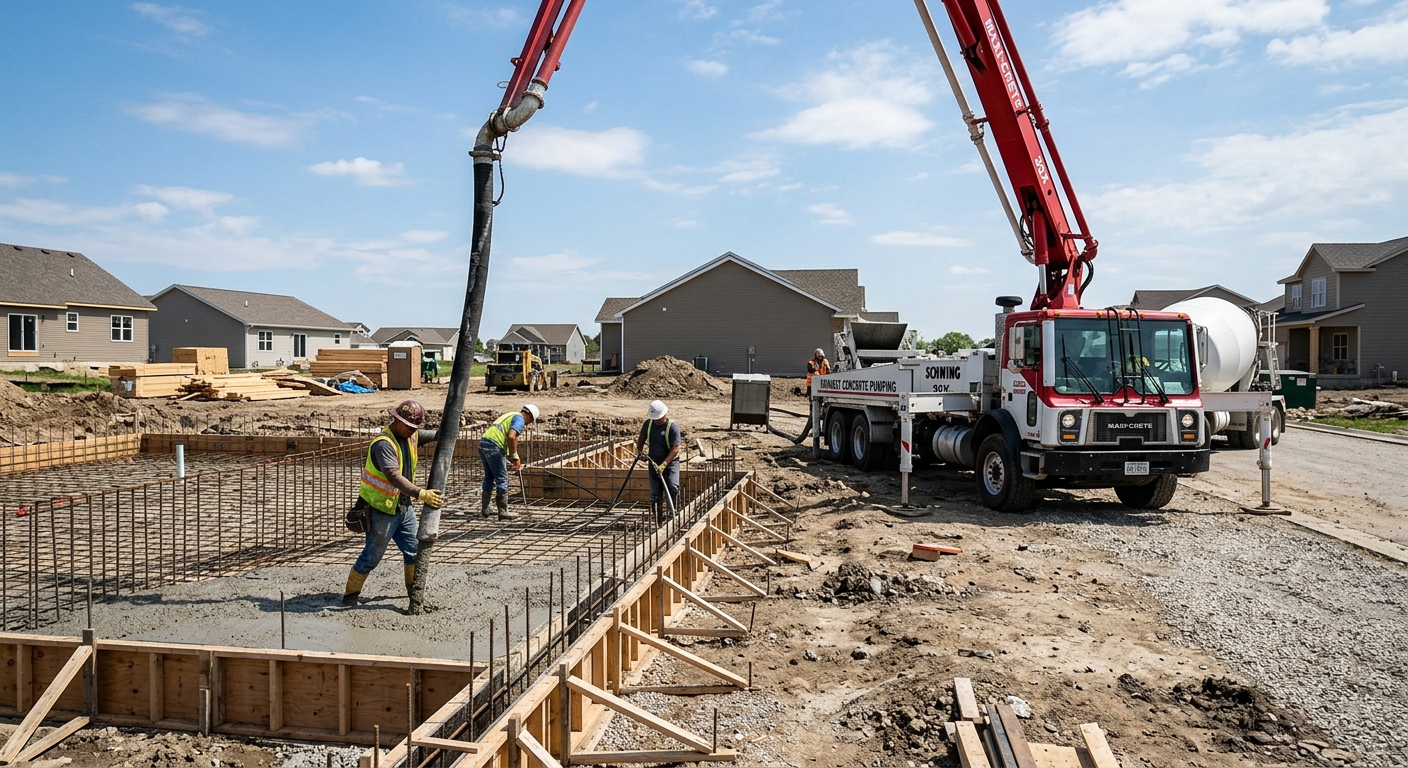
Concrete work options and costs in Stoney Creek
Concrete work in Stoney Creek typically comes down to whether you’re pouring exterior flatwork (driveways, patios, walkways) or doing structural work (foundation footings and related concrete). With a population of 76,382 (Statistics Canada, 2021 Census), Stoney Creek has an active mix of new builds and long-established neighbourhoods—exactly the kind of demand that keeps contractors busy when the May–October pour season opens. In practical terms, concrete flatwork is especially common for single-detached homes, which are a big part of the local housing mix and drive the need for driveways and backyard patios where most homeowners notice upgrades first.
Across the Hamilton–Niagara Peninsula, pricing is strongly shaped by the cold, wet Great Lakes corridor: freeze-thaw stress, higher moisture exposure, and frost depth push us to design deeper foundations and pier footings below frost. That means more excavation, more compacted granular base, steel where required, and air-entrained mixes for exterior slabs. Even though the city is not “year-round pour” friendly, winter work is sometimes possible with hoarding, heating, and cold-weather practices—those add cost and scheduling time.
Trade demand is particularly steady in older, established areas near the Lake Ontario corridor, where replacement driveways and patio renewals are frequent after freeze-thaw cycles and de-icing salt exposure. If you’re comparing options, start by looking at typical installed ranges, then we’ll refine it once we know your lot access and finish level. Use the table below as a baseline for Stoney Creek and the surrounding Hamilton–Niagara Peninsula market.
| Application |
Typical Size |
Key Spec |
Finish Option |
Price Range |
| Concrete driveway (standard broom finish) |
10 ft x 40 ft (400 sq ft) |
Air-entrained exterior mix, control joints |
Broom finish + seal-ready |
$5,600 – $8,800 |
| Exposed aggregate driveway |
10 ft x 40 ft (400 sq ft) |
Air-entrained mix, exposed stone wash |
Exposed aggregate (spray/brush wash) |
$8,000 – $13,500 |
| Stamped concrete driveway or patio |
12 ft x 18 ft (216 sq ft) |
Air-entrained mix, release + color hardeners |
Stamped pattern + integral color |
$5,000 – $7,600 |
| Plain concrete patio or walkway |
10 ft x 12 ft (120 sq ft) |
Air-entrained mix, proper drainage |
Light broom or trowel-finish with joints |
$1,450 – $2,400 |
| Garage floor (interior slab) |
22 ft x 20 ft (440 sq ft) |
Vapour barrier where needed, fibre or mesh |
Steel-trowel finish with saw cuts |
$4,800 – $8,900 |
| Foundation footings (structural, below frost) |
Typical house run 1,000–1,600 lin ft equivalent |
Excavate to below design frost, rebar as required |
Structural concrete + forms |
$16,000 – $38,000 |
Prices are estimates only and vary by project scope, site access and material selection.
What affects the price of concrete work in Stoney Creek
Two homeowners can get quotes that differ by 30–50% for what looks like the “same” concrete job in the Hamilton–Niagara Peninsula, because the fundamentals change: how deep you excavate, what base you build, what mix design you specify, and how much protection you plan for freeze-thaw. In our local market, a premium driveway isn’t just about looks—it’s about managing water, frost, and shrinkage so the slab doesn’t heave or spall in the first few winters.
Frost line depth drives footing depth and form height. In Ontario, footings must extend below the design frost depth (often around 1.5–2.4 m), and exterior slabs need well-prepared granular base and air-entrained concrete to survive repeated freeze-thaw cycles. The cold-weather factor matters too: the May–October pour window is common, and when the weather turns, cold-weather curing precautions (insulating blankets, heated protection) can add labour and material costs. De-icing salt also accelerates surface damage—sealing and correct surface detailing aren’t “cosmetic”; they’re protection, which is why many contractors bundle sealing prep into the scope.
In Stoney Creek, I see costs rise when homeowners want a new driveway that ties into existing elevations (more grading and disposal) or when the subsoil is wet clay and needs over-excavation and drainage improvements. Costs can come down when site access is straightforward and the excavation is shallow—but you still pay for air-entrained mix and proper control joints. For example, a standard broom driveway often lands in the $14–$22 per sq ft band, while stamped or exposed aggregate moves into the $22–$35 per sq ft range because labour-intensive finishing and premium materials are required.
| Price Factor |
Why It Matters |
Cost Impact |
| Frost line depth — determines footing depth and form height |
Deeper excavation/forming required to prevent frost heave |
Higher excavation + labour; typically adds major cost on foundations |
| Site preparation — excavation, grading, compacted granular base |
Base quality controls settlement and surface failures |
Wet subgrade and extra base raise cost; good soil lowers it |
| Reinforcement — rebar or wire mesh requirement |
Controls cracking and improves structural performance |
Additional steel + placement labour can add noticeable dollars |
| Mix design — air-entrainment and compressive strength spec |
Exterior slabs need freeze-thaw durability |
Premium mix may increase per-yard cost; prevents early spalling |
| Finish type — broom vs. stamped vs. exposed aggregate |
Labour intensity and material systems differ by finish |
Stamped/exposed typically shift projects toward the higher per-sq-ft bands |
| Pour size and concrete truck access to site |
Smaller or restricted access can increase labour and time |
Long wheelbarrow distances or multiple pours increase installation cost |
| Cold-weather curing precautions — heating and blankets |
Protects concrete from rapid temperature swings |
Seasonal labour premium; can noticeably increase total price if needed |
| Control joint pattern and sealing cost |
Manages shrinkage cracking and protects from de-icing salts |
More joints/saw-cut labour + sealer can add cost, but reduces callbacks |
Permits & regulations in Ontario
In Ontario, structural concrete work usually needs a building permit. That includes footings, foundation walls, grade beams, and any structural elements that support the building. Municipalities commonly expect engineered drawings for structural foundations, and those drawings may be reviewed before work starts. For concrete flatwork—driveways, patios, and walkways—the work often does not require a permit by default, especially when it’s replacement or a like-for-like upgrade. That said, you should confirm because permits can be triggered if the work changes lot grading, impacts stormwater management, affects impervious surface coverage limits, or touches municipal right-of-way requirements (for example, driveway approaches and curb drainage).
Before breaking ground in Stoney Creek, verify the basics like a pro: (1) ask for the contractor’s business information and insurance documentation; (2) confirm they carry liability insurance; and (3) ensure they have WSIB/WCB coverage appropriate for their workers. Step-by-step, a homeowner can check: first, look up the contractor via the relevant Ontario public business/registry listings (where available), then request a current Certificate of Insurance and confirm the expiry date and coverage amounts. Next, ask for proof of WSIB/WCB clearance (or relevant account details) and verify the document is current. Finally, request references on similar projects in the Hamilton–Niagara Peninsula—driveway and footing work under winter conditions is a good sign they can handle curing and protection properly.
Getting concrete right in Stoney Creek's freeze-thaw climate
Concrete failures in Stoney Creek almost always trace back to one of five issues: weak base, water intrusion, incorrect mix design, poor jointing, or curing mistakes. In our cold, wet Great Lakes corridor, freeze-thaw cycles put real stress on exterior slabs. If the mix isn’t air-entrained and you don’t detail joints and drainage correctly, the surface can spall (flake/peel), and you’ll see early breakdown within a few winters—often around high-salt areas like driveway edges and down-slope sections.
To spec the job correctly, I recommend you ask for a proper base build: compacted granular sub-base to the depth needed for local soil and frost protection, then confirm the slab thickness and elevations. For the mix design, request exterior air-entrainment target of 5–7% air content for freeze-thaw durability and minimum 32 MPa compressive strength. Control joints are not optional in our market—they’re how we manage shrinkage cracking so cracks appear where you can live with them. Curing matters too: plan for a minimum 7-day curing period under proper conditions, and if temperatures dip, include cold-weather protection (heating/blankets). Finally, sealing helps repel de-icing salts; in most cases, apply a penetrating sealer 28 days after the pour once the concrete has cured.
As a practical budget example, homeowners sometimes compare a broom-finish driveway versus a stamped driveway. You might see roughly an extra $22–$35 per sq ft for stamped work depending on size and complexity. That difference is usually justified when you want curb appeal and are committing to the same freeze-thaw durability specs (air-entrainment, base, joints). If a contractor cuts those basics to “pay for the stamp,” you’ll likely pay again.
| Spec | Why It Matters in Stoney Creek |
What to Ask For |
Impact if Skipped |
| Compacted granular base (depth?) |
Supports the slab and protects against frost-related movement in Stoney Creek |
Settlement, uneven cracking, and reduced slab lifespan |
| Air-entrained concrete mix (target air %?) |
Freeze-thaw resistance in exterior slabs across the Hamilton–Niagara Peninsula |
Spalling and scaling, especially near edges exposed to de-icing salts |
| Compressive strength (MPa rating) |
Ensures durability and loading capacity for driveways and exterior flatwork |
Premature wear, surface damage, and higher cracking risk |
| Control joints (spacing per ACI guidelines) |
Manages shrinkage cracking and thermal movement in cold/wet cycles |
Random cracking and wider gaps that trap water |
| Minimum 7-day curing period |
Builds strength and helps resist early freeze damage |
Weak surface, higher risk of deterioration and scaling |
| Penetrating sealer (when applied after cure) |
Helps repel moisture and de-icing salt intrusion in Ontario winters |
Faster surface breakdown and more frequent maintenance |
How to choose a concrete work contractor in Stoney Creek
Choosing a contractor is where you protect your budget and avoid callbacks. In Ontario, verify three things up front: (1) Ontario business licensing/registration for the contractor’s operation (where applicable in their business structure), (2) liability insurance, and (3) WSIB/WCB coverage for workers. Here’s how I suggest homeowners check: request a Certificate of Insurance (confirm coverage limits and expiry date), then ask for proof of WSIB/WCB clearance or account documentation. Don’t accept “it’s in progress”—it should be valid for the period of the job. If they won’t provide paperwork promptly, that’s a red flag.
Get 2–3 itemised written quotes. Ideally, the quote breaks out excavation/site prep, granular base, reinforcement (if required), concrete supply/mix design, forms, finishing, joints, sealing (if included), and disposal. Avoid lump-sum pricing that doesn’t explain what’s excluded: ask specifically about permit pull (if structural work is involved), protection for adjacent landscaping, and whether traffic control or disposal fees are included. For warranty, ask for the workmanship warranty length, whether there’s a manufacturer warranty on the materials, and if any coverage is transferable if you sell the home. Keep payment terms controlled: never pay more than 10–15% upfront; hold back a portion until completion and final walkthrough. Finally, require a start date and a realistic completion estimate in writing—Stoney Creek’s seasonal scheduling is tight, and weather can shift pours quickly.
- Confirm air-entrained exterior mix and minimum compressive strength in writing.
- Ask for base depth and compaction method (not just “good base”).
- Verify control joint plan and saw-cut timing.
- Check whether reinforcement is specified for the slab and/or footings.
- Require cold-weather curing and protection details if dates slip.
- Confirm disposal is included (spoils, old concrete haul-away).
- Ask how drainage and water run-off will be handled to avoid ponding.
- Get finish specifics: broom finish, stamped system, exposed aggregate process.
- Clarify sealing scope—who supplies sealer and when it’s applied.
- Review timeline for curing and when you can park/weight the slab.
- Ensure the quote includes protection for driveways/sidewalks during work.
- Use a written change-order process for any scope changes.
Red flags I see with concrete contractors in Stoney Creek include: vague quotes that don’t specify air-entrainment or joint spacing, refusing to show insurance/WSIB/WCB documentation, quoting a foundation job without discussing below-frost excavation, pushing to pour without cold-weather protection when temperatures drop, and “cheapening” the base to hit price—those shortcuts are what lead to cracking and spalling after freeze-thaw cycles.
Frequently asked questions — concrete work in Stoney Creek
How much does concrete work cost in Stoney Creek?
In Stoney Creek, pricing depends heavily on finish level and site conditions, but you can use local market bands as a starting point. For example, a standard concrete driveway is commonly priced around $14,000 – $22,000 per project baseline depending on size and base prep; exact numbers land in that $14–$22 per sq ft range once we confirm excavation, drainage, and access. Plain patios and walkways typically fall in the $12–$20 per sq ft band, while decorative options like stamped concrete often move into the $22–$35 per sq ft range. Because Hamilton–Niagara Peninsula has colder, wetter conditions and freeze-thaw stress, we design for below-frost footings and air-entrained exterior mixes—those durability requirements are part of why “low-bid” quotes can be risky. The most accurate quote comes from an itemised breakdown of base, reinforcement (if needed), mix spec, finishing, and sealing.
How deep must footings be for Stoney Creek's frost line?
For Stoney Creek and the wider Hamilton–Niagara Peninsula, footings should be placed below the design frost depth to prevent frost heave. In Ontario, design frost depth is commonly in the 1.5–2.4 m range (the exact depth depends on soil conditions and the engineered foundation design). That’s why excavation depth and form height often show up as the biggest driver in foundation pricing—deeper excavation means more labour and more granular base build-up and protection. If a contractor guesses footing depth rather than using the local design requirements and engineering documents, you can end up with uneven settlement or heaving after multiple freeze-thaw cycles and wet winters.
Why does concrete crack in Stoney Creek and how is it prevented?
Concrete in Stoney Creek cracks mainly because it’s exposed to thermal movement and shrinkage, and then it’s hit repeatedly by freeze-thaw cycles in a moisture-heavy environment. Cracking can be “controlled” if joints are planned and cut correctly so shrinkage happens where you expect it to. To prevent uncontrolled cracking, contractors should specify proper base preparation, use an exterior air-entrained mix for durability, and include a joint pattern with saw-cut timing that matches curing conditions. Sealing and good drainage also reduce water trapped under or at the slab edge. If a job is broom-finish only (not decorative), homeowners should still expect control joints—skipping joints is a common reason slabs develop random cracks that widen over time.
Stamped vs broom-finish concrete — cost difference?
Stamped concrete costs more than broom-finish mainly because it uses a stamping/release system, colour materials (often integral), and extra labour for imprinting and finishing. In Stoney Creek, broom-finish driveways commonly fall within the $14–$22 per sq ft range, while stamped concrete typically lands in the $22–$35 per sq ft band depending on pattern complexity and slab size. The key point is that paying for stamping doesn’t replace the durability specs: you still need air-entrainment for freeze-thaw, proper granular base, and a control joint plan. If those durability items are skipped, the stamp can look great initially but you’ll still get spalling or cracking failures. When the decorative finish is paired with correct mix design and curing, the higher cost usually shows up as better curb appeal without sacrificing performance.
When is the best time to pour concrete in Stoney Creek?
For Stoney Creek, the practical best window for exterior and many structural pours is roughly May to October. That aligns with the local Hamilton–Niagara Peninsula climate realities: cold nights can interfere with curing and increase risk during early/late season. Most structural and exterior slabs are scheduled in that period because it reduces the need for heavy heating and protection. If you must pour in shoulder season or winter, contractors need hoarding, temperature management, and cold-weather curing precautions—those add cost and can change the concrete schedule. A well-run crew will also plan for longer curing protection so the slab doesn’t get rapid temperature swings, which can contribute to surface damage and early weakness.
How long does concrete take to cure?
Concrete curing isn’t just “set time”—it’s about strength gain under proper conditions. For typical flatwork in Stoney Creek, a minimum 7-day curing period is expected under favourable conditions, and you should plan to protect the surface during that time. Full readiness for heavier use often involves longer timelines depending on mix design, temperature, and whether fibres or reinforcement are used. For sealing, a common practice is to apply penetrating sealer about 28 days after the pour, once the concrete has cured sufficiently and moisture conditions are right. Curing is especially important in Ontario winters and freeze-thaw cycles: if curing is rushed or concrete is exposed to de-icing salts or cold snaps too early, you increase the risk of scaling and spalling. If your contractor can explain their curing plan (blankets/heating if needed) clearly, that’s a good sign.