Concrete work options and costs in Doon South
Concrete work in Doon South, Ontario is in high demand because homeowners want durable flatwork that can handle the Greater Toronto Area’s freeze–thaw swings. With a population of 11,524 (Statistics Canada, 2021 Census), the local housing market has steadily supported repairs and upgrades—especially for driveways, patios and walkways tied to single-family properties. In this part of town, contractors often see repeat work in established pockets near residential streets where lots are already built up and access for trucks and equipment can be tight. That availability and access can influence pricing as much as the concrete itself.
Toronto-area winter conditions directly shape concrete specs and costs. Exterior pours are commonly scheduled for the warmer months to support proper curing, because when temperatures drop toward 10 °C or below, finishing and strength gain slow down and crews need extra protection. Frost depth and freeze–thaw cycles also push structural and drainage requirements—proper footing depth, well-compacted granular base, and air-entrained concrete are non-negotiable for long-term performance. GTA contractors typically manage this with air-entrained mixes, adequate thickness, and control joints planned to reduce random cracking.
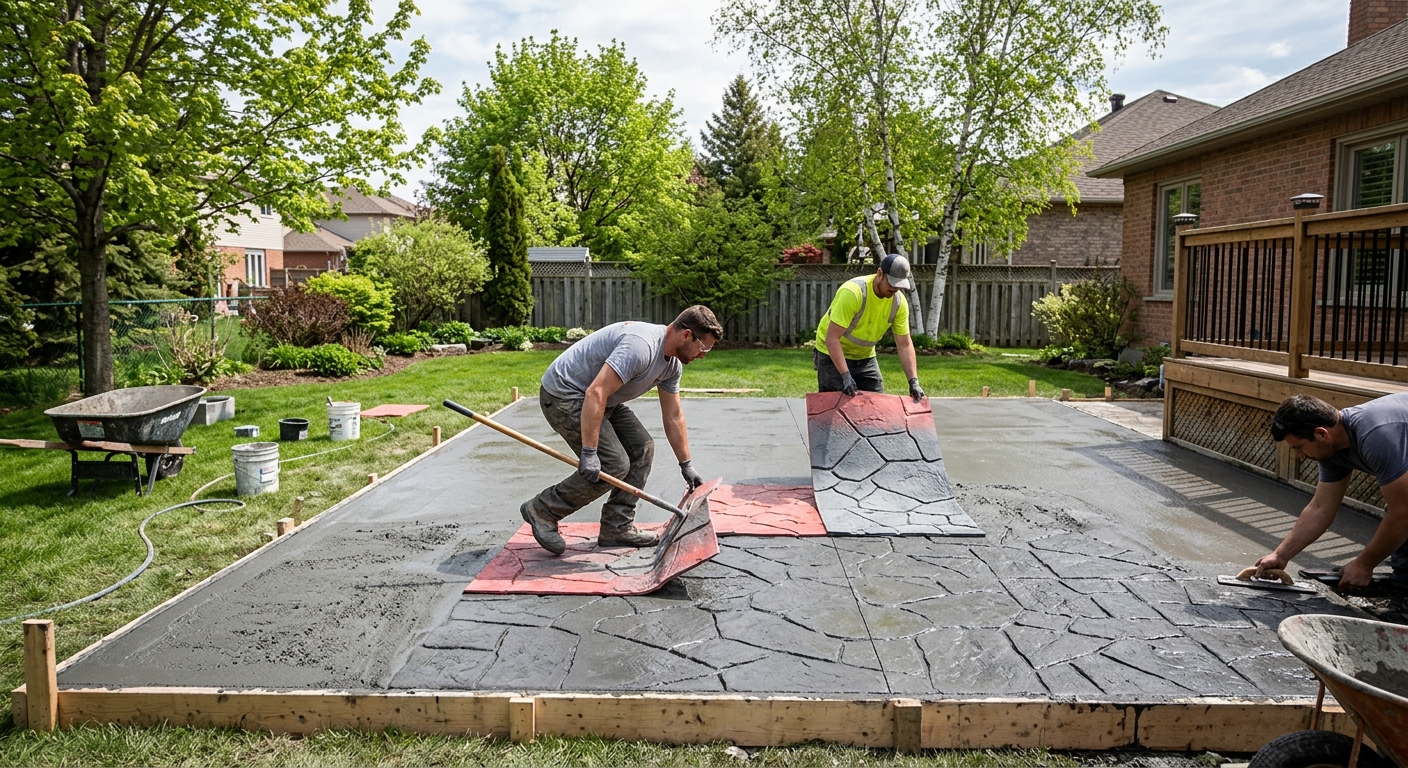
Depending on the look you want, you’ll usually choose between standard broom finishes, exposed aggregate for texture and slip resistance, or stamped concrete for curb appeal. If you’re comparing options, start with the ranges below—then match the finish to your soil conditions, drainage plan, and expected lifespan.
| Application |
Typical Size |
Key Spec |
Finish Option |
Price Range |
| Concrete driveway (standard broom finish) |
400 sq ft |
Air-entrained exterior mix; control joints; compacted granular base |
Broom finish, light broom texture |
$18,500–$26,500 |
| Exposed aggregate driveway |
400 sq ft |
Air-entrained mix; aggregate exposure plan; denser surface |
Exposed aggregate with edging detail |
$24,000–$34,000 |
| Stamped concrete driveway or patio |
300 sq ft |
Air-entrained mix; release agent; proper sub-base thickness |
Stone/brick pattern stamp |
$20,000–$33,500 |
| Plain concrete patio or walkway |
250 sq ft |
Air-entrained exterior mix; slope to drainage; control joints |
Broom finish or light trowel finish (non-slip) |
$4,000–$7,000 |
| Garage floor (interior slab) |
480 sq ft |
Minimum thickness per design; vapor barrier when required |
Plain trowel finish (may include floor hardener) |
$10,000–$17,000 |
| Foundation footings (structural, below frost) |
Typical 1–2 storey home footing run |
Engineered or code minimum footing depth below frost; reinforced concrete |
Structural finish (not decorative) |
$11,000–$22,000 |
Prices are estimates only and vary by project scope, site access and material selection.
What affects the price of concrete work in Doon South
In the Toronto economic region around Doon South, it’s common to see quotes for the same “driveway size” land 30–50% apart once you compare actual site conditions, mix design, and how much prep work is included. A contractor who offers a low number may be assuming an average base, standard thickness, or minimal reinforcement—while another quote may include deeper excavation, more granular base, air-entrainment to the right exposure class, and tighter control joint planning to manage cracking from freeze–thaw.
Frost depth and freeze–thaw cycles dictate nearly every spec. In Ontario, structural footings must typically extend at least 1.2 m (about 4 ft) below grade to help prevent frost heave and differential movement. Exterior flatwork also needs an air-entrained concrete mix to survive repeated freezing and thawing, and crews often concentrate exterior pours into warmer months to support proper curing. If the job runs late fall or early spring and temperatures approach 10 °C or below, cold-weather curing precautions (insulating blankets, heating, and longer protection time) can add labour and material cost.
Two examples from Doon South that commonly swing budgets: (1) a driveway removal on a narrow lot—where trucks can’t stage near the excavation—usually increases labour time and concrete logistics, and that can push a standard broom-finish driveway toward the higher end of the $18–$28 per sq ft band; (2) if you want stamped concrete, the higher finish labour is justified when you’re also correcting drainage and providing adequate base—otherwise you’re paying for aesthetics while risking spalling and uneven settlement.
| Price Factor |
Why It Matters |
Cost Impact |
| Frost line depth — determines footing depth and form height |
Deeper excavation and taller forms increase concrete volume and labour |
Can add significant cost on foundations/footings; generally higher for deeper frost conditions |
| Site preparation — excavation, grading, compacted granular base |
Proper base reduces settlement and prevents cracking caused by movement |
Often the biggest swing factor; missing base prep is a common “cheap quote” cause |
| Reinforcement — rebar or wire mesh requirement |
Reinforcement controls cracking and supports load distribution |
Moderate to high impact depending on access, steel placement, and design |
| Mix design — air-entrainment and compressive strength spec |
Air-entrainment improves freeze–thaw durability; strength supports performance |
Higher-grade mix usually adds per-yard cost but protects against early surface failure |
| Finish type — broom vs. stamped vs. exposed aggregate |
Finishes add labour steps and sometimes more specialized crews |
Stamped/exposed finishes typically cost more than plain concrete |
| Pour size and concrete truck access to site |
Limited access increases setup time, pumping/hoisting, and rebar handling |
Can raise labour by hours; sometimes increases truck count |
| Cold-weather curing precautions — heating and blankets |
Cure time and early strength gain depend on temperature and protection |
Extra blankets, heaters, and longer protection windows |
| Control joint pattern and sealing cost |
Joints manage shrinkage; sealing helps repel de-icing salts |
Usually moderate, but required for best durability on exterior flatwork |
Permits & regulations in Ontario
In Ontario, structural concrete work generally requires a building permit. That includes footings, foundation walls, grade beams and other structural elements tied to a building’s support system. Municipal review often benefits from engineered drawings, particularly for foundation-related details. For homeowners in Doon South, the practical takeaway is simple: if the concrete is part of the structure, treat it as permit-required until proven otherwise.
Concrete flatwork—like patios, walkways and standard driveways—often does not require a permit by itself. However, exceptions are common. If your project affects lot grading, changes drainage paths, or touches municipal requirements around impervious surface coverage or right-of-way boundaries, you may need municipal approval or at minimum a check with the local authority before work begins. The right step is to confirm scope impacts with the municipality before you break ground.
Before you hire anyone, verify three things for Ontario jobs: (1) the contractor has the correct business licensing/registration for the work they’re advertising, (2) they carry liability insurance and (3) they have WSIB/WCB coverage where applicable. For homeowner verification: ask for a current certificate of insurance (COI) that names you or shows coverage for the project; request a clearance letter or proof of account from WSIB/WCB; and check the online registry or contractor listing where Ontario maintains public records. Then ask for references on similar-scale flatwork and structural work in the GTA.
Getting concrete right in Doon South's freeze-thaw climate
Concrete fails in Doon South most often when the base isn’t built to resist movement, the concrete mix isn’t designed for freeze–thaw, or the surface isn’t properly cured and protected. The fix starts below grade. First, prep the sub-base: excavate to the planned depth, place compacted granular material in lifts, and ensure the base is stable and appropriately sloped for drainage. In the Toronto market, you’ll also see crews planning the pour so the concrete can cure steadily without early freeze risk—especially when night temperatures dip.
Second, the mix design matters. For exterior flatwork, specify air-entrainment (typically about 5–7% air content for durability) and a minimum 32 MPa compressive strength appropriate to the application. Third, control joints should be planned to reduce random cracking. Fourth, curing should be protected so strength develops: a minimum 7-day curing period is a practical baseline, and longer protection may be required if it’s cool or damp. Fifth, sealing should happen after the concrete has cured—typically around 28 days post-pour—so de-icing salts can’t attack the surface as easily.
Ask technical questions that connect to freeze–thaw durability, especially air content. A good contractor will be able to explain how they’ll avoid spalling from inadequate air-entrainment and how they’ll protect the slab during cold snaps. For example, a broom-finished driveway often sits around the $18–$28 per sq ft band, while stamped concrete is higher at about $24–$40 per sq ft. That premium is justified when drainage and base prep are also done right; if not, you can end up with the wrong cracks—just more visible under a decorative finish.
| Spec |
Why It Matters in Doon South |
What to Ask For |
Impact if Skipped |
| Compacted granular base (depth?) |
Stable base resists settlement and reduces freeze–thaw movement effects |
Confirm excavation depth and granular thickness; compaction testing approach |
Uneven surface, accelerated cracking, and potential drainage issues |
| Air-entrained concrete mix (target air %?) |
Air voids help concrete withstand repeated freeze–thaw cycles |
Target 5–7% air for exterior flatwork and verify mix design documents |
Higher risk of spalling and surface scaling within a few winters |
| Compressive strength (MPa rating) |
Strength gain supports durability and load resistance in Ontario conditions |
Minimum 32 MPa for exterior flatwork (confirm project specification) |
Wear, cracking and reduced long-term performance |
| Control joints (spacing per ACI guidelines) |
Controls where cracking occurs during shrinkage and temperature changes |
Ask for joint spacing and whether joints align with slab geometry |
Random cracks that can open and allow water to reach the base |
| Minimum 7-day curing period |
Proper early curing supports strength and reduces surface damage |
Confirm curing plan and when de-icing/traffic is allowed |
Reduced strength and early deterioration, especially in cooler weather |
| Penetrating sealer (when applied after cure) |
Helps repel moisture and de-icing salts that attack concrete surfaces |
Penetrating sealer after ~28 days cure, per product directions |
Increased spalling risk and faster surface scaling |
How to choose a concrete work contractor in Doon South
Choosing the right concrete contractor in Doon South (and the broader Ontario market) starts with verification. First, confirm the contractor is operating legally for the work they’re doing and can provide proof of liability insurance. Second, ask for WSIB/WCB clearance or proof of coverage so you’re not stuck with liability if a worker is injured on your property. Request a current certificate of insurance and ensure it includes your address or lists coverage for the specific project type (driveways, flatwork, or structural concrete). If you can’t get paperwork up front, that’s a red flag.
Next, get 2–3 itemised written quotes—not just a lump sum. Ideally, the quote breaks down labour and materials such as excavation/grading, compacted granular base, rebar or mesh, concrete quantity and mix spec, forming, finishing, joints, and sealing (where included). Be very clear on inclusions: is permit pulling included for structural work? Is disposal of waste included? Who handles saw-cutting and patching after joint creation?
Warranty matters. Ask for a workmanship warranty (length and what failures are covered) and separately understand any manufacturer product warranties—especially for sealers and any special admixtures. For payment, avoid paying more than 10–15% upfront; hold back a portion until completion and final grading/cleanup are done. Finally, insist on a written timeline with a start date and completion estimate, including protection steps if weather turns cold.
- Provide proof of liability insurance before work begins
- Provide WSIB/WCB clearance/coverage documentation
- Itemise excavation, base, reinforcement, concrete mix, finishing and joints
- Clarify if joints will be saw-cut or formed and the planned pattern
- Confirm air-entrainment and minimum strength (ask for mix spec details)
- Ask how they handle curing in cool or damp weather
- Confirm sealing scope (product type and timing after cure)
- Show similar local projects in the GTA with before/after photos
- Confirm truck access plan and whether pumping/hoisting is needed
- Verify waste disposal, stump/soil handling and site cleanup inclusions
- Request a defined warranty for workmanship and how claims are handled
- Use a payment schedule with a holdback until punch list is completed
In Doon South, red flags include quotes that omit base preparation details, promised “freeze-proof” concrete without discussing air-entrainment, no written curing plan, no proof of WSIB/WCB/insurance, and warranties that are vague or exclude cracking/spalling without explanation.
Frequently asked questions — concrete work in Doon South
When is the best time to pour concrete in Doon South?
In Ontario (including Doon South), the best results come from pouring when daytime temps are reliably warm and overnight frosts are unlikely. Many GTA crews schedule exterior flatwork for late spring through summer to support consistent curing and proper finishing. If temperatures drop toward 10 °C or below, contractors typically need extra protection—blankets, heaters and longer curing time—which can add cost and sometimes affects surface quality. For homeowners, the practical approach is to book early and align the pour date with your contractor’s weather plan, not just the calendar. If you’re comparing options, note that decorative work like stamped concrete is usually more sensitive to weather delays; a standard broom-finish driveway may tolerate a bit more variability, but durability still depends on correct curing.
How long does concrete take to cure?
Concrete curing is a process, not a single date. For normal residential flatwork in Ontario, you should plan for at least 7 days of curing before heavy use, and you should treat earlier traffic as “light and careful” per your contractor’s instructions. Full strength continues developing beyond that, and sealing timing depends on cure and weather conditions. For exterior surfaces exposed to freeze–thaw and de-icing salts in Doon South, penetrating sealer is commonly applied around 28 days post-pour so the concrete has dried sufficiently and can accept the product effectively. If you pour during cooler periods, curing protection may extend the practical wait time. Always ask for the exact curing plan included in your quote and when the contractor will remove forms, open the area and apply any protection or sealers.
Do I need a permit for concrete work in Ontario?
For Ontario, structural concrete such as footings, foundation walls and grade beams generally requires a building permit, often supported by engineered drawings reviewed through municipal processes. For concrete flatwork—driveways, patios and walkways—permits are often not required by default, but you still need to confirm if your project affects lot grading, drainage, impervious surface limits, or municipal right-of-way areas. In Doon South, the common “miss” is assuming all driveway replacements are permit-free when the scope changes drainage patterns at the curb line or alters how water runs off the property. Before breaking ground, ask your contractor what permits are required for your specific scope and whether the quote includes permit support for structural elements. If you’re uncertain, confirm directly with the local authority using your proposed dimensions and site plan.
Concrete vs pavers for a patio in Doon South?
For a patio in Doon South, concrete is often the lower-maintenance, longer-term choice when it’s done with the right base and drainage. Concrete at roughly $16–$26 per sq ft (depending on thickness and site prep) can be a strong value compared with many paver systems once you include proper base thickness and edge restraint. Pavers can be easier to repair section-by-section, but they still depend heavily on excavation depth, compacted base, and correct slope. The Toronto area’s freeze–thaw cycles mean any patio—concrete or pavers—must resist water infiltration under the surface. If you want a uniform finish with controlled cracking, broom-finished or lightly finished concrete plus sealing can work well. If you want a more intricate look, stamped concrete sits higher (often $24–$40 per sq ft) but provides a similar decorative effect without as many individual units.
How long does a concrete driveway last?
A well-built driveway in Doon South can last decades, but the “lifespan” depends on how it’s constructed for freeze–thaw. Longevity is mostly determined by the base prep (proper compacted granular sub-base), correct thickness, air-entrained exterior mix, control joint planning, and curing/finishing discipline. Sealing later in the cycle also helps with moisture and de-icing salt exposure. If a driveway is priced too cheaply and skips base prep or uses a mix that isn’t designed for freeze–thaw, you’ll often see cracking and spalling earlier—sometimes within a few winters. In practical homeowner terms, compare quotes that land in the driveway band (about $18–$28 per sq ft) and verify that includes air-entrainment, jointing, and drainage considerations. Those details are what protect your investment in Ontario’s humid, wet shoulder seasons.
What is air-entrained concrete and why does it matter here?
Air-entrained concrete is mixed with tiny, evenly distributed air bubbles that give water a place to expand when it freezes. In Doon South and across Ontario, repeated freeze–thaw cycles are exactly what destroys poorly formulated concrete surfaces—water gets into pores and cracks, then expands and breaks the material over time. That’s why exterior flatwork typically uses air-entrained concrete with a target air content (commonly about 5–7%) and a minimum compressive strength (often 32 MPa for flatwork). Contractors should be able to explain the mix design they’re using and how it supports durability against scaling and spalling from winter de-icing salts. If you’re comparing quotes, ask whether the mix is air-entrained for exterior exposure and whether they’ve planned control joints and curing—those are the practical tools that keep your driveway or patio looking good through many seasons.