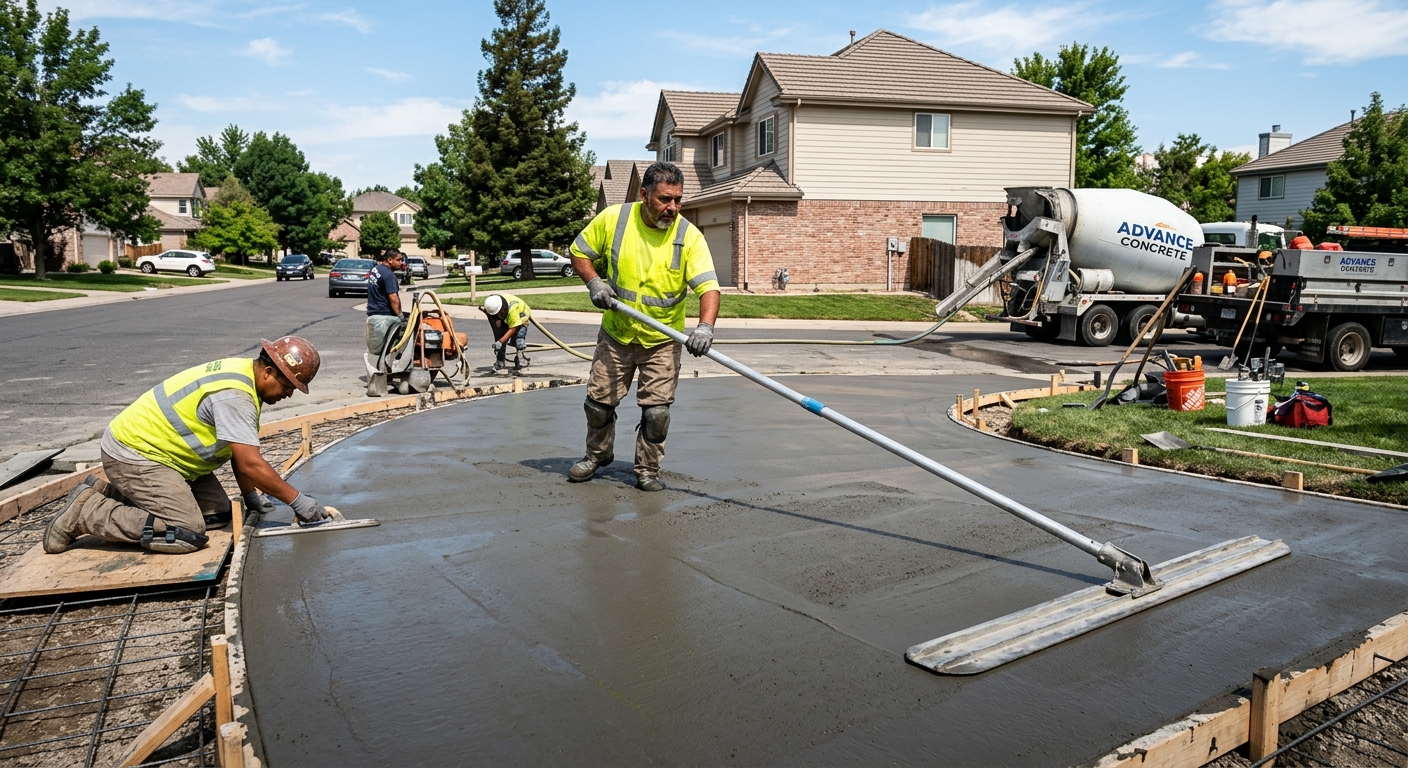
Concrete work options and costs in Hespeler
In Hespeler, concrete work is a year-round need, but it’s priced and planned around Ontario’s freeze–thaw seasons. With Hespeler’s population at 18,445 (Statistics Canada, 2021 Census), the demand is steady—especially because most streets are lined with long-established single-detached neighbourhoods where homeowners commonly upgrade driveways, sidewalks, patios, and garage slabs. In practice, that means concrete contractors are busiest around the wave of spring restorations and summer additions. Toronto’s climate is the main driver: deeper footings and careful exterior detailing are required so saturated soils don’t shift against the concrete each winter, and so surfaces survive repeated freeze–thaw.
In the Toronto economic region, local departments and the Ontario Building Code typically push structural footings to extend to at least about 1.2 m (roughly 4 ft) below grade—below the design frost depth—to reduce frost heave and differential settlement. For exterior flatwork like driveways and patios, crews also rely on air-entrained mixes, proper granular base compaction, and control joints to manage cracking. Pour timing matters too: when temperatures drop toward 10 °C or below, curing slows and finishing becomes more sensitive, so contractors often concentrate exterior work in the warmer months and protect slabs longer to keep quality consistent.
If you’re in an area like Hespeler Village, you’ll typically see high demand for driveway and walkway replacements because access and aesthetics are big priorities—meaning the choice between plain concrete, exposed aggregate, or stamped finishes is where homeowners often see the biggest swing in price. Use the table below to compare typical scopes and budgeting ranges for the most common jobs.
| Application |
Typical Size |
Key Spec |
Finish Option |
Price Range |
| Concrete driveway (standard broom finish) |
24 ft x 12 ft (288 sq ft) |
6 in thickness; air-entrained; compacted granular base |
Broom finish + control joints |
$5,200 – $8,200 |
| Exposed aggregate driveway |
24 ft x 12 ft (288 sq ft) |
6 in thickness; air-entrained; wash exposed surface |
Exposed aggregate + sealed surface |
$6,800 – $10,800 |
| Stamped concrete driveway or patio |
20 ft x 16 ft (320 sq ft) |
4–5 in thickness; air-entrained; base and joint plan |
Stamp + colour hardener + release |
$8,000 – $12,800 |
| Plain concrete patio or walkway |
12 ft x 10 ft (120 sq ft) |
4 in thickness; air-entrained; compacted base |
Straight-edge/steel trowel + light broom |
$1,900 – $3,100 |
| Garage floor (interior slab) |
20 ft x 20 ft (400 sq ft) |
4 in slab; vapour barrier (typical); reinforcement |
Steel-trowel finish + saw cuts |
$6,400 – $10,000 |
| Foundation footings (structural, below frost) |
Average 2–3 bedroom house footing package |
Reinforced footings; excavation + below-frost depth |
Cast-in-place structural concrete |
$3,600 – $7,200 |
Prices are estimates only and vary by project scope, site access and material selection.
What affects the price of concrete work in Hespeler
In Hespeler and across the Toronto region, you can see the same type of concrete project come in 30–50% apart on quotes. The biggest reasons usually aren’t “mystery markups”—it’s differences in how contractors handle site conditions, frost-protection requirements, mix design, and finishing/detailing. Toronto-area work is strongly shaped by freeze–thaw cycles, so exterior slabs and sidewalks/driveways require air-entrained concrete and an engineered base approach so water doesn’t pool and expand under the slab. Even where the job is “just concrete,” the code intent is to control movement and prevent frost heave at the edges and under the slab.
Footings must extend below design frost depth (Ontario commonly calls for roughly 1.5–2.4 m depending on soil and conditions), and that impacts excavation volume, shoring, and the height of formed walls. When concrete is poured in colder stretches, cold-weather curing precautions—like insulating blankets, wind protection, or temporary heating—can add labour and rental costs. Surface damage is also influenced by winter de-icing: salt can accelerate spalling on poorly sealed or under-detailed flatwork, which is why sealing and surface protection are frequently recommended. These climate-driven requirements are why basic work might land near the $18–$28 per sq ft driveway band, while higher detailing or premium finishes like stamped concrete can move toward the $24–$40 per sq ft range.
For example, two Hespeler homeowners can pay very different totals: (1) if one lot has saturated clay and requires deeper granular replacement and better drainage, you may see an increase; (2) if you’re removing an old driveway with limited access for a skid-steer or truck, hauling and demo time raises costs; and (3) if you want stamped work in a visible area and the base needs extra prep for a consistent surface, decorative pricing is usually justified. The region’s housing stock—many properties are older and have legacy grading—means drainage fixes can be the difference between a slab that lasts and one that fails early, sometimes by thousands of dollars over the life of the installation.
| Price Factor |
Why It Matters |
Cost Impact |
| Frost line depth — determines footing depth and form height |
Deeper, below-frost concrete reduces frost heave and settlement |
High (can add significant excavation and concrete volume) |
| Site preparation — excavation, grading, compacted granular base |
Proper base prevents water retention and slab movement |
Medium to high (varies with soil and drainage) |
| Reinforcement — rebar or wire mesh requirement |
Supports slab performance and reduces cracking risk |
Medium (materials + installation labour) |
| Mix design — air-entrainment and compressive strength spec |
Air-entrainment is crucial for freeze–thaw durability |
Low to medium (often well worth the cost) |
| Finish type — broom vs. stamped vs. exposed aggregate |
Surface system affects labour, consumables, and appearance |
Medium to high (decorative options cost more) |
| Pour size and concrete truck access to site |
Access affects line-up time, labour, and potential rework |
Medium (tight sites can add mobilization time) |
| Cold-weather curing precautions — heating and blankets |
Protects strength gain when temperatures drop |
Medium (season timing can change the total) |
| Control joint pattern and sealing cost |
Controls cracking and helps prevent salt-driven surface damage |
Low to medium (but impacts long-term performance) |
Permits & regulations in Ontario
In Ontario, structural concrete work usually triggers permitting and plan review, while typical flatwork often does not. If you’re doing foundation footings, foundation walls, or grade beams, you should expect a building permit and, in many cases, engineered drawings reviewed by the municipality or its plan-check process. That’s because these elements affect structural capacity, loads, and how the building handles frost and ground movement. Concrete flatwork—driveways, patios, sidewalks, and walkways—typically doesn’t require a permit unless it affects lot grading, drainage, impervious surface coverage limits, or the municipal right-of-way (for example, work near a boulevard/sidewalk that touches public space). Always confirm with the local authority before you break ground, especially if you’re changing slopes or moving downspouts.
For contractor verification in Hespeler, take it step-by-step: (1) verify the company’s Ontario licensing/registration status through the appropriate provincial consumer or licensing registry (what you’ll search depends on the contractor type); (2) request a certificate of liability insurance and confirm it’s current and covers the project scope; (3) ask for proof of WSIB coverage (or WCB clearance if applicable through the contractor’s employer arrangements) and ensure the coverage is active for the people on site; and (4) request references from similar-size jobs—especially exterior slabs in freeze–thaw conditions. Then you can compare quotes on equal footing rather than assuming “structural details” are optional.
Getting concrete right in Hespeler's freeze-thaw climate
Concrete fails in Hespeler’s climate for predictable reasons: water, freeze–thaw movement, and premature surface deterioration. The winning approach is to spec the job for exterior durability—starting with base prep and ending with proper curing and sealing. First, base preparation: use a properly compacted granular sub-base to the right depth for local soil and drainage. In the Toronto region, saturated soils can swell and contract as freeze–thaw cycles repeat, so drainage and compaction aren’t optional. Second, mix design: for exterior flatwork, contractors typically target 5–7% air content for air-entrained durability and a minimum 32 MPa compressive strength so the concrete can resist scaling and spalling. Third, control joints: plan saw-cut timing and spacing to limit random cracking to predictable lines. Fourth, curing: plan for at least 7 days of proper curing; cold snaps near or below 10 °C make protection important so strength gain doesn’t stall. Fifth, sealing: apply a penetrating sealer once the slab is fully cured (commonly after 28 days) to repel de-icing salts and reduce moisture uptake.
Ask technical questions before you sign: “What air content are you ordering?” “How deep is the granular base, and what material spec are you using?” “When will joints be cut?” The simplest failure to spot is spalling from inadequate air-entrainment or poor finishing under wet conditions. A practical price comparison: if a standard broom-finish driveway comes in around the $18–$28 per sq ft band, paying the extra for proper air-entrainment, thicker slab design where needed, and joint/curing protection is usually the difference between a normal service life and a costly redo. Conversely, stamped concrete can add cost (often aligned with the $24–$40 range) but it only looks good long-term if the base and cracking control are done right.
| Spec |
Why It Matters in Hespeler |
What to Ask For |
Impact if Skipped |
| Compacted granular base (depth?) |
Controls water, reduces frost movement, and supports slab |
Base depth and granular type; compaction test/process |
Settlement, pumping, and early cracking |
| Air-entrained concrete mix (target air %?) |
Protects from freeze–thaw damage and scaling/spalling |
Target air content (commonly 5–7% for exterior flatwork) |
Spalling and surface deterioration during winters |
| Compressive strength (MPa rating) |
Ensures strength gain and durability under traffic and weather |
Minimum 32 MPa specified for the mix |
Reduced performance and increased cracking risk |
| Control joints (spacing per ACI guidelines) |
Limits random shrinkage cracking and controls crack locations |
Planned joint spacing and cut timing for the slab thickness |
Uncontrolled cracking and higher water intrusion |
| Minimum 7-day curing period |
Strength gain depends on temperature and protection |
Protection plan during cool or windy conditions |
Weak surface, scaling, and long-term durability issues |
| Penetrating sealer (when applied after cure) |
Helps repel moisture and de-icing salts common in Ontario winters |
Sealer type and confirm timing after full cure (often 28 days) |
Faster spalling/scaling and staining |
How to choose a concrete work contractor in Hespeler
Choosing the right contractor is mostly about verification and scope clarity. Start with Ontario licensing/registration where applicable, and always request proof of liability insurance before work begins. For workplace coverage, ask for confirmation of WSIB/WCB status and a clearance letter or proof that their coverage is active for the crew working in Hespeler. Don’t accept “we’re covered” without documents you can review—then confirm the coverage aligns with the job date and address.
Next, get 2–3 itemised written quotes that break out labour and materials. You want line items that cover demo/removal, excavation and grading, granular base, reinforcement, concrete supply, forms, finishing, and—if exterior—joint cutting and sealing. Ensure the scope shows what’s included or excluded: permit pull included (if required), disposal/hauling included, curb/boulevard limitations, and whether old concrete removal includes saw cutting and concrete trucking away. Watch for quotes that look cheap because they omit base depth, reinforcement, or curing/protection.
For warranty, ask for the workmanship warranty length, whether there’s a manufacturer warranty on products (like sealers), and whether warranties are transferable if you sell the home. Payment should be controlled: never pay more than 10–15% upfront, and hold back retainage until the job is complete and accepted. Finally, request a written start date and a completion estimate that accounts for curing time and weather.
- Ask what air-entrained mix and target air content is being ordered for exterior work.
- Confirm footing depth assumptions for structural work below frost.
- Verify base prep includes granular type and compaction approach (not just “level and pour”).
- Request a joint plan: spacing, saw-cut timing, and sealing details if exterior.
- Get details on curing protection for cool nights near 10 °C.
- Confirm reinforcement is included when required (mesh vs. rebar and placement).
- Check whether disposal/hauling of concrete and debris is included.
- Ask how truck access and concrete pumping/line-up will be handled.
- Review whether forms, finishing, and cleanup are included in labour pricing.
- Get the warranty in writing and clarify what is covered (labour vs. materials).
- Ensure permit and inspection responsibility is clear for structural scopes.
- Confirm the contractor will protect edges during curing (no early traffic or rain exposure).
Concrete red flags in Hespeler: contractors who won’t discuss air-entrainment or joint spacing, who give only lump-sum pricing without base depth/reinforcement details, who ask for large upfront payments (beyond 10–15%), who start exterior pours without a curing/protection plan when temperatures fall, or who can’t provide WSIB/WCB proof and current liability insurance documents.
Frequently asked questions — concrete work in Hespeler
What is air-entrained concrete and why does it matter here?
Air-entrained concrete is mixed with tiny, evenly distributed air bubbles that give freeze–thaw stresses somewhere to go, reducing cracking and surface scaling. In Hespeler and the broader Toronto economic region, the freeze–thaw cycle is the main reason exterior flatwork needs this. Without enough air, water expands in the concrete during winter and can cause spalling—especially where de-icing salts are used on driveways and steps. This is why reputable contractors align exterior mixes with the local durability needs rather than offering a “one mix fits all” approach. When you compare quotes, look for wording about air-entrainment for exterior slabs and an air content target (often 5–7%). On typical driveway projects that fall within the $18–$28 per sq ft band, paying the modest difference for the right mix design is usually the best long-term value.
How do I prepare the base for a concrete slab?
Base prep is where concrete jobs are won or lost in Ontario freeze–thaw conditions. A proper slab starts with excavation to the design elevation, removal of topsoil/organic material, and installation of a compacted granular base. The key is depth and compaction: the granular layer must be compacted to an appropriate level and graded so water drains away rather than saturating the base. In Hespeler, clay-heavy or poorly drained areas can hold moisture, which increases movement against the slab over repeated winters. Ask your contractor what granular material is used and what thickness they’re providing, and whether they’ll compact in lifts. If your site has drainage issues, fixing them upfront can prevent the “cheap pour” from becoming an early replacement. Well-prepared base work also supports consistent finishing and joint performance, which matters for outdoor patios and driveways.
How do I compare concrete quotes?
To compare concrete quotes fairly in Hespeler, require itemised scopes rather than lump sums. Ask for line items covering demo/removal, excavation, granular base (including depth), reinforcement, concrete mix (including air-entrainment for exterior), formwork, finishing, joint cutting, curing/protection, and sealing for exterior surfaces. Quotes can differ 30–50% across the Toronto region because one contractor includes deeper base prep or cold-weather curing measures while another assumes standard conditions. Use the local price bands as a reality check: for example, a standard driveway often lands in the $18–$28 per sq ft range, while stamped concrete typically costs more and can align with the $24–$40 per sq ft range. If two quotes are far apart, don’t just ask “why is it cheaper?”—ask what’s missing: reinforcement, base depth, mix spec, sealing, or curing protection. If the scopes are equal, pricing differences are easier to understand.
Can concrete be poured in cold weather in Hespeler?
Yes, concrete can be poured in cold weather in Hespeler, but it needs a protection plan. The problem isn’t just air temperature—it’s how quickly concrete loses heat and how curing temperature affects strength gain. When temperatures trend toward 10 °C or below, finishing can be harder and the concrete may not reach the needed early strength in time. Reliable contractors handle this with measures like insulating blankets, wind protection, and sometimes temporary heating, then they manage curing so the slab isn’t exposed to freeze risk during early set. Exterior flatwork is also more sensitive to surface damage if rain or snow hits before curing is adequate. When comparing quotes, ask whether the contractor includes cold-weather curing precautions and how they handle start dates if temperatures drop. For structural work, permits/inspections and engineered requirements can add to the schedule considerations.
How do I maintain concrete in Hespeler's freeze-thaw climate?
Maintenance in Hespeler is about limiting moisture and salt exposure and keeping the surface protected. For exterior slabs, sweeping leaves away before freeze periods helps prevent localized water retention. Use de-icing products carefully: they’re helpful, but rough scraping or high-salt exposure can accelerate surface wear. The biggest upgrade you can make after installation is sealing. Penetrating sealers are typically applied after the slab is fully cured—commonly after 28 days—to reduce moisture uptake and help repel de-icing salts. Also keep drainage functioning: make sure downspouts and grade away from the slab don’t discharge water onto the concrete. If you notice small cracks, prompt attention can reduce water entry, but don’t attempt repairs until the concrete has properly cured. Proper joint lines and drainage reduce movement and keep cracks from spreading, which is especially important for driveways and walkways in freeze–thaw cycles.
What causes concrete to spall in Hespeler winters?
Concrete spalling in Hespeler winters usually comes from a combination of freeze–thaw exposure and insufficient protection. The most common cause is inadequate air-entrainment or poor mix selection for exterior conditions. If the concrete doesn’t have enough air bubbles to relieve internal pressure from freezing water, scaling and spalling can occur over repeated winters—often first on edges, steps, and areas repeatedly hit by de-icing salts. Another frequent contributor is water pooling due to insufficient base prep or poor grading, which keeps the slab saturated. Skipped or poorly timed control joints can also allow random cracking, letting water get into the slab structure. Finally, rushed curing during cool weather can lead to a weaker surface layer that’s more vulnerable. If your project is in the $18–$28 per sq ft driveway band, insist the quote includes air-entrained exterior mix, correct base preparation, proper curing, and sealing—those are the practical steps that directly reduce spalling risk in Ontario winters.