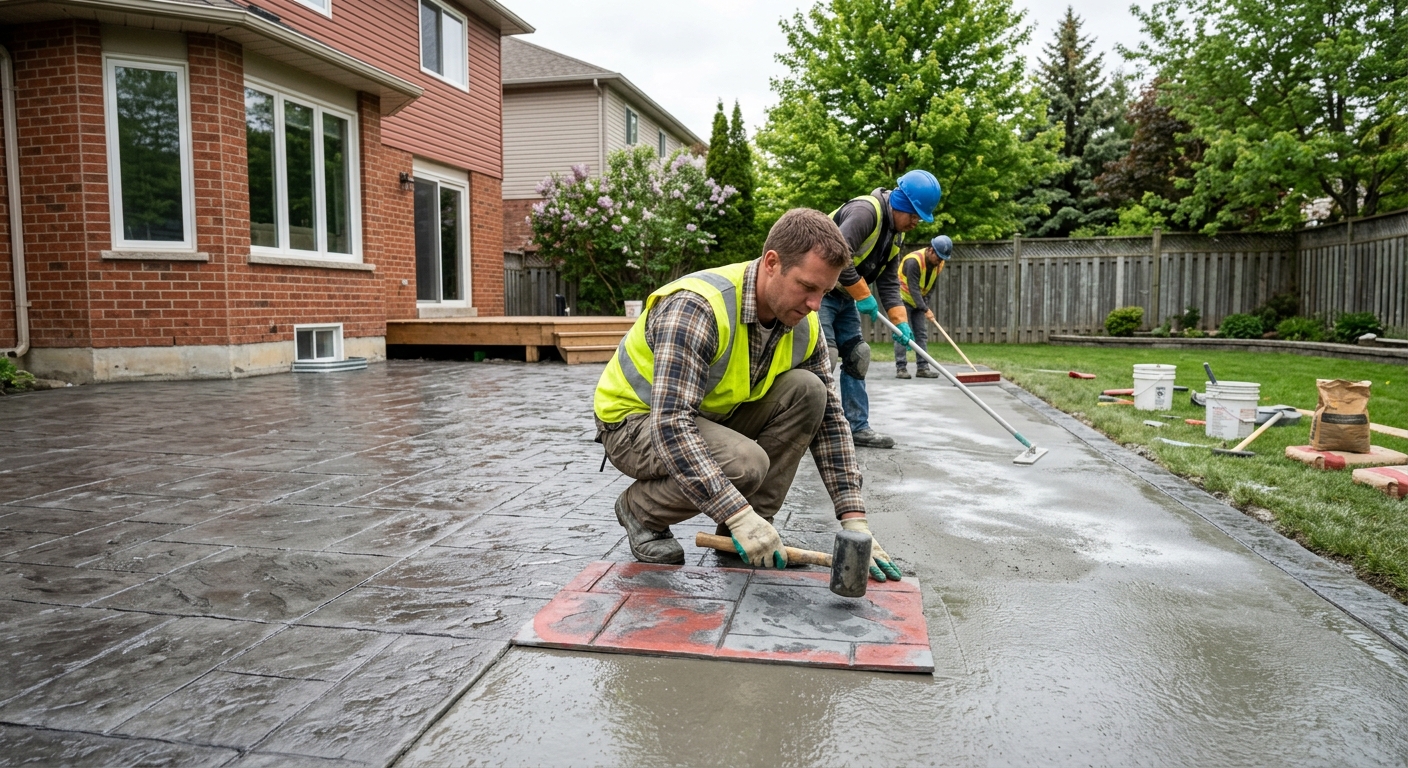
Concrete work options and costs in Southdale
In Southdale, concrete work is a year-round need for a wide mix of homeowners, from first-time buyers to long-term residents upgrading their driveways and outdoor living areas. With a population of 5,267 (Statistics Canada, 2021 Census), the local market is small enough that good crews are booked quickly during the short, reliable exterior pour window. Southdale also mirrors the broader Toronto area in that many houses are built for family living—so driveways, patios and walkways see heavy seasonal use, and that’s where freeze–thaw wear shows up first.
In the Toronto economic region, pricing is shaped by frost depth requirements and repeated freeze–thaw cycles. Most structural footings must extend at least about 1.2 m below grade to reduce frost heave and differential movement, which increases excavation, formwork height, and concrete volume on foundation-related work. For flatwork like driveways and patios, contractors typically price for a well-compacted granular base, proper drainage, air-entrained concrete, and control joints to manage exterior cracking over time. Humid, often wet fall and spring weather can also delay pours and curing, and cold snaps near 10 °C require protection and longer cure management—things homeowners feel in the final quote even when the slab size looks “standard.”
When competition is tight, contractors also prioritize neighbourhoods where demand is consistently high—Southdale’s established residential pockets around local arterial connections tend to see the most driveway replacements and patio builds each spring and early summer. Below is a practical comparison of typical options and price ranges so you can sanity-check quotes before you schedule site measurement.
| Application |
Typical Size |
Key Spec |
Finish Option |
Price Range |
| Concrete driveway (standard broom finish) |
24 ft x 10 ft (approx. 240 sq ft) |
Air-entrained mix, compacted granular base, control joints |
Broomed texture, standard form edges |
$18,000 – $28,000 |
| Exposed aggregate driveway |
24 ft x 10 ft (approx. 240 sq ft) |
Air-entrained mix, base prep for drainage, proper curing |
Exposed stone finish, sealed top surface |
$20,000 – $33,000 |
| Stamped concrete driveway or patio |
200 sq ft typical (driveway section or larger patio) |
Air-entrained mix, integral colouring, joint plan |
Stamp mats/colour hardener, release agent texture |
$24,000 – $40,000 |
| Plain concrete patio or walkway |
12 ft x 12 ft (approx. 144 sq ft) or 4 ft wide x 20 ft walk |
Compacted base, proper slope, control joints |
Float-and-broom or light broom finish |
$16,000 – $26,000 |
| Garage floor (interior slab) |
20 ft x 20 ft (approx. 400 sq ft) |
Vapour barrier where needed, rebar or mesh (site-specific) |
Steel trowel with light broom lines, optional densifier |
$18,000 – $30,000 |
| Foundation footings (structural, below frost) |
Per linear footage (typical single-family home) |
Below-grade excavation, engineered reinforcement, concrete volume |
Cast-in-place footings (no decorative finish) |
$180 – $300 |
Prices are estimates only and vary by project scope, site access and material selection.
What affects the price of concrete work in Southdale
Even for “the same” driveway size in Southdale, quotes across the Toronto economic region can diverge by 30–50%. The biggest reason isn’t the concrete itself—it’s the hidden line items: how much excavation is required, how deep and how well the granular base is compacted, whether reinforcement is included where it’s needed, and how the crew plans for freeze–thaw durability. Contractors also price their risk differently. In wet spring and early-fall conditions, delays can drive up labour costs, and cold snaps can change how long they must protect curing concrete when temperatures hover near 10 °C or lower.
Here’s the core Ontario effect: frost depth and freeze–thaw cycles dictate almost every exterior specification. Structural footings generally need to extend below the design frost depth (often at least 1.2 m) to prevent frost heave and differential movement. For exterior slabs—driveways, patios and walkways—air-entrained concrete is essential to survive repeated freezing and thawing. In colder stretches of Ontario, the pour season is shorter and cold-weather curing precautions (insulating blankets, heaters, longer cure schedules) can add cost. Finally, de-icing salt accelerates surface spalling if the mix and curing weren’t right, which is why sealing is a practical durability step on many flatwork projects.
In Southdale, practical examples that swing cost include: (1) removing existing asphalt or failed concrete can add disposal and trucking fees; (2) driveways on poorly draining soils require improved base thickness and drainage detailing before you pour—otherwise you pay later in cracking; and (3) if you choose decorative stamped concrete, you’re paying for colour, finishing labour, and more careful joint placement compared with a standard broom finish. As a quick reality check, standard flatwork might land in the $18,000 – $28,000 band for a typical driveway scope, while stamped decorative work often moves into the $24,000 – $40,000 band because of materials and extra labour.
| Price Factor |
Why It Matters |
Cost Impact |
| Frost line depth |
Footing depth drives excavation volume and form height |
Higher depth can add major labour and concrete costs |
| Site preparation |
Excavation, grading, and compacted granular base prevent voids and pumping |
More base and better compaction increases material and labour |
| Reinforcement |
Rebar or mesh improves crack control and reduces failure under loads |
Extra steel and tie-wire time adds cost but often prevents costly rework |
| Mix design |
Air-entrainment and required compressive strength improve freeze–thaw durability |
Specified mix can cost more than standard, especially for exterior work |
| Finish type |
Broom vs. exposed aggregate vs. stamped affects labour time and materials |
Decorative finishes raise cost through workmanship intensity |
| Pour size and concrete truck access to site |
Access affects crew efficiency, pumping needs, and setup time |
Pump/extra labour can materially increase the final bill |
| Cold-weather curing precautions |
Heating and insulated blankets protect early strength development |
Shorter pour windows can increase scheduling and protection costs |
| Control joint pattern and sealing cost |
Joints manage cracking; sealing reduces moisture and salt intrusion |
More joints and proper sealing add line-item cost but improve longevity |
Permits & regulations in Ontario
In Ontario, the permit picture depends on what you’re building. Structural concrete work—typically including footings, foundation walls, grade beams and other load-bearing elements—requires a building permit, and municipalities often expect engineered drawings for the design review. For concrete flatwork like patios, walkways and driveways, a permit often isn’t required by default, especially when you’re keeping similar grades and not altering drainage in a way that impacts neighbours. That said, you should confirm with your local authority before breaking ground, because permits can come into play if the work affects lot grading, increases impervious surface coverage beyond local limits, or impacts municipal right-of-way elements (for example, curb interfaces or drainage swales).
For Southdale homeowners, verifying the contractor is a simple, step-by-step process. First, ask for proof of liability insurance (certificate of insurance) showing your project address is covered or that the policy is active at the time of work. Second, confirm WSIB/WCB coverage where applicable—contractors should be able to provide a clearance letter or current account status details. Third, for structural concrete scopes, request the engineered plan set and confirm the contractor is building to the stamped drawings and Ontario code requirements. Finally, check the Ontario business registration status and licensing/coverage details through appropriate provincial and municipal channels, and compare their references to projects of similar scale and exterior freeze–thaw exposure.
If you’re ever unsure whether your specific driveway slope change or drainage adjustment triggers a permit or site plan condition, get the answer in writing before the demo day—those delays are expensive once excavation starts.
Getting concrete right in Southdale's freeze-thaw climate
In Southdale, concrete most often fails because water and freeze–thaw work together against an imperfect base and an underspecified mix. The sequence is familiar: saturated sub-base, ice formation, expansion, then stress concentration at weak points. Over time, that shows up as random cracking, settlement “edges,” and—most visibly—spalling on exterior surfaces. The fix is specification discipline, not shortcuts.
To spec the job correctly, start with base preparation: a properly compacted granular sub-base to the right depth for your site conditions and frost strategy, plus correct drainage and slope away from foundations. Next, the mix design should include air-entrainment—commonly in the 5% to 7% air range for exterior flatwork in freeze–thaw exposure—along with minimum compressive strength of 32 MPa (verify in writing on the ticket/spec). Then plan control joints so cracking happens where you want it: typical ACI guidance focuses on joint spacing to limit random shrinkage cracking, and for driveways it usually means an intentional grid rather than “whatever fits.” Curing matters as much as the pour: aim for at least 7 days of curing under proper conditions; if temperatures drop near 10 °C or below, crews should use protection so early strength develops properly. Finally, sealing should be applied after full cure—often around 28 days—so the surface can better resist de-icing salts and moisture intrusion.
Here’s a concrete dollar example: adding proper air-entrained mix and disciplined joint layout can feel like a “small” difference versus a low-cost bid, but it’s often the difference between a driveway that needs patching within a few winters and one that stays serviceable for many seasons. If you’re comparing $18,000 – $28,000 broom-finish work to decorative options in the $24,000 – $40,000 band, the higher cost is justified when the decorative finish is paired with correct base prep, correct mix, and a joint/sealing plan—not when it’s used to replace fundamentals.
| Spec |
Why It Matters in Southdale |
What to Ask For |
Impact if Skipped |
| Compacted granular base (depth?) |
Reduces pumping, settlement and water retention that drives freeze–thaw |
Granular base depth target and compaction method (proof/records if available) |
Cracking, edge heaving, and uneven slabs from saturation and movement |
| Air-entrained concrete mix (target air %?) |
Creates microscopic air voids to resist freeze–thaw damage |
Air content target in the mix (commonly 5%–7% for exterior flatwork) documented |
Spalling and rapid surface deterioration in winter |
| Compressive strength (MPa rating) |
Ensures durability and adequate strength gain before cold weather stress |
Minimum 32 MPa rating stated clearly in the proposal/spec |
Lower strength increases cracking and scaling under traffic and freeze–thaw |
| Control joints (spacing per ACI guidelines) |
Controls where cracks form so they don’t become random failures |
Joint spacing, saw-cut timing, and alignment details |
Random cracking that can open paths for water and salt |
| Minimum 7-day curing period |
Builds early strength so the slab survives Toronto-area weather shifts |
Protection plan for cool nights and curing duration expectations |
Surface weakness, cracking, and poor long-term performance |
| Penetrating sealer (when applied after cure) |
Helps repel moisture and reduce salt-driven spalling risk |
Sealer type and application timing (often ~28 days after pour) |
More water/salt ingress leading to scaling and spalling |
How to choose a concrete work contractor in Southdale
Choosing the right concrete contractor in Southdale is mostly about verifying coverage, getting a scope you can compare, and confirming they build to freeze–thaw durability standards—not just “pour and finish.” Start with licensing/coverage checks for Ontario: ask for a certificate of liability insurance (current dates and project details on the COI) and confirm WSIB/WCB coverage with a clearance letter or proof of account status. If they can’t provide clear evidence, that’s a major gap—especially for excavation and hauling-heavy projects.
Next, get 2–3 itemised, written quotes. You want breakdowns that separate demolition/excavation, compacted granular base, reinforcement (if included), formwork, concrete supply and finishing labour, plus disposal and any pumping or access labour. Avoid a single “lump sum” if they can’t explain how they reached it. Carefully read what’s excluded: for example, is rebar supply/tie-wire included or “allowance only”? Is permit pulling included for structural scopes? Is disposal included for removed materials, or is it “at cost” later?
Warranty matters too. Ask for the workmanship warranty length, what it covers (spalling, settlement, cracking tolerances), and whether product/manufacturer warranty applies to the specific concrete/sealer used. A non-transferable warranty can be a problem if you sell the home. For payment schedule, never pay more than about 10–15% upfront; insist on holding back a portion until the job is complete and cleanup is finished. Finally, get the start date and completion estimate in writing—Toronto-area scheduling can tighten in spring, and you need clarity on curing and protection time windows.
- Provide an itemised quote (labour and materials), not just a total price.
- Confirm air-entrained concrete and joint plan for all exterior flatwork.
- Ask for base prep depth and compaction method (not vague “proper base”).
- Verify rebar/mesh inclusions and where they sit (chairs/spacers, coverage).
- Request curing/protection plan for cool nights and temperature drops.
- Ask when saw cuts will be made and how joint spacing will be set.
- Confirm sealer type and timing (after cure) if sealing is included.
- Get concrete truck access/pump plan in writing if the site is tight.
- Ensure debris removal and disposal are clearly included.
- Check that liability insurance is current and matches project dates.
- Confirm WSIB/WCB coverage with a clearance letter or proof.
- Review warranty terms in plain language before signing.
Concrete red flags in Southdale: bids that skip details on air content or joints, promises of “no cracking guaranteed,” contractors who won’t discuss curing/temperature protection, vague base prep specs (no depth/compaction), and quoting structural work without referring to engineered drawings and permit requirements.
Frequently asked questions — concrete work in Southdale
Can concrete be poured in cold weather in Southdale?
Yes, but Ontario contractors need to treat “cold” as a materials and curing problem, not just a scheduling issue. In the Southdale area, freeze–thaw cycles and typical temperature swings mean crews must protect fresh concrete until it gains sufficient strength. Practically, contractors often wait for workable conditions or use cold-weather curing precautions—insulated blankets, temporary heating, and sometimes longer cure times—when temperatures trend toward 10 °C or below. That added protection affects labour and materials, so it can shift pricing toward the upper end of local bands. For example, driveway work quoted around the $18,000 – $28,000 range may rise if heaters/blankets are needed and curing has to be extended. Ask for their temperature/cure plan in writing, including when you can use the driveway.
How do I maintain concrete in Southdale's freeze-thaw climate?
Maintenance in Southdale is about keeping water and salts from getting into the concrete. Start with sealing: a penetrating sealer applied after proper cure (often around 28 days) helps repel moisture and reduces the risk of salt-driven surface scaling. Regularly sweep off debris so standing water doesn’t sit in corners and low spots. Avoid using sharp tools on the surface in winter—scraping and chipping can accelerate spalling. When de-icing, use product types recommended for concrete and avoid over-salting small areas. Also keep an eye on drainage: if the driveway or walkway develops a low spot, freeze–thaw will enlarge it quickly. If you’re comparing options, maintenance is easier on properly built slabs—good base prep and air-entrainment reduce early failure, which is why durability is bundled into realistic $16,000 – $26,000 patio/walkway scopes.
What causes concrete to spall in Southdale winters?
Spalling (flaking or scaling of the surface) is usually a symptom of freeze–thaw stress plus inadequate resistance to moisture intrusion. In Southdale and the broader Toronto region, the common causes are insufficient air-entrainment, poor curing, or surface water being trapped due to inadequate slope/drainage and base prep. When water enters tiny pores and freezes repeatedly, it expands and forces the outer paste layer to break down. De-icing salts then accelerate deterioration by increasing chemical and moisture exposure. A contractor who doesn’t specify air-entrained concrete and who doesn’t manage curing during cool weather is the most likely culprit. If you notice early scaling, don’t just patch it with a cheap overlay—ask whether the mix, joint plan, and sealing were done correctly. That’s why credible quotes for exterior flatwork focus on durability fundamentals even before finishing choices.
What is rebar and when is it required in Ontario?
Rebar (reinforcing steel) is embedded inside concrete to improve tensile capacity and crack control, especially where loads or bending stresses are expected. In Ontario, whether rebar is required depends on the structural design and the application. For structural concrete like foundation footings and walls, rebar is typically specified in engineered drawings reviewed through the municipal permitting process. For exterior flatwork (driveways, patios, garage floors), reinforcement may be recommended based on thickness, base condition, soil type, and expected traffic loads. Some slabs can be designed with mesh or with specific thickness and proper base prep, while others require more robust steel placement. The key homeowner step in Southdale is to ask for the reinforcement spec in the written scope: type of steel (rebar vs. mesh), placement (chairs/spacers for cover), and whether it’s included or an allowance. If it’s missing, that’s a serious comparison gap between quotes.
How long does a concrete project take in Southdale?
Time depends on excavation, prep, weather, and curing. A straightforward interior slab (like a garage floor) can be faster because it’s less exposed to temperature swings, but it still needs curing time before heavy use. Exterior flatwork in Southdale typically follows a practical schedule: demo (if needed), excavation and base compaction, forming, concrete pour, then finishing and joint cutting. Even if the pour happens in one day, homeowners should plan for curing and protection—especially when temperatures drop toward 10 °C or below. As a rough guide, small patio or walkway projects are often measured in days for active work, but you should expect a longer “usable after cure” timeline. More complex jobs with rebar cages, pumping, tight access, or decorative finishes can extend the schedule. Always ask contractors to provide a start and completion estimate in writing, including curing/protection days.
What is a concrete overlay and is it suited to Southdale?
A concrete overlay is a cementitious top layer applied over an existing concrete slab to refresh the surface. It can be suited to Southdale when the existing base is still structurally sound, cracks are stable, and there’s no major settlement or deep spalling that has compromised the slab below. However, overlays are not a universal fix. In freeze–thaw climates like the GTA, problems in the underlying slab—water intrusion, movement, and joint failure—can transmit upward and cause the overlay to delaminate or crack. Before considering an overlay, ask the contractor to evaluate: surface condition, bond readiness (prep/grinding), crack mapping, drainage, and joint locations. If the slab is already failing, removal and replacement may be the only durable route. Cost-wise, overlays can sometimes be less than full replacement, but if you’re chasing long-term durability, a properly built new slab in the $18,000 – $28,000 driveway range can outperform repeated patching.